My family didn’t come to my wedding.Not one of them.Not my father. Not my mother. Not my older brother, Daniel. Not my younger sister, Emily. Not even my aunt Ruth, who had spent my entire childhood telling everyone that I was her favorite niece.
The church had been decorated with white roses and eucalyptus. There were eighty-seven chairs arranged in neat rows, but by the time the ceremony began, twenty-three of them were still empty.
Twenty-three chairs reserved for people who shared my blood.
I kept looking toward the doors.
Every time they opened, my heart jumped.Maybe Dad had changed his mind.Maybe Mom was running late.Maybe Daniel had gotten stuck in traffic.
Maybe Emily would rush in at the last second, crying and apologizing.
But nobody came.The music started.
I walked down the aisle anyway.
My name is Clara Bennett, and that afternoon, I married the man who had stayed when everyone else had left.My husband, Nathan, stood at the altar with tears in his eyes.
He wasn’t looking at the empty chairs.He was looking at me.Only me.
When I reached him, he whispered, “You don’t have to pretend you’re okay.”
I smiled through the lump in my throat.
“I know.””Then don’t.”I squeezed his hand.”I’m here. You’re here. That’s enough.”It wasn’t enough.Not really.But it was enough to get through the ceremony.
Afterward, we took photographs beneath an arch covered in roses. I smiled beside my bridesmaids. I smiled beside Nathan’s parents. I smiled while cutting the cake.
And every time the photographer said, “Look at the camera,” I did.
But inside, I kept wondering the same thing.Why?
Why had my family chosen not to come?
The answer had started six months earlier.
My father had always treated my wedding as if it were a family business transaction.
From the moment I announced my engagement, he had asked one question.
“How much is Nathan contributing?”
Not, “Are you happy?”
Not, “When’s the wedding?”
Not, “Can I see the ring?”
Just money.
Nathan and I had been together for three years. He wasn’t wealthy, but he worked hard. He owned a small construction company with two employees and had slowly built it from nothing.
I worked as an accountant.
Together, we had saved enough to pay for a modest wedding ourselves.
We didn’t need help.
But my father insisted on giving me some.
“Your wedding is a reflection of this family,” he said.
I should have known then that the money would come with strings.
He offered $20,000.
I accepted because I thought it was a father’s gift to his daughter.
Two months later, he changed the terms.
“Daniel needs the money more than you do.”
Daniel was my older brother.
He was thirty-two, constantly in debt, and somehow always had another business idea.
My father wanted me to return the $20,000 so Daniel could invest in a new restaurant.
I told him I couldn’t.
Most of the money had already been spent on deposits.
Dad became furious.
“You’ve always been selfish.”
I stared at him.
“Selfish?”
“Your brother is trying to build something.”
“So am I.”
“You’re getting married. You’re not building a career.”
I didn’t answer.
Then he said the sentence that changed everything.
“If you don’t give that money back, don’t expect this family to celebrate your wedding.”
I thought it was an empty threat.
It wasn’t.
Three weeks before my wedding, my mother called.
“Your father says you’re refusing to help Daniel.”
“I’m not responsible for Daniel’s business.”
“You could be more supportive.”
“Mom, I’ve supported him for years.”
“You’ve always had an attitude about your brother.”
I laughed bitterly.
“Because I don’t give him money?”
She hung up.
After that, nobody called.
My sister Emily sent one message.
I’m sorry. I can’t get involved.
I replied:
Involved in what? My wedding?
She never answered.
Then came the wedding day.
And they all stayed away.
That night, Nathan and I returned to our new house.
It was small, but it was ours.
We had bought it together after saving for two years.
I changed out of my wedding dress and sat on the edge of our bed.
Nathan sat beside me.
“You can cry now,” he said.
I did.
I cried for nearly an hour.
Not because my family had missed the wedding.
Because I finally understood that they hadn’t accidentally abandoned me.
They had chosen to.
The next morning, I woke up to silence.
No missed calls.
No apologies.
No congratulations.
Nothing.
Days became weeks.
I stopped checking my phone.
Nathan never pressured me to forgive anyone.
He simply stood beside me.
Then, three weeks after the wedding, my phone buzzed.
It was Dad.
His message contained only one sentence.
We need you to wire $8,400 for your brother’s wedding.
I read it twice.
My hands actually trembled.
Daniel was getting married?
Apparently.
And apparently, the same people who couldn’t spare one afternoon to attend my wedding suddenly needed my money for his.
I stared at the message for almost five minutes.
Then I opened my banking app.
I transferred exactly $1.
In the note, I wrote:
Best wishes.
Then I put my phone down.
Nathan looked at me.
“What did you do?”
“I sent them their wedding gift.”
He raised an eyebrow.
“One dollar?”
“Generous, isn’t it?”
He laughed.
For the first time in weeks, I laughed too.
Then I looked around our house.
Suddenly, I remembered something.
My father still had a key.
He had insisted on keeping one “for emergencies.”
After everything that had happened, I had forgotten about it.
I stood.
“Nathan?”
“Yeah?”
“Change every lock.”
He didn’t ask why.
He just nodded.
We spent the next two hours replacing every lock.
Front door.
Back door.
Garage.
Basement.
Even the side gate.
By three that afternoon, we were finished.
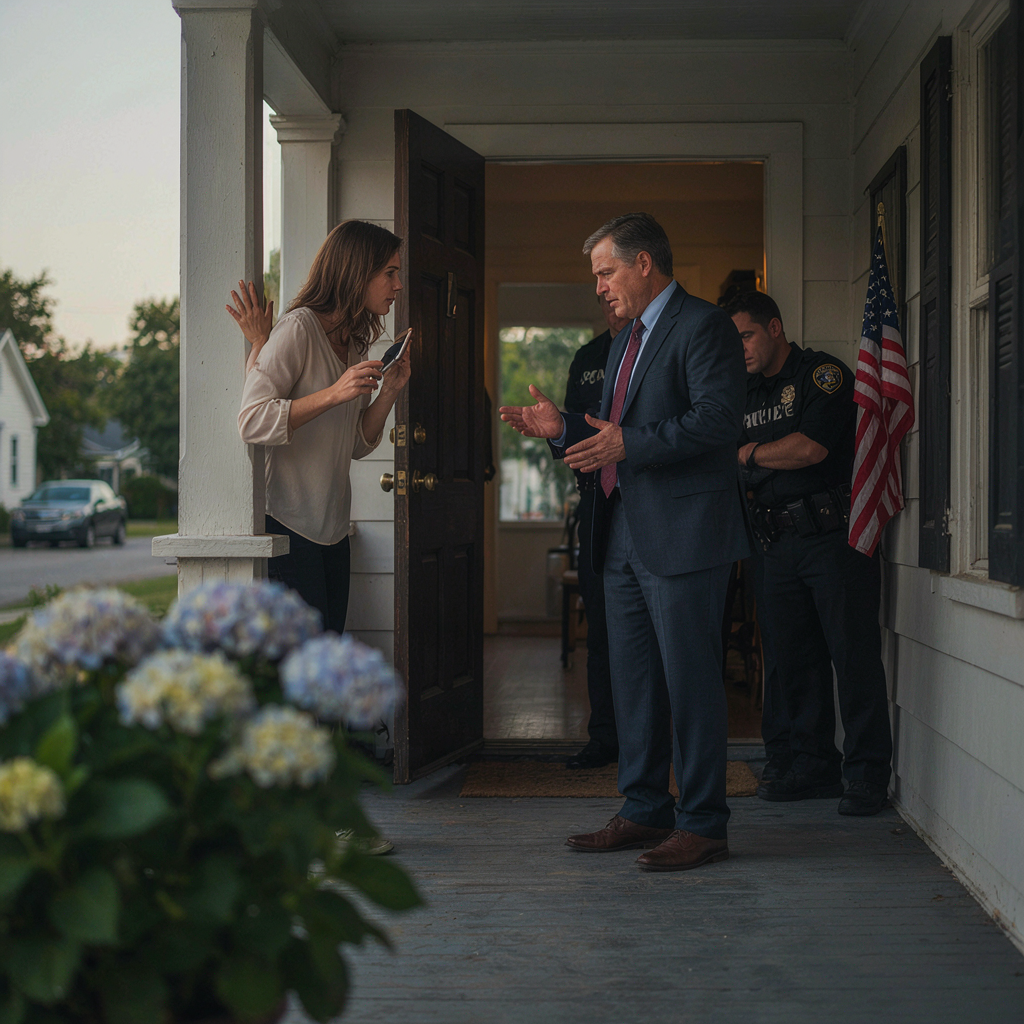
At 3:17, someone pounded on the front door.
I froze.
Nathan looked through the window.
Then his expression changed.
“Clara.”
“What?”
“It’s your father.”
Behind him stood two police officers.
My stomach dropped.
Dad began pounding again.
“Clara! Open the door!”
Nathan stepped in front of me.
Dad shouted, “You can’t lock me out of my own property!”
I stared at him through the glass.
“My own property?”
He held up a folder.
“The police are here because you’ve stolen family property.”
One of the officers motioned toward the door.
“Ma’am, we’d like to speak with you.”
Nathan quietly said, “Don’t open it.”
I didn’t.
Instead, I called the police department.
Within minutes, I learned something strange.
My father had told the officers that our house had been purchased with his money and that I had unlawfully changed the locks to prevent him from accessing it.
I almost laughed.
Then I remembered the $20,000.
The wedding money.
Suddenly, everything clicked.
My father wasn’t trying to get into the house because of a key.
He was trying to establish ownership.
But there was one problem.
The house wasn’t his.
Not even close.
Nathan and I had purchased it with our savings.
The deed was in both our names.
And the mortgage was in both our names.
Dad had never contributed a cent.
So why was he claiming otherwise?
Because of the $20,000.
Apparently, after I refused to return the money, my father had told the bank that the money had been a loan toward our house.
He had even produced a document.
A document supposedly bearing my signature.
The police left after determining that it was a civil dispute.
Dad didn’t.
He stood on our porch for another twenty minutes.
Then he leaned toward the door.
“You’ll regret this.”
I watched him walk away.
I thought that was the end.
It wasn’t.
The next morning, I received an email from an attorney.
My father was demanding repayment of $20,000.
But there was more.
He claimed that I had agreed to repay the money within six months.
I forwarded everything to a lawyer.
Her name was Michelle Harper.
She read the documents carefully.
Then she looked at me.
“Did you sign this?”
“No.”
“Are you sure?”
“Absolutely.”
She pointed to the signature.
“This isn’t your signature.”
I leaned closer.
The handwriting looked similar.
But it wasn’t mine.
Michelle’s expression hardened.
“Your father may have a bigger problem than you do.”
“What do you mean?”
“Forgery.”
I felt sick.
Then Michelle asked something else.
“Did your family have access to your personal documents?”
I thought about it.
“My father had copies of my driver’s license and Social Security card from when I helped him refinance a property years ago.”
Michelle nodded slowly.
“Then we need to move quickly.”
She requested bank records, emails, texts, wedding contracts, mortgage documents, and every message from my father.
As I gathered everything, I noticed something strange.
There were charges on my credit card from three months before my wedding.
A hotel.
A jewelry store.
A luxury restaurant.
I hadn’t made any of them.
I called the bank.
The representative told me the card had been used with a digital wallet.
Someone had added my card to another device.
I knew immediately who it was.
Daniel.
He had once asked me to let him use my card for an emergency.
I had refused.
Apparently, he had found another way.
The charges totaled nearly $6,000.
Michelle told me to report them.
I did.
Then everything exploded.
Daniel called me.
“You went to the police?”
“Yes.”
“You could have called me first.”
“You stole my credit card.”
“I was going to pay you back.”
“When?”
Silence.
Then he said:
“You’ve always hated me.”
“No, Daniel. I’ve always hated being treated like your personal bank.”
“You’ve become arrogant since marrying Nathan.”
“No. I’ve become tired.”
He hung up.
Two days later, Mom called.
I almost didn’t answer.
But I did.
Her voice was trembling.
“Clara, what are you doing to this family?”
I closed my eyes.
“What am I doing?”
“Your brother’s wedding is ruined.”
“Why?”
“Because the money isn’t there.”
“What money?”
“The $8,400.”
I almost smiled.
“You mean the money Dad asked me for?”
“Yes.”
“Mom, you knew he wasn’t coming to my wedding.”
She was silent.
“You all knew.”
Another silence.
Then she whispered:
“Your father said you needed to learn a lesson.”
I felt something inside me break.
“So my wedding was a lesson?”
“Clara—”
“No.”
I interrupted her.
“Don’t explain.”
I hung up.
That night, Nathan found me sitting alone in the kitchen.
He placed two cups of tea on the table.
“Michelle called.”
“What did she say?”
“She found something.”
He sat down.
“What?”
“The $20,000 wasn’t a gift.”
My heart sank.
“What?”
“It wasn’t from your father.”
“Then where did it come from?”
Nathan pushed a document toward me.
I read it.
Then I read it again.
The money had been transferred from an account belonging to my grandmother.
My grandmother had died two years earlier.
And according to her will, she had left me $20,000 as a wedding gift.
My father had intercepted it.
He had transferred it into his account.
Then he gave it to me as though it were his own money.
I stared at the page.
“Why?”
Nathan’s voice was soft.
“Because your grandmother left you more than twenty thousand dollars.”
I looked up.
“What?”
Michelle had discovered another document.
A trust.
My grandmother had left me a substantial inheritance.
Not millions.
Not even hundreds of thousands.
But enough to change my life.
And my father had been appointed temporary trustee.
He had never told me about it.
Instead, he had been using the account for years.
My grandmother’s money had paid for Daniel’s car.
Emily’s college tuition.
A family vacation.
A failed business.
And countless other expenses.
My inheritance had been funding everyone except me.
Michelle estimated that more than $180,000 had been withdrawn over the years.
I felt numb.
Then I remembered something my grandmother had said shortly before she died.
“Never let anyone convince you that love means surrendering everything you have.”
I finally understood.
The next week, we went to court.
My father arrived with Daniel and Mom.
He looked confident.
Until Michelle presented the documents.
The forged loan agreement.
The bank records.
The unauthorized credit card charges.
The inheritance records.
And finally, a handwritten letter from my grandmother.
The letter had been sealed with the words:
To Clara, when she is ready.
My father had apparently known about it.
He had never given it to me.
The judge read it privately.
Then he looked at my father.
“Mr. Bennett, why did you tell your daughter the $20,000 was your money?”
Dad said nothing.
The judge continued.
“And why did you claim ownership of her home?”
Still nothing.
Then Michelle presented the final piece of evidence.
A recording.
It was from a conversation my father had with Daniel two days before my wedding.
My father could be heard saying:
“If Clara doesn’t give us the money, nobody goes to that wedding. She’ll come crawling back.”
Daniel laughed.
Then my mother spoke.
“She always does.”
I sat completely still.
The courtroom was silent.
My father looked at me.
For the first time in my life, he looked afraid.
The judge ruled that the $20,000 belonged to me.
The trust had to be fully transferred to my control.
My father was removed as trustee.
The forged agreement was referred for investigation.
The credit card charges were reported as fraud.
And the claim against my house was dismissed.
My father lost everything he had tried to use against me.
But that wasn’t the part that mattered most.
After the hearing, my mother approached me.
Her eyes were red.
“I’m sorry.”
I looked at her.
“For what?”
“For not coming to your wedding.”
I waited.
She swallowed.
“I thought if I stood with you, your father would turn against me.”
I nodded slowly.
“Maybe.”
She started crying.
“But I should have gone.”
“Yes.”
“I should have protected you.”
“Yes.”
She reached for my hand.
I let her.
But I didn’t hug her.
Not yet.
Some wounds don’t disappear because someone finally admits they caused them.
Daniel eventually canceled his wedding.
Emily moved out of my parents’ house.
And my father stopped contacting me.
Months passed.
Nathan and I renovated our home.
We planted roses along the walkway, the same kind from our wedding.
One Saturday morning, I found an envelope in the mailbox.
No return address.
Inside was a photograph.
It was from my wedding.
Someone had taken it from across the street.
It showed Nathan and me standing beneath the flower arch.
The empty chairs were visible behind us.
On the back, someone had written:
“You looked happier than all of us deserved.”
I knew who had sent it.
Mom.
I kept the photograph.
Not because it reminded me of what I lost.
Because it reminded me of what I gained.
A husband who stayed.
A home that belonged to us.
A life I was finally allowed to control.
And a lesson I would never forget.
Family isn’t the people who share your last name.
It’s the people who show up when the chairs are empty.
It’s the people who stand beside you when they have nothing to gain.
It’s the people who don’t ask what you can give them before asking how you’re doing.
A year after my wedding, Nathan and I renewed our vows.
We didn’t invite my father.
We didn’t invite Daniel.
We invited Mom and Emily.
They came early.
Mom cried when she saw me.
Emily hugged me so tightly I could barely breathe.
And this time, every chair was filled.
After the ceremony, Nathan handed me a small envelope.
Inside was a receipt for $1.
I laughed.
“You kept it?”
He smiled.
“Of course.”
It was the receipt from the transfer I’d sent my father.
The one with the note:
Best wishes.
Nathan had framed it.
I looked at it for a long moment.
Then I realized something.
That one dollar had been the most expensive dollar my father ever received.
Because it had cost him access to my life.
And it had bought me freedom.
I placed the framed receipt on a shelf in our hallway.
Not as a reminder of my family.
As a reminder of the day I finally stopped begging people to love me.
My father once believed I would come crawling back.
He was wrong.
I didn’t crawl.
I walked.
I walked down the aisle.
I walked into my new home.
I walked into court.
And eventually, I walked into a life where nobody could make me feel guilty for protecting what was mine.
The locks on our house had been changed that afternoon.
But the truth was, I had been changing the locks long before that.
I had finally learned how to lock out guilt.
Manipulation.
Fear.
Obligation.
And the desperate need to be accepted by people who had never accepted me as I was.
The day my family skipped my wedding, I thought they had abandoned me.
Years later, I understood something different.
They hadn’t abandoned me.
They had accidentally set me free.
And sometimes, the greatest blessing in your life doesn’t arrive as a gift.
Sometimes it arrives as an empty chair.
A silent phone.
A cruel message.
A door you finally decide to lock.
And a single dollar that says everything you were too afraid to say before:
Best wishes.