The House They Thought They Sold
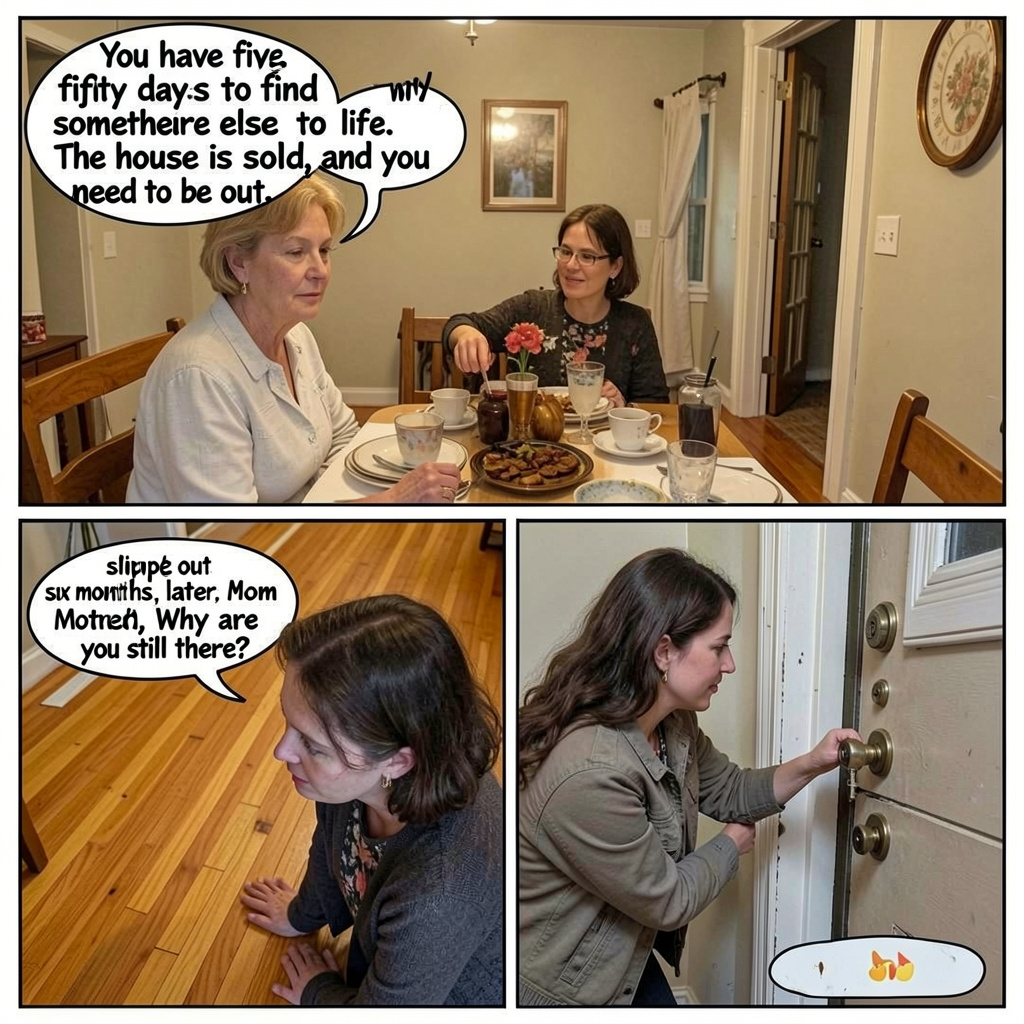
Over dinner, my mother calmly said, “You have thirty days to find somewhere else to live. The house is sold, and you need to be out.”She said it the way someone might announce that the grocery store was out of milk.
No anger.No hesitation.No apology.Just a statement.
I was sitting at the far end of the dining table, slowly cutting into a piece of chicken I suddenly had no appetite for.
My father kept his eyes on his plate.
My younger brother, Ethan, looked uncomfortable for about three seconds before reaching for his glass.My mother folded her napkin beside her plate.
“The closing is already scheduled,” she added. “There’s nothing to discuss.”I stared at her.
“What do you mean, the house is sold?”“The house is sold.”“Our house?”
She sighed.“Obviously, our house.”I looked around the dining room.
The scratched oak table had been here since I was seven. The chandelier above us had a missing crystal on one side. The wallpaper was faded near the window because the afternoon sun had beaten against it for years.
I had grown up here.I had taken my first steps in the hallway.I had brought home school projects, birthday presents, broken hearts, college acceptance letters.
After my father lost his job years ago, I had been the one paying the property taxes.
When the roof leaked, I paid for half the repair.
When the furnace died, I paid for the replacement.But technically, the house belonged to my parents.Or at least, that’s what I’d always believed.“Where are you going?” I asked.
My mother looked at me as if the question were strange.
“We’re moving.”“Where?”“Somewhere smaller.”“When?”“Tomorrow.”
My fork slipped from my hand.“Tomorrow?”She nodded.“We’ve arranged everything.”
I looked at my father.“Dad?”He finally looked up.
There was something in his expression that bothered me.
Not guilt exactly.
Fear.
But before I could ask him anything, my mother spoke.
“You’re an adult, Daniel. It’s time you started living like one.”
I almost laughed.
I was thirty-two years old.
I had worked since I was sixteen.
I had never been arrested, never asked them for money, never brought trouble home.
I had stayed because Dad’s health had gotten worse after his surgery.
I had stayed because Mom said she couldn’t manage the house alone.
I had stayed because this was home.
And now she was telling me that I had thirty days to leave.
“Who bought it?” I asked.
My mother’s expression changed for the briefest moment.
“That’s private.”
“You’re selling my childhood home and I don’t even get to know who bought it?”
“You don’t own it.”
The words landed harder than they should have.
“You’re right,” I said quietly.
My mother stood.
“Good. Then there’s nothing more to say.”
That night, I couldn’t sleep.
At 5:17 in the morning, I heard footsteps in the hallway.
Boxes scraped against the floor.
Drawers opened.
Doors slammed.
I got out of bed.
My parents were already packing.
Not preparing to pack.
Packing.
The living room had been emptied.
The photographs were gone.
The china cabinet was empty.
Even the old grandfather clock my grandmother had left us was missing.
“What’s going on?” I asked.
My father avoided my eyes.
Mom kept moving.
“Mom.”
She turned.
“We’re leaving today.”
“You said thirty days.”
“For you.”
I stared at her.
“What does that mean?”
“It means you have thirty days to leave. We don’t.”
I felt something cold settle in my stomach.
“Why are you rushing?”
“Because the buyer wants possession.”
“The buyer wants possession before closing?”
She froze.
For half a second, I saw panic in her eyes.
Then it disappeared.
“Don’t make this difficult, Daniel.”
I looked at my father.
“Dad, what’s really happening?”
He opened his mouth.
My mother cut him off.
“We’re late.”
Within two hours, they were gone.
My brother went with them.
He didn’t even say goodbye.
I stood in the driveway watching the moving truck disappear around the corner.
Then I went inside.
The house was almost completely empty.
They had taken the furniture.
The electronics.
The kitchen appliances.
The artwork.
The curtains.
Even the old rug from the hallway.
What remained was dust, nail holes, and the echo of my own footsteps.
I walked into the dining room and sat at the bare table.
There was one thing they had forgotten.
A small wooden box.
I recognized it immediately.
It belonged to my grandmother.
Inside were old documents, photographs, letters, and receipts.
I opened it.
Most of it was sentimental junk.
Then I found something that wasn’t.
A property tax statement.
I frowned.
The address was 42 Oak Street.
But the owner’s name wasn’t my father.
It was Oak Street Family Trust.
I read it again.
Then again.
I took pictures of every document with my phone.
That was the first moment I realized my mother might not have been telling me the whole story.
The next morning, I searched the property records.
That’s when I discovered something even stranger.
Six months earlier, my parents had placed the house on the market.
Two months earlier, the listing had gone public.
The asking price was exactly what the house was worth.
No discount.
No strange conditions.
No suspicious buyer.
Just a normal sale.
Except there was one detail that caught my attention.
The buyer’s identity was hidden behind a holding company.
AVTech Holdings.
I stared at the name.
I had heard it before.
Not recently.
Years ago.
I worked in corporate software security, and AVTech was a company I had encountered during a contract dispute.
But the company was much larger than I remembered.
I kept digging.
AVTech Holdings was registered in Delaware.
Its listed officers were attorneys.
Its ownership was layered behind several trusts.
And one of those trusts was connected to a private investment group.
I didn’t understand why the company had purchased a suburban family home.
Until I found the final document.
The property had been purchased at my parents’ full asking price.
Cash.
No mortgage.
No financing.
No contingencies.
The closing date was exactly one week away.
I sat back.
Something was wrong.
I called a real-estate attorney.
Her name was Margaret Ellis.
She was sixty-three, direct, and completely unimpressed by my story.
“You’re telling me your parents sold the property,” she said.
“Yes.”
“And you’re living there.”
“Yes.”
“And you believe you have some claim to it.”
“I don’t know.”
She leaned back.
“Then we start with what you do know.”
I handed her the documents.
She studied them.
For nearly twenty minutes, she said nothing.
Finally, she looked at me.
“Daniel, did you authorize any purchase?”
“No.”
“Did you sign anything?”
“No.”
“Did you form AVTech Holdings?”
“No.”
She smiled.
“That’s where you’re wrong.”
I blinked.
“What?”
She slid a document across the desk.
My name was on it.
Daniel Carter.
Managing member.
AVTech Holdings.
I stared at the page.
“I didn’t sign this.”
“You did.”
“I’ve never seen this.”
“Look at the date.”
I did.
Two years earlier.
Then I remembered.
I’d been developing a side business with two friends.
We had talked about creating a holding company for software patents.
The paperwork had been abandoned.
But apparently, it hadn’t been.
Margaret pointed to the signature.
“This is your electronic signature.”
I felt my heart pound.
“So you’re saying I own AVTech?”
“Not exactly. You’re the controlling member.”
“And AVTech bought my parents’ house?”
“Yes.”
I stared at her.
“That makes no sense.”
Margaret leaned forward.
“Unless you knew something was coming.”
“I didn’t.”
“Then someone else may have known.”
That sentence stayed with me.
I went home and searched everything.
And then I found the first real clue.
Three months earlier, my mother had sent me an email.
She had asked me to scan an old insurance document.
Nothing unusual.
Except the attachment she sent contained metadata showing it had been edited from a computer registered to my brother Ethan.
I called him.
He didn’t answer.
I called again.
Nothing.
Then my father called.
His voice was barely above a whisper.
“Daniel.”
“Dad, what happened?”
Silence.
“Why did Mom sell the house?”
“I can’t talk about it.”
“You can.”
“Your mother thinks she’s protecting you.”
“From what?”
Another silence.
“From herself.”
The call ended.
I didn’t sleep that night.
The next morning, I drove to the attorney’s office.
Margaret had already uncovered more.
She put a file in front of me.
“Your parents didn’t simply sell the house.”
“What did they do?”
“They borrowed against it.”
My stomach tightened.
“How much?”
“Three hundred eighty thousand dollars.”
I stared at her.
“For what?”
“Your brother’s company.”
Everything suddenly made sense.
Ethan had started a construction business three years earlier.
It had failed.
He had debts.
Lots of them.
My parents had apparently used the house as collateral.
When the business collapsed, the lender came after the property.
My mother had panicked.
But that still didn’t explain why AVTech had bought it.
Margaret turned another page.
“There’s more.”
She pointed to a transfer document.
“Your parents were given an option.”
“By whom?”
“The lender.”
“They could sell the property privately before foreclosure.”
“And they sold it to AVTech.”
“Yes.”
“But why?”
Margaret looked at me.
“Because the buyer agreed to pay enough to clear the debt.”
I felt sick.
“My family sold the house to save Ethan.”
She nodded.
“But that’s not the strange part.”
“What is?”
“The buyer wasn’t a random investor.”
She slid another document toward me.
AVTech Holdings had been purchasing distressed properties.
But not for resale.
For development.
The company planned to renovate older properties and convert them into affordable housing units.
And 42 Oak Street was one of the first properties in a new community project.
I stared at the paperwork.
“Why would I buy my own house?”
Margaret gave me a long look.
“That’s what I’m trying to figure out.”
Then she found the answer.
A clause buried in the company’s operating agreement.
If AVTech acquired property in which a controlling member had a personal connection, the property could be held as a protected family asset.
I laughed.
Not because anything was funny.
Because suddenly the whole thing was absurd.
My mother had sold the house.
I had unknowingly bought the house.
And she had no idea.
But there was still one question.
Why had my mother texted me six months later?
Why had she waited?
I got the answer that evening.
My phone buzzed.
Mom.
“Why are you still there?”
I stared at the message.
Then another appeared.
“The buyer is supposed to have possession.”
I typed.
“I’m not leaving.”
Three dots appeared.
Then disappeared.
Then:
“Daniel, this isn’t funny.”
I replied:
“You’re right.”
“Come home.”
I looked around the empty house.
“You’re the one who sold it.”
The response came almost instantly.
“It’s not yours.”
I smiled.
“Are you sure?”
She didn’t answer.
The next morning, I heard a car pull into the driveway.
Then another.
My mother got out.
My father followed.
Ethan stayed in the car.
Mom marched toward the front door.
She pulled out her old key.
She inserted it into the deadbolt.
Turned it.
Nothing.
She tried again.
The lock wouldn’t move.
I watched through the window.
She looked at the key.
Then at the house.
Then back at the key.
I opened the door.
She stared at me.
“Daniel.”
“Mom.”
“Open the door.”
“You’re standing on my property.”
Her face went white.
“Don’t be ridiculous.”
“Who owns 42 Oak Street?”
She looked toward my father.
He lowered his head.
Mom whispered, “You don’t.”
I held out a folder.
“Read it.”
She didn’t take it.
“What’s this?”
“Closing documents.”
Her eyes moved over the first page.
Then the second.
Her hands started shaking.
“No.”
“Yes.”
“You couldn’t have.”
“I did.”
“You don’t have that kind of money.”
“AVTech did.”
She looked at me.
“What is AVTech?”
I smiled.
“You tell me.”
She froze.
My father finally spoke.
“It’s his company.”
Mom turned toward him.
“What?”
Dad nodded.
“Daniel owns it.”
Her face collapsed.
“You knew?”
“I found out after the sale.”
“Why didn’t you tell me?”
“Because you told me not to interfere.”
Mom looked back at me.
“This is a mistake.”
“No.”
“You don’t understand.”
“I understand perfectly.”
She stepped closer.
“We needed the money.”
“For Ethan.”
Her eyes filled with tears.
“Yes.”
Ethan finally got out of the car.
“Daniel.”
I looked at him.
“You knew too?”
He stared at the ground.
“I knew we were in trouble.”
“You knew Mom was selling the house.”
“Yes.”
“You knew she was forcing me out.”
He didn’t answer.
“That was your plan?”
“No.”
“Then what was?”
He finally looked at me.
“To save the family.”
I laughed bitterly.
“You didn’t save the family.”
I pointed toward the empty house.
“You sold it.”
Ethan’s face tightened.
“You wouldn’t have helped.”
“You never asked.”
“You always thought you were better than me.”
“That isn’t true.”
“You had the career. The money. The stability.”
“And you thought stealing the roof over my head was easier than asking for help?”
He said nothing.
My mother stepped between us.
“Enough.”
I looked at her.
“No. Not enough.”
For thirty-two years, I had swallowed things.
The little comments.
The comparisons.
The favoritism.
The excuses.
Every time Ethan made a mistake, someone rescued him.
Every time I succeeded, everyone assumed I’d be fine.
I had become the dependable child.
The invisible child.
The one who didn’t need anything.
And now, when they needed money, they had decided my home was expendable.
Mom whispered, “What do you want?”
I looked at her.
“For once?”
She nodded.
“The truth.”
She closed her eyes.
Then she told me everything.
Ethan’s company had collapsed.
He owed contractors.
Suppliers.
Banks.
Employees.
My parents had guaranteed several of his loans.
The house was the last thing they had.
When the lender threatened foreclosure, Mom sold the property.
She believed she could use the money to pay Ethan’s debts.
Then they would move somewhere smaller.
Ethan would rebuild.
And I would eventually find somewhere else.
“It was never supposed to hurt you,” she said.
I shook my head.
“You didn’t even think about whether it would.”
She cried.
“I thought you were strong.”
“I was.”
I looked at the empty rooms behind me.
“But being strong doesn’t mean I don’t feel pain.”
Nobody spoke.
Finally, I opened the door wider.
“Come inside.”
Mom hesitated.
Then stepped through.
Her eyes moved across the empty living room.
She touched the wall where the family portraits had hung.
“This doesn’t feel like home.”
I looked at her.
“It stopped feeling like home when you decided I didn’t belong here.”
She began crying again.
But this time, I didn’t rush to comfort her.
I had spent my entire life doing that.
Instead, I let the silence remain.
A week later, I made a decision.
I wasn’t going to keep the house exactly as it was.
I hired contractors.
Not to turn it into luxury property.
To turn it into something useful.
The lower level became office space.
The upstairs became three apartments.
The backyard was converted into a shared garden.
And one section of the house remained untouched.
The dining room.
The old wooden table came back.
The chandelier was repaired.
The missing crystal was replaced.
I didn’t restore the house because I wanted to preserve the past.
I restored it because I wanted to decide what the past meant.
Six months after my mother told me to leave, I invited my parents back.
Not to move in.
Just to talk.
We sat around the table.
Mom looked older.
Dad looked tired.
Ethan had started working for a construction company and was slowly paying his debts.
Nobody mentioned the house.
Until Mom finally said, “Do you hate us?”
I thought about it.
“No.”
She looked surprised.
“I thought I did.”
“And now?”
“I don’t hate you.”
She waited.
“But I don’t trust you yet.”
She nodded.
“That is fair.”
Dad reached across the table.
“I should have stood up for you.”
“Yes.”
He swallowed.
“I was afraid.”
“I know.”
Mom whispered, “Can you ever forgive me?”
I looked around the room.
The same room where she’d told me I had thirty days to leave.
The same room she believed belonged to someone else.
I took a breath.
“Maybe.”
She smiled faintly.
“That’s enough.”
I shook my head.
“No.”
She looked at me.
“What’s enough is that you finally understand forgiveness isn’t something you get because you apologize.”
She nodded.
“You earn it.”
“Yes.”
Outside, children were playing in the garden.
The house no longer echoed.
It was full of voices again.
Different voices.
New lives.
People who needed somewhere safe to begin again.
My mother looked toward the window.
“You really turned it into something beautiful.”
“I didn’t do it alone.”
She smiled.
Then she said something I never expected.
“I’m proud of you.”
For years, I had wanted to hear those words.
And yet, sitting there, I realized something.
I didn’t need them anymore.
I had spent too long measuring my worth by whether my family saw it.
Now I knew better.
They had tried to sell my home.
They had tried to push me out.
They had assumed I would simply accept whatever they decided.
But they had made one mistake.
They thought the house was what made me belong.
It wasn’t.
The house was just wood, glass, nails, and memories.
Home was something I built after they left.
And when my mother had stood on my porch that morning, jamming her old key into a lock that no longer turned, she had finally learned the truth.
She hadn’t just sold a house.
She had sold the illusion that she could decide where I belonged.
And I had bought it back—not to punish her, but to make sure nobody could ever take it away from me again.
Years later, people would ask why I kept the original name of the property.
42 Oak Street.
I always smiled.
Because there was a story behind that number.
A story about betrayal.
A story about family.
A story about losing everything and discovering that sometimes losing everything is the moment you finally stop living according to someone else’s rules.
My mother never got her old key back.
I kept it.
Not as a trophy.
Not as revenge.
I kept it in the little wooden box my grandmother had left behind.
The same box that had contained the document that changed everything.
And whenever I looked at that old brass key, I remembered the woman standing on my porch, confused and angry because the lock wouldn’t turn.
She had thought the key was supposed to open the door.
She was wrong.
The key had never belonged to the house.
It belonged to the past.
And I had finally learned how to leave that door locked.