The Party She Tried to Keep Me Out Of
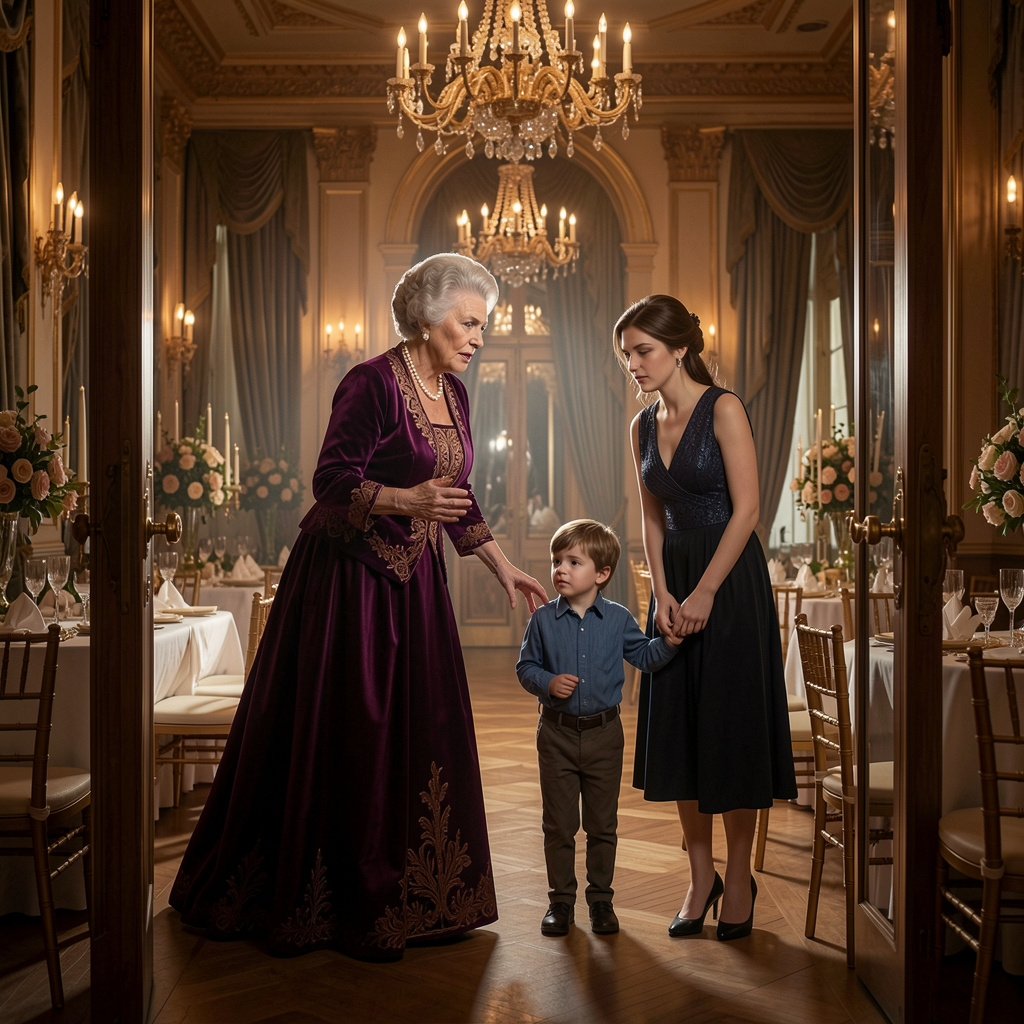
Mom threw a lavish party and blocked me at the door.“This is for the elite, not for a broke single mother like you,” she sneered.Her friends laughed.
One of them looked at my six-year-old son, Ethan, and whispered loudly enough for everyone to hear, “Oh, Margaret, you actually let them come dressed like that?”
Ethan looked down at his faded blue shirt.
It had belonged to his cousin.
The sleeves were slightly too short, and one of the buttons was missing.He tried to hide his hands behind his back.That hurt more than anything my mother had said.I smiled.
Not because I wasn’t hurt.Because I had learned something important about powerful people.
The loudest person in the room isn’t always the person who controls it.
“Go wash dishes somewhere,” Mom said. “At least you’ll earn something tonight.”
Her friends laughed again.I looked at the massive gold letters above the ballroom entrance.AURORA HOSPITALITY GROUP — FOUNDERS’ GALAThen I looked at the woman standing in front of me.
Margaret Sterling.My mother.She had spent the last ten years telling everyone that her daughter had failed at life.
What she didn’t know was that I hadn’t failed.
I had simply stopped explaining myself.
I took out my phone.
Mom crossed her arms.
“What are you doing?”
I dialed a number.
The call connected almost immediately.
“Hello?”
“It’s Sarah.”
The voice on the other end became instantly professional.
“Good evening, Ms. Sterling.”
I looked at the ballroom.
“Cancel the party.”
Silence.
Then:
“I’m sorry?”
“The party tonight. Cancel it.”
Mom’s smile disappeared.
“What did you just say?”
I ended the call.
For several seconds, nobody moved.
Then the ballroom doors opened.
A man in a black suit hurried toward us.
It was Daniel Reeves, the regional managing director of Aurora Hospitality Group.
He looked at me.
Then at my mother.
Then back at me.
“Ms. Sterling,” he said carefully, “I’ve been trying to reach you.”
Mom’s face went pale.
“Daniel?”
He ignored her.
“Is this really your instruction?”
“Yes.”
He nodded.
“Understood.”
Mom grabbed his arm.
“Wait. What is happening?”
Daniel gently removed her hand.
“Mrs. Sterling, I think you should speak with your daughter.”
Mom stared at him.
Then at me.
“You know her?”
Daniel looked confused.
“Know her?”
He gave a nervous laugh.
“She’s one of our principal shareholders.”
The laughter behind us stopped.
Completely.
My mother blinked.
“What?”
Daniel swallowed.
“Sarah Sterling controls a significant voting interest in Aurora Hospitality Group.”
Mom’s mouth opened.
Nothing came out.
I took Ethan’s hand.
“Come on, buddy.”
“But, Mommy…”
He looked frightened.
I squeezed his hand.
“It’s okay.”
We walked past my mother.
And for the first time in my entire life, she stepped aside for me.
I hadn’t planned for any of this.
The truth was, I had spent years trying to avoid my family’s world.
My mother believed money was the measure of human worth.
She had raised me to believe that appearance mattered more than character.
The right clothes.
The right school.
The right neighborhood.
The right friends.
The right husband.
The right last name.
And, above all, the right bank account.
My father had been different.
He was the quiet one.
He owned a small chain of hotels before selling his company to a larger hospitality corporation.
That corporation eventually became part of Aurora.
When he died unexpectedly, everyone assumed Mom had inherited everything.
She hadn’t.
My father had left her enough to live comfortably.
But the controlling shares of his original company had gone into a trust.
For me.
I was twenty-seven when the attorneys explained it.
I didn’t understand the significance at first.
I thought I’d inherited a few investments.
Then the lawyer said something that changed my life.
“Your father wanted you to have financial independence without becoming a public figure.”
So I kept quiet.
I didn’t announce it.
I didn’t buy a mansion.
I didn’t start wearing designer clothes.
I didn’t change my car.
I didn’t even tell Mom.
Especially Mom.
Because I’d seen what money did to her.
It made her kinder to strangers and crueler to family.
So I became invisible.
I married young.
Too young.
His name was Kevin.
He was charming when we met.
Then we had Ethan.
Then Kevin started changing.
He wanted a lifestyle I didn’t want.
Expensive restaurants.
Luxury vacations.
Designer watches.
Private clubs.
When I refused to spend my father’s money on his fantasies, he called me selfish.
Eventually, he left.
He told everyone I had driven him away.
Mom believed him.
Or pretended to.
After the divorce, I moved into a modest three-bedroom house.
I worked.
I raised Ethan.
I wore inexpensive clothes.
I drove a ten-year-old SUV.
And I never touched the money I had inherited unless absolutely necessary.
I wanted Ethan to grow up knowing the difference between wealth and worth.
Mom hated that.
She told people I was “struggling.”
She told relatives I was “too proud to accept help.”
She once told a neighbor that I was “living paycheck to paycheck.”
I wasn’t.
But I didn’t correct her.
Because correcting her would have meant revealing the truth.
And I wasn’t ready.
The gala was supposed to celebrate Aurora’s fiftieth anniversary.
My mother had been invited because she had donated a large amount of money to the company’s charitable foundation.
She had spent weeks talking about the party.
She told everyone she was “personally connected” to Aurora’s leadership.
She had no idea how literal that connection was.
The night of the gala, I almost didn’t go.
Then Ethan came home from school with a handmade card.
“Happy birthday, Mommy.”
I laughed.
“My birthday isn’t until next month.”
He shrugged.
“I wanted to practice.”
Inside, he’d drawn the two of us standing under a giant yellow sun.
He had written:
MOMMY + ETHAN = FAMILY
I kissed his forehead.
“Do you want to come to a party with me?”
His eyes lit up.
“Will there be cake?”
“Probably.”
“Then yes.”
I found him the cleanest shirt we had.
I wore a simple black dress.
Nothing expensive.
Nothing designed to impress.
When we arrived at the hotel, I saw hundreds of luxury cars.
Women in diamonds.
Men in tailored tuxedos.
Photographers.
Servers carrying champagne.
Ethan held my hand tightly.
“Mommy, everyone looks fancy.”
“You look handsome.”
He smiled.
Then we reached the entrance.
And Mom saw us.
Her expression changed instantly.
She walked toward us like she had just discovered a stain on an expensive carpet.
“What are you doing here?”
I smiled.
“You invited me.”
“I absolutely did not.”
“You sent an invitation.”
She lowered her voice.
“You misunderstood.”
Ethan looked up at her.
“Grandma…”
She ignored him.
“Sarah, this isn’t appropriate.”
“What’s inappropriate?”
“You.”
I felt Ethan’s fingers tighten around mine.
Mom glanced at his shirt.
Then she sighed dramatically.
“You couldn’t even dress the boy properly?”
One of her friends laughed.
“He’s adorable,” the woman said.
But her tone made the word sound like an insult.
Mom leaned toward me.
“This is an elite event.”
I stared at her.
“You’re my mother.”
“That doesn’t make you entitled to attend.”
I almost laughed.
“Who told you I was entitled?”
“You always do this,” she snapped. “You show up looking miserable and make everyone uncomfortable.”
I looked around.
Nobody looked uncomfortable.
They looked entertained.
Mom was putting on a show.
And I suddenly understood something.
She didn’t want me excluded because I was poor.
She wanted me excluded because I reminded everyone that she had a daughter she couldn’t control.
Then she said the sentence that changed everything.
“Go wash dishes somewhere. At least you’ll contribute.”
Ethan looked at me.
“Mommy, are we going home?”
I bent down.
“Not yet.”
I stood.
Then I called Daniel.
And told him to cancel the party.
Within fifteen minutes, the ballroom was in chaos.
Managers ran between rooms.
Security staff received instructions.
Catering supervisors began stopping service.
The musicians were told to pause.
Guests whispered.
“What happened?”
“Why are they shutting down?”
“Is there an emergency?”
Mom stood frozen near the entrance.
Daniel approached her.
“Mrs. Sterling, I need you to understand that Ms. Sterling’s instruction carries legal authority.”
Mom stared at him.
“She is my daughter.”
“I understand.”
“She has no authority over this event.”
Daniel looked uncomfortable.
“She does.”
Mom turned toward me.
“What have you done?”
I took a breath.
“I told them to cancel.”
“You can’t.”
“I already did.”
“You’re destroying my reputation!”
“No, Mom.”
I looked around at the people watching.
“You did that yourself.”
She slapped me.
The sound echoed through the lobby.
Ethan screamed.
“Mommy!”
Everything stopped.
For a moment, nobody breathed.
Mom stared at her own hand as if she couldn’t believe what she’d done.
Then she whispered:
“You made me do that.”
That sentence broke something inside me.
Not because of the slap.
Because it confirmed everything.
She would never take responsibility.
I picked Ethan up.
“Let’s go.”
Daniel stepped forward.
“Ms. Sterling—”
“Tomorrow,” I said.
He nodded.
We left.
The next morning, my phone exploded.
News articles.
Messages.
Emails.
Someone had filmed the confrontation.
The video had already been posted online.
LOCAL SOCIALITE EXCLUDES DAUGHTER FROM AURORA GALA — THEN DISCOVERS DAUGHTER IS MAJOR SHAREHOLDER
It was everywhere.
The comments were brutal.
But the truth was more complicated.
The board called an emergency meeting.
I attended remotely.
Daniel presented the facts.
The gala had cost nearly $480,000.
Most of it was recoverable.
But there was a larger problem.
My mother had been using her position within the foundation to influence company decisions.
She had pressured executives.
She had demanded special treatment.
She had used Aurora’s name to strengthen her own social standing.
The board had tolerated it because she was a donor.
Now they couldn’t.
One director asked:
“Sarah, what do you want?”
I looked at the screen.
For years, I had avoided answering that question.
Now I knew.
“Accountability.”
Silence.
“I don’t want my mother humiliated,” I continued.
“But I don’t want her protected either.”
The board voted.
My mother was removed from the foundation’s advisory committee.
Her gala privileges were suspended.
An audit was ordered.
And Aurora’s charitable foundation established a new program for single parents.
I named it after my father.
The Sterling Family Initiative.
Its first grant funded childcare and education for struggling parents.
When I told Ethan, he asked:
“Does that mean you’re a superhero?”
I laughed.
“No.”
“You have lots of money.”
“I do.”
“So you’re a rich superhero.”
I kissed his cheek.
“Maybe.”
He thought about that.
“Can rich superheroes still wear old clothes?”
“Absolutely.”
Three weeks later, Mom came to my house.
She didn’t arrive in a luxury car.
She came alone.
No friends.
No jewelry.
No photographers.
Just Mom.
She stood on my porch for nearly a minute before knocking.
I opened the door.
“What do you want?”
She looked older.
Not physically.
Emotionally.
“I want to apologize.”
I didn’t answer.
She continued.
“I was wrong.”
Still nothing.
“I treated you terribly.”
I nodded.
“You did.”
She swallowed.
“I thought you were ashamed of me.”
I almost smiled.
“I was.”
She looked hurt.
“Because of the way I treated you?”
“Yes.”
She lowered her eyes.
“Your father always told me that money was supposed to give us freedom.”
“He was right.”
“I forgot.”
“No,” I said quietly.
“You didn’t forget.”
She looked at me.
“You chose.”
Her eyes filled with tears.
“I don’t know how to fix this.”
“You can’t fix everything.”
“Can I try?”
I thought about it.
“Not for me.”
She frowned.
“For Ethan.”
That seemed to surprise her.
I continued.
“He deserves a grandmother who doesn’t measure his worth by his clothes.”
She nodded.
“I understand.”
“I hope you do.”
She hesitated.
“Can I see him?”
I looked into the living room.
Ethan was building a tower with blocks.
“Ethan?”
He looked up.
“Grandma?”
Mom smiled through tears.
“Hi, sweetheart.”
He ran toward her.
She knelt.
He hugged her.
And for the first time, I saw my mother cry without pretending anyone else was watching.
Months passed.
The story faded from the news.
Aurora continued growing.
I remained mostly behind the scenes.
I didn’t suddenly become a celebrity.
I didn’t start wearing designer clothes.
I didn’t move into a mansion.
I kept my house.
My old SUV.
My simple routines.
But something changed.
I stopped hiding.
Not because I wanted to prove anything.
Because I finally realized hiding had allowed my mother to define me.
At the next Aurora shareholders’ meeting, I attended in person.
The room was filled with executives and investors.
I walked to the podium.
The chairman introduced me.
“Sarah Sterling, principal shareholder and trustee representative.”
There was polite applause.
I looked at the audience.
Then I said:
“My father believed hospitality meant making people feel welcome.”
I paused.
“Not important people.”
“People.”
The room became silent.
“We’ve built beautiful hotels, restaurants, and resorts. But the greatest luxury we can offer someone is dignity.”
I looked toward the board.
“So from this year forward, Aurora will invest more heavily in employees, families, and communities—not just appearances.”
The applause began slowly.
Then grew.
I stepped away from the podium.
And saw Mom sitting in the back.
She wasn’t smiling because she wanted attention.
She was smiling because she was proud.
That was different.
A year after the gala, I received an envelope.
It was from Mom.
Inside was a photograph.
It showed Ethan standing beside her in a garden.
He wore the same faded blue shirt from the night of the gala.
Mom had framed it.
On the back she had written:
I almost missed the best part of my family because I was too busy trying to impress strangers.
There was another note.
I’m sorry.
I put the photograph on my desk.
Then Ethan walked in.
“What’s that?”
“Your grandma.”
He studied the picture.
“Can I have it?”
I handed it to him.
He smiled.
“She’s nice now.”
I smiled back.
“She is trying.”
He thought about that.
“Trying is good.”
“Yes,” I said.
“It is.”
Then he hugged me.
“Mommy?”
“Yes?”
“Are we rich?”
I laughed.
“We’re okay.”
“But are we rich?”
I looked at the photograph.
Then at my son.
And finally, I understood what my father had tried to teach me.
Wealth wasn’t the number in the bank.
It wasn’t the car outside.
It wasn’t the clothes on your back.
It wasn’t the people who laughed at your jokes because they wanted something from you.
Wealth was being able to sleep peacefully at night.
It was having someone who loved you when you had nothing to offer.
It was having the courage to walk away from people who made you feel small.
And sometimes, wealth was simply knowing that your child would never have to wonder whether he was good enough.
I hugged Ethan.
“We’re rich in the ways that matter.”
He smiled.
“Can we get pizza?”
I laughed.
“Absolutely.”
As we walked into the kitchen, my phone rang.
It was Daniel.
“Sarah, the board approved the new family initiative.”
“How many families?”
“Two hundred in the first year.”
I smiled.
“Make it five hundred.”
He laughed.
“I thought you’d say that.”
I hung up.
Ethan looked at me.
“What was that?”
“Work.”
“Are you going to work?”
“Not tonight.”
“Good.”
He grabbed my hand.
“Pizza.”
“Pizza.”
We walked toward the kitchen.
And for the first time in years, I didn’t care what my mother thought.
I didn’t care what her friends thought.
I didn’t care what anyone thought.
Because the woman they had laughed at outside that ballroom was never actually broke.
She had simply refused to spend her life proving she wasn’t.
My mother had believed blood was currency.
She had spent mine trying to buy status.
But she learned something that night.
Some things cannot be purchased.
Respect.
Love.
Dignity.
Family.
And the most valuable inheritance my father ever left me wasn’t the shares in Aurora Hospitality Group.
It was the freedom to decide what kind of person I would become.
So I chose differently.
I chose Ethan.
I chose kindness.
I chose truth.
And I chose to become the kind of mother who would never look at her child’s old clothes and see shame.
Because sometimes the richest person in the room isn’t the one wearing diamonds.
Sometimes she’s the woman standing outside the door with her little boy’s hand in hers.
The woman everyone thought had nothing.
The woman who quietly owned the room.
And who finally understood that she never needed to be invited inside.
She already belonged there.