The Secret Beneath My Uncle’s Truck
My uncle passed away two winters ago.It was January, the kind of January that made the roads look abandoned and the trees seem permanently frozen.
He died alone in the little house he had owned for nearly forty years,
out past the county line where the pavement narrowed, the mailboxes became fewer, and the nearest neighbor was almost half a mile away.
His name was Raymond Carter.
Most people in the family called him Ray.I called him Uncle Ray.He had never married. He had no children of his own, and from what I understood, he had never particularly wanted any.
He was a hard, quiet man.
Not cruel.Just distant.
He didn’t talk about his feelings. He didn’t call people to ask how they were doing. He wasn’t the kind of uncle who showed up at birthdays with wrapped presents.
But whenever something broke, Ray appeared.A water heater.A fence.
A lawn mower.
A transmission.
He could fix almost anything with a wrench, a length of wire, and enough time.He also had one possession he seemed more attached to than anything else.
An old blue pickup truck.
It was a 1989 Ford F-150, though by the time I inherited it, the paint had faded to the color of a storm cloud. Rust had eaten through the wheel wells. The driver’s seat had a tear so large that foam spilled out like bread dough.
Ray had driven that truck for more than thirty years.
He drove it to town.
He drove it to the hardware store.
He drove it to the county fair.
He drove it through snow, rain, mud, and summer heat.
When the truck stopped working, Ray fixed it.
When it stopped working again, he fixed it again.
And when everyone else told him it was time to buy something newer, he would shrug and say, “This one knows me.”
After he died, the family gathered at his house.
His will wasn’t complicated.
His savings were divided among several relatives.
The house went to my cousin Daniel.
His tools went to another cousin.
And the truck?
Nobody wanted it.
My aunt said it was worthless.
My cousins laughed when I said I’d take it.
“You’re serious?” Daniel asked.
“Yeah.”
“You know it barely runs.”
“I know.”
“You’re going to spend more fixing it than it’s worth.”
“Probably.”
He shrugged.
“Suit yourself.”
So I took the truck.
For almost two years, it sat behind my garage.
I started it occasionally, but it always sounded like it was coughing up nails.
Then, one Saturday morning, I decided to stop pretending I was going to restore it.
I was going to strip it for parts.
The engine had some valuable components.
The transmission might still be useful.
The wheels were salvageable.
And the old toolbox bolted into the truck bed could probably be sold for scrap metal.
I backed the truck into my garage and started removing everything.
By noon, I had most of the bed cleared.
That’s when I noticed something strange.
The metal floor underneath the toolbox didn’t look right.
I crouched down.
There was a raised section running nearly the entire width of the truck bed.
At first I thought it was part of the original construction.
Then I ran my hand along the edge.
There was a seam.
A weld.
I wiped away years of dirt and rust.
The panel had been welded into place.
But it wasn’t flush.
It sat almost an inch higher than the surrounding metal.
I stared at it.
“That’s weird.”
I grabbed a flashlight.
The welds were ugly.
Uneven.
Rushed.
Whoever had installed the panel hadn’t cared how it looked.
But something else caught my attention.
Bolts.
Several of them.
They held the panel down.
And the bolt heads were strange.
They weren’t rusted solid like everything else.
They were polished.
Bright.
As though someone had removed them repeatedly over the years.
I touched one.
Then another.
My stomach tightened.
Whoever had sealed this compartment had opened it.
Again.
And again.
And again.
I found my socket set.
One by one, I removed the bolts.
The final bolt came loose with a sharp metallic crack.
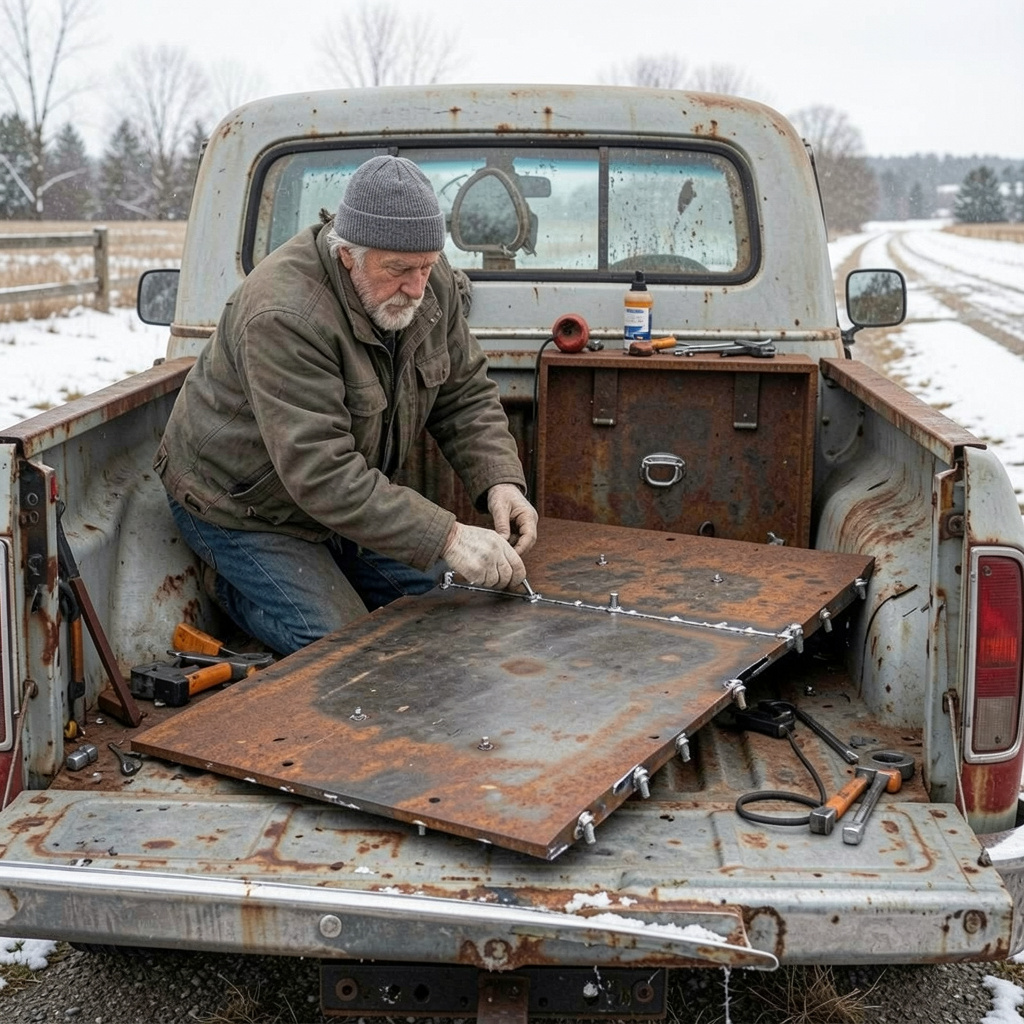
I slid a pry bar beneath the panel.
It resisted.
Then suddenly it popped free.
I lifted it.
And froze.
There was a hidden compartment underneath.
It was roughly four feet long and two feet wide.
Inside were several metal boxes.
A black canvas bag.
A stack of envelopes.
And something wrapped in an old gray blanket.
For several seconds, I didn’t move.
I couldn’t.
My first thought was money.
My second was drugs.
My third was that whatever I had found was the reason Ray had kept this truck for thirty years.
I reached for the nearest box.
It was locked.
The canvas bag wasn’t.
I opened it.
Inside were dozens of photographs.
Old photographs.
Some were black and white.
Some were faded color prints.
I picked up the first one.
It showed three men standing beside a pickup truck.
My uncle was one of them.
But he was young.
Maybe twenty-five.
I’d never seen him like that.
He was smiling.
Actually smiling.
Beside him stood two other men.
I recognized one.
My grandfather.
Ray’s older brother.
The third man was a stranger.
I turned the photograph over.
There was handwriting.
October 14, 1989. Miller Road.
I picked up another.
Ray.
My grandfather.
The same stranger.
Then another.
And another.
Dozens of them.
They appeared together repeatedly.
Construction sites.
Gas stations.
A barn.
A diner.
A county road.
Then I found one that made my heart pound.
It showed Ray standing beside the stranger in front of a burned building.
Written on the back were five words.
The night everything changed.
I set the photo down.
My hands were trembling.
I opened the first metal box.
Inside were newspaper clippings.
Hundreds of them.
I picked up the first.
The headline read:
LOCAL FARMHOUSE DESTROYED IN FIRE
The date was October 15, 1989.
I read the article.
A farmhouse on Miller Road had burned to the ground shortly after midnight.
The owner, Thomas Bell, had died inside.
The fire was ruled accidental.
Faulty electrical wiring.
I picked up another clipping.
SHERIFF’S OFFICE CLOSES MILLER ROAD FIRE INVESTIGATION
Another.
LOCAL BUSINESSMAN DIES IN APPARENT ACCIDENT
Another.
COUNTY CONTRACTOR DISAPPEARS
I felt cold despite the garage heater running.
Then I found an envelope.
On it was written:
FOR WHOEVER FINDS THIS.
I stared at it for a long time.
Then I opened it.
Inside was a letter.
The handwriting was Ray’s.
My heart sank.
If you’re reading this, then I’m dead.
And if you’re holding these things, then you probably found them in the truck.
I hope you found them by accident.
That’s the only way I ever wanted anyone to find them.
For thirty years, I kept evidence of something that happened in this county.
Something the sheriff’s office refused to investigate.
Something your grandfather and I spent most of our lives trying to prove.
We failed.
But I never stopped keeping records.
There are people who believed the truth would disappear if enough time passed.
They were wrong.
Truth doesn’t disappear.
It waits.
I stopped reading.
I looked around the garage.
Suddenly the old truck didn’t seem like a worthless pile of metal anymore.
It felt like a locked room.
A witness.
I continued.
Ray explained that in 1989, he and my grandfather had worked for a construction company owned by a man named Walter Bell.
Walter had a son named Thomas.
The same Thomas who had died in the farmhouse fire.
According to Ray, Walter Bell’s company had been illegally dumping industrial waste on private land outside the county.
The waste contaminated groundwater.
Several families had complained.
But their complaints went nowhere.
Then one family hired a lawyer.
The lawyer was Thomas Bell.
He had discovered his father’s involvement.
He intended to expose everything.
The night before the fire, Thomas met Ray and my grandfather on Miller Road.
He gave them documents.
Financial records.
Photographs.
Names.
Bank transfers.
Everything.
He told them that if anything happened to him, they were supposed to take the evidence to the state authorities.
But Thomas never made it to morning.
His house burned.
The evidence disappeared.
The investigation was closed within days.
Ray wrote that he and my grandfather didn’t believe the fire was accidental.
They suspected Thomas had been murdered.
But they had no proof.
So they began collecting evidence themselves.
For years, they watched.
They recorded.
They photographed.
They saved documents.
But the people involved were powerful.
Every time they got close to proving something, someone backed away.
One witness disappeared.
Another suddenly changed his story.
A third refused to talk.
Eventually, my grandfather gave up.
Ray didn’t.
I sat on the concrete floor, reading until my legs went numb.
Then I found another envelope.
This one contained a single photograph.
It showed a man standing outside a courthouse.
The man was older now.
Gray hair.
Expensive suit.
I recognized him immediately.
Walter Bell.
Except he wasn’t dead.
He was still alive.
And according to the note written beneath the photograph, he had become one of the wealthiest developers in the county.
My uncle had spent thirty years watching him.
But there was more.
Much more.
Under the photographs was a second box.
Inside were cassette tapes.
Dozens of them.
Each labeled with dates.
I found an old tape recorder in the truck compartment.
Ray had thought of everything.
I put in the first cassette.
A man’s voice filled the garage.
“…I told him the documents were gone.”
Another voice answered.
“Then make sure they stay gone.”
My blood ran cold.
I stopped the tape.
Then I played another.
This time it was Ray’s voice.
He sounded younger.
“This is Raymond Carter. October 14, 1989. I’m recording this because I don’t trust my memory.”
He described meeting Thomas Bell.
Then he described hearing a car approaching.
Then footsteps.
Then shouting.
The tape ended.
I listened to another.
And another.
The recordings continued through the years.
Some were conversations.
Some were observations.
Some were simply Ray documenting events.
But eventually I found something that changed everything.
A tape labeled:
December 3, 2001.
Ray’s voice was quiet.
“Daniel came to me today.”
I stopped.
Daniel.
My cousin.
I wondered if he meant my cousin Daniel or someone else.
Then Ray continued.
“He’s asking questions about Thomas.”
I felt a chill.
My cousin Daniel had inherited Ray’s house.
I played the tape again.
Ray explained that Daniel had discovered part of the story when he was a teenager.
He had asked Ray about the burned farmhouse.
Ray told him to forget about it.
Daniel apparently didn’t.
He had begun researching Walter Bell.
Then, according to Ray, Daniel found something.
A witness.
Someone who claimed to have seen Thomas alive shortly before the fire.
A witness who said two men had entered Thomas’s property that night.
Ray never recorded their names.
But he wrote them down elsewhere.
I searched through the envelopes.
Nothing.
Then I found the gray blanket.
I slowly unfolded it.
Inside was a small steel case.
It had a combination lock.
I tried dates.
Nothing.
Thomas’s death date.
Nothing.
Ray’s birthday.
Nothing.
My grandfather’s birthday.
Nothing.
Then I remembered something Ray used to say.
Whenever someone asked about the truck, he’d smile and say:
“She’s older than you think.”
I entered 1989.
The lock clicked.
Inside was a single flash drive.
And a note.
This is the part I couldn’t put on tape.
My heart began pounding.
I found an old laptop and connected the drive.
There was only one folder.
Inside were scanned documents.
Bank statements.
Property records.
Photographs.
And a video.
The video was dated three weeks before Ray died.
I clicked it.
My uncle appeared on the screen.
He was sitting at his kitchen table.
He looked thinner than I remembered.
Tired.
But his eyes were steady.
“If you’re watching this,” he said, “then you found the compartment.”
He paused.
“I wish I could’ve told you myself.”
He looked directly into the camera.
“You probably think I was just a stubborn old man who couldn’t let go of the past.”
A faint smile crossed his face.
“Maybe I was.”
He leaned closer.
“But there’s something you need to understand.”
He took a breath.
“Your grandfather and I didn’t keep this evidence because we wanted revenge.”
He pointed toward a stack of folders.
“We kept it because Thomas Bell had a family.”
Then he told me the truth.
Thomas hadn’t been the only victim.
The chemical dumping had poisoned the groundwater around Miller Road.
Several people had become sick.
Some died.
But their families never knew why.
The company had buried the reports.
The county had accepted money to look the other way.
And Thomas had discovered it.
He had planned to expose everyone.
That was why he was killed.
But Ray had spent thirty years trying to find the one piece of evidence that would make the entire case impossible to dismiss.
He finally found it.
A ledger.
The original financial record showing payments from Walter Bell’s company to several county officials.
Including the sheriff who had closed Thomas’s fire investigation.
The ledger wasn’t in the truck.
It was somewhere else.
Ray told me where.
Then he said something I will never forget.
“I didn’t leave this for you because you’re the smartest person in the family.”
I laughed despite myself.
“You’re probably not even the bravest.”
He smiled.
“I left it for you because you were the only one who took the truck.”
My eyes filled with tears.
“Everybody else wanted what was worth money.”
He looked down.
“You wanted something that belonged to me.”
The video ended.
I sat in silence.
For nearly ten minutes, I didn’t move.
Then I called my cousin Daniel.
He answered on the third ring.
“What’s up?”
“Did you know?”
There was silence.
“Know what?”
“About Miller Road.”
His breathing changed.
“Where did you hear that?”
“Uncle Ray.”
Another silence.
Then Daniel said quietly:
“You found the truck compartment.”
I stood.
“You knew?”
“I knew there was something.”
“Why didn’t you tell me?”
“Because I was scared.”
His voice cracked.
“I saw what happened to people who asked questions.”
I sat back down.
“Daniel, Ray left me evidence.”
“I know.”
“How?”
“He told me before he died.”
“Why didn’t you take it?”
“Because he asked me not to.”
Daniel told me that twenty years earlier, he had tried to investigate Thomas Bell’s death.
He had found the witness.
An elderly mechanic named Samuel Price.
Samuel had told Daniel that he saw two men leaving Thomas’s property the night of the fire.
One was Walter Bell’s employee.
The other was a county official.
Samuel had agreed to testify.
But before he could, someone broke into his house.
They didn’t steal anything.
They simply left a note on his kitchen table.
Some things are better forgotten.
Samuel never spoke again.
Daniel had stopped investigating.
But Ray never did.
I asked him where the ledger was.
Daniel hesitated.
“Your uncle told me he put it somewhere nobody would think to look.”
“Where?”
“The old church.”
I knew exactly which one.
A small abandoned church near Miller Road.
The next morning, Daniel and I drove there.
The building was half-collapsed.
We searched for hours.
Finally, Daniel found a loose floorboard beneath the old pulpit.
Under it was a metal box.
Inside was the ledger.
And beside it was another note.
This one was addressed to me.
I opened it with shaking hands.
You may be wondering why I waited.
Because I learned something during those thirty years.
Sometimes the truth isn’t enough.
You need proof.
And you need someone willing to stand beside you.
If you’re reading this, then you have both.
Daniel knows the story.
The recordings tell the history.
The ledger proves the money.
And the final document proves who ordered the fire.
I looked at Daniel.
“Final document?”
He nodded slowly.
“I know where it is.”
“Where?”
He looked toward the road.
“My father’s house.”
We drove there.
Daniel had inherited my grandfather’s property years earlier.
He took me to the basement.
Behind an old workbench was a wooden cabinet.
Inside was a sealed envelope.
Daniel handed it to me.
“Ray gave this to my father in 1994.”
I opened it.
Inside was a handwritten confession.
Not from Walter Bell.
From one of his employees.
The man admitted that he had been paid to destroy Thomas Bell’s evidence.
He described the night of the fire.
He named the men involved.
He named Walter Bell.
He named the sheriff.
And he named the county commissioner.
At the bottom was a signature.
And a date.
Three months before the man died.
For thirty years, my uncle had been carrying the truth.
Not because he wanted to be famous.
Not because he wanted revenge.
He simply couldn’t stand the idea that Thomas Bell had died believing nobody would ever know what happened.
We took everything to a lawyer.
Then to the state authorities.
Then to investigators.
For the first time in thirty years, the case was reopened.
Walter Bell was eighty-three by then.
The sheriff was dead.
The county commissioner had died years earlier.
But the evidence was real.
Financial records matched.
The recordings were authenticated.
The confession was verified.
And the contaminated land was tested again.
The results were devastating.
The old chemical dumping had affected groundwater for decades.
Several families received compensation.
The state filed civil claims against companies connected to Walter Bell.
News reporters came.
People who had ignored Ray for thirty years suddenly wanted to know who he was.
I hated that part.
Because they never knew him.
They knew the story.
I knew the man.
I knew the uncle who fixed my bicycle when I was ten.
The man who never said “I love you” but once drove two hours in a snowstorm because I’d mentioned my car battery was weak.
The man who always kept peppermints in the glove compartment.
The man who drove the same battered truck for thirty years because, as he said, “This one knows me.”
Months after the investigation began, I finally decided what to do with the truck.
I repaired it.
Not completely.
I left some of the dents.
I kept the faded blue paint.
I replaced the seat.
I rebuilt the engine.
And I left the hidden compartment exactly where it had been.
Empty.
One summer afternoon, I drove it out past the county line.
I stopped near Miller Road.
The fields were green.
Birds were calling from the trees.
For a moment, I could almost imagine Ray sitting beside me.
I looked at the passenger seat.
“Hey, Uncle.”
The truck ticked softly as the engine cooled.
“I found it.”
Of course, there was no answer.
But somehow, I didn’t need one.
Before I left, I opened the toolbox.
Inside, beneath the tools, I had placed one photograph.
The photograph of Ray and my grandfather standing beside the truck in 1989.
On the back, I wrote:
You were right. Truth waits.
Then I closed the toolbox.
And I drove home.
The truck is still mine.
I still drive it.
Sometimes people ask why I keep an old pickup that should have been scrapped years ago.
I tell them the truth.
“Because it belonged to my uncle.”
But that’s not the whole reason.
The whole reason is that underneath the rust, underneath the old paint, underneath thirty years of dirt and neglect, there was something my uncle had protected with his life.
Not money.
Not treasure.
Not secrets for the sake of secrets.
A promise.
He had promised a dead man that someday, someone would know the truth.
And when I lifted that rusted panel and saw what he had hidden beneath the bed of the truck he drove every day for thirty years, I stopped and stared because I finally understood something about my uncle.
He hadn’t spent his life running from the past.
He had been carrying it.
Waiting for someone willing to carry it the rest of the way.