I am seventy-four years old, and for six years, I have eaten lunch at the same Cracker Barrel every Tuesday.Same restaurant.Same booth.Same meal.Same waitress.Same empty chair across from me.
And, until last Tuesday, I thought I knew exactly why I kept going back.My husband, Harold, died six years ago.
The Tuesday after his funeral, I couldn’t stand being alone in our house.
Every room had become a museum of him.
His recliner.His slippers.His reading glasses.The coffee mug with the little crack near the handle.Even the dent in his pillow where his head had rested for thirty-eight years.
So I drove to the Cracker Barrel where we’d eaten lunch almost every Tuesday since retiring.
I slid into our booth.
I ordered my usual.
Chicken and dumplings.Mashed potatoes.Green beans.A biscuit.Sweet tea.The bill was $12.49.I remember staring at that number.Twelve dollars and forty-nine cents.It seemed so ordinary.
So ridiculously small compared with the size of the emptiness inside me.I almost left without eating.
Then a young waitress named Becca came over.
She was probably twenty-two at the time.
She had freckles across her nose, a messy ponytail, and a smile that seemed too bright for the mood I was in.
She looked at the empty seat across from me.
“Waiting for someone?”
I shook my head.
“My husband used to sit there.”
She didn’t say, “I’m sorry.”
She didn’t give me that careful look people give widows.
She simply pulled out the other side of the booth and sat down.
“Then I’ll sit here for a minute.”
I looked at her.
“You aren’t supposed to sit with customers.”
“I’m on my break.”
“You could get in trouble.”
“Then you’ll have to lie for me.”
For the first time since Harold died, I laughed.
It wasn’t much.
Just a little sound.
But it was the first laugh I’d heard from myself in weeks.
Becca smiled.
“Good. You’re still in there.”
I didn’t understand what she meant.
I would later.
Every Tuesday after that, Becca would sit with me during her break.
Sometimes we’d talk for ten minutes.
Sometimes twenty.
Sometimes she was too busy and would only stop by long enough to refill my tea.
But she always knew what I ordered.
And I always sat in the same booth.
Over six years, she became more than my waitress.
She became my Tuesday.
I learned about her life.
She was raised by a single mother.
She was trying to finish community college.
She wanted to become a nurse.
She had a little boy named Noah.
She was constantly worried about money.
And she had a habit of saying, “I’m fine,” whenever she was clearly not fine.
She learned about me too.
She knew Harold had been a mechanic.
She knew we’d been married forty-three years.
She knew we had no children.
She knew I still sometimes talked to him when I was driving.
She knew I hated eating dinner alone.
And she knew that every Tuesday, no matter how bad my week had been, I would show up at that booth.
For six years.
312 Tuesdays.
312 meals.
$12.49 every time.
I never thought twice about paying.
Until last Tuesday.
I had just finished my mashed potatoes when the manager approached my table.
His name was Daniel.
I’d seen him hundreds of times, but he rarely spoke to me beyond a polite greeting.
That afternoon, he stood beside my booth holding a tablet.
“Mrs. Patterson?”
“Yes?”
“Can I ask you something?”
I smiled.
“If you’re about to tell me I’m finally banned from taking home all those biscuits, I’ll have you know I’ve earned them.”
He laughed nervously.
“No. It’s about your account.”
“My account?”
“Yes.”
He glanced toward the dining room.
Then back at me.
“Do you know your Tuesday lunch has been paid for every week for the past six years?”
I stared at him.
“What?”
“Every Tuesday. Same meal. Same amount. Paid anonymously.”
I thought he’d made a mistake.
“I pay every week.”
“No, ma’am.”
He turned the tablet toward me.
There were hundreds of transactions.
Each one had been marked as prepaid.
Six years.
312 meals.
$3,888.
My mouth went dry.
“Who?”
“We don’t know.”
“Someone has been paying for my lunch?”
“Yes.”
“For six years?”
“Yes.”
“Why?”
He shook his head.
“I don’t know.”
I looked across the booth.
At the empty seat.
Suddenly, I couldn’t breathe.
“Who started it?”
“Six years ago.”
“When?”
He checked.
“The Tuesday after your husband died.”
My hands began to tremble.
I looked at him.
“Harold?”
Daniel didn’t answer.
He didn’t need to.
I whispered, “Where’s Becca?”
“She’s in the back.”
“Get her.”
A few minutes later, Becca came through the kitchen doors.
The second she saw my face, she stopped.
“Linda?”
I had never told her to call me Mrs. Patterson.
She’d always called me Linda.
She sat down across from me.
“What happened?”
I pointed to the tablet.
“My lunches.”
Her face changed.
She looked at Daniel.
Then at me.
Her eyes immediately filled with tears.
“How did you find out?”
My heart stopped.
“You knew?”
She nodded.
I felt something inside me crack.
“Becca.”
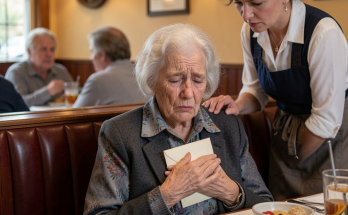
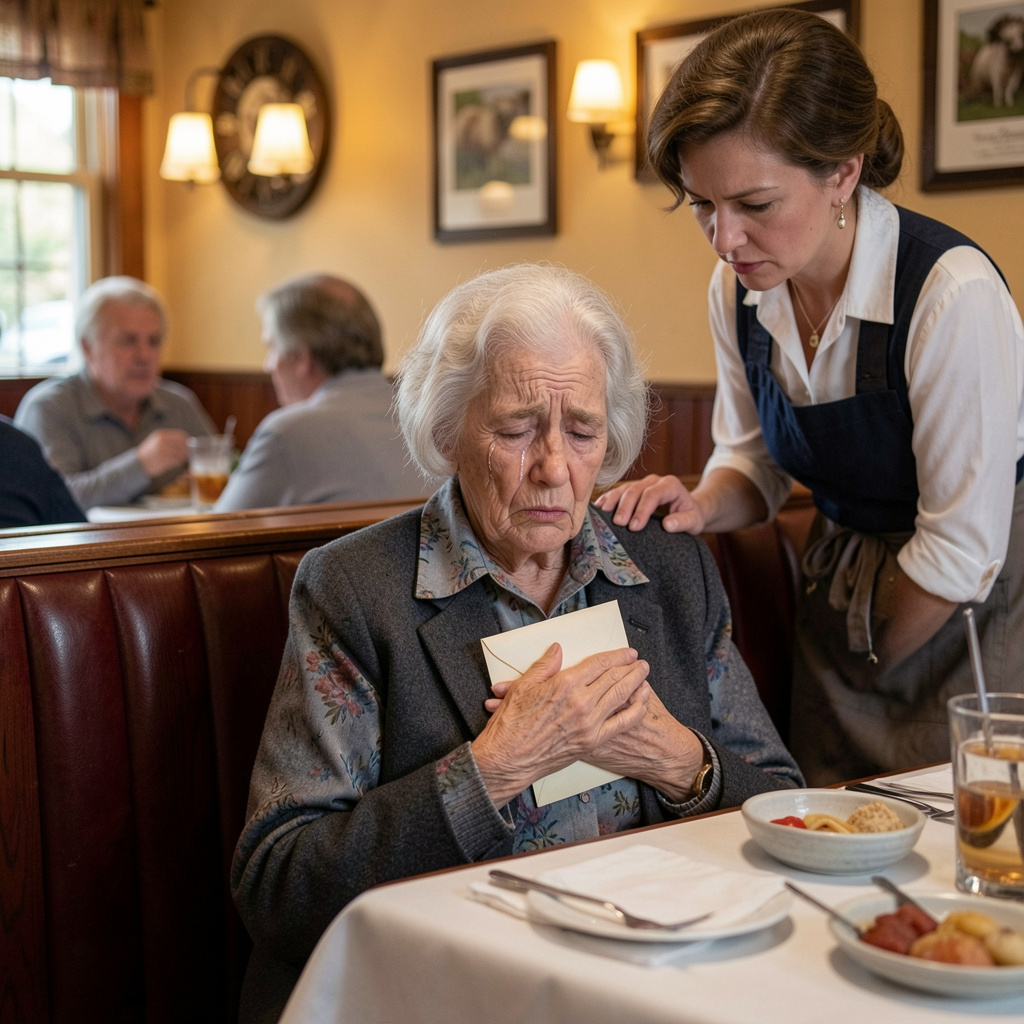
She reached into her apron.
Pulled out a small envelope.
It was old.
Yellowed.
The edges were worn.
There was handwriting across the front.
My husband’s handwriting.
My breath caught.
For my Linda.
My fingers went numb.
I pressed the envelope against my chest.
“Where did you get this?”
Becca wiped her eyes.
“Harold gave it to me.”
“When?”
“Six years ago.”
“Before he died?”
She nodded.
“He came in here three days before he passed.”
I couldn’t speak.
“He sat in this booth.”
My booth.
“Our booth.”
“He ordered coffee. He didn’t eat much. He just talked.”
“About me?”
“About you.”
I looked at the envelope.
“What did he say?”
Becca took a breath.
“He told me he was sick.”
I closed my eyes.
I hadn’t known.
Not really.
Harold had complained about being tired.
He’d blamed his back.
His age.
The weather.
He’d told me he was fine.
Then one morning, he collapsed in the kitchen.
A heart attack.
No warning.
No goodbye.
At least that’s what I’d believed.
Becca continued.
“He told me he didn’t know how much time he had left.”
A tear rolled down my cheek.
“He said you were his whole world.”
I covered my mouth.
“He asked me to do something.”
“What?”
“Keep you coming here.”
I stared at her.
“He said you wouldn’t want to leave the house after he was gone.”
She looked down.
“And he was right.”
“He told me this restaurant was the only place where you two still had a routine.”
I looked around.
The wooden walls.
The old signs.
The rocking chairs outside.
The booth.
Our booth.
“He prepaid the lunches.”
“All of them?”
“He put money into an account.”
“How much?”
“Enough for six years.”
I shook my head.
“Then how did it last this long?”
Becca smiled sadly.
“He told the manager to charge your meal at the same price every Tuesday and use the account until the money ran out.”
I laughed through my tears.
“That sounds like Harold.”
Becca nodded.
“He also said if the money ran out before you stopped coming, I was supposed to pay for the meal myself.”
I looked at her.
“You did?”
She smiled.
“Every time.”
“Becca…”
“Don’t.”
“But—”
“Your husband asked me to take care of you.”
I began crying.
She reached across the table and held my hand.
“He also gave me the envelope.”
I looked down at it again.
“Why didn’t you give it to me?”
“He told me not to.”
“When?”
“When you found out someone had been paying.”
I stared at her.
“Why?”
“He said you wouldn’t believe me if I just told you.”
I almost smiled.
“That sounds like Harold too.”
Becca nodded.
“He wanted you to know because he thought you might stop coming.”
I looked around the restaurant.
“I don’t think I can.”
“Good.”
She squeezed my hand.
“Because he left one more instruction.”
“What?”
“He said, ‘If Linda is still coming every Tuesday, and you’re still there, then tell her the truth.'”
My heart began pounding.
“What truth?”
Becca looked toward the envelope.
“Open it.”
I tore it carefully.
Inside was a folded sheet of paper.
I recognized the handwriting immediately.
My vision blurred.
I read.
My Linda,
If you’re reading this, then somehow you found out about the lunches.
Knowing you, you’re probably upset that I spent money behind your back.
Don’t be.
It isn’t charity.
It isn’t a gift.
It’s a promise.
Every Tuesday, you and I had lunch together for years.
I know that after I’m gone, you will think you have to stop doing the things we used to do.
Don’t.
Go to the restaurant.
Sit in our booth.
Order the same meal.
And if Becca is still there, let her sit with you.
She’s a good girl.
She reminds me of you when you were young.
Stubborn.
Kind.
Always pretending you don’t need anybody.
I need you to know something else.
Something I never had the courage to tell you.
I met Becca before you ever did.
I had a reason for choosing her.
Ask her.
She knows.
I love you.
Every Tuesday until the money runs out.
And then, if you’re still coming, keep going anyway.
Love,
Harold
I read it twice.
Then a third time.
My eyes moved to the final sentence.
Ask her.
She knows.
I looked up.
“Becca?”
She was crying.
“What did he mean?”
She took a long breath.
“I think it’s time.”
“Time for what?”
She reached into her purse and pulled out another envelope.
This one was thicker.
She placed it on the table.
“Harold gave me this too.”
My hands froze.
“What’s inside?”
“Something I’ve been afraid to show you.”
I opened it.
There was a photograph.
Old.
Faded.
It showed Harold standing beside a woman I’d never seen before.
The woman was holding a newborn baby.
I stared at the photograph.
“Who is this?”
Becca whispered.
“My mother.”
I looked at her.
The room seemed to tilt.
“Your mother?”
She nodded.
“My mother was named Sarah.”
I stared at the photograph again.
“Sarah.”
The name was familiar.
But I couldn’t place it.
Then I remembered.
A woman from Harold’s past.
A woman he had mentioned only once.
Thirty-one years ago.
Sarah had worked at a repair shop near Harold’s garage.
He’d told me she’d moved away.
I had never asked more.
Becca continued.
“My mother died when I was six.”
I swallowed.
“What does this have to do with Harold?”
“My mother knew him.”
“How?”
“She worked for him.”
I stared at her.
“He helped her when she was pregnant with me.”
My heart began pounding.
“Pregnant?”
Becca nodded.
“My mother was nineteen. She was alone. She was scared.”
I couldn’t breathe.
“She told Harold she didn’t know what to do.”
I looked at the photograph.
“He helped her?”
“He paid her rent for almost a year.”
I closed my eyes.
“Why?”
“Because my father left.”
Silence.
Then Becca said something that made my entire body go cold.
“And because he was my father.”
I stared at her.
“No.”
Her eyes filled.
“Linda…”
“No.”
I pushed the photograph away.
“No.”
Becca didn’t move.
“Harold was my biological father.”
The restaurant disappeared.
The voices around us became distant.
The clinking of plates sounded like it was happening underwater.
I looked at the photograph again.
The baby.
The woman.
Harold.
“No,” I whispered.
Becca nodded.
“My mother told me when I was seventeen.”
I felt anger rise through the grief.
“Harold had a daughter?”
“He had me.”
“And he never told me?”
“No.”
“Why?”
“Because my mother asked him not to.”
I couldn’t understand.
“Why would she?”
“She was afraid.”
“Of what?”
“Of losing me.”
Becca explained that Sarah had been struggling when she became pregnant.
Harold had been twenty-seven.
He had already met me.
We weren’t married yet, but we’d been dating.
Sarah believed that if Harold claimed the child, he would leave her.
But Harold refused to abandon either of them.
He provided money.
He visited.
He helped.
And when Sarah eventually married another man, Harold stepped back.
He stayed out of her life.
But he never stopped checking on Becca.
He watched from a distance.
He sent birthday cards without signing his name.
He paid for school supplies.
He helped with her community college tuition.
And when Sarah died, Harold became the anonymous person who kept looking after her.
I was stunned.
“You knew all these years?”
“No.”
“When did you find out?”
“When I was seventeen.”
“Did Harold tell you?”
“No.”
“Then who?”
“My mother.”
I sat back.
“Did you ever confront him?”
Becca nodded.
“What did he say?”
“He said he was sorry.”
“For hiding you?”
“For everything.”
I looked at the letter.
“He told you to take care of me.”
“He told me something else.”
“What?”
“He said you were the only woman he ever loved.”
I started crying again.
“But if I was the only woman he loved, why did he have another child?”
Becca reached for my hand.
“Because loving you didn’t mean he didn’t love me.”
I looked at her.
“He loved you differently.”
She paused.
“He called me his daughter.”
My heart broke in a way I didn’t know was possible.
“Why didn’t he ever tell me?”
“Because he was afraid.”
“Of me?”
“Of losing you.”
I laughed bitterly.
“He should have trusted me.”
“Maybe.”
She looked down.
“But you know what he said?”
“What?”
“He said if you knew, you’d forgive him before you were ready to.”
I didn’t answer.
For the next few minutes, neither of us spoke.
Finally, I asked:
“Why did you keep sitting with me?”
Becca smiled through her tears.
“Because he asked me to.”
I looked at her.
“And after six years?”
She squeezed my hand.
“Because I wanted to.”
That sentence broke whatever was left of my resistance.
I reached across the table.
She took my hand.
For the first time, I didn’t see a waitress.
I saw the little girl in the photograph.
Harold’s daughter.
My husband’s secret.
My family.
“My goodness,” I whispered.
Becca laughed softly.
“What?”
“I’ve spent six years sitting across from you.”
“Yes.”
“And I never knew.”
“No.”
“Harold knew.”
“Yes.”
“And he arranged for us to meet.”
“He did.”
I shook my head.
“That man.”
Becca smiled.
“He always had a plan.”
We sat there until the restaurant began emptying.
Eventually, Daniel came over.
“Everything okay?”
I looked at Becca.
Then at him.
“Everything is finally okay.”
He smiled.
“Good.”
I stood slowly.
My knees weren’t as strong as they used to be.
Becca helped me put on my coat.
Outside, the sun was beginning to set.
I stood on the sidewalk and looked back through the window at our booth.
For six years, I’d believed I was sitting there because I couldn’t let Harold go.
But perhaps I’d misunderstood.
Maybe Harold hadn’t wanted me to remain trapped in the past.
Maybe he’d wanted me to find a way forward.
And somehow, he’d left a path.
Every Tuesday.
One lunch at a time.
The next Tuesday, I returned.
Same booth.
Same meal.
$12.49.
But this time, I didn’t sit alone.
Becca sat across from me.
We ordered two lunches.
I paid for both.
She protested.
“Linda, you don’t have to.”
“I know.”
“Then why?”
I smiled.
“Because Harold’s money ran out.”
She laughed.
“So?”
“So now it’s my turn.”
We ate.
We talked.
We laughed.
And for the first time in six years, the empty seat beside me didn’t feel like a grave.
It felt like a memory.
A good one.
After lunch, Becca handed me another envelope.
I stared at it.
“Another one?”
She nodded.
“I found it yesterday.”
“Where?”
“In my mother’s old belongings.”
My hands trembled.
Inside was a letter from Sarah.
It was addressed to Harold.
The date was thirty years old.
I read it slowly.
Harold,
I know you believe you have to stay away.
But someday, if Becca is old enough, tell her.
Tell her she was loved.
Tell her you never abandoned her.
And tell Linda that I am sorry.
She deserves to know that the man she loves is not the man she thinks he is.
He is better.
He just doesn’t know how to forgive himself.
I stopped reading.
I looked at Becca.
“Your mother knew about me.”
“Yes.”
“She knew we were married?”
“Yes.”
“She wanted me to know?”
“Eventually.”
I folded the letter.
“She was right.”
“About what?”
“Harold didn’t know how to forgive himself.”
I looked toward the window.
“He carried that guilt for thirty years.”
Becca nodded.
“Maybe that’s why he loved you so hard.”
I smiled.
“Maybe.”
Six months passed.
Then a year.
I continued going every Tuesday.
But now I had company.
Sometimes Becca sat with me.
Sometimes Noah joined us.
Sometimes Becca’s mother-in-law came.
Sometimes Daniel would stop by.
The booth that had once represented loss slowly became a place of life.
We celebrated birthdays there.
Christmases.
Graduations.
Becca eventually became a nurse.
I was there when she received her certificate.
She hugged me afterward.
“You know what Harold would say?”
“What?”
“He’d say, ‘Took you long enough.'”
I laughed.
“That sounds exactly like him.”
Years passed.
One Tuesday, I brought a framed photograph to the restaurant.
It was the photograph from the envelope.
Harold.
Sarah.
Baby Becca.
I placed it on the table.
Becca sat beside me.
“You finally framed it.”
“I did.”
She touched the glass.
“I never knew he had this.”
“He wanted you to have it.”
She looked at me.
“How do you know?”
“Because he knew I’d give it to you.”
We were quiet.
Then I reached into my purse.
I pulled out a small envelope.
I had written on it:
For Becca.
She opened it.
Inside was a photograph of Harold and me on our wedding day.
On the back, I’d written:
He loved you.
He loved me.
And somehow, he found a way to bring us together.
Becca cried.
So did I.
Then she smiled.
“You know what I think?”
“What?”
“I think this was never about $3,888.”
I looked at her.
“No.”
“It was about making sure you weren’t alone.”
I nodded.
“And making sure you found me.”
She leaned her head against my shoulder.
Outside, cars passed on the highway.
Inside, dishes clattered.
Someone laughed at another table.
The restaurant smelled like biscuits and coffee.
Everything was ordinary.
And yet nothing was.
Because six years ago, my husband had died.
I thought he’d taken my future with him.
I thought my life had ended in that kitchen when he collapsed.
I thought the best part of my story was over.
I was wrong.
Harold hadn’t left me money.
He’d left me Tuesdays.
He’d left me a booth.
He’d left me a waitress who turned out to be his daughter.
He’d left me a secret I didn’t know I needed.
Most importantly, he had left me proof that love doesn’t always disappear when someone dies.
Sometimes it changes shape.
Sometimes it hides inside a prepaid lunch.
Sometimes it sits across from you wearing a waitress uniform.
Sometimes it waits six years before finally saying:
I’m still here.
I am seventy-four years old now.
I still eat lunch at the same Cracker Barrel every Tuesday.
Same booth.
Same meal.
Same $12.49.
Well, not exactly the same.
Because now I order two.
One for me.
One for Becca.
And every Tuesday, before we eat, I look at the empty seat beside me.
I still miss Harold.
I always will.
But I no longer feel abandoned.
Because I finally understand what he was trying to tell me.
The last line of his letter said:
Every Tuesday until the money runs out.
He thought he was paying for my lunches.
He wasn’t.
He was buying me time.
Time to heal.
Time to grieve.
Time to keep living.
And time to discover that the family you lose isn’t always the end of your family.
Sometimes, if you’re lucky, the person you lost leaves you a door.
You just have to keep showing up long enough to find it.
Last Tuesday, Becca arrived late.
She slid into the booth, breathless.
“Sorry.”
I smiled.
“You’re forgiven.”
She looked at the framed photograph.
Then at me.
“You know, Dad would have loved this.”
I reached across the table.
“I know.”
She held my hand.
Then she said something that still makes me cry.
“Thank you for loving him even after you found out.”
I squeezed her fingers.
“Thank you for giving me another reason to.”
And that’s how I learned that sometimes the greatest inheritance isn’t money.
It’s not a house.
It’s not jewelry.
It’s not a bank account.
Sometimes, it’s one ordinary promise made by a man who knew he was running out of time.
A promise that costs $12.49.
A promise repeated 312 times.
A promise that says:
I know you will be lonely.
I know you will be angry.
I know you will think you can’t go on.
So I’m leaving you something simple.
A place to go.
Someone to talk to.
A reason to get dressed.
A reason to leave the house.
A reason to keep living.
Every Tuesday.
Until the money runs out.
And when it does…
Keep going.
Because the money was never the point.
You were.
My name is Linda Patterson.
I’m seventy-four years old.
And every Tuesday, I have lunch with my husband’s daughter.
She calls me Linda.
Sometimes she calls me Mom.
I never force her to.
I don’t need to.
Because six years ago, Harold left me an envelope.
And inside that envelope wasn’t just a letter.
It was a second chance.
A family I never knew I had.
And one final gift from the man I thought had taken everything with him.
He gave me a reason to keep showing up.
Every Tuesday.
Until the end.