The Forty-Eighth Envelope
My neighbor died alone at eighty-two.That was the first thing everyone in town said about Eleanor Vale.No husband. No children. No siblings anyone could find.
No visitors except the occasional grocery delivery driver and, according to the mail carrier, a woman from the pharmacy who came every other Tuesday.
Eleanor had lived in the little white house at the end of Rosewood Lane for forty-seven years.
I had lived three houses away for eleven.
I knew her the way neighbors sometimes know one another without ever becoming friends.I knew she wore the same gray wool coat every winter.I knew she planted roses every spring.
I knew she never put up Christmas lights.I knew that when storms came, her porch light stayed on all night.
But I didn’t know her.Not really.
She died in February.
The county found her three days later.By March, the house was part of a county auction.I bought it for $187,000.Everyone told me I was getting a bargain.I didn’t realize I was buying a mystery.
The first week, I did nothing but clean.The house smelled like old paper, cedar, and something faintly medicinal.
Eleanor had kept everything.
Receipts.Newspapers.
Birthday cards.Broken clocks.Empty jars.There were three rooms filled almost entirely with books.The kitchen was spotless except for the refrigerator, which contained almost nothing.Milk.Mustard.
Half a lemon.And frozen peas.
I almost threw the refrigerator away.
Then I opened the freezer.
Behind the peas were forty-seven envelopes.
Identical.
White.
Sealed.
Each had a date written across the front in Eleanor’s careful handwriting.
And so on.
Forty-seven envelopes.
Twenty-three years.
My first thought was that they contained old bills.
Then I opened the first one.
Five thousand dollars fell onto the kitchen floor.
I stared at it.
Then I picked up the Polaroid.
A little boy.
Maybe four years old.
Brown hair.
Blue jacket.
Standing beside a playground.
On the back of the photograph Eleanor had written:
March 17, 1999.
I opened another envelope.
Five thousand dollars.
Another photograph.
A little girl.
Red sweater.
Missing front tooth.
Written on the back:
June 4, 2000.
Another.
Another child.
Another $5,000.
Another date.
I sat on the kitchen floor surrounded by photographs of children I had never seen.
Forty-seven children.
Forty-seven envelopes.
Two hundred thirty-five thousand dollars.
My hands started shaking.
I called the police.
Detective Marcus Reed arrived twenty-seven minutes later.
He was in his forties, broad-shouldered, with tired eyes and the kind of calm voice people use when they don’t want frightened people to become more frightened.
He looked at the envelopes.
Then at me.
Then at the photographs.
“Did you touch anything else?”
“Only the envelopes.”
“Did you open all of them?”
“Yes.”
He carefully examined each photograph.
“Do you know who these children are?”
“No.”
“Did Eleanor have children?”
“Not that I know of.”
“Grandchildren?”
“No.”
He looked toward the living room.
“You’ve lived here eleven years?”
“Three houses down.”
“And she never mentioned these?”
“Never.”
He picked up one photograph.
“These aren’t random.”
“What makes you say that?”
“The way they’re labeled.”
He flipped it over.
There was a number written beneath the date.
17.
He checked another.
24.
Another.
9.
“The numbers are different,” he said.
“Maybe they’re birthdays.”
He shook his head.
“No.”
Then he looked at me.
“Do you have a computer?”
Three hours later, Detective Reed had entered the photographs into a missing-person database.
The first match appeared at 7:42 p.m.
A boy named Caleb Morris.
Missing since 1999.
Age four.
Last seen at a county fair in neighboring Franklin County.
The photograph in Eleanor’s envelope showed the same boy.
I couldn’t breathe.
Detective Reed leaned closer to the screen.
“That’s him.”
“How?”
“His parents have been searching for him for twenty-three years.”
I stared at the little face.
The blue jacket.
The playground.
The frightened eyes.
“Where is he now?”
“We don’t know.”
“Then why did Eleanor have his picture?”
Reed didn’t answer.
The second match appeared fifteen minutes later.
A girl named Hannah Bell.
Missing since 2000.
Age five.
Then a boy.
Then another girl.
Four of the first ten photographs matched children reported missing between 1999 and 2008.
By midnight, Detective Reed had stopped calling it strange.
He called it a case.
The next morning, federal agents were in Eleanor’s house.
They searched every room.
They found nothing.
No weapons.
No hidden rooms.
No newspaper clippings.
No letters.
No diaries.
No fingerprints that immediately explained anything.
And no evidence that Eleanor had ever harmed a child.
Then one agent asked me something I couldn’t answer.
“Why would she save five thousand dollars for each child?”
I didn’t know.
But I was about to find out.
The forty-seventh envelope contained something different.
There was still $5,000.
But instead of a Polaroid, there was a small brass key.
On the key was a number.
48.
Detective Reed examined it.
“There’s no lock in this house labeled forty-eight.”
We searched anyway.
Closets.
Drawers.
Cabinets.
Attic.
Basement.
Nothing.
Then I remembered the freezer.
Forty-seven envelopes.
But the key said forty-eight.
“Maybe there’s another envelope.”
Reed turned sharply.
“Where?”
“I don’t know.”
We searched the freezer again.
Behind the frozen peas was a false panel.
Underneath it was a forty-eighth envelope.
My name was written on it.
Not Detective Reed’s.
Mine.
Daniel Mercer.
I couldn’t move.
“How did she know?” Reed asked.
I shook my head.
“I don’t know.”
He opened the envelope.
There was no money.
Only a letter.
The paper was yellowed.
The handwriting was Eleanor’s.
The first line read:
Daniel, if you’re reading this, I was right.
Reed read over my shoulder.
The letter continued.
You bought this house because you thought you were buying an old property cheaply. You weren’t. I needed someone who would buy it after I was gone. Someone who would not know me well enough to be afraid of me.
My heart began pounding.
The forty-seven envelopes are not the beginning. They are proof. The forty-eighth is the reason.
Then came a sentence that changed everything.
Start digging where the roses are. What you’ll find there is what I spent twenty-three years trying to protect.
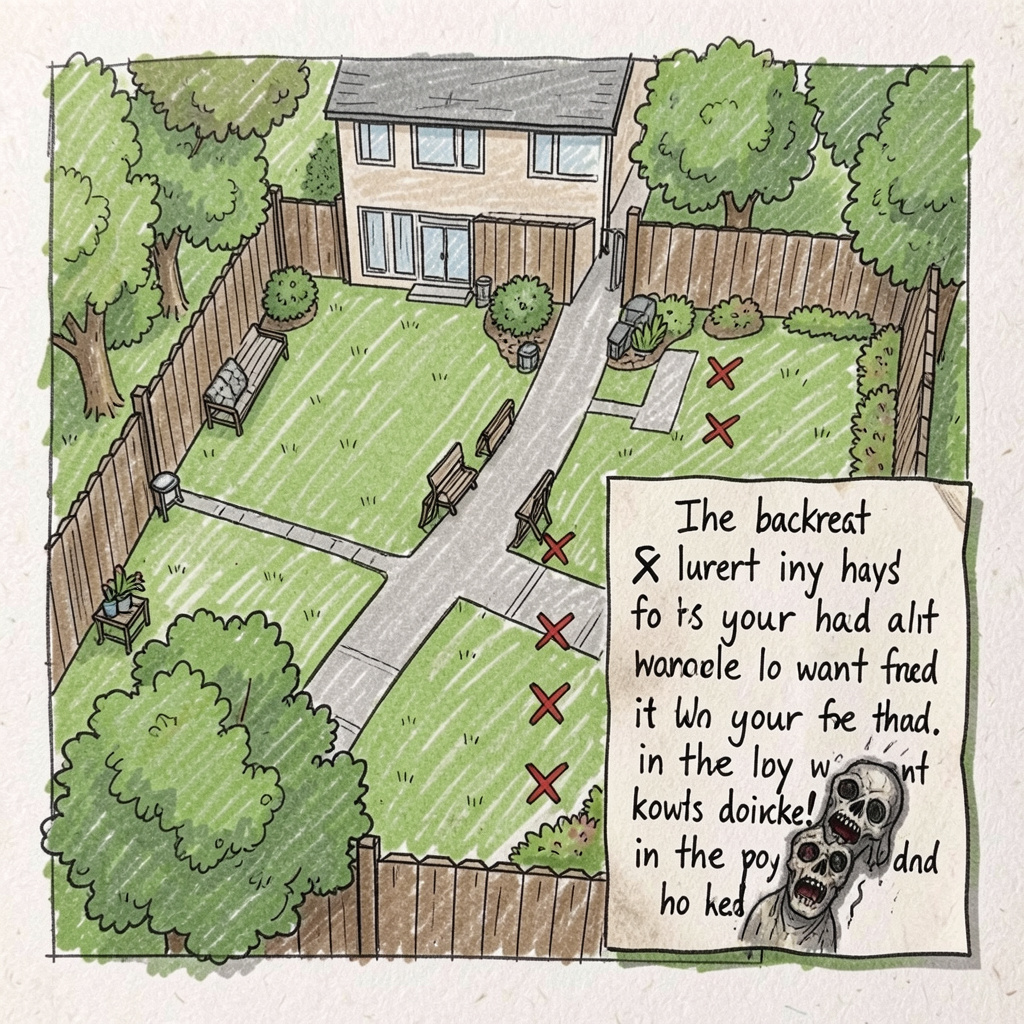
Below that was a hand-drawn map of the backyard.
Six red X’s.
All beneath the rose garden.
Detective Reed stared at the map.
“Nobody digs until my team gets here.”
But we both knew what we would find.
The only question was whether Eleanor had buried bodies.
The excavation began the next morning.
Six marked locations.
Six teams.
The first shovel hit something hard at 10:18 a.m.
Everyone stopped.
A technician brushed away the dirt.
It was a metal box.
Inside were photographs.
Hundreds of them.
Newspaper clippings.
Birth certificates.
Police reports.
Court documents.
And names.
Dozens of names.
Some belonged to missing children.
Others belonged to people who had never been reported missing.
The second X contained a cassette recorder.
The third contained a stack of letters.
The fourth contained videotapes.
The fifth contained a notebook.
The sixth contained nothing except a rusted tin lunchbox.
Inside the lunchbox was a single sentence:
They weren’t all taken. Some were given. Find out why.
Detective Reed looked at me.
“What does that mean?”
I didn’t know.
Then one of the agents found a photograph.
It showed Eleanor thirty years younger.
She was standing beside a teenage girl.
The girl was smiling.
On the back:
Lydia. Age 16. March 1996.
Underneath was another line.
She survived because someone finally believed her.
The notebook explained everything.
At first, Eleanor had been a social worker.
Not a nurse.
Not a teacher.
A social worker.
In 1996, she had been assigned to a case involving a sixteen-year-old girl named Lydia.
Lydia had accused her stepfather of abusing her.
The case was dismissed.
Her mother refused to believe her.
Lydia ran away.
Eleanor found her three days later.
She brought her to a shelter.
But the shelter couldn’t keep her.
So Eleanor did something illegal.
She hid her.
For nine days.
Then she helped Lydia disappear permanently.
A new state.
A new school.
A new identity.
A new life.
It worked.
Lydia survived.
But Eleanor had broken the rules.
She was fired.
Her career was over.
And that should have been the end.
It wasn’t.
Because Lydia wasn’t the only child Eleanor had encountered.
Over the next twenty-three years, children kept appearing in her life.
Children who were being abused.
Children whose parents were addicts.
Children whose families were involved in trafficking.
Children whose cases had been ignored because nobody powerful cared enough to investigate.
Some were officially missing.
Some were not.
Some had been taken.
Some had been sold.
And some had been deliberately erased.
Eleanor began documenting everything.
The photographs.
The dates.
The names.
The money.
The $5,000 in each envelope had a purpose.
It wasn’t ransom.
It wasn’t payment.
It was emergency money.
A way to give a child enough cash to survive if they ever escaped.
But why hide it in the freezer?
Because Eleanor believed someone was watching her.
And she was right.
The cassette recorder contained her voice.
Old.
Trembling.
But unmistakable.
“My name is Eleanor Vale.”
A pause.
“I know what people will think when they find these things.”
Another pause.
“They will think I kidnapped children.”
My skin prickled.
“I did not.”
She breathed heavily.
“I helped children disappear from people who should never have had them.”
Then came the sentence that made Detective Reed sit forward.
“But one child disappeared because of me.”
Silence.
“I failed him.”
The recording ended.
Reed played it again.
Then again.
We found the second tape.
This time Eleanor sounded younger.
She was talking about Caleb Morris.
The four-year-old boy in the blue jacket.
She had not kidnapped him.
She had found him.
His father had been arrested for trafficking stolen prescription drugs.
His mother was missing.
Caleb was placed in temporary foster care.
Then the foster family vanished.
The official file said the boy had been abducted.
But Eleanor’s notebook said otherwise.
Caleb was taken by a private adoption broker operating through three states.
She had tracked him for months.
She found him.
But before she could rescue him, he disappeared again.
The $5,000 envelope had been prepared for him.
The photograph was taken during a brief encounter when Eleanor had located him.
She had promised herself she would bring him home.
She never did.
The detective stared at the documents.
“There’s a name here.”
“What name?”
“Victor Hale.”
I recognized it.
Everyone did.
Victor Hale had been a respected businessman.
Philanthropist.
Owner of several private children’s homes.
He had died ten years earlier.
His foundation had donated millions to child welfare organizations.
Reed kept reading.
Then his expression changed.
“Daniel.”
“What?”
“You need to see this.”
He handed me the notebook.
Eleanor had written:
Victor Hale knows about the children. He knows about the money. He knows about Lydia.
Below that:
If anything happens to me, he will try to destroy the evidence.
Victor Hale was dead.
But his organization wasn’t.
The investigation exploded.
Federal agents raided three properties connected to Hale’s foundation.
They found financial records.
False identities.
Photographs.
And dozens of sealed files.
Some belonged to children who had supposedly died.
They hadn’t.
They had been relocated.
Sold.
Hidden.
Renamed.
The authorities spent months tracing the records.
Then they found something unbelievable.
Forty-six of the forty-seven children in Eleanor’s envelopes had been located.
Some were adults now.
Some had families of their own.
Some had never known they were missing.
But one remained unaccounted for.
Caleb Morris.
The first photograph.
The blue jacket.
The four-year-old boy.
He had disappeared twenty-three years ago.
He was now twenty-seven.
Detective Reed refused to close the case.
Neither did I.
Three months after the excavation, I received a letter.
No return address.
Inside was a photograph.
A man stood beside a lake.
Twenty-seven years old.
Brown hair.
Blue eyes.
There was a scar over his eyebrow.
On the back were six words:
I know who Eleanor was.
My hands went cold.
There was a phone number beneath the sentence.
I called.
A man’s voice answered.
“Daniel?”
“Who is this?”
“My name is Caleb.”
I couldn’t speak.
“I’ve been waiting for someone to find the house.”
“Where are you?”
“Two hours north.”
“Why didn’t you come forward?”
A long silence.
“Because I was afraid.”
“Of who?”
“People who thought Eleanor died with her secrets.”
He paused.
“She didn’t.”
I met Caleb the following afternoon.
He looked nothing like the little boy in the Polaroid.
But when he smiled, I recognized the eyes.
He told me Eleanor had found him when he was four.
She had tried to take him.
She had failed.
He had been moved through three foster homes and eventually adopted under a false identity.
His adoptive parents knew nothing about his real history.
When he was twenty-one, he discovered the truth.
He found Eleanor.
But he didn’t contact her.
“Why?”
“Because I thought she had betrayed me.”
He explained that he had found one of her old records.
It suggested she knew where he was but never rescued him.
“I hated her.”
Then he laughed sadly.
“Turns out I was wrong.”
He handed me a folder.
Inside were letters.
Eleanor had written dozens of them.
She had tried to contact him.
Every letter had been returned.
Someone had intercepted them.
Someone had made sure Caleb never knew she was searching.
“Who?”
Caleb looked at me.
“Victor Hale.”
The final secret was hidden inside the roses.
Not underground.
Inside the oldest rose bush.
The brass key marked 48 opened a tiny compartment beneath a stone planter.
Inside was a USB drive.
The files contained everything Eleanor had spent twenty-three years collecting.
Names.
Dates.
Payments.
Photographs.
Recordings.
Bank transfers.
Police reports.
And one video.
Victor Hale was sitting at a desk.
He was younger.
Maybe fifty.
Across from him sat a woman I recognized from an old photograph.
Caleb’s biological mother.
Hale slid a document toward her.
She signed.
Then he said something that made my stomach turn.
“You don’t have the money to keep him.”
She cried.
He leaned closer.
“I can give him a better life.”
The video ended.
But there were hundreds of other files.
Enough to destroy an entire network.
Enough to explain why Eleanor had spent twenty-three years preparing.
She knew she wouldn’t live forever.
She knew the evidence had to survive her.
And she knew the person who eventually bought her house would have to be someone ordinary.
Someone outside the system.
Someone with no connection to the people she had exposed.
Someone like me.
I finally understood the letter.
You bought this house because you thought you were buying an old property cheaply. You weren’t.
She had known the county would auction it.
She had known the house would probably sell quickly.
And she had known the roses would attract attention.
The six X’s weren’t graves.
They were hiding places.
Each contained a piece of the truth.
The forty-eight envelopes weren’t evidence of crimes.
They were messages.
Each child represented a life Eleanor had tried to save.
The money was meant to help them start over.
And the forty-eighth envelope was for me.
Because she needed me to finish what she couldn’t.
A year later, the investigation was still making headlines.
Several people were arrested.
Several organizations were shut down.
Families were reunited.
Some stories ended happily.
Others didn’t.
Not every missing child was found.
Not every guilty person was punished.
But Caleb finally met his biological mother.
She was sixty-one.
They sat together for nearly three hours.
When they came out of the building, neither of them spoke.
They simply held hands.
I thought about Eleanor.
She never got to see that.
But maybe she knew it would happen.
Maybe that’s why she kept going.
I kept the house.
People asked me why.
I never knew how to explain it.
The house wasn’t beautiful.
The roof needed work.
The pipes were old.
The floors creaked.
The roses had become overgrown.
But I couldn’t sell it.
Not after everything that happened there.
I restored the garden.
I repaired the porch.
And I planted forty-seven new rose bushes.
One for every envelope.
Then I planted a forty-eighth.
For Eleanor.
A small brass plaque sits beside it.
It doesn’t contain her full name.
It simply says:
She believed every child deserved a door that opened.
Sometimes children come to visit.
Not missing children anymore.
Children from the local shelter.
We turned the house into a community center.
A place where kids can eat.
Read.
Do homework.
Call someone they trust.
And, if necessary, disappear safely from a dangerous place while authorities work out what comes next.
The irony isn’t lost on me.
Eleanor spent twenty-three years hiding children.
Now her house exists to protect them in the open.
Two years after I bought the property, Detective Reed called me.
“Daniel, I found something.”
“What?”
“A letter.”
“Another one?”
“Yeah.”
“Where?”
“Inside an evidence box.”
He came over that evening.
The letter had been written by Eleanor.
But it wasn’t addressed to me.
It was addressed to Caleb.
Caleb arrived an hour later.
He opened it himself.
His eyes moved slowly across the page.
Then he started crying.
I looked away.
After several minutes, he whispered the words aloud.
“I am sorry I couldn’t save you when you were four.”
He swallowed.
“But I hope someday you understand that I never stopped trying.”
He continued.
“I know you may hate me. You have every right.”
His voice cracked.
“But if you’re reading this, it means someone found the house.”
Then came the final line.
And if someone found the house, it means I finally found someone I could trust with the truth.
Caleb lowered the letter.
He looked at me.
“She chose you.”
I shook my head.
“I don’t think so.”
“Why not?”
“Because I bought the house by accident.”
Caleb smiled.
“No.”
He folded the letter carefully.
“She knew you would.”
That night, I went outside.
The roses moved gently in the wind.
I stood beside the forty-eighth bush.
For the first time, I noticed something I had never noticed before.
A small stone beneath it.
There was writing carved into the surface.
I brushed away the dirt.
Four words.
You were never just a neighbor.
I stared at it.
Then I laughed.
Not because it was funny.
Because suddenly I understood Eleanor’s greatest secret.
She had spent her entire life believing that ordinary people could change extraordinary things.
She didn’t need a wealthy person.
A politician.
A detective.
A hero.
She needed someone who would simply refuse to look away.
And somehow, without knowing it, I had become that person.
The next morning, I called Detective Reed.
“There’s one more thing,” I told him.
“What?”
“I think we should check the roses again.”
He laughed.
“Daniel, we’ve dug up half the backyard.”
“I know.”
“Then what did you find?”
I looked at the forty-eight rose bushes.
“Nothing.”
“Then why are you calling?”
“Because I finally understand what Eleanor meant.”
“What?”
I smiled.
“The things she buried weren’t meant to stay buried.”
There was silence.
Then Reed said quietly:
“You’re right.”
I hung up.
Behind me, the house stood in the morning sunlight.
The same house that had once belonged to an eighty-two-year-old woman who died alone.
The same house that the county had sold for $187,000.
The same house where forty-seven envelopes had waited twenty-three years.
But it no longer felt haunted.
It felt alive.
And every spring, when the roses bloomed, I remembered the little faces in those Polaroids.
Forty-seven children.
Forty-seven stories.
Forty-seven chances Eleanor refused to abandon.
She had died alone.
But she had not died forgotten.
Because buried beneath those roses was proof that one ordinary woman had spent half her life fighting for people who couldn’t fight for themselves.
And now her story belonged to us.
All of us.
The children she saved.
The families she reunited.
The investigators who finally believed her.
And the accidental homeowner who opened a freezer one afternoon and discovered that the dead sometimes leave behind something far more valuable than money.
A reason to keep digging.