The Daughter She Left Behind
I was ten years old when my mother decided she wanted a different life.Not a better life.Not necessarily a happier one.Just a different one.And somehow, in that new life, there wasn’t enough room for me.
My name is Clara Bennett, and for most of my childhood, I believed there must have been something fundamentally wrong with me.
I wasn’t pretty enough.
I wasn’t cheerful enough.
I wasn’t smart enough.Maybe I reminded my mother of my father, the man she divorced when I was seven. Maybe she looked at me and saw everything she wanted to forget.
Whatever the reason, she never said it.Instead, she simply stopped choosing me.
At first, it happened slowly.
My mother remarried when I was ten.
His name was Daniel, a quiet man with a good job, a nice house, and a smile that made my mother laugh in a way I hadn’t seen for years.I tried to like him.I really did.
I even made him a birthday card with a crooked blue tie drawn on the front.
He thanked me.
Mom barely noticed.
Then, less than a year after the wedding, my mother gave birth to a boy.His name was Ethan.The day he came home from the hospital, I stood in the hallway holding a little stuffed rabbit I’d bought with my allowance.
Mom walked past me carrying him.She didn’t even look up.”He’s perfect,” she whispered.I smiled.”He is.”
She kissed the baby’s forehead.
“My perfect little boy.”
I remember standing there for a long time after they disappeared into the nursery.
I was ten years old.
I already understood enough to know that “perfect” was not a word my mother had ever used for me.
A few months later, Grandma came to visit.
She was my mother’s mother, a short woman with silver hair, warm brown eyes, and the remarkable ability to know when someone was hurting without being told.
She noticed.
Of course she noticed.
One evening, after dinner, she found me sitting on the back steps.
“Why aren’t you inside, sweetheart?”
“I’m fine.”
Grandma sat beside me.
“You’ve said that three times today.”
I shrugged.
She waited.
That’s what Grandma did.
She never forced words out of you.
Eventually, I whispered, “Mom doesn’t need me anymore.”
Grandma’s face changed.
Not dramatically.
Just enough for me to see something break behind her eyes.
She put an arm around my shoulders.
“Your mother may be confused,” she said softly. “But you need to understand something.”
“What?”
“Love doesn’t pick favorites.”
I looked at her.
“Mom does.”
Grandma shook her head.
“Then your mother has forgotten what love is.”
A few weeks later, Grandma asked my mother if I could stay with her.
Mom didn’t argue.
That was the part that hurt most.
She didn’t fight.
She didn’t cry.
She didn’t say she couldn’t imagine her life without me.
She simply said, “If that’s what Clara wants.”
But nobody had asked what I wanted.
I was eleven.
And somehow, I had become a child my own mother could give away without a second thought.
Grandma never made me feel unwanted.
She woke me for school every morning.
She packed my lunches.
She helped me with math.
She attended every school play, every recital, every parent-teacher conference.
When I got sick, she slept beside my bed.
When I got my first A in advanced science, she framed the test.
When I came home crying because a girl at school had called me “the abandoned kid,” Grandma hugged me until I could breathe again.
“You are not abandoned,” she told me.
“I have you.”
“You have me.”
And she meant it.
Still, I wanted my mother.
Children can forgive almost anything if the person they love simply reaches for them.
So when Mom invited us to a family dinner when I was eleven, I was excited.
I spent an entire afternoon making her a card.
I used colored paper.
I drew flowers.
On the inside, I wrote:
I love you, Mom.
I stared at those words for almost an hour before closing the card.
Maybe this time would be different.
Maybe she would hug me.
Maybe she would tell me she’d missed me.
Maybe she would say she was sorry.
When we arrived, my mother barely acknowledged me.
She was completely focused on Ethan.
“My baby!” she said, lifting him from his chair.
She kissed his cheeks.
She laughed at everything he did.
He spilled juice on the table.
She laughed.
He threw a spoon.
She laughed.
He crawled under the table.
She laughed.
I sat quietly across from them.
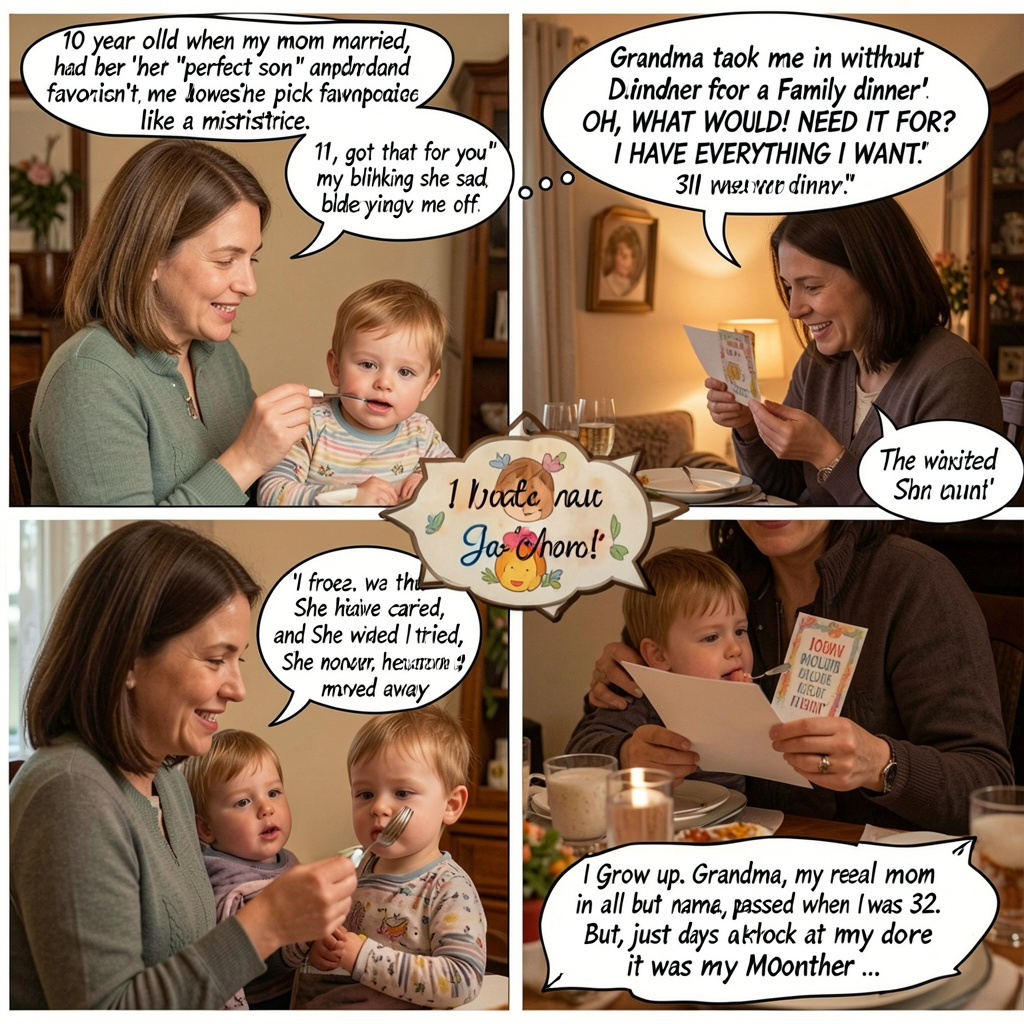
Finally, I took out the card.
“Mom?”
She looked at me.
“What?”
“I made this for you.”
She took it.
For one beautiful second, I thought she’d smile.
Instead, she handed it to Ethan.
“Here, sweetheart.”
I froze.
“I got that for you.”
She waved me off.
“Oh, what would I need it for? I have everything I want.”
The room seemed to go silent.
Grandma stopped eating.
My mother turned back to Ethan.
I don’t remember what happened after that.
I only remember putting my hands under the table so nobody could see them shaking.
That was the last time I tried.
I never made her another card.
I never called her first.
I never asked why she didn’t love me.
And, eventually, she stopped pretending to care.
When I was fourteen, she moved to another state with Daniel and Ethan.
She sent Grandma a postcard once.
I saw it on the kitchen counter.
There was a picture of Ethan standing in front of a Christmas tree.
On the back, Mom had written:
We’re doing great. Ethan loves his new school.
Nothing about me.
Nothing about Grandma.
Nothing about the daughter she’d left behind.
So I stopped waiting.
I grew up.
I graduated high school.
I went to college.
I studied architecture.
I got my first apartment.
I fell in love.
I got married.
I built a career.
And through every milestone, Grandma was there.
When I graduated, she cried harder than I did.
When I got my first promotion, she bought a cake.
When I bought my first house, she stood in the empty living room and whispered, “Look at you.”
I smiled.
“I made it.”
She shook her head.
“No, sweetheart. We made it.”
That was Grandma.
She never let me forget that she had chosen me.
Years passed.
I was thirty-two when Grandma died.
It happened quietly.
She’d been sick for a while, but she’d refused to let anyone make a fuss.
The last night I sat beside her, she squeezed my hand.
“Clara.”
“I’m here.”
“I need you to promise me something.”
“Anything.”
“Don’t let your mother’s choices become your identity.”
I swallowed hard.
“Grandma…”
“You spent too many years wondering why she didn’t love you.”
Tears filled my eyes.
“Because there must have been a reason.”
“There was.”
I looked at her.
“What?”
“She was incapable of giving you what you deserved.”
I started crying.
Grandma smiled.
“That was never your fault.”
She passed away the next morning.
I felt like someone had taken the foundation out from under my life.
For three days, I barely slept.
The funeral was small.
Neighbors came.
Friends came.
Former coworkers came.
My husband, Daniel, stayed beside me through everything.
But my mother didn’t come.
I didn’t expect her to.
Still, when the funeral ended, I found myself staring at the empty road outside the cemetery.
Part of me had hoped.
That evening, I returned home alone.
I took off my coat.
Set my keys on the table.
And sat in the darkness.
Then came the knock.
Three sharp knocks.
I frowned.
It was nearly nine at night.
I opened the door.
And forgot how to breathe.
My mother stood there.
She looked older.
Much older.
Her hair was almost completely gray.
Her eyes were swollen.
She was holding a black handbag in one hand.
“Clara.”
I didn’t answer.
She stared at me.
For a moment, neither of us moved.
Then she whispered,
“Can I come in?”
I should have said no.
Instead, I stepped aside.
She walked into the house.
Her eyes moved around the living room.
There were photographs everywhere.
Me and Grandma.
Me graduating.
Me getting married.
Me standing beside my first house.
Grandma holding my niece.
My mother stared at the photographs.
“She really raised you.”
“Yes.”
My voice was cold.
“She was my mother.”
My mother’s face tightened.
“Clara…”
“What do you want?”
She sat down.
I remained standing.
“I came because of the will.”
I almost laughed.
Of course.
Even after all these years.
Money.
That was the reason she had finally come.
“How much did she leave you?”
My mother looked at me.
“Everything.”
I frowned.
“What?”
“Everything.”
She opened her handbag and removed an envelope.
“I was named in the will.”
I stared at it.
“Why?”
“I don’t know.”
“Did Grandma ever tell you?”
“No.”
“Did you ask her?”
“I was afraid to.”
I looked away.
My mother continued.
“There was a letter.”
She handed it to me.
My hands trembled as I opened it.
The handwriting was unmistakable.
My dear Clara,
I stopped reading.
Tears blurred the page.
If you’re reading this, I’ve already left you.
I pressed my lips together.
There are things I never told you because I wanted you to grow up without carrying my burdens.
I looked at Mom.
She was crying silently.
I kept reading.
Your mother will probably come to you after my death. She may tell you she wants money. She may tell you she wants forgiveness. She may tell you she has changed.
My eyes lifted.
Mom looked down.
Listen to what she says. But judge her by what she does.
I swallowed.
Then I read the next line.
I am leaving my estate to you, Clara.
My heart stopped.
I looked at my mother.
She whispered, “She left you the house, the investment accounts, everything.”
“Why?”
“Because she knew you were the only person who loved her without asking what she could give you.”
I continued.
The estate was worth nearly $2.4 million.
The house.
The investments.
Her savings.
A small rental property.
Everything.
But there was another paragraph.
There is one final thing I need you to know.
My breathing became shallow.
Your mother did not give you away because Ethan was better than you.
I looked at Mom.
She was crying now.
She gave you away because she was afraid.
I frowned.
Your mother was struggling after your father’s departure. She was angry, depressed, and convinced she had failed at motherhood. When Ethan was born, she became obsessed with creating a “perfect family.” She thought if she could make everything perfect, she could erase what had happened before.
I stared at the page.
She told me once that looking at you reminded her of the life she had failed to save.
My mother covered her face.
I couldn’t speak.
That does not excuse what she did.
I read that sentence twice.
Nothing excuses abandoning a child.
My mother whispered,
“She’s right.”
I looked at her.
She wiped her eyes.
“I was sick,” she said. “But I was also selfish.”
I didn’t answer.
“I thought if I started over, I could become someone else.”
She laughed bitterly.
“And Ethan was the child who belonged to that new life.”
My chest tightened.
“What about me?”
She looked directly at me.
“You belonged to the life I was trying to erase.”
I stared at her.
For the first time in twenty-two years, she wasn’t pretending.
“I hated myself every time I looked at you,” she whispered.
“Not because I hated you.”
She paused.
“Because I knew I had failed you.”
I sat down.
She continued.
“I convinced myself you were better off with your grandmother.”
“You were.”
The words came out before I could stop them.
She flinched.
“I know.”
Silence filled the room.
Then she said,
“I didn’t come here for the inheritance.”
I almost smiled.
“Really?”
“No.”
She looked at the floor.
“I came because Ethan is gone.”
My heart sank.
“What happened?”
“He left.”
“Why?”
She hesitated.
“Because he found out.”
“Found out what?”
“About you.”
I stared at her.
“What did he find out?”
“Everything.”
She explained that Ethan, now twenty-one, had recently discovered that Grandma had been financially supporting me and that my mother had abandoned me as a child.
He confronted her.
He asked why she had never told him he had a sister.
She couldn’t answer.
“He told me I was a terrible mother,” she said.
I looked away.
“He was right.”
“What does he want?”
“He doesn’t want to speak to me.”
I didn’t know what to say.
My mother pulled another envelope from her bag.
“Ethan left this for you.”
My hands went cold.
“Me?”
She nodded.
I opened it.
Inside was a single page.
Clara,
I don’t know if you want to hear from me.
I don’t blame you if you don’t.
I grew up believing I was Mom’s whole world.
I thought she was just a good mother.
Then I learned she had another child.
You.
I found the photographs.
I saw your school pictures.
I saw the cards you made her.
I asked Mom why she never told me.
She said she was ashamed.
I asked what she did to you.
She wouldn’t answer.
I think I know.
I’m sorry.
I didn’t ask to be the favorite.
And you didn’t deserve to be forgotten.
I hope someday I can meet you.
Not as Mom’s son.
Just as your brother.
I couldn’t see the words anymore.
I was crying.
My mother sat across from me.
“I wanted to bring you this myself,” she said.
“Why didn’t Ethan come?”
“He’s ashamed.”
I laughed through my tears.
“He’s not the one who should be ashamed.”
“No.”
She looked at me.
“I am.”
The room became quiet again.
Then my mother said something I never expected.
“You don’t have to forgive me.”
I looked at her.
“You don’t owe me that.”
My eyes burned.
“Then why are you here?”
She took a deep breath.
“Because I spent twenty-two years waiting for you to understand why I abandoned you.”
She paused.
“And then I realized I was asking the wrong person to carry my guilt.”
She stood.
“I came to tell you I’m sorry.”
I looked at her.
“Sorry doesn’t change anything.”
“I know.”
“You missed everything.”
“I know.”
“My first day of high school.”
“I know.”
“My graduation.”
“I know.”
“My wedding.”
“I know.”
“Grandma’s funeral.”
Her face collapsed.
“I know.”
I stood too.
“Do you know what hurt the most?”
She nodded.
“I kept waiting for you.”
Tears rolled down her cheeks.
“Every birthday.”
She covered her mouth.
“Every Christmas.”
Her shoulders shook.
“I kept thinking maybe this would be the year you called.”
She whispered,
“I’m sorry.”
“I wanted you to choose me.”
She closed her eyes.
“And I didn’t.”
“No.”
She looked at me.
“But Grandma did.”
My mother nodded.
“She did.”
“Every single day.”
“I know.”
I looked at the letter on the table.
“She told me love doesn’t pick favorites.”
My mother began crying harder.
“I know.”
I took a breath.
“Maybe that’s what you never understood.”
She looked at me.
“Love isn’t about choosing the child who makes you feel successful.”
I pointed toward the photographs.
“Love is showing up.”
She nodded.
“Love is staying.”
Another nod.
“Love is making sure your child never has to wonder if she matters.”
My mother whispered,
“You mattered.”
I looked directly into her eyes.
“I know that now.”
She seemed surprised.
“Grandma taught me.”
She smiled sadly.
Then I asked,
“Do you want the money?”
She shook her head.
“No.”
I studied her face.
“What do you want?”
She took a long breath.
“A chance.”
“For what?”
“To know you.”
I didn’t answer immediately.
Because that was the hardest question.
Part of me wanted to slam the door.
Another part of me wanted to ask her why she hadn’t come sooner.
And somewhere deep inside, there was still the little ten-year-old girl holding a handmade card.
That girl still wanted her mother.
But I wasn’t ten anymore.
I wasn’t helpless.
I didn’t need my mother’s love to know my worth.
Finally, I said,
“I can’t be your daughter overnight.”
“I understand.”
“I can’t pretend none of this happened.”
“I know.”
“And I won’t let you use Grandma’s money to buy forgiveness.”
My mother nodded.
“I wouldn’t.”
“Good.”
I picked up Ethan’s letter.
“I want to meet him.”
My mother looked shocked.
“You do?”
“He’s my brother.”
She started crying again.
“I’ll tell him.”
I nodded.
“And Mom?”
She looked at me.
“You can come back.”
Her face changed.
“But only if you’re willing to come without expectations.”
She nodded quickly.
“I am.”
“And if you ever disappear again…”
“I won’t.”
“You don’t know that.”
She looked at me for a long moment.
“No.”
She smiled sadly.
“But I know one thing now.”
“What?”
“I don’t want to spend the rest of my life being the woman who lost her daughter.”
I didn’t hug her.
Not that night.
I wasn’t ready.
But I walked her to the door.
Before she left, she turned around.
“Clara?”
“Yes?”
“I still have something.”
She reached into her purse.
My breath caught.
She pulled out a small, faded piece of colored paper.
The edges were worn.
The handwriting was unmistakable.
It was my card.
The one I’d made when I was eleven.
The one she’d handed to Ethan.
I stared at it.
“You kept it?”
She nodded.
“All these years.”
“Why?”
She swallowed.
“Because after you left the table that night, I found it in Ethan’s room.”
She looked down.
“I wanted to throw it away.”
My heart tightened.
“But I couldn’t.”
She held it out.
“I’ve carried it ever since.”
I took it.
On the front were my childish flowers.
Inside were three words.
I love you, Mom.
My vision blurred.
“I should have told you,” she whispered.
I couldn’t speak.
She stepped outside.
“Goodnight, Clara.”
I looked at the card.
Then at her.
“Goodnight, Mom.”
She froze.
It was the first time I’d called her that in twenty-one years.
She didn’t turn around.
She simply stood there, crying.
Then she walked away.
Three weeks later, I met Ethan.
He was tall, nervous, and painfully familiar.
The moment he saw me, he smiled.
“I’m sorry,” he said.
I laughed softly.
“You don’t have to apologize for being born.”
He looked down.
“I know.”
We sat together for two hours.
He told me about his childhood.
I told him about mine.
We discovered we both hated raisins.
We both loved old movies.
We both laughed when nervous.
And we both had the same habit of tapping our fingers when thinking.
At one point, Ethan looked at me.
“Do you think we can be siblings?”
I smiled.
“I think we already are.”
He hugged me.
And for the first time in my life, I understood something.
My mother’s rejection had once convinced me that I was the child who wasn’t chosen.
But Grandma had taught me the truth.
Being rejected by someone doesn’t make you unworthy of love.
Sometimes the family that saves you isn’t the family that gave you your name.
Sometimes a grandmother becomes your mother.
Sometimes a stranger becomes your brother.
Sometimes the person who hurt you comes back too late.
And sometimes, forgiveness doesn’t mean forgetting.
It means deciding that the person who hurt you doesn’t get to control the rest of your life.
A year after Grandma died, I moved into her house permanently.
I kept her kitchen exactly the way she had left it.
Her favorite mug still sat beside the sink.
Her gardening gloves still hung by the back door.
And on the wall in the hallway, I framed the old handmade card.
Not because I wanted to remember my mother’s rejection.
But because I wanted to remember the girl who made it.
The girl who still believed love could be given freely.
The girl who didn’t understand why her mother didn’t want her.
The girl who survived anyway.
One evening, my mother came over for dinner.
She brought dessert.
Ethan brought flowers.
We sat around Grandma’s old table.
For a moment, I looked at the empty chair where Grandma used to sit.
I wished she could see us.
I wished she could see what she’d created from the broken pieces of my childhood.
My mother noticed me staring.
“She would be proud of you,” she said.
I smiled.
“She already was.”
Mom nodded.
Then she reached across the table.
Her hand stopped halfway.
She didn’t touch mine.
She waited.
I looked at her hand.
Then, slowly, I placed mine on top of it.
Her fingers closed around mine.
It wasn’t a magical moment.
Nothing was erased.
The years were still gone.
The birthdays were still missed.
The childhood I deserved could never be returned.
But for the first time, my mother wasn’t trying to rewrite the past.
She was simply sitting beside me in the present.
And somehow, that was enough.
Because Grandma had been right all along.
Love doesn’t pick favorites.
People do.
Love stays.
People leave.
Love shows up.
People make excuses.
And sometimes, the greatest victory isn’t making the person who hurt you regret losing you.
It’s growing into someone who no longer needs them to regret it.
I spent years wondering why my mother hadn’t chosen me.
Now I know the answer.
She didn’t choose me because she wasn’t capable of choosing anyone correctly.
But Grandma did.
She chose me every morning.
Every birthday.
Every Christmas.
Every heartbreak.
Every victory.
She chose me until I learned to choose myself.
And that, more than any inheritance, was the greatest thing she ever left me.
Years later, when people asked about my family, I stopped explaining the complicated parts.
I simply smiled and said:
“I was raised by a woman who taught me that love doesn’t pick favorites.”
Then I’d glance at the old card hanging on my wall.
And sometimes, when nobody was watching, I’d whisper:
“Thank you, Grandma.”
Because she had rescued a ten-year-old girl from believing she was a mistake.
And she had spent the rest of her life proving that she never was.