The Rusted Chevy
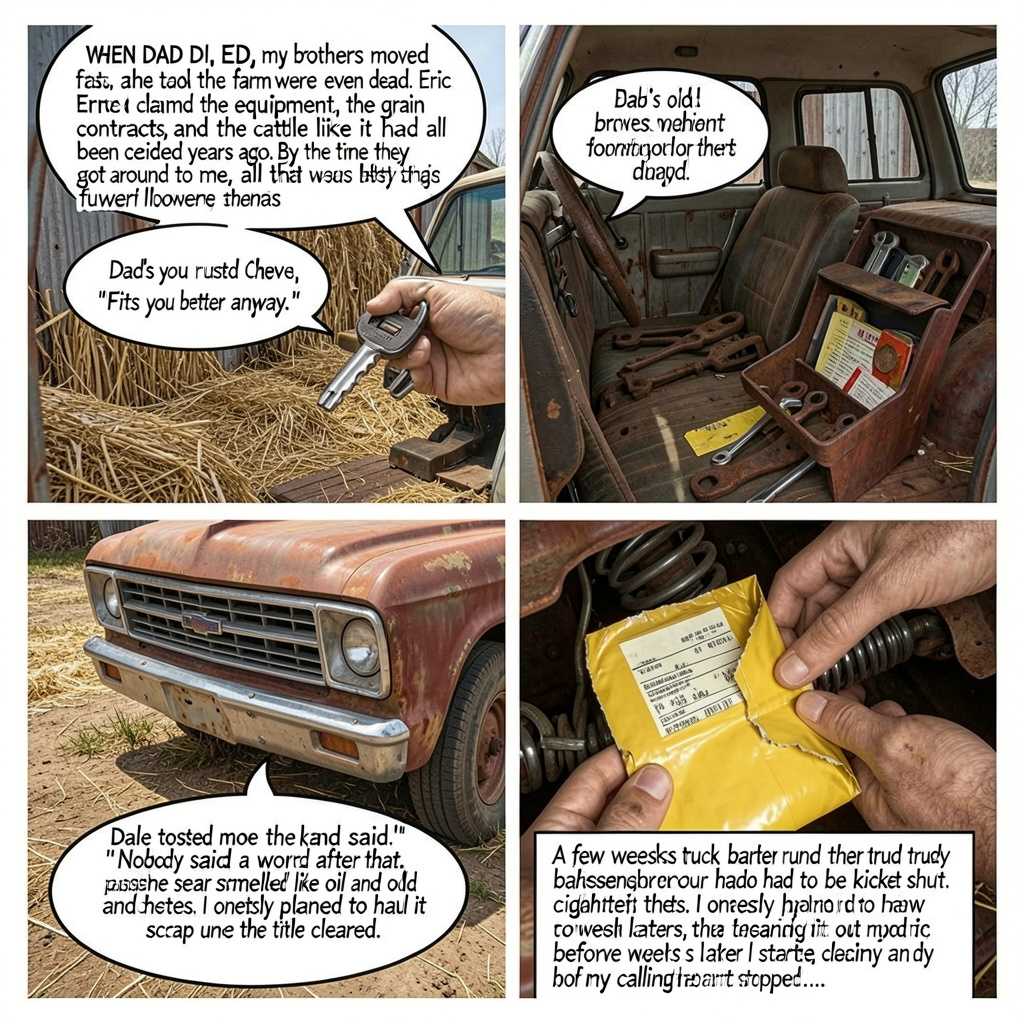
When Dad died, my brothers moved fast.Dale took the farm before the funeral flowers were even dead.Eric claimed the equipment, the grain contracts, and the cattle like it had all been decided years ago.
By the time they got around to me, all that was left was Dad’s old rusted Chevy sitting behind the barn.
Dale tossed me the keys.
“Fits you better anyway.”
Nobody said a word after that.The truck barely ran. The passenger door had to be kicked shut, the driver’s window was stuck halfway down, and the seat smelled like oil and old cigarettes.
I honestly planned to haul it for scrap once the title cleared.
Dad would have hated that.
He loved that truck.
He bought it when I was twelve, back when the paint was still dark blue and the engine didn’t sound like a bucket of bolts being thrown down a staircase.I remembered sitting beside him on the bench seat, my knees barely reaching the dashboard, while he drove us into town for feed.
He always kept one hand on the wheel and the other resting near the gearshift.“Listen to her,” he’d say whenever the engine coughed.“She’ll tell you what she needs.”
I used to laugh.“A truck can’t talk, Dad.”He’d smile.
“You’d be surprised what old things can say when you bother listening.”
Three weeks after his funeral, I finally decided to clean it out.The farm had already been divided in practice, even though the lawyers were still sorting through paperwork.Dale lived in the farmhouse now.
Eric had the machinery shed packed with tractors and combines.
And I had a Chevy nobody wanted.
I parked the truck behind my little rental house and started pulling things from the cab.
Feed receipts.
Old gloves.
A cracked flashlight.
Three rusted wrenches.
A coffee thermos that still smelled faintly like black coffee.
Then I reached beneath the driver’s seat.
My fingers brushed something.
I frowned.
The truck had a torn seat cushion, and beneath it was a mess of metal springs.
I reached deeper.
Something was taped against the underside.
My heart gave a strange little jump.
I pulled it loose.
It was a yellow envelope wrapped tightly in several layers of duct tape.
My name was written across the front.
MARTHA.
Dad’s handwriting.
I stared at it for almost a full minute.
Then I tore one side open.
There was a key inside.
Not a car key.
A small brass key.
And beneath it was a folded piece of paper.
My hands started shaking before I even opened it.
The note was only four lines.
Martha,
If you’re reading this, your brothers have probably already taken everything they think is theirs.
Don’t trust what they tell you.
The truth is under the old grain office.
I read it twice.
Then a third time.
Under the old grain office?
I sat down in the truck.
The engine was silent.
The house was silent.
Even the wind seemed to disappear.
Dad had died suddenly.
At least, that’s what we’d been told.
A heart attack.
He’d been sixty-eight years old and had complained about chest pain that morning, but he refused to go to the hospital.
Dale said Dad had been stubborn.
Eric said Dad had known his time was coming.
And I had believed them.
Because grief makes you stupid.
It makes you accept explanations simply because you’re too tired to fight them.
But now I was looking at my father’s handwriting.
And he had left me a warning.
I grabbed my coat and drove back to the farm.
The old grain office sat behind the main barn, a building Dad had stopped using years ago.
The door was swollen from decades of weather.
I tried the brass key.
It fit.
The lock clicked.
Inside, the air smelled like dust, grain, and old wood.
Sunlight came through cracks in the boards.
I pulled out my phone and turned on the flashlight.
There wasn’t much.
A broken desk.
A filing cabinet.
Old seed catalogs.
A scale.
I searched beneath the desk.
Nothing.
Behind the filing cabinet.
Nothing.
Then I remembered Dad’s note.
Under the old grain office.
Not inside.
Under.
I stepped outside.
The building sat on an old concrete foundation.
I walked around the back.
Near the corner, one section of ground looked slightly different.
I knelt.
There was a metal ring almost buried beneath the dirt.
My stomach tightened.
I pulled.
A square section of wooden flooring lifted.
Beneath it was a narrow concrete stairwell.
I stared into the darkness.
Then I laughed nervously.
“Dad,” I whispered.
“What did you get yourself into?”
I climbed down.
At the bottom was a steel door.
The brass key fit that lock too.
When I opened it, I found a room.
Not a cellar.
An office.
A real office.
There was a desk, two filing cabinets, a safe, and shelves stacked with binders.
On the wall hung an old framed photograph of Dad standing beside the farm’s first grain elevator.
I walked toward the desk.
There was another envelope.
This one said:
FOR MARTHA ONLY.
I opened it.
Inside was a letter.
Sweetheart,
If you found this room, then I didn’t get the chance to tell you myself.
Your brothers believe the farm belongs to them.
It doesn’t.
I stopped breathing.
I kept reading.
Dad explained that twenty-two years earlier, when the farm nearly went bankrupt, he had placed the property into a family trust.
The trust named all three children as beneficiaries.
But there was a condition.
The farm could not be sold or divided without unanimous consent.
Dale couldn’t simply take it.
Eric couldn’t simply take the equipment.
And neither of them had authority over the grain contracts.
I stared at the papers.
There was more.
Dad had created a separate company for the farm’s commercial operations.
The cattle.
The grain.
The equipment.
The contracts.
Everything.
And I was the managing beneficiary.
Not Dale.
Not Eric.
Me.
I actually laughed.
Then I cried.
Then I laughed again.
It wasn’t because I wanted revenge.
It was because Dad had known.
He had known exactly how my brothers would behave.
And he’d apparently spent years preparing for it.
At the bottom of the letter, he had written:
I didn’t choose you because you’re the strongest.
I chose you because you never needed to prove you were.
I pressed the paper against my chest.
That was Dad.
He never said things directly if he could hide them inside a story, a lesson, or a piece of advice.
I found another folder.
Inside were bank statements.
Farm valuations.
Tax records.
Legal documents.
And something else.
A recording.
A small digital recorder sat inside a box.
I pressed play.
Dad’s voice filled the room.
“If you’re hearing this, I’m gone.”
I closed my eyes.
His voice sounded tired.
But steady.
“I want you to know something before your brothers tell you their version of events.”
There was a pause.
“I didn’t leave Martha the truck because she was worth less.”
My throat tightened.
“I left her the truck because I knew she’d look inside it.”
I covered my mouth.
Dad chuckled softly on the recording.
“She always was the curious one.”
Then his voice became serious.
“Dale and Eric have been pressuring me for years to sell parts of the farm. They’ve accumulated debts. Bad investments. Gambling, in Dale’s case. Eric has been borrowing against equipment he doesn’t own.”
I froze.
Suddenly, things made sense.
Dale hadn’t taken the farm because he was confident.
He’d taken it because he was desperate.
Eric hadn’t claimed the equipment because he was entitled to it.
He needed collateral.
Dad continued.
“I refused.”
Another pause.
“They don’t know about the trust. They think the old will is controlling everything.”
I looked at the folder.
The old will.
I remembered the funeral.
Dale standing beside the lawyer.
Eric telling everyone Dad had “made his wishes clear.”
Apparently, those wishes weren’t what they thought.
Dad’s recording continued.
“I also need you to know that I wasn’t completely honest with you either.”
I stopped.
“What?”
His voice softened.
“Martha, your mother didn’t leave because she stopped loving us.”
My entire body went cold.
Mom had died when I was nineteen.
But Dad had always told us she’d left because she wanted a different life.
He’d said she couldn’t handle farm life.
He’d said she abandoned us.
I had believed him.
My whole life.
The recording continued.
“Your mother discovered what Dale had been doing with the farm accounts.”
I stared at the wall.
“Dale was seventeen.”
I whispered the words.
Seventeen.
Dad explained that years earlier, Dale had stolen money from a farm account to pay gambling debts.
Mom had found out.
She wanted Dad to send him away.
Dad refused.
They fought.
And Mom left.
Not because she didn’t love us.
Because she couldn’t forgive Dad for protecting Dale.
My knees weakened.
I sat in Dad’s chair.
For decades, I’d carried the belief that my mother had abandoned us.
And now, in the basement beneath an old grain office, my father was telling me that the story I’d lived with was a lie.
But the recording wasn’t finished.
“There is one more thing.”
I leaned closer.
“If your brothers have already divided the farm between themselves, don’t confront them immediately.”
I frowned.
“Why?”
Dad answered my question as though he were sitting beside me.
“Because I want you to let them believe they’ve won.”
I stared at the recorder.
Then I understood.
Dad had anticipated everything.
He knew Dale would grab the land.
He knew Eric would grab the equipment.
He knew they would laugh at me when they gave me the truck.
And he knew I’d eventually discover the truth.
There was a final folder.
Inside was a list of debts.
Dale owed nearly $400,000.
Eric owed more than $250,000.
Both had used the farm’s assets as collateral without Dad’s permission.
If the lenders discovered the truth, the consequences would be severe.
I drove home that night without telling anyone.
For three days, I said nothing.
Dale called me.
“Hey, Martha. You still got that junk truck?”
“Yes.”
“You planning on fixing it?”
“No.”
“Good. I might need some parts.”
I smiled.
“Take whatever you want.”
He laughed.
“That’s why you’re my favorite sister.”
I hung up.
The next morning, I hired an attorney.
Her name was Rebecca Sloan.
She was recommended by Dad’s old accountant.
I showed her everything.
She read silently for almost an hour.
Then she looked at me.
“Your father was very thorough.”
“So the trust is real?”
“Yes.”
“And the farm belongs to all three of us?”
“Technically, yes. But you’re the controlling trustee.”
I swallowed.
“What happens to Dale and Eric?”
“That depends on what they’ve done.”
She opened the financial records.
“And judging by this, they’ve done quite a lot.”
Over the next two weeks, Rebecca uncovered more.
Dale had already signed a preliminary agreement to sell a section of the farm to a developer.
Eric had negotiated the sale of several pieces of equipment.
Both deals were illegal.
Both men had forged documents.
And worse, they’d lied to the bank.
They had been planning to use the farm to erase their personal debts.
My brothers weren’t dividing Dad’s inheritance.
They were dismantling it.
I could have stopped them immediately.
But I remembered Dad’s words.
Let them believe they’ve won.
So I waited.
The confrontation happened at the farm on a cold Saturday morning.
Dale called a family meeting.
Eric was there.
So were several cousins.
Dale stood in the kitchen with a stack of papers.
“We need everyone to understand what’s happening.”
I sat quietly.
He smiled at me.
“Martha, Dad left the farm to us boys.”
I raised an eyebrow.
“Did he?”
Eric jumped in.
“Don’t start.”
“I haven’t started anything.”
Dale pushed a paper across the table.
“This is the old will.”
I looked at it.
It was genuine.
But incomplete.
Rebecca had already explained that it had been superseded by the trust.
Dale pointed to it.
“This proves Dad wanted Eric and me to run the farm.”
I looked around the room.
Everyone was watching.
Then I reached into my bag.
I placed Dad’s trust agreement on the table.
Nobody spoke.
Dale’s face changed.
Eric stared at the pages.
“What is that?”
“Dad’s actual estate plan.”
Dale picked it up.
His hands began to shake.
“No.”
I said nothing.
He flipped through the pages.
“No.”
Eric grabbed it from him.
“Where did you get this?”
I looked at both of them.
“From Dad.”
“How?”
“The truck.”
Silence.
The entire room seemed to freeze.
Dale’s eyes narrowed.
“That piece of junk?”
I smiled.
“The piece of junk you gave me.”
Eric slammed the papers down.
“This isn’t real.”
“It is.”
“You forged this.”
Rebecca stepped forward.
“I wouldn’t recommend making that accusation.”
Eric looked at her.
“Who the hell are you?”
“Rebecca Sloan. Estate counsel.”
Dale’s face went pale.
“You hired a lawyer?”
“No,” I said.
“Dad did.”
That sentence destroyed them.
Because suddenly they understood.
Dad had prepared for this.
Every move they’d made had been anticipated.
The forged sale agreement.
The equipment transfers.
The bank loans.
Everything.
Rebecca laid out the evidence.
Dale had illegally attempted to sell land he didn’t own.
Eric had attempted to sell equipment held by the trust.
And both had concealed debts.
The cousins slowly backed away from the table.
Nobody wanted to be associated with them.
Dale looked at me.
“You’re doing this to us?”
I shook my head.
“No.”
“Then what is this?”
“Dad’s doing.”
He laughed bitterly.
“He always favored you.”
I looked at him.
“No, Dale.”
My voice was quiet.
“He trusted me.”
That hurt him more than shouting ever could.
He stared at me for several seconds.
Then he asked the question I knew was coming.
“What are you going to do?”
I looked down at Dad’s documents.
“I could have you arrested.”
Eric swallowed.
“You wouldn’t.”
“I could.”
“But I won’t.”
They both stared at me.
I continued.
“You’re going to repay what you stole. You’re going to withdraw every fraudulent agreement. You’re going to sign the farm back into proper management. And you’re going to stop treating Dad’s property like your personal bank account.”
Dale’s jaw tightened.
“And if we don’t?”
“Then Rebecca sends everything to the authorities.”
No one moved.
Finally, Eric whispered:
“You really changed.”
I looked at him.
“No.”
I shook my head.
“I finally stopped letting you decide what I was worth.”
That was the end of the meeting.
It took months to untangle everything.
Dale had to sell his house and several personal assets to repay his debts.
Eric lost two trucks he’d bought using borrowed money.
The developer withdrew from the land deal.
The bank discovered the fraud.
And the farm stayed intact.
But something else happened during those months.
I found Mom’s letters.
They were in another box beneath the floor.
Dad had kept them all.
There were twenty-three.
She’d written to him over the years.
Some were angry.
Some were sad.
Some were about us.
She had never stopped loving her children.
In one letter, she wrote:
Tell Martha she was always my brave one.
I pressed the letter against my face.
For the first time in forty-nine years, I knew my mother hadn’t abandoned me.
She had been kept away.
And Dad had carried that guilt until his final day.
The last letter was dated only six months before his death.
Mom had died years earlier, but apparently Dad had found it among her belongings and never opened it until late in his life.
The letter said:
If we fail as parents, promise me one thing.
Don’t let our mistakes become our children’s inheritance.
Dad had underlined that sentence.
I understood then why he had built the trust.
Why he had hidden the documents.
Why he’d left me the truck.
It wasn’t about property.
It was about breaking a cycle.
One evening, almost a year after Dad’s funeral, I drove the old Chevy back to the farm.
Dale was repairing a fence.
Eric was working in the equipment shed.
Neither spoke when I pulled up.
I got out.
Dale glanced at the truck.
“You still have that thing?”
I smiled.
“Yep.”
“Thought you were going to scrap it.”
“I changed my mind.”
He looked at me.
“Why?”
I ran my hand along the faded blue hood.
“Because Dad was right.”
“About what?”
“Old things have something to say if you bother listening.”
Dale looked away.
For a moment, neither of us spoke.
Then he said quietly:
“I was wrong.”
I looked at him.
He swallowed.
“About the farm. About you.”
Eric stepped out of the shed.
He stood beside his brother.
“I was wrong too.”
I didn’t forgive them immediately.
Forgiveness isn’t a light switch.
You don’t flip it because someone finally says the words you wanted to hear.
But I allowed the possibility.
Because Dad hadn’t left me the truck so I could punish my brothers.
He’d left it so I could find the truth.
The farm eventually became profitable again.
I rebuilt the old grain office.
I turned the hidden room into a small archive.
Dad’s papers went there.
Mom’s letters too.
And above the desk, I hung a photograph of Dad beside the old Chevy.
Every year, on the anniversary of his death, I drove that truck to the hill overlooking the fields.
I’d park beneath the cottonwood tree.
Then I’d sit on the hood and watch the sunset.
One year, Dale joined me.
He stood beside the truck.
“You know,” he said, “Dad always said that truck would outlive all of us.”
I laughed.
“He wasn’t wrong.”
Dale smiled.
Then he looked across the fields.
“I used to think getting the farm was winning.”
“What do you think now?”
He took a long breath.
“I think I missed the point.”
I looked at him.
“What was the point?”
He nodded toward the fields.
“Taking care of what you’re given.”
I smiled.
That sounded like Dad.
A few months later, I restored the truck.
Not completely.
I kept the dents.
The scratches.
The cracked dashboard.
Even the cigarette burn on the driver’s seat.
I wanted it exactly as it had been when Dad left it to me.
Because every mark told a story.
And beneath the seat, I kept a copy of his letter.
The original stayed in the archive.
Sometimes people ask why I didn’t sell the truck.
They see the rust.
They see the faded paint.
They see an old machine that should have been thrown away years ago.
I just smile.
Because they don’t know what I know.
The most valuable thing my father ever left me wasn’t the farm.
It wasn’t the cattle.
It wasn’t the grain contracts.
It wasn’t the money.
It was the truth.
And he hid that truth inside the one thing my brothers were certain wasn’t worth having.
An old rusted Chevy.
The very thing they gave me because they thought I deserved less.
They were wrong.
It was the greatest inheritance I ever received.
Because when everyone else was fighting over what Dad owned, that old truck led me to discover what Dad wanted me to understand.
Family isn’t about who gets the biggest piece.
It’s about who is willing to protect what matters after the person who built it is gone.
And sometimes the thing everyone else throws away is the one thing that saves you.
Dad knew that.
He knew me.
And on quiet evenings, when the old Chevy’s engine hums beneath me and the fields stretch golden toward the horizon, I can almost hear his voice beside me.
Listen to her.
She’ll tell you what she needs.
So I listen.
And somehow, after all these years, the old truck still has something to say.:::