The Boy from Route 6
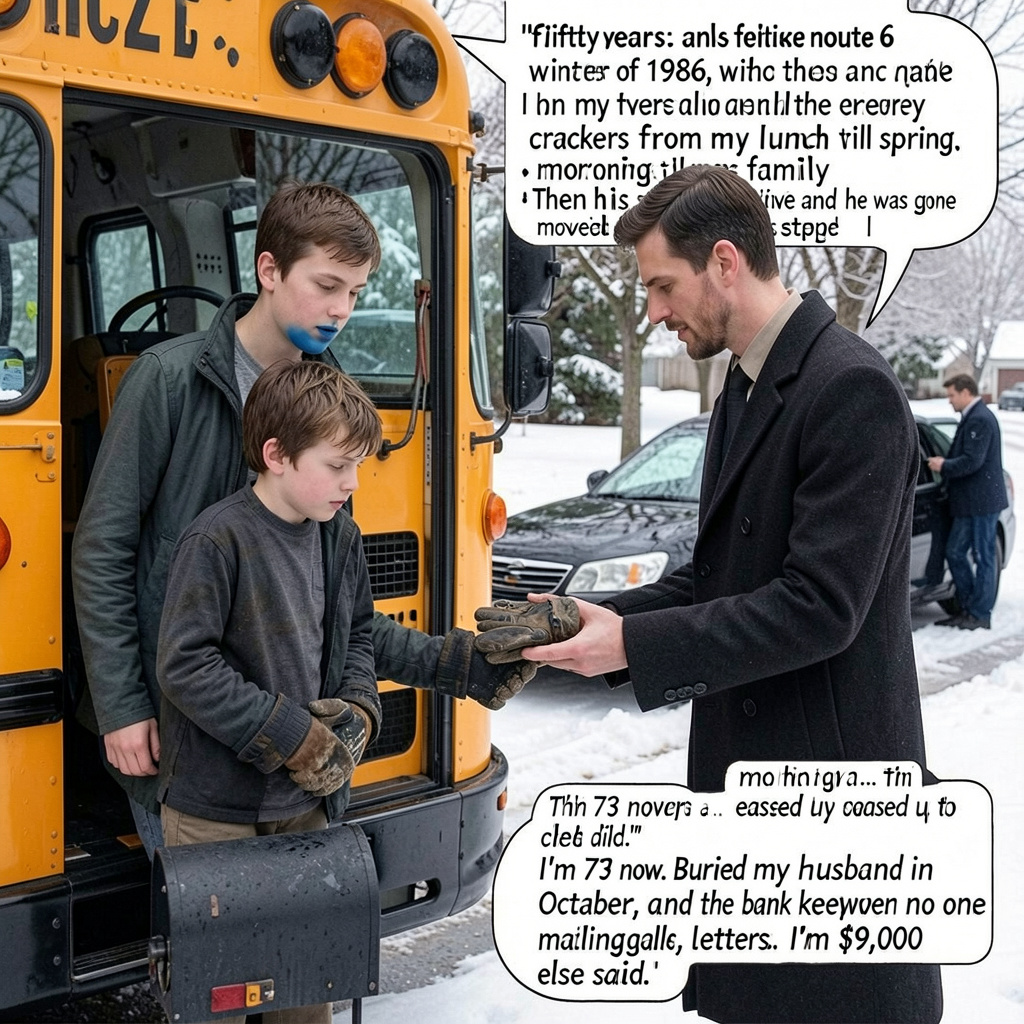
The first thing I noticed was the boy’s lips.They were blue.Not purple from candy or blue from a marker, but the frightening blue of someone who had been standing in the cold for too long.
It was January 1986, and I had been driving School Bus Route 6 for almost ten years.
That morning, the temperature had dropped below zero before sunrise
. Snow covered the roads, and the wind pushed little white clouds of powder across the pavement.
I remember gripping the steering wheel with both hands because the metal felt like ice even through my gloves.At 6:42 a.m., I pulled up to the corner of Maple and Third.Usually, three children climbed aboard there.
That morning, only one did.He was maybe six years old.Thin.Much too thin.He climbed the steps slowly, holding one hand against his chest.
He had no coat.Just a faded blue shirt.No hat.
No scarf.No gloves.His sneakers were soaked through with snow.
I stared at him.”Where’s your coat, sweetheart?”He shrugged.”Don’t have one.”I looked behind him.The street was empty.”Where’s your mom?”Another shrug.I knew I was supposed to stay on schedule.
I knew I couldn’t simply leave children waiting because I was worried about one child.
But rules have never been much good at telling you what to do when a little boy is standing in front of you with blue lips.
“Come on,” I said softly. “Sit up front.”
He looked at me cautiously.
“Am I in trouble?”
“No.”
“Then why?”
“Because it’s warmer up here.”
He climbed into the seat directly behind me.
I turned the heater toward him as far as it would go.
Then I took off my spare gloves.
They were old and stretched at the fingers, but they were warm.
I handed them to him.
“Put these on.”
He hesitated.
“Those are yours.”
“I have another pair.”
It wasn’t true.
But he didn’t need to know that.
He put them on.
They swallowed his little hands.
I handed him the crackers from my lunch.
“Eat.”
He stared at them.
“I can’t.”
“Why not?”
“Mom says we don’t take food from people.”
I looked at him in the mirror.
“Tell your mom I made you.”
For the first time, he smiled.
It was a tiny smile.
But I saw it.
And I never forgot it.
His name was Daniel.
Daniel Carter.
For the next three months, he became part of my morning routine.
Every day, he waited at Maple and Third.
Every day, he wore the same thin blue shirt.
And every day, I put the heater on him before I pulled away.
I began keeping crackers in the bus.
Then granola bars.
Then apples.
Sometimes a peanut butter sandwich.
I never asked questions.
Children have a way of telling you things when you don’t make them feel like they’re being questioned.
Daniel told me his favorite subject was science.
He told me he wanted to be an astronaut.
He told me his mother worked nights.
He told me his father “wasn’t around anymore.”
Once, in February, he fell asleep in the front seat.
His head leaned against the window.
I watched his reflection in the mirror.
He looked peaceful.
And I remember thinking how strange it was that a child could look so tired.
One morning, I brought him a secondhand winter coat I’d found at the church.
It was too big.
The sleeves reached past his fingers.
But when I handed it to him, he stared at it as if I’d given him a treasure.
“Is this mine?”
“If it fits.”
“It fits.”
“It doesn’t even have a zipper.”
“I don’t care.”
He hugged it against his chest.
“Thank you.”
I smiled.
“You’re welcome.”
He wore it every day afterward.
Then, one morning in March, he wasn’t at the corner.
I waited.
Five minutes.
Ten.
Finally, I had to leave.
The next day, he wasn’t there.
Neither was the day after that.
I asked the school office.
“Daniel Carter? First grade?”
The secretary checked her records.
“They moved.”
“Moved where?”
She shook her head.
“Sorry. It doesn’t say.”
And that was it.
Daniel disappeared from my life.
I kept the gloves he’d worn in the first weeks, even though I had no idea why.
They were just old gloves.
But I couldn’t throw them away.
For thirty years, I drove Route 6.
Thousands of children climbed onto my bus.
Some remembered me.
Some didn’t.
Some waved when they saw me years later.
One became a teacher.
One became a police officer.
One sent me a Christmas card every year until her death.
But Daniel Carter remained the child I wondered about.
Did he stay warm?
Did he eat enough?
Did he become an astronaut?
Did he remember me?
Life kept moving.
I married my husband, Robert, in 1989.
We never had children.
Not because we didn’t want them.
It simply never happened.
So I poured my love into my students.
Robert always teased me about it.
“You’ve got three hundred kids,” he’d say.
“Three hundred and twelve.”
“You counted?”
“Of course.”
He would laugh.
Then he’d kiss my forehead.
We grew old together.
He retired first.
I drove the bus until I was sixty-eight.
When I finally turned in my keys, I cried in the parking lot.
The school district gave me a little plaque.
“Thirty years of dedicated service.”
I put it on the kitchen wall.
Robert said it belonged somewhere more important.
“Put it above the fireplace.”
So I did.
Then, last October, Robert died.
Heart attack.
Quick.
Too quick.
One minute he was complaining that the coffee was too hot.
The next minute, he was gone.
The funeral was small.
Afterward, the house became painfully quiet.
His chair remained beside the window.
His slippers were still beneath it.
His coffee mug sat in the cabinet where he’d always left it.
I couldn’t move anything.
Then the bills started arriving.
Medical expenses.
Property taxes.
Insurance.
Mortgage payments.
By spring, I was $9,000 behind on the house.
The bank sent letters.
Then more letters.
I put them into a drawer.
I didn’t open them.
I told myself I’d figure it out.
At seventy-three, I had learned that sometimes you could survive almost anything if you simply refused to look directly at it.
Then came August.
It was a cold morning for summer.
I was standing at the mailbox when I heard an engine.
I looked up.
A black car was slowly approaching my driveway.
It stopped beside the mailbox.
A tall man stepped out.
He wore a dark wool coat despite the warm weather.
He looked to be in his forties.
Maybe forty-five.
His hair was neatly trimmed.
His shoes were polished.
Everything about him looked expensive.
He walked toward me carrying something in his hand.
“Mrs. Miller?”
I froze.
Nobody had called me that in years.
“Yes?”
He stopped a few feet away.
Then he held out his hand.
In it was a pair of old children’s gloves.
Blue.
Worn.
Faded.
I stared at them.
My heart stopped.
I knew those gloves.
I had bought them at a thrift store in 1986.
I had given them to a little boy who had climbed onto my bus with blue lips.
The man’s eyes filled with tears.
“You kept me warm when no one else did.”
I couldn’t speak.
He placed the gloves gently in my palm.
“They were the first things anyone ever gave me that were mine.”
I looked at him.
“Daniel?”
He smiled.
And suddenly I could see the little boy behind the grown man’s face.
The same eyes.
The same slight tilt of his head.
I whispered his name.
“Daniel.”
He nodded.
“Hello, Mrs. Miller.”
I covered my mouth.
“Oh my God.”
He laughed softly.
“I’ve been trying to find you for years.”
I looked toward the black car.
“How?”
“That took a while.”
He reached into his coat.
“I found the old school district records.”
“You remembered my name?”
“I remembered everything.”
He looked down at the gloves.
“I remembered the crackers. The heater. The coat.”
I shook my head.
“It was nothing.”
His expression changed.
“It wasn’t nothing.”
He took a breath.
“When I was six, my mother was sick. She was working two jobs and barely keeping us alive. My father had left. We were evicted from our apartment that winter.”
I felt my chest tighten.
“I didn’t know.”
“You weren’t supposed to.”
He smiled sadly.
“She tried. She really did. But there were days when she couldn’t get out of bed.”
I looked at the gloves.
“Where did you go?”
“My mother took me to live with my aunt in another state.”
“That’s why you moved.”
“Yes.”
He paused.
“And things got worse before they got better.”
I listened silently.
“My mother died when I was eleven.”
My eyes filled.
“I’m so sorry.”
“After that, I went into foster care.”
He looked at the ground.
“I moved eight times in six years.”
I wanted to reach for him, but I didn’t know if I had the right.
Then he smiled.
“But there was one thing I carried with me.”
“The gloves?”
“The memory.”
He looked directly at me.
“You were the first adult who noticed I was cold.”
I swallowed hard.
“Daniel…”
“I know it sounds small.”
“It doesn’t.”
“It was huge to me.”
He reached into his coat again.
This time he pulled out a photograph.
It was old.
Bent at the corners.
A photograph of a school bus.
My school bus.
Route 6.
I stared at it.
“I don’t remember this.”
“I took it.”
“You had a camera?”
He smiled.
“No. Someone else did. I found the photograph years later in my mother’s things.”
He turned it over.
Written on the back were four words.
The woman who helped Daniel.
I began to cry.
He reached out and gently touched my shoulder.
“I spent years trying to find you.”
“Why?”
“Because I wanted to say thank you.”
I wiped my eyes.
“You don’t owe me anything.”
“I know.”
He smiled.
“That’s why I came.”
Then the passenger door of the black car opened.
A young woman stepped out.
She was perhaps twenty years old.
She wore a simple blue dress.
Beside her stood a little boy.
Maybe six.
He was holding a small backpack.
Daniel turned toward them.
“Come here.”
The little boy ran to him.
Daniel placed his hand on the boy’s shoulder.
“This is my son, Ethan.”
The child looked at me.
“Are you the bus lady?”
I laughed through my tears.
“I used to be.”
Daniel smiled.
“I told him about you.”
The boy looked at the gloves in my hand.
“Those are old.”
“Very old.”
He nodded seriously.
Then he asked, “Did you know my dad when he was little?”
“Yes.”
“Was he naughty?”
Daniel groaned.
I laughed.
“Sometimes.”
“Hey!”
Daniel shook his head.
“See? Thirty-five years later and she’s still telling stories about me.”
For the first time since Robert died, I laughed so hard my stomach hurt.
Then Daniel looked toward my house.
His expression became serious.
“Mrs. Miller, I need to ask you something.”
“Anything.”
“How are you doing?”
I smiled automatically.
“I’m fine.”
He looked at me.
He knew.
“You don’t have to pretend.”
My smile disappeared.
“I’ve been better.”
He nodded.
“I heard about your husband.”
“How?”
“I asked around.”
I looked down.
“The house…”
“Yes?”
“I’m behind.”
He waited.
I sighed.
“Nine thousand dollars.”
He didn’t react.
Not even a blink.
“I can pay it.”
“No.”
“Mrs. Miller—”
“No.”
“I haven’t even told you what I mean.”
“I know.”
He smiled.
“I’d like to pay the nine thousand.”
“I can’t accept that.”
“Why?”
“Because I gave you crackers thirty years ago?”
“Because you gave me something worth much more than crackers.”
I shook my head.
“I don’t want charity.”
“It’s not charity.”
“What is it?”
He looked toward Ethan.
“It’s an investment.”
I frowned.
“In what?”
Daniel smiled.
“In the woman who taught me that kindness doesn’t have to be earned.”
I didn’t know what to say.
He continued.
“I started my first company at twenty-eight. Technology. We grew quickly. Then I sold it.”
“You’re wealthy.”
“Comfortable.”
“Daniel.”
“Very comfortable.”
I laughed.
“That sounds like something a rich man says.”
He laughed too.
Then he became serious.
“I built my entire life believing I had to become strong enough that no one could ever make me feel helpless again.”
He looked at the gloves.
“But whenever things went wrong, I remembered sitting on that bus.”
His voice softened.
“You didn’t ask what my mother had done wrong. You didn’t ask why I didn’t have a coat. You didn’t make me feel ashamed.”
He swallowed.
“You just turned on the heater.”
I cried again.
Daniel stepped closer.
“And I wanted to become the kind of man who could do that for someone else.”
He pulled out his phone.
“I created a foundation.”
“For children?”
“For children without coats. Winter clothing. School supplies. Food.”
I stared at him.
“How many?”
“We started with fifty children.”
“And now?”
“Twenty-three thousand.”
I covered my mouth.
“Twenty-three thousand?”
“Across twelve states.”
He smiled.
“We call it Route 6.”
I laughed.
“You named your foundation after my bus?”
“After the place where I learned what kindness was.”
He handed me a folder.
I opened it.
Inside was a photograph.
A group of children standing in winter coats.
And behind them, a sign.
Route 6 Foundation.
My knees suddenly felt weak.
Daniel noticed.
He guided me toward the porch.
“Sit down.”
I sat.
He sat beside me.
For a moment, neither of us spoke.
Then he said, “There’s one more thing.”
I looked at him.
“What?”
He nodded toward Ethan.
“My son has something for you.”
The little boy stepped forward.
He was holding a small paper bag.
He handed it to me.
I opened it.
Inside was a pair of brand-new gloves.
Red.
Warm.
Soft.
I smiled.
“These are beautiful.”
Ethan nodded.
“My dad said you need them.”
I looked at Daniel.
He shrugged.
“I thought you might.”
I laughed.
“I have gloves.”
“These are special.”
“Why?”
Ethan answered.
“Because everybody deserves to be warm.”
I couldn’t speak.
Daniel stood.
“There’s another reason we came.”
“What?”
He looked toward the black car.
“Do you remember how you used to give kids food on your bus?”
“Yes.”
“We’re opening a community center.”
“Where?”
“Three blocks from here.”
I stared at him.
“In this town?”
He nodded.
“The building used to be an abandoned grocery store. We bought it last year.”
He handed me a key.
I stared at it.
“What does this have to do with me?”
“We’re naming the children’s room after you.”
I shook my head immediately.
“No.”
“Too late.”
“Daniel.”
“Mrs. Miller’s Room.”
I laughed.
“That’s ridiculous.”
“It’s already on the sign.”
He showed me a photograph on his phone.
A renovated brick building.
Bright windows.
Children’s artwork.
And above one door:
THE MARGARET MILLER WARM ROOM
I stared at it.
Margaret.
My first name.
The name Robert used to call me when he wanted to make me laugh.
I began crying again.
Daniel sat beside me.
“I thought you’d like it.”
“I do.”
“Good.”
He hesitated.
“There’s one more thing.”
I laughed.
“How many more things?”
“Just one.”
He pulled out a document.
“This isn’t charity.”
I looked at him suspiciously.
“What is it?”
“A job.”
I blinked.
“A job?”
“Part-time.”
“Doing what?”
“Storytelling.”
I laughed.
“I’m seventy-three.”
“So?”
“I don’t think anyone wants to hire a seventy-three-year-old school bus driver.”
“I do.”
“For what?”
“Every Friday afternoon, we have a group of children come to the center.”
He pointed toward the building.
“They eat together. Read. Do homework. Talk.”
“And?”
“I want you to tell them stories.”
I looked at him.
“Stories about what?”
“Your life.”
I laughed softly.
“My life isn’t very exciting.”
“Maybe not to you.”
He leaned forward.
“But you know something I’ve spent millions of dollars trying to teach.”
“What?”
“That sometimes saving a person’s life doesn’t look dramatic.”
He nodded toward the gloves.
“Sometimes it’s just turning on a heater.”
The words hit me harder than anything else he’d said.
I looked at the house behind me.
At Robert’s chair visible through the window.
For months, I had believed my life was getting smaller.
My husband was gone.
My career was over.
The bills were piling up.
The house felt empty.
I thought I was approaching the end of my story.
But perhaps I had been wrong.
Perhaps I had simply reached the part where the story changed.
I took Daniel’s hand.
“I’ll do it.”
He smiled.
“I hoped you would.”
“And the nine thousand dollars?”
He sighed.
“You’re still arguing?”
“Absolutely.”
He laughed.
“What if I tell you the foundation is buying your house?”
I stared at him.
“What?”
“We’re buying it.”
“No.”
“Then renting it to you.”
“Daniel!”
“At one dollar a year.”
I stared at him.
“You can’t do that.”
“I can.”
“I won’t accept it.”
“Then consider it your salary.”
“For what?”
“Being the reason Route 6 exists.”
I shook my head.
“You always were stubborn.”
He smiled.
“You taught me that.”
We laughed.
Then Ethan tugged on my sleeve.
“Can I see your bus?”
I looked at Daniel.
“You never told him?”
“Told him what?”
“That I don’t have a bus anymore.”
Ethan looked disappointed.
I smiled.
“I don’t have my old bus.”
“Oh.”
“But I know where one is.”
His eyes widened.
“Where?”
“At the school depot.”
Daniel smiled.
“Can we go?”
“Of course.”
That afternoon, Daniel drove me to the old school depot.
The building looked smaller than I remembered.
A retired school bus sat behind the fence.
Its paint was faded.
Its windows were dusty.
But when I walked toward it, I felt thirty years younger.
I placed my hand against the hood.
“This one is Route 6.”
Ethan pressed his face against the window.
“Can we go inside?”
I found the caretaker.
A few minutes later, the door opened.
I climbed the steps.
The smell hit me immediately.
Rubber.
Vinyl.
Old metal.
It was the smell of my life.
I sat in the driver’s seat.
My hands rested on the steering wheel.
For a moment, I could almost hear the children.
Laughter.
Arguments.
Backpacks hitting the floor.
And then I heard a small voice behind me.
“Mrs. Miller?”
I turned.
Daniel was standing there.
He had tears in his eyes.
“Thank you.”
I smiled.
“For what?”
“For remembering me.”
I looked at him.
“I never forgot you.”
He nodded.
“I know.”
He placed the old gloves on the dashboard.
Then he put the new red ones beside them.
Two pairs of gloves.
Thirty-nine years apart.
One pair from a woman who had almost nothing.
One pair from a boy who had grown into a man who could give almost anything.
I looked at them and finally understood something.
Kindness doesn’t disappear.
It travels.
From one person to another.
From one generation to the next.
Sometimes it takes years.
Sometimes decades.
But it keeps moving.
The following Friday, I stood in the new Route 6 community center.
Twenty children sat on the floor.
Some were eating sandwiches.
Some were coloring.
One little girl wore a coat that was clearly too large for her.
I smiled.
Then I began.
“Once upon a time, there was a little boy who climbed onto a school bus with no coat…”
Daniel stood quietly in the doorway.
His son Ethan sat in the front row.
As I told the story, I looked at the children.
Their faces were warm.
Their hands were warm.
Their bellies were full.
And for the first time since Robert died, I didn’t feel alone.
When the story ended, Ethan raised his hand.
“Mrs. Miller?”
“Yes?”
“Did the boy ever become an astronaut?”
Everyone laughed.
I looked at Daniel.
He shook his head.
“Not quite.”
I smiled.
“No.”
I looked back at Ethan.
“He became something better.”
“What?”
I glanced toward Daniel.
“A man who makes sure other children don’t have to be cold.”
The room became quiet.
Then Daniel smiled.
And I knew.
The little boy from Route 6 had finally found his way home.
Not to the house where he had lived.
Not to the family he’d lost.
But to the place where someone had once noticed him.
Where someone had turned on a heater.
Where someone had handed him a pair of gloves and a handful of crackers.
And where, thirty-nine years later, he had returned the warmth.
Not just to me.
But to thousands of children who would never know his name.
That night, when I returned home, I found an envelope waiting in my mailbox.
I opened it.
Inside was a letter from the bank.
The debt was gone.
Paid in full.
I stood on my porch for a long time.
Then I looked at the two pairs of gloves sitting on the kitchen table.
The old blue ones.
The new red ones.
I thought about Robert.
I wished he could have seen all of this.
Then I smiled.
Because I knew exactly what he would have said.
He would have looked at the letter, looked at me, and said:
“Margaret, I told you those kids were worth the trouble.”
I laughed.
And for the first time in months, the house didn’t feel empty.
It felt warm.
Very warm.
Just like that school bus on Route 6, back in the winter of 1986.
The winter when a little boy climbed aboard without a coat.
And a bus driver decided that, at least for that morning, no child on her bus was going to be cold.
Sometimes we spend our lives wondering whether the small things we do matter.
The extra sandwich.
The old pair of gloves.
The few minutes we spend listening.
The kindness no one applauds.
The help we give without expecting anything in return.
We wonder if anyone remembers.
But sometimes they do.
Sometimes they remember for thirty-nine years.
Sometimes they build their entire lives around it.
And sometimes, when you think your own story is almost over, someone arrives in a black car carrying the proof that every small act of kindness mattered.
Daniel never became an astronaut.
He became something else.
He became the man who made sure thousands of children had coats.
And every winter, when the first snow began falling, he would visit the Route 6 center.
He would bring gloves.
Food.
Coats.
And stories.
But he always saved one chair at the front.
The chair closest to the heater.
Because some memories never fade.
Some kindness never dies.
And some children never forget the person who kept them warm.