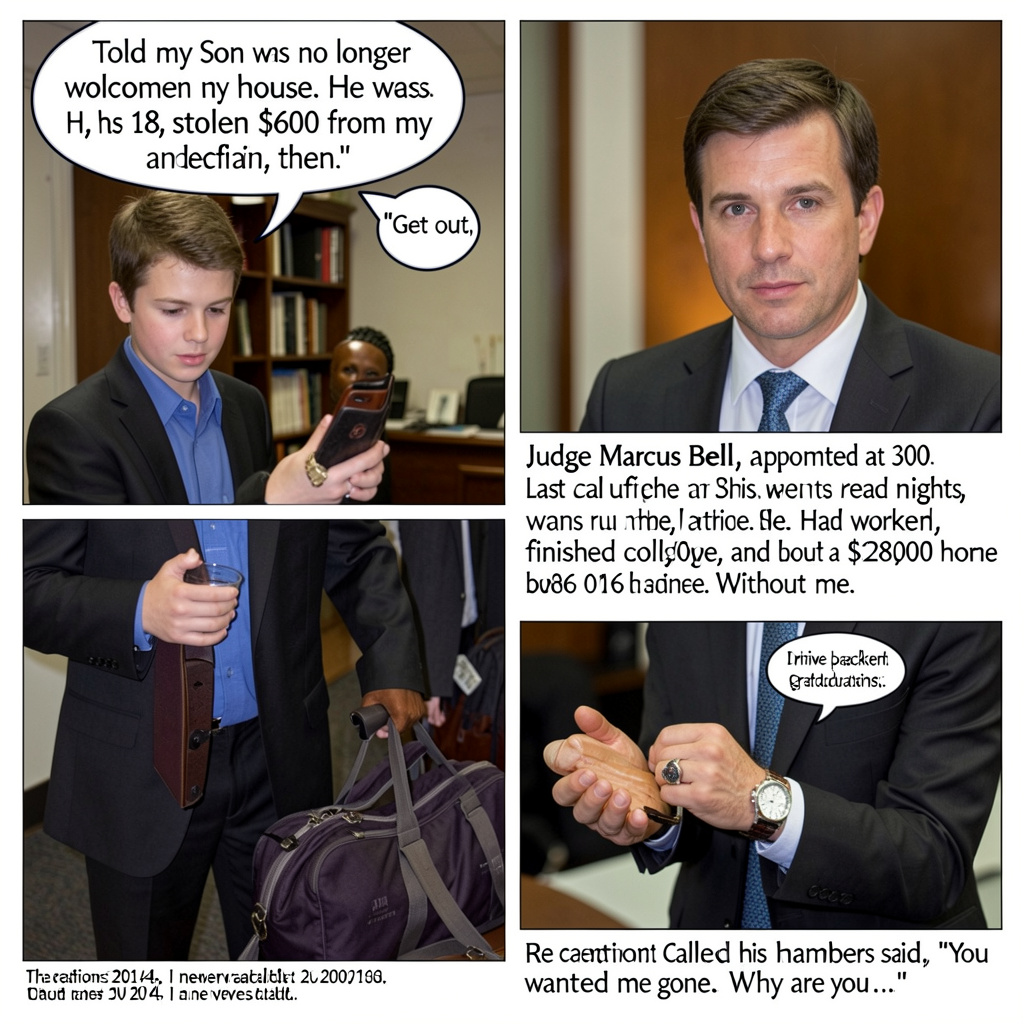
The receptionist looked at me as though I had asked for something impossible.“Judge Bell is in chambers,” she said politely. “Do you have an appointment?”I looked down at the watch in my palm.
It was scratched along the back now. The leather strap had softened with age, and the little silver hands moved steadily toward three o’clock.
“No,” I said. “I’m his mother.”
The receptionist smiled uncertainly.
“I’ll let him know you’re here.”I nodded.Then I waited.Ten minutes later, the doors behind the reception desk opened.And my son walked through.For a moment, I forgot how to breathe.
He was taller than I remembered, though perhaps that was because the last time I had really looked at him, he had been an eighteen-year-old boy carrying one duffel bag out of my house.
Now he wore a dark judge’s robe over a white shirt. His hair was neatly trimmed. His face had lost the softness of youth.
But his eyes were the same.
Brown.Tired.And suddenly guarded.He stopped when he saw me.Neither of us spoke.Then he looked at the watch in my hand.His expression changed.“You wanted me gone,” he said quietly. “Why are you here?”
I swallowed.“I wanted to give you this.”I held out the watch.He stared at it.“You still have that?”
“I kept it.”“You gave it to me.”“I know.”“At graduation.”“I know.”His jaw tightened.
“That was twelve years ago.”
“I know that too.”
The receptionist glanced between us, sensing something far deeper than an ordinary family visit.
Marcus stepped aside.
“Come into my chambers.”
I followed him.
His office was exactly what I imagined a judge’s chambers might look like: shelves filled with law books, framed certificates, photographs, and a large wooden desk.
But there was one thing that caught my attention immediately.
On the wall was a photograph of a young Marcus.
He was standing beside a university building, wearing a graduation gown.
And beside him was an older woman.
His grandmother.
My mother.
She had died two years after Marcus left my house.
I stared at the photograph.
“You kept that?”
Marcus followed my eyes.
“She believed in me.”
The words were simple.
But they hurt.
Because I suddenly realized I had never said those words to him.
Not when he was eight.
Not when he was twelve.
Not when he graduated.
Not even when he left.
I sat down.
Marcus remained standing.
“Tell me why you’re here.”
I looked at the watch.
“I heard about you.”
“From the newspaper?”
“Yes.”
“You read the article.”
“I did.”
“And?”
I smiled sadly.
“I was proud.”
He looked away.
“Proud.”
“Yes.”
“After twelve years of silence?”
I flinched.
“I know.”
“You didn’t call when I graduated.”
“I didn’t know where you were.”
“You could have asked Grandma.”
“I was ashamed.”
That made him look at me.
“Of what?”
I took a breath.
“Of what I had done.”
The room became very quiet.
Marcus sat behind his desk.
“I was eighteen,” he said.
“I know.”
“I stole six hundred dollars.”
“I know.”
“You told me to get out.”
“I know.”
“You didn’t ask why.”
My eyes filled with tears.
“No.”
“You didn’t give me a chance to explain.”
“No.”
“You just decided I was a thief.”
I lowered my head.
“I did.”
“And you never came after me.”
“I thought you wanted nothing to do with me.”
He laughed once.
There was no humor in it.
“I was eighteen, Mom.”
The word struck me.
Mom.
He had called me Mom.
After twelve years.
I looked at him.
“I was eighteen,” he repeated. “I had one bag, sixty-three dollars in my wallet, and nowhere to go.”
I covered my mouth.
“Where did you go?”
“Grandma’s.”
I closed my eyes.
Of course.
He had gone to my mother.
“She let me sleep on her couch,” he continued. “The next morning, she asked me what happened.”
“What did you tell her?”
“The truth.”
I looked up.
“What truth?”
Marcus leaned back.
“I didn’t steal the money for myself.”
My heart sank.
“Then why?”
He stared at me for a long moment.
“Because Dad was sick.”
I froze.
His father had died when Marcus was twelve.
Cancer.
At the time, I had believed I had handled everything alone.
I had worked two jobs. Paid the bills. Bought groceries. Kept the house running.
But apparently there were things my son had seen that I had never understood.
“Dad had been hiding medical bills,” Marcus said. “I found them in his desk.”
I stared at him.
“He knew he was dying. He didn’t want you to know how bad the debt was.”
My hands trembled.
“I knew about the hospital bills.”
“You knew some of them.”
He opened a drawer.
From it, he pulled out an old envelope.
My name was written across the front.
I recognized the handwriting immediately.
My husband’s.
Marcus placed it on the desk.
“He owed six hundred dollars to the pharmacy.”
I stared at the envelope.
“You’re saying…”
“I took the money from your desk because I was going to pay the pharmacy.”
My throat tightened.
“You could have told me.”
“I tried.”
“What?”
“I came into the kitchen that night. You were crying over bills.”
I remembered.
God, I remembered.
I had been sitting at the kitchen table surrounded by envelopes.
Marcus had stood in the doorway.
I had barely looked at him.
I had said, “Not now, Marcus.”
He had nodded.
Then he disappeared upstairs.
The next morning, six hundred dollars were missing.
I had assumed the worst.
I had screamed.
He had refused to explain.
And I had told him to leave.
I had spent twelve years believing he had stolen from me because he didn’t respect me.
But he had been trying to protect me.
“I didn’t know,” I whispered.
“I know.”
“I swear, Marcus, I didn’t know.”
“I know.”
“Why didn’t you come back?”
His eyes became wet.
“Because every day I expected you to.”
I stared at him.
“I thought you’d call.”
“I wanted to.”
“Then why didn’t you?”
“Because Grandma told me something.”
“What?”
“She said sometimes people need time to understand what they’ve done.”
I nodded slowly.
“And you waited.”
“I waited.”
“For how long?”
“Three years.”
My heart broke.
“Three years?”
“I used to check the mailbox.”
I began crying.
“Marcus…”
“Every birthday, I wondered if you’d send something.”
“I wanted to.”
“But you didn’t.”
“No.”
“Every Christmas.”
“I know.”
“Every graduation.”
“I know.”
He looked down at his hands.
“I finally stopped waiting.”
Silence filled the room.
Then he said, “I worked nights.”
“I read that.”
“Warehouse. Restaurant. Security desk. Anything I could get.”
“You went to college.”
“Community college first.”
“And then?”
“State university.”
“How did you pay?”
“Scholarships. Loans. Work.”
I nodded.
The newspaper article had said he had graduated near the top of his class.
Then law school.
Then the bar.
Then, at thirty, he became the youngest judge in the county.
And somehow I had missed all of it.
Every milestone.
Every victory.
Every struggle.
“I bought the house last year,” he said.
“The article said two hundred eighty-six thousand.”
He smiled faintly.
“You remember the number?”
“I read the article three times.”
“It isn’t much.”
“To me, it is.”
He looked at me.
“Why?”
“Because I remember when you were twelve and told me you wanted a house with a red front door.”
His expression softened.
“I forgot that.”
“I didn’t.”
He looked toward the window.
“My house has a red front door.”
I smiled through my tears.
“I know.”
“How?”
“I drove past it.”
He looked sharply at me.
“You came to my house?”
“Once.”
“When?”
“Last week.”
He stared.
“I didn’t go inside.”
“Why?”
“Because I didn’t know if I was welcome.”
He looked down.
The irony wasn’t lost on either of us.
“You understand how that feels now,” he whispered.
I nodded.
“Yes.”
For a long moment, neither of us moved.
Then I pushed the watch across the desk.
“Take it.”
Marcus looked at it.
“I don’t want it.”
“It was yours.”
“You gave it to me because you said I needed something to remind me that time matters.”
I smiled faintly.
“I remember.”
“You said every minute is a choice.”
“I remember that too.”
He picked up the watch.
His thumb brushed over the scratched metal.
“You kept it all these years?”
“Yes.”
“Why?”
“Because after you left, it was the only thing you had left behind.”
He looked at me.
“No.”
His voice cracked.
“It wasn’t.”
“What?”
“You had me.”
I stared at him.
“You had me, Mom.”
The tears came harder.
“I know.”
“No, you don’t.”
He stood.
“I needed you.”
“I know.”
“I needed you to ask me why.”
“I know.”
“I needed you to come looking.”
“I know.”
“I needed you to be my mother instead of being angry.”
“I know.”
“And I needed you to tell me that one mistake didn’t make me a bad son.”
I couldn’t speak.
Because he was right.
Every word.
I had spent twelve years telling myself that Marcus had abandoned me.
The truth was uglier.
I had abandoned him first.
I stood slowly.
“I can’t change what happened.”
“No.”
“But I can tell you I’m sorry.”
He looked at me.
“I am so sorry.”
His face tightened.
“I don’t expect you to forgive me today.”
“I don’t know if I can.”
“I understand.”
“I don’t know if I can ever forget.”
“I don’t want you to forget.”
He looked surprised.
“I want you to remember,” I said. “So I never make you feel unwanted again.”
His eyes filled.
Then, for the first time in twelve years, my son stepped toward me.
I didn’t move.
I was afraid.
Afraid he’d stop.
Afraid he’d change his mind.
Instead, he hugged me.
It wasn’t the embrace of a little boy.
It was the embrace of a grown man who had spent twelve years learning how to survive without his mother.
I held him tightly.
“I missed you,” I whispered.
“I missed you too.”
We stood there for a long time.
Then he pulled away.
“I have court in twenty minutes.”
I laughed softly through my tears.
“Of course you do.”
He smiled.
It was the first real smile I’d seen from him.
“Come back tomorrow.”
I stared at him.
“Are you sure?”
“Yes.”
“Why?”
“Because there’s something I want to show you.”
The next day, I returned.
This time there was no receptionist.
Marcus was waiting outside.
He wasn’t wearing his robe.
He was wearing jeans and an old gray sweater.
For a moment, he looked like my son again.
He drove me to his house.
The red front door was exactly as he’d described.
Inside, the house was warm and modest.
There were books everywhere.
Photographs.
Awards.
A small kitchen.
A dining table for four.
And on the refrigerator was a photograph.
Marcus at eighteen.
Holding one duffel bag.
I stared at it.
“Why do you have that?”
“Grandma took it the morning after I arrived.”
I touched the photograph.
He looked so young.
Too young to be alone.
Too young to understand why his mother had let him walk away.
“I hated this picture for years,” he said.
“Why?”
“Because it reminded me of the night I thought my life was over.”
I turned toward him.
“But?”
“But eventually I realized it was the night my life began.”
I frowned.
“How?”
“If you hadn’t thrown me out, I might never have learned how strong I could be.”
“That doesn’t make what I did right.”
“No.”
He paused.
“But it doesn’t mean something good couldn’t come from it.”
I nodded.
He walked toward a bookshelf.
There was a small wooden box.
He opened it.
Inside was a folded piece of paper.
He handed it to me.
I unfolded it.
It was a letter.
My letter.
I recognized it immediately.
“What is this?”
“You wrote it three days after I left.”
My hands shook.
“I don’t remember.”
“I found it in Grandma’s things after she died.”
I read the first line.
Marcus, I don’t know how to fix what happened.
My breath caught.
“You wrote this?”
“I wrote it. I never sent it.”
“Why?”
“Because I was too proud.”
I kept reading.
I am angry. I am hurt. But underneath all of that, I am scared. I don’t know where you are.
The tears came.
He watched silently.
“I wrote twelve letters,” he said.
“Twelve?”
“One for every year.”
I looked at him.
“Where are they?”
“Here.”
He opened another drawer.
Twelve envelopes.
One for each birthday.
I touched them.
“You wrote to me every year?”
“Yes.”
“Why didn’t you send them?”
“Because I didn’t know if you wanted to hear from me.”
I looked at my son.
“I would have.”
“I know that now.”
He sat across from me.
“I don’t want to spend the rest of my life wondering what we could have been.”
Neither did I.
“So what do we do?” I asked.
He smiled.
“We start.”
“Start what?”
“Being mother and son.”
I laughed softly.
“After twelve years?”
“Better late than never.”
We ate dinner together that night.
Nothing fancy.
Chicken, rice, vegetables.
He complained that I still overcooked everything.
I told him judges weren’t supposed to criticize their mothers.
He laughed.
It felt strange.
Wonderful.
Almost normal.
Over the next few months, we learned each other again.
I learned that he drank his coffee black.
That he hated tomatoes.
That he listened to old jazz while reading.
That he still rubbed the edge of his thumb against his index finger when nervous, exactly as he had done as a child.
He learned that I had developed a habit of talking to the television.
He teased me about it.
I teased him about his terrible cooking.
We began meeting every Sunday.
Sometimes at my house.
Sometimes at his.
The first time he came to my house, he stood outside for several seconds before entering.
I noticed.
“You’re welcome here,” I told him.
He looked at me.
“I know.”
But I knew he needed to hear it.
So I said it again.
“You’re always welcome here.”
He nodded.
Then he stepped inside.
Months passed.
One Sunday morning, Marcus arrived carrying a small box.
“What is that?” I asked.
“Open it.”
Inside was the watch.
The same watch I’d brought to the courthouse.
I looked at him.
“You kept it.”
“Yes.”
“But I thought you didn’t want it.”
“I didn’t.”
He smiled.
“Then I realized something.”
“What?”
“You gave it to me when I graduated.”
“Yes.”
“And I gave it back to you when you finally apologized.”
I laughed.
“That doesn’t make sense.”
“It does to me.”
He took the watch from the box.
“I think we both lost twelve years.”
He placed it in my hand.
“But we don’t have to lose another minute.”
I looked at the watch.
The second hand continued moving.
Tick.
Tick.
Tick.
For years, I had thought that moment in 2014 was the end of our story.
It wasn’t.
It was simply the chapter where we both got lost.
The chapter where anger spoke louder than love.
The chapter where a mother made the worst decision of her life and a son spent years becoming the man he needed to become without her.
But life had given us something I never expected.
A second chance.
Not a clean one.
Not a perfect one.
The scars were still there.
They always would be.
But forgiveness doesn’t erase the past.
It changes what the past is allowed to do to the future.
One evening, months after our reunion, Marcus and I were sitting on his porch.
The red door was behind us.
The sunset painted the sky orange.
He looked at me.
“Mom?”
“Yes?”
“Do you remember the six hundred dollars?”
I smiled sadly.
“Every day.”
“I paid that pharmacy bill.”
“I know.”
“I kept the receipt.”
“Why?”
He shrugged.
“I guess I wanted proof.”
“Proof of what?”
“That I wasn’t the person you thought I was.”
I reached over and held his hand.
“You never were.”
He squeezed my fingers.
“And you’re not the mother I thought you were either.”
I looked at him.
He smiled.
“You’re better.”
I laughed.
“That’s not what I expected.”
“I know.”
Then he leaned back.
“I’m glad you came to the courthouse.”
“So am I.”
“What made you do it?”
I thought for a moment.
“The newspaper article.”
He nodded.
“But that’s not the whole reason.”
“No.”
“What was it?”
I looked at the watch.
“The picture.”
“What picture?”
“The photograph of you.”
“Which one?”
“The one where you were standing in front of the courthouse.”
He smiled.
“I looked at you and realized something.”
“What?”
“You were eighteen when I told you to leave.”
He nodded.
“And you were thirty when they made you a judge.”
“Yes.”
“I missed twelve years of your life.”
He looked down.
“And I realized I didn’t want to miss thirteen.”
He was silent.
Then he leaned his head against my shoulder.
Just like he used to when he was little.
I rested my cheek against his hair.
For years, I had believed the worst thing my son had ever done was steal six hundred dollars.
Now I understood the truth.
The worst thing I had ever done was decide that six hundred dollars mattered more than asking my child why.
I had been so certain I was teaching him a lesson.
Instead, I taught him how to live without me.
And somehow, despite everything, he became kind.
He became hardworking.
He became a man who listened before judging.
Perhaps that was the greatest irony of all.
My son became a judge.
And I became the person who finally learned not to judge him.
The watch ticked softly between us.
One minute.
Then another.
And another.
Time had taken twelve years from us.
But it had also given us something unexpected.
The chance to begin again.
This time, when my son stood up to leave, he didn’t carry a duffel bag.
He hugged me.
“See you Sunday, Mom.”
I smiled.
“Sunday.”
He walked toward the red door.
Then he turned around.
“Mom?”
“Yes?”
“I love you.”
My heart broke open.
“I love you too.”
He smiled.
Then he left.
Not because I had told him to.
But because he knew he could always come back.
And for the first time since 2014, I wasn’t afraid of the sound of a door closing.
Because this time, I knew it wasn’t goodbye.
It was simply:
See you Sunday.