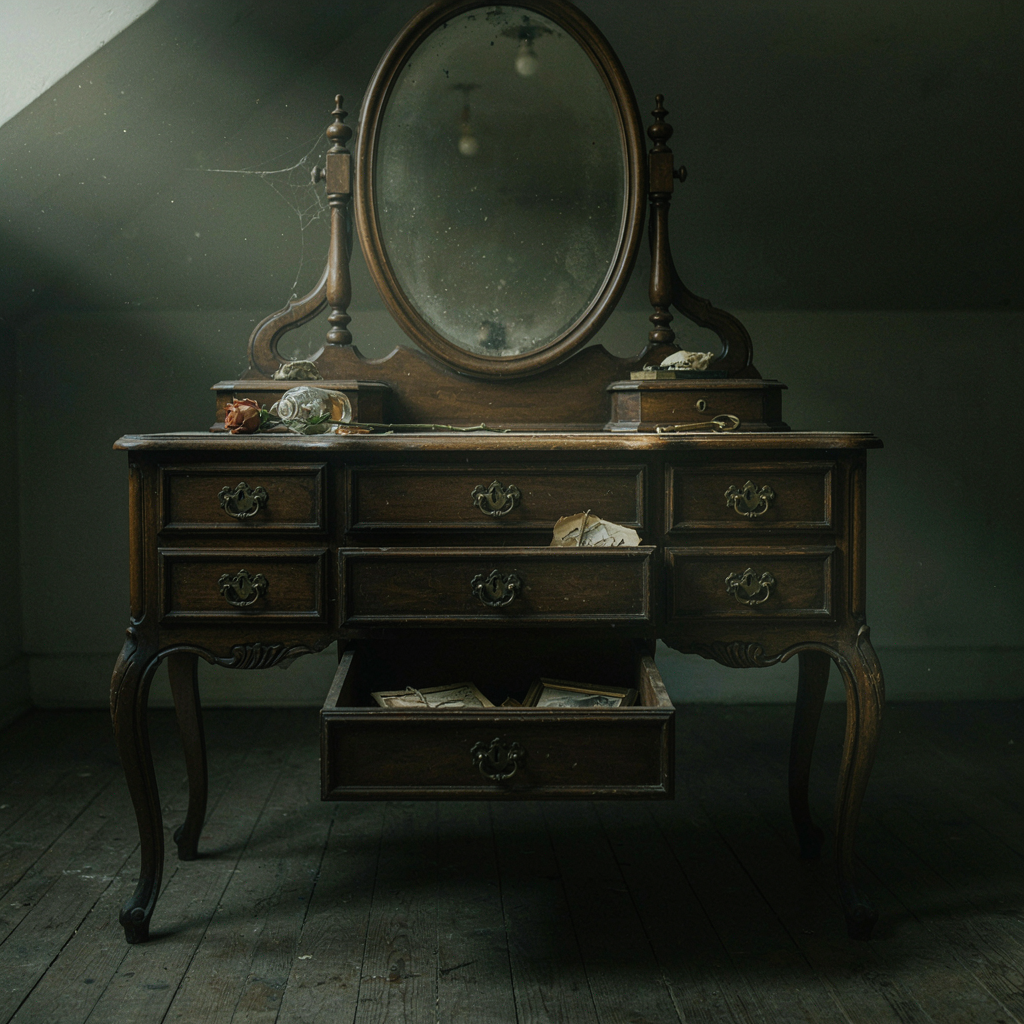
The Mirror Behind the Glass
“I bought an antique mirror at a flea market. Eighty dollars.”That was how I explained it later.As if the price mattered.As if the mirror had been nothing more than an old piece of furniture I brought home because I liked the carved wooden frame.
I remember the Saturday clearly.It was October, and the flea market had spread across three blocks of an old fairground on the edge of town.
The air smelled like coffee, wet leaves, and dust. Vendors shouted over one another, trying to sell everything from silverware to military uniforms.
I wasn’t looking for anything in particular.
Then I saw the mirror.It stood against the back of a vendor’s truck, half-covered by a stained blanket.The frame was beautiful—dark walnut, hand-carved with tiny flowers and curling vines.
The glass itself was slightly cloudy around the edges, but the center was remarkably clear.
I asked the vendor how much.“Eighty.”I expected him to say eight hundred.
Instead, he shrugged.
“Take it or leave it.”I bought it.I should have left it there.That evening, I carried it into my apartment and leaned it against the wall of my bedroom.For the first time in twenty-seven years, I saw my sister’s bedroom again.
Not literally.But the wallpaper reflected in the mirror brought it all back.Tiny pale-blue flowers.White vines.
A pattern I hadn’t seen since I was seventeen.
My sister, Emily, had slept in a room with that wallpaper.
She had disappeared in 1999.
She was twenty-one.
I was seventeen.
The police searched our neighborhood, the river, abandoned buildings, bus stations, hospitals, and every road leading out of town.
They found nothing.
Not her purse.
Not her clothes.
Not her body.
Nothing.
After several years, people stopped asking questions.
Eventually, people stopped saying her name.
But I never stopped remembering.
Especially the night she vanished.
The night before she disappeared, Emily had come into my room.
She stood in the doorway wearing an oversized gray sweatshirt, her dark hair pulled into a messy ponytail.
“Are you awake?”
I looked up from my book.
“Obviously.”
She smiled.
“Can I sleep in here tonight?”
I laughed.
“You’re twenty-one.”
“So?”
“So you’re weird.”
She walked in anyway.
She sat on the edge of my bed.
For a few seconds, she didn’t say anything.
Then she asked, “Do you ever feel like someone is watching you?”
I remember laughing.
I wish I hadn’t.
“Who?”
“I don’t know.”
“Emily, it’s midnight.”
“I know.”
She looked toward the hallway.
“I keep hearing something.”
“What?”
“A clicking sound.”
“Like what?”
“Like a camera.”
My smile disappeared.
“You think someone is taking pictures of you?”
She shook her head quickly.
“No. Forget it.”
She kissed my forehead.
“Go to sleep.”
That was the last normal conversation I ever had with my sister.
The next morning, she was gone.
No goodbye.
No note.
Nothing.
For years, I blamed myself for laughing.
That was why, when I noticed the gap behind the mirror, my hands began shaking before I even understood why.
It happened three days after I bought it.
I was cleaning the glass when I noticed something strange.
The backing wasn’t flush with the frame.
There was a narrow gap along the bottom.
I assumed it was damage from age.
I turned the mirror around.
The back was covered with old brown paper, some of it torn away.
I pressed my fingers against the loose section.
It moved.
I grabbed a screwdriver.
The backing popped free.
Something slid forward.
A photograph.
Then another.
Then another.
They spilled across the floor.
Polaroids.
Dozens of them.
At first, I didn’t understand what I was looking at.
Then I saw the bedroom.
My childhood bedroom.
The pale-blue wallpaper.
The white curtains.
The old wooden dresser.
And the person sleeping in the bed.
Emily.
I stopped breathing.
I picked up one photograph.
Emily was asleep on her side.
Another showed her facing the wall.
Another showed her lying beneath a blanket.
Every photograph had been taken from the same angle.
From inside the closet.
I turned one over.
Another.
Another.
The photographs continued through the year.
Some had dates written in black ink.
September 12.
October 3.
November 19.
December 1.
My hands were numb.
Who had taken these?
Why?
And how had they ended up inside an antique mirror twenty-seven years later?
I picked up another.
Emily was sitting on the edge of the bed, staring toward the closet.
Her face looked frightened.
On the back was a date.
January 7, 1999.
I remembered that night.
Or at least, I thought I did.
I had been awake because of a thunderstorm.
Emily had walked past my room at about two in the morning.
She’d stopped.
She’d stared toward her bedroom.
Then she’d gone inside.
The photograph in my hand showed what happened next.
Emily was standing beside the bed.
Looking directly at the closet.
My stomach twisted.
I grabbed another.
She was closer to the closet.
Another.
She had opened the closet door.
The photograph was blurry.
The final picture from that sequence showed nothing but darkness.
Then I found the last Polaroid.
Emily was asleep.
Her face was peaceful.
Almost too peaceful.
On the back, someone had written an address in thick black marker.
I recognized the handwriting.
I didn’t know why.
But I did.
I gathered the photographs into a box and drove straight to the police station.
The detective who had worked Emily’s disappearance was still alive.
Detective Thomas Reed was seventy-two years old.
I hadn’t seen him in nearly two decades.
He recognized me immediately.
“Sarah?”
I nodded.
He looked older than I remembered, but his eyes were the same.
“What happened?”
I placed the photographs on his desk.
He picked up the first one.
His face changed.
He looked at another.
Then another.
His fingers began trembling.
“Where did you get these?”
“Inside a mirror.”
“What mirror?”
“I bought it at a flea market.”
He stared at me.
Then he flipped over the final photograph.
His face went completely pale.
He whispered the address.
“Do you know this place?”
“No.”
He looked at me.
“That address belongs to the old Hawthorne house.”
I waited.
“Who lived there?”
Reed swallowed.
“Your family.”
My blood went cold.
“What?”
“The address is your childhood home.”
I stared at him.
“That can’t be right.”
He turned his computer toward me.
The address was there.
My childhood address.
The house where Emily disappeared.
The house my parents had sold six months after she vanished.
I couldn’t speak.
Reed sat back.
“I always thought your sister left voluntarily.”
“She didn’t.”
“I know.”
“You don’t.”
He looked at me for a long moment.
Then he said something I had never expected.
“We found evidence that someone had been inside your house.”
I frowned.
“What kind of evidence?”
“Hidden photographs. Strange marks on the walls. A small camera lens.”
“Camera lens?”
“We found it inside the closet.”
My heart stopped.
“Why didn’t you tell us?”
“We did.”
“No. You didn’t.”
Reed looked away.
“Your father told us the evidence was probably unrelated.”
My father’s name was Richard.
He had died twelve years earlier.
For most of my life, I remembered him as a grieving father.
A man who had spent years putting flowers on Emily’s grave even though she never had one.
A man who cried when her birthday came around.
A man who never forgave himself.
But suddenly, I remembered something.
The night Emily disappeared, Dad had been standing outside her bedroom.
Not crying.
Listening.
I had seen him.
I had forgotten.
Or perhaps I had forced myself to forget.
Reed opened an old case file.
“We received an anonymous tip three months after Emily disappeared.”
“What did it say?”
“That she wasn’t missing.”
My skin prickled.
“What did it say?”
Reed read from the file.
“She’s still inside.”
I stared at him.
“Inside what?”
“The house.”
For several seconds, neither of us spoke.
Then Reed said, “We searched the house again.”
“And?”
“Nothing.”
“Then why did you keep the file?”
“Because I never believed the search was complete.”
He pulled out a photograph of the Hawthorne house.
The house looked exactly as I remembered.
Two stories.
White siding.
Black shutters.
A large oak tree in the front yard.
Reed pointed to the second-floor window.
“Your sister’s room.”
I nodded.
He pointed lower.
“The basement.”
“What about it?”
“There was a false wall.”
I felt dizzy.
“A false wall?”
“Yes.”
“What was behind it?”
“Nothing.”
I stared at him.
He continued.
“That’s what bothered me.”
I took the mirror photograph out of my bag.
“The address on the back.”
Reed nodded.
“I know.”
“Why would someone put the address of my old house on this?”
“I don’t know.”
He stood.
“But I think there’s one person who does.”
“Who?”
He looked at me.
“Your mother.”
My mother had died when I was twenty-nine.
A stroke.
Sudden.
There was no one left.
Or so I thought.
That night, I couldn’t sleep.
I placed the Polaroids across my dining table.
There were forty-three.
I arranged them chronologically.
September 1998.
October.
November.
December.
January 1999.
February.
March.
April.
May.
June.
The final photograph was dated June 14.
Emily disappeared on June 17.
Three days later.
I studied the photographs.
Something changed in the last month.
The photographer moved closer.
At first, the pictures had been taken from deep inside the closet.
Then from the doorway.
Then beside Emily’s bed.
The final photographs were so close I could see individual strands of her hair.
Whoever took them had been standing inches away.
Then I noticed something.
In one photograph, reflected in the mirror behind Emily’s bed, was a shape.
A man’s face.
I enlarged the photograph.
My hands began shaking.
It was my father.
I knew that face.
The same heavy eyebrows.
The same crooked nose.
The same scar beneath his left eye.
Dad had been taking the pictures.
I didn’t want to believe it.
I called Detective Reed.
He answered immediately.
“I found something.”
“Come back to the station.”
“No.”
“What?”
“I know who took the photographs.”
Silence.
“Who?”
“My father.”
Another silence.
Then Reed said quietly, “I was afraid you’d find that.”
I went cold.
“You knew?”
“I suspected.”
“Why didn’t you tell me?”
“Because I didn’t have proof.”
“I have forty-three photographs.”
“And none show his face clearly.”
“I saw him in the mirror.”
“Sarah—”
“I saw him.”
Reed sighed.
“Then you need to understand something.”
“What?”
“Your father wasn’t the only person in that house.”
The next morning, we returned to the Hawthorne property.
The house had been abandoned for years.
The current owner had agreed to let us search it.
The moment I stepped inside, I felt seventeen again.
The wallpaper was still there.
Faded.
Peeling.
But unmistakable.
My old bedroom was empty.
Emily’s room was worse.
The closet door hung crookedly.
Reed crouched beside it.
“Look.”
There were tiny holes in the wood.
One.
Two.
Three.
A row of them.
Camera holes.
He removed part of the closet’s interior panel.
Behind it was a narrow cavity.
Inside was an old electrical wire.
And a tiny metal bracket.
Reed stared at it.
“He installed cameras.”
I felt sick.
“Why?”
We searched the basement.
The false wall was still there.
Reed brought in equipment and opened it.
Behind the wall was a narrow passage.
The passage led beneath the stairs.
And there, hidden in darkness, was a small room.
A chair.
A desk.
Old film reels.
Boxes.
A cassette recorder.
And photographs.
Hundreds of them.
Emily.
Sleeping.
Eating.
Reading.
Changing clothes.
Walking through the house.
Every part of her life had been recorded.
I covered my mouth.
Reed whispered, “Your father was watching her.”
But then he opened a drawer.
Inside was a stack of letters.
All addressed to Emily.
The first was dated February 1999.
Emily,
I know what you’ve been doing.
Stop asking questions.
Stop looking in the basement.
You don’t understand what you’re involved in.
Another letter.
You saw the room.
You shouldn’t have.
Another.
If you tell Sarah, she’ll disappear too.
My knees weakened.
I sat down.
Reed looked at me.
“Your sister knew.”
“Knew what?”
“That your father had been watching her.”
I remembered Emily’s question.
Do you ever feel like someone is watching you?
She had known.
And I had laughed.
We found the final letter.
It was dated June 16, 1999.
One day before Emily vanished.
Emily,
Tonight we finish this.
You will leave with me.
No one will know where you went.
If you refuse, Sarah pays for it.
Reed read the sentence again.
Then he looked at me.
“Your father threatened her with you.”
I felt something break inside me.
But there was more.
At the bottom of the letter was another address.
Not the Hawthorne house.
A warehouse.
Three miles outside town.
We went there that afternoon.
The building was scheduled for demolition.
Behind a rusted metal door was a room filled with old furniture.
And in the center stood another mirror.
Same carved frame.
Same walnut wood.
Same cloudy glass.
Reed walked around it.
“This is impossible.”
I touched the frame.
A small piece of paper was wedged beneath it.
I pulled it free.
It was a note.
Sarah,
If you found this, then someone finally told you the truth.
I didn’t disappear.
I ran.
Emily.
My hands shook so badly I almost dropped it.
“She was alive.”
Reed looked at the note.
“Keep reading.”
There was more.
Dad found out I knew about the cameras.
He tried to convince me I was imagining things.
When I threatened to go to the police, he told me he would hurt you.
So I made a plan.
The night I disappeared, I climbed through the basement window.
I left town with someone I trusted.
I couldn’t tell you where I was going.
I couldn’t risk you following me.
I watched from far away for years.
I wanted to come back.
But Dad had people looking for me.
Then came the sentence that shattered me.
Sarah, I’m sorry.
I never stopped loving you.
There was no signature.
There didn’t need to be.
I knew.
Emily.
My sister had been alive.
All those years.
Somewhere.
Waiting.
Reed turned the mirror around.
The back had a small metal compartment.
Inside was a cassette tape.
We found an old player in the warehouse.
Reed pressed play.
Static filled the room.
Then a woman’s voice.
Older.
But unmistakable.
“Sarah?”
I began crying.
It was her.
Emily.
“I don’t know if you’ll ever hear this.”
Her voice trembled.
“I wanted to come home so many times.”
A pause.
“Dad wasn’t the only person who knew where I was.”
My tears stopped.
“What?”
Reed leaned closer.
Emily continued.
“Mom knew.”
I looked at Reed.
The tape continued.
“Mom helped me escape.”
I couldn’t breathe.
“She pretended to believe Dad’s story. She told the police nothing because she was afraid he’d find me. She hid the photographs. She kept evidence because she knew someday the truth would need to be found.”
Then came the part that changed everything.
“The mirror is the key.”
I stared at the mirror.
“Dad had two hiding places. The basement room and the mirror. Mom moved the mirror after I left. She sold it years later through an estate dealer.”
I looked at the mirror I had bought for eighty dollars.
Emily’s voice continued.
“If you’re hearing this, then Mom succeeded.”
A long silence.
Then:
“I want you to know something.”
Her voice cracked.
“You were never the reason I left.”
I cried harder.
“You were the reason I survived.”
The tape ended.
Reed turned off the machine.
For a long time, neither of us spoke.
Then he said, “We need to find her.”
But I already knew where to start.
The address written on the final photograph wasn’t simply the old house.
It was a message.
A place where Emily knew I would look.
We contacted the estate dealer who had handled my mother’s belongings.
He was eighty-three now.
He remembered the mirror.
He remembered my mother.
And he remembered someone who had visited her shortly before she died.
“A woman,” he said.
“What did she look like?”
He smiled faintly.
“Dark hair. Same eyes as your mother.”
My heart stopped.
“Did she give you a name?”
He shook his head.
“She didn’t have to.”
He pulled out an old receipt.
On it was a mailing address.
A town three states away.
We drove for fourteen hours.
I spent the entire journey staring out the window.
I imagined every possibility.
What if she had died?
What if she didn’t want to see me?
What if she blamed me?
What if I arrived too late?
We found the house just after sunset.
Small.
Blue.
A garden in front.
There was a woman sitting on the porch.
She was older.
Her hair was streaked with gray.
But I knew her immediately.
She stood.
Neither of us moved.
Then she whispered:
“Sarah?”
I couldn’t speak.
I walked toward her.
She covered her mouth.
And then she ran to me.
We held each other for what felt like hours.
I cried against her shoulder.
“You’re alive.”
She sobbed.
“I tried to come back.”
“I thought you were dead.”
“I know.”
“Why didn’t you tell me?”
“Because Dad promised he’d kill you.”
I pulled away.
“Dad died twelve years ago.”
She closed her eyes.
“I know.”
“Then why didn’t you come home?”
“Because by then, I didn’t know who I could trust.”
I told her about the mirror.
About the photographs.
About Detective Reed.
About the hidden room.
Emily listened silently.
Then she said something that made my blood run cold.
“There was one thing Mom never told you.”
“What?”
Emily looked toward the house.
“Dad didn’t start watching me because he hated me.”
“Why, then?”
“Because I found something.”
“What?”
She took my hand.
“The night before I disappeared, I found a photograph in Dad’s desk.”
“What photograph?”
“A photograph of Mom.”
I frowned.
“Doing what?”
“Meeting someone.”
“Who?”
Emily looked directly into my eyes.
“Detective Thomas Reed.”
I felt the world tilt.
“No.”
“Yes.”
“He helped find you.”
“He was supposed to.”
I stepped backward.
Emily continued.
“Reed wasn’t working alone.”
“What are you saying?”
“My father had been involved in something illegal. Money. Blackmail. People disappearing. He used cameras to collect evidence against powerful men.”
I stared at her.
“Then why photograph you?”
“Because I discovered the evidence.”
“And Reed?”
“Reed wanted it.”
I remembered his pale face.
The moment he saw the final photograph.
The way he seemed to know what it meant.
Emily whispered:
“The address wasn’t a message to you.”
“What was it?”
“It was a warning.”
“About Reed?”
She nodded.
“He knew where I was hiding.”
I felt ice spread through my chest.
“We need to leave.”
Emily nodded.
We rushed inside.
The phone rang.
Once.
Twice.
Emily froze.
“No.”
“What?”
“That number.”
The phone rang again.
She stared at it.
“He’s here.”
“Who?”
She whispered:
“Reed.”
The front window shattered.
We dropped to the floor.
A gunshot echoed through the house.
Emily grabbed my hand.
“Basement.”
We ran.
Behind a cabinet was a hidden door.
Emily opened it.
A narrow tunnel stretched beneath the house.
“Where does it go?”
“Three houses down.”
We crawled through darkness.
Behind us, footsteps thundered above.
Then a voice echoed through the tunnel.
“Emily!”
Detective Reed.
“It’s over!”
Emily squeezed my hand.
“No.”
We kept moving.
At the end of the tunnel, we emerged into an abandoned garage.
Emily had planned for this.
There was a car waiting.
We drove until sunrise.
Only then did she explain everything.
My father had been part of a surveillance network.
He secretly recorded people for blackmail.
Emily discovered the hidden room and threatened to expose him.
My mother helped her escape.
Reed had been investigating my father, but instead of protecting Emily, he wanted the evidence for himself.
The photographs had been hidden because they were proof that my father had been watching Emily.
The final Polaroid had contained the old address because Emily knew that if she ever needed to be found, the mirror would lead me there.
And she had been right.
Twenty-seven years later, I found her.
The case was reopened.
Reed was arrested.
My father’s crimes were uncovered.
The photographs became evidence.
For the first time, Emily’s name appeared in the newspapers not under the word “missing,” but under the word “survivor.”
Months later, Emily and I returned to the old house.
The wallpaper was still peeling.
The closet was empty.
We stood in her old bedroom.
She touched the wall.
“I used to hate this room.”
“I did too.”
She smiled.
“I used to think the walls were watching me.”
I looked toward the closet.
“They were.”
She laughed softly.
Then she hugged me.
“I missed you.”
“I missed you every day.”
She pulled back.
“Do you still have the mirror?”
I nodded.
“It was the first thing I ever bought that belonged to you.”
She smiled.
“No.”
“What?”
“It belonged to Mom.”
I looked at her.
“She bought it because she knew someday you’d find it.”
I thought about that.
My mother had spent years carrying a secret.
She had protected Emily.
She had hidden the evidence.
And somehow, decades later, she had still managed to put the truth into my hands.
I kept the mirror.
I restored the frame.
I replaced the damaged backing.
But I never repaired the cloudy glass.
I wanted it exactly as I had found it.
Because every time I looked into it, I remembered something.
Sometimes the truth doesn’t disappear.
Sometimes it waits.
Behind a wall.
Inside a photograph.
Under a piece of old paper.
Inside a mirror you almost throw away.
And sometimes, after twenty-seven years of silence, it finally finds its way home.
The last photograph remains on my desk.
Emily is asleep in her old bedroom.
The date is June 14, 1999.
For years, I thought the photograph showed a girl who was about to disappear.
Now I see something else.
If you look carefully at the corner of the image, you can see a small sliver of the mirror.
And reflected in it is Emily’s face.
Her eyes are open.
She isn’t sleeping at all.
She is staring directly at the camera.
And written on the back, beneath the address, are five words I didn’t notice until years later.
“Sarah, don’t trust the detective.”
I still have the photograph.
I still have the mirror.
And every now and then, when the room is dark and the glass catches the light just right, I swear I can see my sister standing behind me.
Not as she was in 1999.
As she is now.
Older.
Alive.
Smiling.
A reminder that sometimes the scariest thing isn’t discovering that someone was watching you.
It’s discovering how long the people you trusted knew.
And said nothing.