MY MOM WAS SENTENCED TO DIE FOR KILLING MY DAD.
For six years, no one believed she was innocent.Not the police.Not the judge.Not the neighbors who had watched our family fall apart.Not even me.
But minutes before my mother’s execution, my little brother Matthew hugged her through the prison glass, buried his face against her shoulder, and whispered four words that changed everything.
“Mom… I know who hid the knife.”
My mother went completely still.
Then she pulled him closer.“Matthew,” she whispered, her voice trembling, “what are you talking about?”He looked at me.And I knew immediately.Whatever he was about to say was going to destroy the life we had been living for the past six years.
I was seventeen when my father died.I remember that night with painful clarity.It had been raining.
Not the gentle kind of rain that makes everything feel peaceful, but a violent storm that rattled the windows and turned the streets into black rivers.
My father, Daniel Carter, had come home around eight.
He had been angry.I didn’t know why.He walked into the kitchen, slammed his briefcase on the table, and started arguing with my mother.I was upstairs doing homework.Matthew was eight years old and asleep in his room.
I remember hearing voices.My father’s voice first.Then my mother’s.Then a loud crash.Then silence.I thought they had simply stopped arguing.
I wish I had gone downstairs.
Instead, I kept studying.
Twenty minutes later, Matthew woke up crying.
I went into his room and sat beside him.
“Bad dream?”
He nodded.
I hugged him.
Then we heard something downstairs.
A chair scraping across the floor.
I told Matthew to stay in his room.
I went downstairs.
My father was lying on the kitchen floor.
There was blood everywhere.
My mother was standing beside the counter.
She was wearing her white robe.
Blood covered one sleeve.
I screamed.
My mother looked at me with a face I had never seen before.
She wasn’t angry.
She wasn’t frightened.
She looked completely broken.
“Call 911,” she whispered.
I ran for the phone.
The police arrived within minutes.
They searched the house.
They found the murder weapon under my mother’s bed.
A kitchen knife.
The same knife that had killed my father.
There were fingerprints on the handle.
My mother’s fingerprints.
There was blood on her robe.
And there was no sign of forced entry.
The case seemed obvious.
My mother had killed my father.
At least, that’s what everyone told me.
And eventually, I believed them.
The trial lasted eleven days.
The prosecutor painted my mother as a woman who had finally snapped after years of marital problems.
They talked about arguments.
Money.
My father’s temper.
My mother’s unhappiness.
They showed photographs of the kitchen.
They showed the knife.
They showed photographs of my mother’s robe.
Every piece of evidence seemed to point toward her.
I sat behind the prosecution table with Matthew.
He didn’t understand what was happening.
He kept asking me when Mom was coming home.
I didn’t know what to tell him.
On the sixth day, my mother looked at me from across the courtroom.
Her eyes were filled with tears.
I looked away.
That moment haunted me for six years.
At the end of the trial, the jury found her guilty.
First-degree murder.
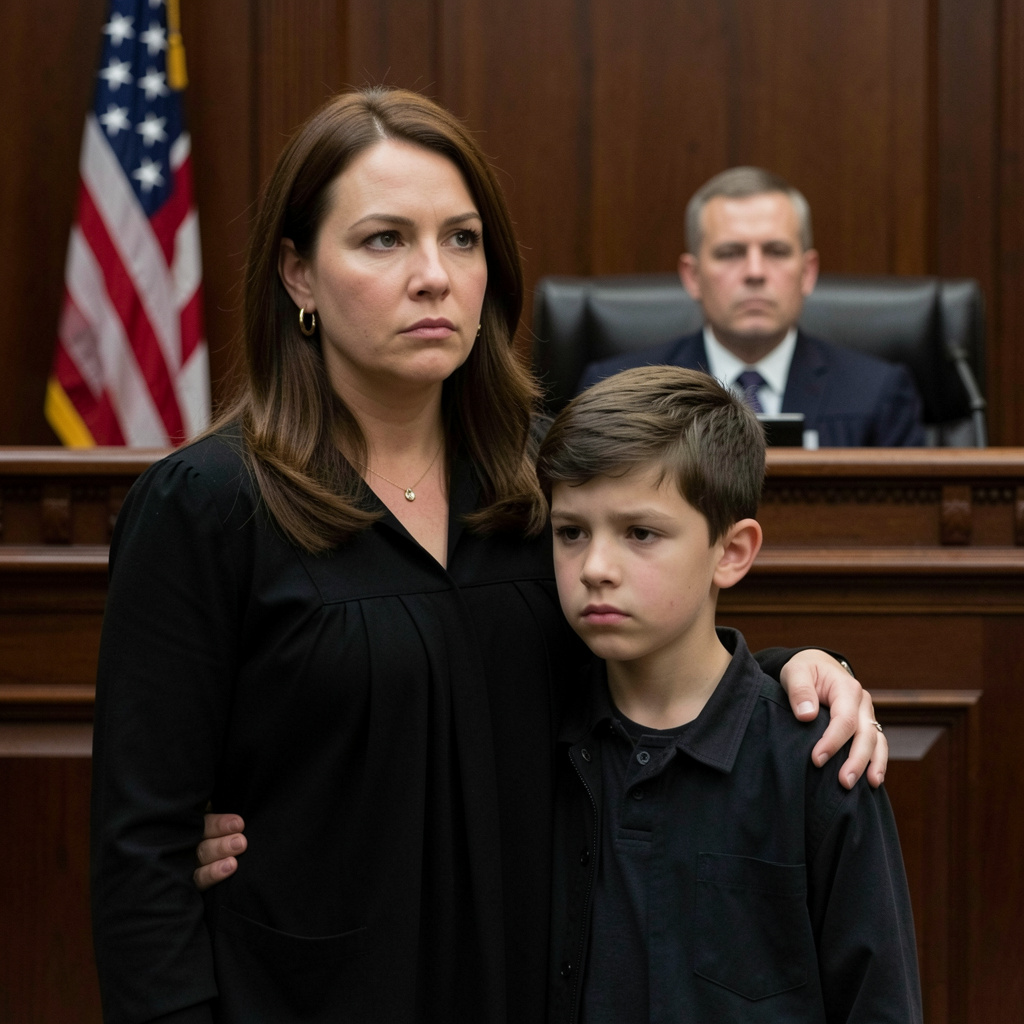
The judge sentenced her to death.
Matthew cried.
I didn’t.
I was too numb.
As the guards took my mother away, she looked directly at me.
“I didn’t kill him,” she said.
I said nothing.
“I swear to you, Emily.”
I was seventeen.
I wanted to believe her.
But every piece of evidence told me not to.
So I committed the worst sin a daughter can commit.
I doubted her.
For six years, my mother wrote me letters.
Every month.
Sometimes twice a month.
I kept every one.
Most began the same way.
Dear Emily,
I didn’t kill your father.
I know you don’t believe me yet.
But one day you will.
I never knew how to answer.
What could I say?
“I believe you”?
I didn’t.
“I don’t believe you”?
I couldn’t bring myself to write that either.
So I rarely answered.
Matthew was different.
He wrote to her constantly.
He drew pictures.
He sent birthday cards.
He told her about school.
He told her about his friends.
He told her about the dog we adopted.
He never once questioned her innocence.
“She told me she didn’t do it,” he would say.
“Mom doesn’t lie.”
I used to think he was simply too young to understand.
I was wrong.
Over the years, I watched Matthew become obsessed with the night our father died.
He asked questions.
Little questions at first.
“What time did Dad die?”
“Who found him?”
“Why was the knife under Mom’s bed?”
“Why didn’t the police find it in the kitchen?”
I always told him the same thing.
“Matthew, stop digging into it.”
But he never stopped.
Six years after my father’s death, my mother received an execution date.
October 17.
I remember staring at the letter when it arrived.
I was twenty-three.
Matthew was fourteen.
I felt something inside me collapse.
For six years, I had avoided believing my mother.
Now I was about to lose the chance forever.
I visited her three days before the execution.
She looked thinner.
Older.
But her eyes were exactly the same.
She smiled when she saw me.
“You came.”
“I should have come sooner.”
She shook her head.
“No.”
“I should have believed you.”
She reached through the opening in the glass and placed her hand against mine.
“Emily, you were seventeen.”
“I was your daughter.”
“And you were scared.”
I started crying.
“I was wrong.”
She smiled sadly.
“Then don’t waste another day punishing yourself.”
I pressed my forehead against the glass.
“Did you really not do it?”
She stared at me.
“I swear on both of my children.”
I believed her.
For the first time in six years, I believed her.
But it was too late.
Or so I thought.
The morning of the execution was cold.
Matthew was allowed to see her.
I wasn’t sure whether I should bring him.
But he insisted.
“She needs to see me.”
We entered the prison at 8:20 in the morning.
My mother’s execution was scheduled for 10:00.
She was already wearing prison clothes.
Her hands were cuffed.
Her hair was pulled back.
She looked exhausted.
But when Matthew walked through the door, her face changed.
She smiled.
“My baby.”
Matthew ran to her.
They hugged.
He cried into her shoulder.
She closed her eyes.
“Don’t cry for me,” she whispered.
“I don’t want you to go.”
“I know.”
“You didn’t kill Dad.”
My mother opened her eyes.
“I didn’t.”
Matthew pulled away.
“I know.”
Then he looked at me.
“Emily doesn’t know.”
I felt my heart stop.
“Know what?”
Matthew turned toward Mom.
“I know who hid the knife.”
Silence.
My mother’s face went pale.
“Matthew,” she whispered.
“I remember.”
“Remember what?”
“The night Dad died.”
I stared at him.
“You were eight.”
“I know.”
“You were asleep.”
“No.”
He shook his head.
“I wasn’t.”
Matthew started talking.
Slowly.
Carefully.
As if he had been carrying the memory for years and was finally ready to put it down.
“That night, I woke up because I heard Dad yelling.”
I remembered.
The voices.
The crash.
The silence.
“I opened my bedroom door,” he continued.
“I saw Dad walking toward the kitchen.”
My mother stared at him.
“What did you see?”
“Someone was already in the hallway.”
“Who?”
Matthew looked at me.
Then at our mother.
“It wasn’t you.”
My mother’s breath caught.
“Who was it?”
“I don’t know his name.”
“Matthew, you have to tell us everything.”
He nodded.
“He was wearing a dark jacket. He had something over his face. Like a hood.”
I felt cold.
“What happened next?”
“He went into the kitchen.”
Matthew swallowed.
“I heard Dad scream.”
Then silence.
“I was scared. I went back into my room.”
My mother closed her eyes.
“Then I heard footsteps.”
“Whose?”
“I don’t know.”
Matthew’s voice trembled.
“But someone walked past my room.”
“Did you see his face?”
“No.”
“Then how do you know it wasn’t Mom?”
“Because Mom was already in the kitchen.”
I stared at him.
“What?”
“I saw her.”
My mother looked at him.
“I was coming downstairs because Dad called for me.”
Matthew nodded.
“You went into the kitchen.”
“Yes.”
“And then?”
“I heard Mom screaming.”
My stomach twisted.
“What did you hear?”
“Dad was already on the floor.”
My mother covered her mouth.
“I tried to help him,” she whispered.
Matthew continued.
“Then the man came back.”
I felt my heart pounding.
“He was standing behind Mom.”
“Did he attack her?”
“No.”
“Then what?”
“He took the knife.”
“What knife?”
“The one from the kitchen.”
He looked at me.
“He wiped it on Mom’s robe.”
My mother’s eyes filled with tears.
Then Matthew said the words that changed everything.
“He told Mom, ‘If you call the police, your children die.’”
Nobody spoke.
The prison room seemed to disappear.
All I could hear was my own heartbeat.
“Why didn’t you tell anyone?” I asked.
Matthew looked down.
“Because he told me he’d come back.”
I stared at him.
“You saw him?”
“Yes.”
“Who was he?”
Matthew shook his head.
“I didn’t know.”
“Then how do you know who hid the knife?”
He reached into his pocket.
And pulled out a small piece of paper.
My mother looked confused.
“What is that?”
Matthew unfolded it.
“I found this two months ago.”
It was an old photograph.
My father’s photograph.
On the back was a name.
Frank Carter.
My father’s younger brother.
My uncle.
I stared at it.
“Uncle Frank?”
Matthew nodded.
“He was at our house that night.”
I remembered something.
Something I had buried.
Uncle Frank had been there earlier that evening.
He had argued with Dad.
Then he left.
At least, that’s what everyone thought.
“Why would Uncle Frank kill Dad?”
Matthew looked at me.
“Because Dad found out.”
“Found out what?”
“Uncle Frank had been stealing money from Dad’s company.”
My mother’s face changed.
She remembered.
“I knew something was wrong with Frank,” she whispered.
“But your father never told me what.”
Matthew continued.
“Dad was going to report him.”
My mind raced.
Suddenly, pieces that had never fit together began sliding into place.
The argument.
The missing money.
Frank’s disappearance.
The knife.
The blood.
The threat.
My mother had been protecting us.
And I had spent six years believing she murdered the man she loved.
I grabbed the phone.
“We need a lawyer.”
The guard looked at me.
“Ma’am, the execution is less than an hour away.”
“My mother is innocent.”
“I understand you’re upset.”
“No.”
I slammed my hand against the table.
“You don’t understand.”
I showed him the photograph.
“My uncle killed my father.”
The guard called his supervisor.
Within minutes, everything changed.
The execution was temporarily delayed.
An attorney arrived.
Then another.
The prison chaplain came in.
Police officers followed.
Everyone asked questions.
Matthew told them the story again.
And again.
This time, investigators listened.
They reopened the original case.
They examined the evidence.
They discovered something horrifying.
The knife had not been cleaned properly.
There were traces of another person’s DNA beneath my mother’s fingerprints.
A partial match.
Frank Carter.
My uncle.
He had been questioned six years earlier.
He had claimed he left our house before eight.
But phone records showed his vehicle remained near our home until nearly nine.
Then investigators found security footage from a gas station three blocks away.
Frank’s car appeared at 8:47.
The murder had occurred around 8:40.
He had lied.
And the blood on my mother’s robe?
It wasn’t evidence that she killed Dad.
It was evidence that she had tried to save him.
Frank was arrested that afternoon.
He didn’t confess immediately.
He denied everything.
But investigators found financial records.
Millions of dollars had disappeared from my father’s company.
Transfers had been made to accounts controlled by Frank.
My father had discovered the theft.
He had confronted him.
Frank had panicked.
He killed him.
Then he planted the knife under my mother’s bed.
He knew her fingerprints would be on it.
He wiped the handle with her robe.
Then he threatened Matthew.
He believed an eight-year-old child would never understand what he had seen.
He was wrong.
Matthew remembered.
Six years later, my mother’s conviction was overturned.
She walked out of prison three months after the execution had been scheduled.
I was there.
So was Matthew.
When she stepped through the prison gates, she stopped.
She looked at the sky.
Then she took a deep breath.
Freedom.
After six years, she was finally breathing free air.
Matthew ran to her.
She dropped to her knees and hugged him.
I stood behind them crying.
My mother looked at me.
“Come here.”
I did.
She wrapped both of us in her arms.
And for the first time since I was seventeen, I felt like a child again.
Safe.
Loved.
Home.
A year later, we returned to the house.
The kitchen had been renovated.
The walls had been repainted.
The old bloodstains were gone.
But some memories never disappear.
My mother stood beside the counter.
“I used to think I’d never be able to stand here again.”
“I thought so too.”
Matthew walked into the room.
He was sixteen now.
Taller.
Stronger.
But sometimes I could still see the frightened eight-year-old boy inside him.
He placed something on the table.
The old photograph.
Uncle Frank was serving a life sentence.
My father’s name had been cleared of financial wrongdoing.
My mother’s name had been cleared of murder.
But none of that could give us back the six years we lost.
No verdict could.
No apology could.
My mother looked at Matthew.
“You saved me.”
He shook his head.
“No, Mom.”
She smiled.
“You did.”
Then he looked at me.
“You saved us too.”
I frowned.
“I didn’t do anything.”
“You finally believed her.”
That sentence hurt.
Because he was right.
For six years, my mother had been telling the truth.
I simply hadn’t been brave enough to hear it.
That night, I opened the box where I kept her letters.
Hundreds of them.
I read the first one again.
Dear Emily,
I don’t know if you believe me.
Maybe you never will.
But I need you to know one thing.
I loved your father.
I loved you.
And I love Matthew.
I didn’t kill him.
Someday, the truth will find its way home.
I cried as I read the last sentence.
The truth had found its way home.
But it had taken six years.
I looked toward the living room.
My mother was laughing with Matthew.
The sound was ordinary.
Beautiful.
A sound I had once been afraid I would never hear again.
I closed the letter.
Then I understood something.
Sometimes innocence doesn’t arrive dramatically.
Sometimes it waits quietly.
Inside a child’s memory.
Inside a forgotten photograph.
Inside a sentence nobody thinks to question.
And sometimes the person everyone has already condemned is simply waiting for one brave voice to say:
“That’s not what happened.”
Matthew had been eight years old when he saw the truth.
He was fourteen when he finally understood it.
And on the morning my mother was supposed to die, he was brave enough to speak.
My mother once told me not to cry for her.
She was wrong.
I cried.
I cried for the woman who spent six years behind bars for a crime she didn’t commit.
I cried for the father we lost.
I cried for the little boy who carried a terrible secret alone.
And most of all, I cried for the seventeen-year-old girl I used to be.
The girl who looked at her mother and chose evidence over love.
The girl who believed that because everyone said something was true, it had to be.
But I also forgave her.
She had been seventeen.
She had been scared.
And she hadn’t known that sometimes the truth is buried deeper than a knife.
Years later, Matthew asked me something.
“Do you still think about that morning?”
“Every day.”
“Me too.”
He was twenty-one then.
My mother had gray in her hair.
We were sitting together at the kitchen table.
The same kitchen.
A different family.
A different life.
Matthew smiled.
“Mom always says I saved her.”
“You did.”
He shook his head.
“No.”
He looked at me.
“You believed me.”
I smiled.
“And you gave me a chance to believe her.”
He nodded.
Then we sat in silence.
Outside, rain began tapping against the windows.
For a moment, I remembered the night everything changed.
The shouting.
The crash.
The blood.
The knife.
The prison.
The execution chamber.
The fear.
And then Matthew’s voice.
Mom…
I know who hid the knife.
That sentence had given us our mother back.
But it had also taught me something I would carry for the rest of my life:
Never confuse silence with guilt.
Never confuse evidence with the whole truth.
And never stop asking questions simply because everyone else has stopped.
Because sometimes the truth isn’t waiting in a courtroom.
Sometimes it’s waiting in the memory of a frightened little boy.
And sometimes, when everyone else has given up, one small voice is enough to bring an innocent person home.