I KICKED MY 17-YEAR-OLD DAUGHTER OUT FOR COMING HOME DRUNK… 8 MONTHS LATER, MY SON FOUND HER IN A HOMELESS SHELTER
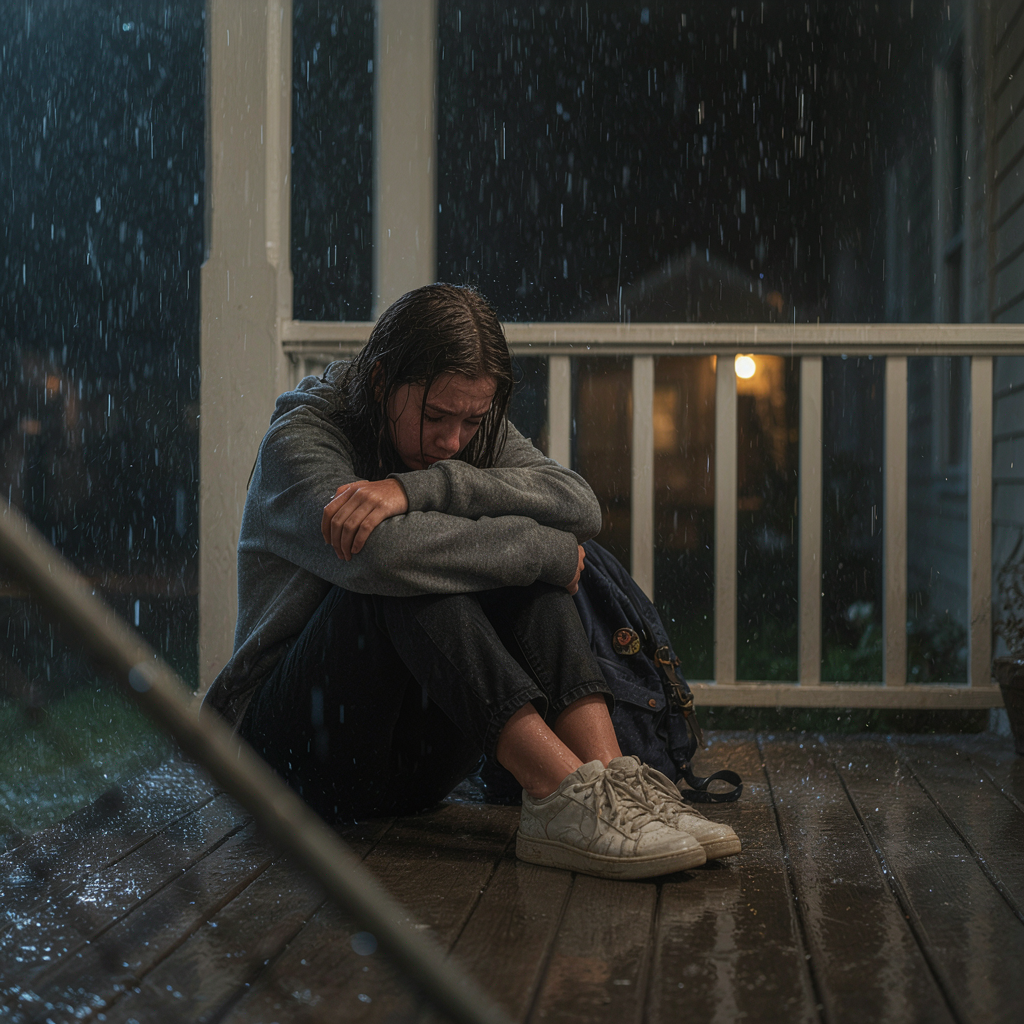
At 2:07 in the morning, I opened the front door and smelled vodka.My daughter stood on the porch, soaked from the rain.She was seventeen.Her hair was stuck to her face, her mascara was running, and she could barely keep her eyes open.
I looked down.There was a half-empty bottle of vodka sticking out of her backpack.I didn’t ask where she’d been.I didn’t ask who she’d been with.
I didn’t ask why.
I was furious.
“Kayla,” I said, “what the hell is this?”She looked at the bottle.Then at me.”Dad, please.”That one word should have stopped me.It didn’t.”You’ve been drinking?”She nodded.”I had a little.””A little?”
“I wasn’t driving.””That’s not the point!”My wife, Linda, appeared behind me.She looked terrified.”Is she okay?””I’m fine,” Kayla whispered.
I stepped outside.
“You think this is funny?”
“No.””You think you can come home at two in the morning drunk and just walk back into this house?””No, Dad.””You’re seventeen. You’re supposed to have responsibilities.””I know.””You don’t know anything.”
She started crying.”I made a mistake.”I pointed toward the street.”Then learn from it.”She stared at me.”What do you mean?”
“You’re not staying here tonight.”
Linda grabbed my arm.
“John.”I pulled away.”No.”Kayla’s face went white.”Dad…””You heard me.””Please don’t.””You need to learn that actions have consequences.””I’ll never do it again.””You said you were sorry.””I am.”
“Sorry doesn’t fix everything.”She stepped closer.”I’ll do anything.”I opened the door wider.”Pack a bag.”Linda stared at me like she’d never seen me before.
“John, she’s seventeen.”
“I know exactly how old she is.”
“Where is she supposed to go?”
“She can stay with someone.”
Kayla shook her head.
“I don’t have anyone.”
That should have been the moment I stopped.
Instead, I said the sentence I would spend the next eight months wishing I could erase.
“Then maybe you should have thought about that before you got drunk.”
She went upstairs.
Twenty minutes later, she came back down carrying a small backpack.
She stood on the porch.
Rain poured around her.
“Dad?”
I wouldn’t look at her.
“Yes?”
“I love you.”
My throat tightened.
But I forced myself to say:
“Goodnight, Kayla.”
I shut the door.
Then I locked it.
Behind me, Linda was crying.
“You just threw our daughter out.”
“She needs to learn.”
“She’s seventeen!”
“I said she needs to learn responsibility.”
Linda looked at me with tears running down her face.
“One day you’re going to realize this wasn’t about responsibility.”
“What was it about?”
“She needed her father.”
I didn’t answer.
The next morning, Kayla was gone.
And I convinced myself that was a good thing.
For the next several days, I expected her to call.
She didn’t.
A week passed.
Then another.
I told myself she was embarrassed.
I told myself she’d come around.
I told myself she was probably staying with a friend.
I told myself hundreds of things.
Anything except the truth.
I had no idea where my daughter was.
And neither did her mother.
Linda asked me repeatedly to call the police.
I refused.
“She’s seventeen,” Linda said. “She’s a minor.”
“She’ll come home.”
“You don’t know that.”
“She’s stubborn.”
“So are you.”
That started the fight that ended our marriage.
Linda packed a suitcase three days later.
Before she left, she stood in the driveway.
“You keep telling yourself you taught her responsibility.”
She wiped her eyes.
“But you didn’t teach her responsibility, John.”
“What did I teach her?”
“That when she makes a mistake, the person she trusts most will abandon her.”
Then she drove away.
My mother called me that evening.
“Your wife told me what happened.”
“Mom—”
“You’re being heartless.”
“She came home drunk.”
“She’s seventeen.”
“I can’t raise a child who thinks there are no consequences.”
My mother went silent.
Then she said:
“Consequences aren’t supposed to mean losing your home.”
I hung up.
For eight months, I heard nothing.
No calls.
No texts.
No birthday message.
Nothing.
My son, Tyler, was fourteen.
He barely spoke about Kayla.
But I noticed things.
He kept her bedroom door closed.
Sometimes I found him sitting on her bed.
Once, I caught him crying.
“She’s fine,” I told him.
He nodded.
But he didn’t believe me.
Neither did I.
Still, I refused to admit it.
Because admitting it meant admitting I might have made the biggest mistake of my life.
Then, eight months after that rainy night, Tyler came home from school shaking.
He slammed the front door.
“Dad!”
I came downstairs.
“What happened?”
He was holding his phone.
His face was pale.
“Where did you find that?”
“Facebook.”
“What is it?”
He shoved the phone into my hand.
It was a post from a homeless shelter in Phoenix.
The headline read:
“Local Teen Mother? No. Young Woman Rebuilds Her Life After Homelessness.”
I started reading.
Then I saw the photograph.
My heart stopped.
It was Kayla.
She looked nothing like my daughter.
She was thinner.
Much thinner.
Her cheeks were hollow.
Her eyes looked tired.
The post said she had been working at a Waffle House for $9.50 an hour while staying at a shelter.
Twenty-two pounds lighter.
I stared at the screen.
“No.”
Tyler whispered:
“That’s her.”
I couldn’t breathe.
The post included a quote from Kayla.
I read it twice.
Then a third time.
She wrote:
“My dad threw me out over one mistake.”
My hands started shaking.
But the next sentence destroyed me.
“I wasn’t drinking because I wanted to rebel. I was drinking because I was trying to numb myself after something happened that night.”
I stopped reading.
“Tyler…”
He was crying.
“What happened to her?”
“I don’t know.”
“Why didn’t she tell us?”
I stared at the screen.
And suddenly, something from that night came back to me.
Something I had completely ignored.
Kayla had tried to say something.
She had stood on the porch in the rain.
She had looked terrified.
And she’d said:
“Dad, I wasn’t trying to…”
Then I’d interrupted her.
I’d been so angry that I never let her finish.
I scrolled down.
There was another sentence.
“That night, I wasn’t coming home drunk because I wanted to get drunk.”
My stomach twisted.
“I was trying to get home because I was scared.”
I sat down.
Tyler stared at me.
“Dad?”
I couldn’t answer.
I kept scrolling.
Kayla explained that she’d been at a party with some classmates.
Someone had pressured her to drink.
When she realized what was happening, she had left.
She’d walked for nearly an hour in the rain before finding a ride home.
She’d taken the vodka bottle with her because she was afraid someone would find it in the car.
She hadn’t wanted to drink it.
She’d barely remembered getting home.
And there was something else.
Something she had never told me.
She had been afraid someone from the party was following her.
She thought she’d escaped.
She thought home was safe.
She thought her father would protect her.
But when she reached the porch…
I threw her out.
My son whispered:
“Dad…”
I couldn’t look at him.
“Why didn’t she come back?”
I stared at Kayla’s photograph.
“Because I told her not to.”
Tyler’s voice cracked.
“No. You told her to learn responsibility.”
I looked at him.
He shook his head.
“You told her she wasn’t welcome.”
Those words hit harder than anything.
I grabbed my keys.
“Where are you going?”
“Phoenix.”
“Right now?”
“Right now.”
The shelter was nearly 2,000 miles away.
I drove to the airport without thinking.
During the flight, I read every single word of the shelter’s post.
At the bottom was an update.
Kayla had been working two jobs.
She had saved money.
She was trying to get an apartment.
The shelter director wrote that she had refused emergency assistance because she wanted to prove she could support herself.
I almost laughed.
Not because it was funny.
Because I’d used those exact words.
“She needs to learn responsibility.”
She had.
She’d learned it so well that she had stopped asking anyone for help.
When I arrived in Phoenix, the shelter director met me at the door.
A woman named Maria.
She looked at my driver’s license.
Then at me.
“You’re John?”
“Yes.”
She folded her arms.
“Kayla doesn’t want to see you.”
My chest collapsed.
“Please.”
“No.”
“I just want five minutes.”
“She doesn’t want five minutes.”
“I made a mistake.”
Maria’s expression hardened.
“Your daughter was seventeen when you made that mistake.”
I lowered my eyes.
“You’re right.”
She studied me.
Then she sighed.
“She’s inside.”
I couldn’t move.
“Can I see her?”
“She knows you’re here.”
“She does?”
Maria nodded.
“She said if you came, she wanted you to hear something.”
My hands began shaking.
“What?”
“She wants you to know she never hated you.”
I covered my mouth.
Maria opened the door.
Kayla was sitting at a small table.
She looked up.
Our eyes met.
And for eight months, I’d imagined what I’d say if I ever saw her again.
I had prepared speeches.
Apologies.
Explanations.
None of them mattered.
Because she looked at me and whispered:
“Hi, Dad.”
I started crying.
She didn’t.
I walked toward her.
Then stopped.
I didn’t know if I was allowed to hug my own daughter anymore.
“I’m sorry.”
She looked down.
“I know.”
“I should have listened.”
“I know.”
“I was wrong.”
“I know.”
Those three words somehow hurt more than anger.
Because she wasn’t fighting me.
She had simply accepted that I was wrong.
I sat across from her.
“Why didn’t you call me?”
She stared at the table.
“I did.”
My heart stopped.
“What?”
“That first week.”
“You called?”
“Six times.”
I felt dizzy.
“I never got any calls.”
She looked at me.
“I left messages.”
I pulled out my phone.
She stared at it.
Then whispered:
“You changed your number.”
I froze.
“What?”
“Remember? Mom said you were changing it.”
I remembered.
After Linda left, I’d changed my number because I was getting angry calls from relatives.
Kayla hadn’t known.
She had been calling the old number.
“Why didn’t you call Grandma?”
“I did.”
“Your mother?”
“She said she didn’t know where you wanted me to stay.”
I covered my face.
“My God.”
Kayla looked away.
“I eventually stopped calling.”
“Why?”
She took a deep breath.
“Because every time I called someone, I heard your voice.”
I looked at her.
“What do you mean?”
She whispered:
‘Actions have consequences.’
I broke.
I cried harder than I had cried since my father died.
“I’m so sorry.”
Kayla finally looked at me.
“You know what hurt the most?”
“What?”
“It wasn’t that you kicked me out.”
I waited.
“It was that you didn’t come looking.”
I couldn’t speak.
“I kept thinking you’d show up.”
She smiled sadly.
“Every night for the first month, I thought I’d hear your truck.”
My chest tightened.
“I thought you’d knock.”
She wiped her cheek.
“But you didn’t.”
“I thought you were safe.”
“I wasn’t.”
Those two words destroyed me.
She told me what happened after she left.
A classmate’s older cousin had picked her up.
She’d stayed at his place for two nights.
Then he told her she couldn’t stay anymore.
She spent several nights sleeping on buses and in public places.
Eventually, a woman found her crying outside a grocery store and brought her to the shelter.
At the shelter, she got a job.
Then another.
She started saving.
She stopped drinking completely.
She finished school online.
And through all of it, she kept one thing.
A photograph of our family.
She pulled it from her wallet.
It was a picture from Christmas.
All four of us were smiling.
Me.
Linda.
Tyler.
Kayla.
She looked at it.
“I almost threw this away.”
“Why didn’t you?”
“Because I kept hoping someday I’d understand why you stopped loving me.”
I leaned forward.
“Kayla, I never stopped loving you.”
She looked straight into my eyes.
“Then why did you make me feel like you did?”
I had no answer.
Because sometimes love isn’t enough.
Sometimes love without listening becomes cruelty.
I stayed in Phoenix for three days.
I didn’t ask Kayla to come home.
I didn’t tell her what she should do.
For the first time in my life, I listened.
On the third day, she asked:
“Do you want me to come back?”
I said:
“I want you to be wherever you feel safe.”
She looked surprised.
“Even if that’s not with you?”
“Even then.”
She nodded.
Then she started crying.
“I think I want to come home.”
I cried too.
But I told her something I should have said eight months earlier.
“Then let’s go home.”
When we returned, Tyler was waiting at the airport.
He ran toward Kayla.
They hugged for almost a minute.
Then he whispered something in her ear.
She laughed through her tears.
I stood behind them.
Unsure.
Kayla finally turned.
“Dad?”
“Yeah?”
“Come here.”
I walked over.
She hugged me.
And I held my daughter like I should have held her that night on the porch.
I held her until she stopped shaking.
Linda eventually came back into our lives too.
But things were never exactly the same.
How could they be?
Some mistakes don’t disappear just because you apologize.
You have to live differently afterward.
I started therapy.
I apologized to my mother.
I apologized to Tyler.
And most importantly, I apologized to Kayla without asking her to forgive me.
Months later, Kayla moved into her own apartment.
She kept working.
She finished school.
She eventually became a counselor for homeless teenagers.
One afternoon, I asked her why.
She smiled.
“Because I know what it feels like to think nobody is coming.”
I looked at her.
“You could’ve hated me.”
“I did.”
I swallowed.
“For a while.”
“Then why did you forgive me?”
She looked at me for a long moment.
“I didn’t forgive you because what you did was okay.”
She smiled faintly.
“I forgave you because I didn’t want your worst mistake to become the rest of my life.”
I will never forget that.
Because for eight months, I thought I was teaching my daughter responsibility.
But the truth was much harder.
I was teaching her something else.
That people can love you and still fail you.
That parents can be wrong.
That pride can destroy a family faster than anger ever could.
And that sometimes the person standing on your porch in the rain doesn’t need a lecture.
They need you to open the door.
Today, Kayla is twenty.
She’s doing well.
She still doesn’t like vodka.
She still hates thunderstorms.
And every time it rains heavily, I remember that night.
Sometimes I drive past the old house and stare at the porch.
I remember my seventeen-year-old daughter standing there.
Soaked.
Terrified.
Begging me not to shut the door.
And I wish I could go back.
I wish I could open it.
I wish I could wrap my arms around her and say:
“Come inside.”
But I can’t.
All I can do is make sure that if she ever stands on my porch again…
I never make her wonder whether her father will open the door.
Because the worst mistake I ever made wasn’t letting my daughter leave.
It was making her believe she had to face the world alone.
And the most painful lesson I ever learned was this:
A child doesn’t learn responsibility by being abandoned.
Sometimes…
they learn it by knowing that even when they make the worst mistake of their life…
home is still home.