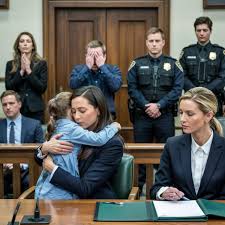
My 5-Year-Old Told Her Teacher, “My Stepdad Counts My Bones at Bedtime.”
“My stepdad counts my bones at bedtime.”Those were the words that changed my life.They were only seven words.Seven words spoken by a five-year-old girl sitting in a kindergarten classroom, probably thinking she was describing an ordinary game.
But when her teacher called me at work that afternoon, I knew immediately that something was terribly wrong.I was standing behind the pharmacy counter at CVS, wearing my blue vest, counting change for a customer.
I had been making $14.50 an hour.
I was exhausted.
I was thinking about rent.I was thinking about dinner.I was thinking about whether we had enough milk at home.Then my phone vibrated.The school.I answered immediately.“Hello?”“Is this Emily Carter?”
“Yes.”“This is Mrs. Reynolds, your daughter’s kindergarten teacher. Are you somewhere you can talk privately?”Something in her voice made my stomach drop.
“What happened?”
There was a pause.
“Your daughter told me something concerning.”My hand tightened around the phone.“What did she say?”Another pause.Then Mrs. Reynolds said quietly:“She said, ‘My stepdad counts my bones at bedtime.’”
Everything around me disappeared.The pharmacy.The customers.The fluorescent lights.The ringing phones.Gone.I couldn’t hear anything except my daughter’s voice in my memory.
Mommy, look.
Mommy, watch this.
Mommy, can I have another story?My little girl.My five-year-old baby.“What does that mean?” I whispered.“I don’t know yet,” her teacher said. “She’s with the school counselor right now. We’re asking her only basic questions. We don’t want to influence what she says.”
“I’m coming.”“Please drive safely.”“I’m coming.”I hung up.My manager looked at me.“What happened?”“My daughter.”He saw my face.“Go.”I didn’t even clock out.
I grabbed my purse and ran.
Fourteen dollars and fifty cents an hour didn’t matter anymore.
Nothing mattered except getting to my daughter.
I made the twelve-minute drive to the school in what felt like twelve seconds.
When I walked through the front office doors, the secretary immediately stood.
“She’s in the counselor’s office.”
I nodded.
I couldn’t speak.
I followed her down the hallway.
The kindergarten artwork on the walls suddenly looked unbearably cheerful.
Finger-painted flowers.
Construction-paper butterflies.
Smiling suns.
Pictures of families.
I saw one drawing my daughter had made two weeks earlier.
Three people standing beneath a blue sky.
Me.
Her.
And my husband, Daniel.
She had written our names underneath.
MOMMY.
LILY.
DADDY DAN.
I stopped looking at it.
I couldn’t breathe.
The counselor opened the door.
My daughter was sitting in a small chair.
She was holding a teddy bear against her chest.
When she saw me, her face changed.
“Mommy!”
She jumped up.
I caught her.
I held her so tightly she complained.
“Mommy, you’re squeezing me.”
I immediately loosened my arms.
“I’m sorry, baby.”
She looked at me.
“Are you mad?”
“No.”
“Did I do something bad?”
My heart shattered.
“No, sweetheart.”
I kissed the top of her head.
“You didn’t do anything wrong.”
The counselor motioned for me to sit.
Her name was Ms. Patel.
She had a folder on the table, but she didn’t open it.
“I want to explain what happened,” she said.
I nodded.
“She told her teacher that your husband has a bedtime game called ‘counting bones.’”
My mouth went dry.
“She described him turning off the lights and touching or pressing along her ribs while counting.”
I stared at the floor.
“She said it hurts?”
Ms. Patel nodded.
“She said it hurts but that he tells her good girls don’t cry.”
I felt something inside me break.
I sat down on the floor.
I didn’t choose to.
My legs simply stopped working.
My daughter watched me.
“Mommy?”
I covered my mouth.
Ms. Patel crouched beside me.
“Mrs. Carter, please remember that you are not responsible for what she may have experienced.”
But I couldn’t hear her.
Because suddenly I remembered every night I had ever trusted Daniel to put my daughter to bed.
Every time he’d said:
“Don’t worry. I’ve got her.”
Every time I’d answered:
“Thank you.”
Every time I had gone to work believing my child was safe.
Daniel had been my husband for four years.
He had never been arrested.
Never yelled in public.
Never missed a birthday.
He packed Lily’s lunches.
He fixed her bicycle.
He helped her with her letters.
He called himself her “bonus dad.”
And I had believed him.
The school resource officer arrived eight minutes after I called 911.
He introduced himself as Officer Harris.
He didn’t interrogate my daughter.
He asked her two simple questions.
“Are you scared of going home?”
She nodded.
Then he asked:
“Is there someone at home who hurts you?”
My daughter looked down at the teddy bear.
After several seconds, she whispered:
“Daniel.”
Officer Harris’s expression changed.
He stood.
He walked into the hallway and spoke into his radio.
“Requesting backup.”
I looked at him.
“What does that mean?”
He looked at me carefully.
“Ma’am, based on what your daughter described, your husband has been placed under investigation for suspected child abuse.”
The words hit me like a physical blow.
“No.”
It came out automatically.
“No. Daniel wouldn’t—”
I stopped.
Because I realized I wasn’t defending him.
I was trying to defend the life I thought I had.
Officer Harris continued.
“We need to make sure your daughter is safe first. Do not confront your husband.”
“I wasn’t going to.”
But I knew I had been thinking exactly that.
I wanted to drive home.
I wanted to open the front door.
I wanted to look Daniel in the eyes and demand an explanation.
I wanted him to tell me it wasn’t true.
I wanted him to laugh and say there had been a misunderstanding.
I wanted my world back.
Instead, I listened to the officer.
I stayed with my daughter.
A child protective services investigator arrived shortly afterward.
Her name was Karen Brooks.
She was calm.
Professional.
She didn’t ask Lily to repeat everything.
She explained that children shouldn’t have to tell the same painful story over and over.
That night, Lily and I stayed somewhere safe.
Not at home.
Not with Daniel.
At my sister’s apartment.
I barely slept.
Lily slept beside me with her teddy bear tucked under her chin.
Around two in the morning, I looked at her sleeping face.
She looked so peaceful.
And I wondered how many nights she had gone to sleep afraid.
The next morning, investigators searched our home.
I wasn’t there.
I didn’t want to be.
I was terrified of what they might find.
But around noon, Karen called.
“We found some things we need to discuss with you.”
My heart stopped.
“What things?”
“There are several details we can’t discuss over the phone. We need you to come in.”
I went.
I sat in a small interview room while Karen placed several photographs on the table.
They weren’t graphic.
They were ordinary household things.
Lily’s bedroom.
Her night-light.
Her bed.
A chair beside it.
A small notebook.
I stared at the notebook.
“What is that?”
“Your husband’s.”
I picked it up.
Inside were dates.
Times.
Short notes.
I turned a page.
Another date.
Another entry.
Then another.
Some of the entries referred to Lily.
I couldn’t understand why anyone would keep records like that.
“What is this?”
Karen looked at me.
“We’re still investigating.”
I flipped another page.
There were measurements.
Descriptions.
Patterns.
My hands began shaking.
Daniel had told me he was keeping track of Lily’s growth.
He’d said he was making sure she was healthy.
He had shown me charts before.
I had thought he was being attentive.
Now I realized those weren’t ordinary notes.
They were evidence.
Evidence that he’d been documenting things about my daughter that no loving stepfather should have been documenting.
I started crying.
“I trusted him.”
Karen said nothing.
“I trusted him with everything.”
She slid a box of tissues toward me.
“I know.”
“No, you don’t.”
I wiped my face.
“He made breakfast for her.”
“I understand.”
“He sat at her school plays.”
“I understand.”
“He called me from work to ask whether she needed new shoes.”
Karen looked at me.
“People who harm children do not always look like monsters.”
That sentence stayed with me.
Because Daniel didn’t look like a monster.
He looked like my husband.
That was what made it so difficult.
The investigation continued for weeks.
There were interviews.
Medical examinations.
School reports.
Messages.
Witness statements.
And slowly, pieces of the truth emerged.
Lily wasn’t the only child who had raised concerns.
Another family had previously complained about Daniel’s behavior at a neighborhood gathering.
Nothing had been proven.
No formal report had been made.
But there had been warning signs.
And I had never known.
Then the investigators found something else.
A hidden storage box.
Inside were notebooks and recordings that changed the entire case.
Daniel had been deliberately documenting his interactions with Lily.
He had created his own explanation for everything.
He called it discipline.
He called it games.
He called it bonding.
But the evidence showed something much darker.
He had been testing boundaries.
And he’d been counting on Lily being too young to explain what was happening.
He had been counting on me trusting him.
That realization made me sick.
One evening, I sat beside Lily on my sister’s couch.
She was coloring.
I watched her draw a house.
“Mommy?”
“Yes?”
“Can I ask you something?”
“Anything.”
“Am I going back home?”
I swallowed.
“Not right now.”
“Why?”
“Because we’re making sure you’re safe.”
She thought about that.
“Is Daniel mad?”
“I don’t know.”
“Is he going to come get me?”
“No.”
She looked at me.
“Promise?”
I held her hand.
“I promise I’ll do everything I can to keep you safe.”
She leaned against me.
After a moment, she whispered:
“Mommy?”
“Yes?”
“I tried to tell you.”
I froze.
“What?”
She looked at her coloring book.
“I tried to tell you before.”
My heart pounded.
“When?”
She shrugged.
“Sometimes.”
“What did you say?”
“I told you Daniel’s game hurt.”
I couldn’t breathe.
I remembered.
A few months earlier, Lily had complained about bedtime.
I’d been tired.
I’d been rushing to work the next morning.
I’d said:
“Daniel’s just playing with you, sweetheart.”
I remembered saying it.
I remembered walking away.
I had thought I was reassuring her.
Instead, I had taught her that the adult she trusted wouldn’t believe her.
I pulled her into my arms.
“I’m sorry.”
She looked confused.
“Why?”
“Because I should have listened better.”
She shook her head.
“You didn’t know.”
That was the kindness of a five-year-old.
She forgave me before I had figured out how to forgive myself.
The case eventually went to court.
Daniel was charged.
He insisted the entire thing was a misunderstanding.
His attorney described the behavior as “misinterpreted affection.”
That phrase made my blood run cold.
But the evidence was stronger than his explanation.
The investigators had the notebook.
The statements.
The recordings.
The school report.
The professional evaluations.
And most importantly, the pattern.
Daniel had carefully constructed a world in which everything could be called a game.
But a game stops being a game when one person is afraid.
A game stops being a game when a child says it hurts.
A game stops being a game when an adult tells that child to stay silent.
And Lily had been afraid.
She had tried to tell someone.
Eventually, she told the one person at school she trusted enough to listen.
Her teacher.
That teacher saved my daughter’s future.
The trial lasted several days.
I sat behind the prosecutor.
Daniel never looked at me.
Not once.
During a recess, I saw him laughing quietly with his attorney.
For a second, I saw the man I married.
The man who made pancakes on Sundays.
The man who helped me move apartments.
The man who held Lily when she had nightmares.
Then I remembered my daughter sitting in that counselor’s office, gripping a teddy bear.
And I stopped seeing my husband.
I saw the truth.
When the verdict came, Daniel was found guilty.
I didn’t celebrate.
There was nothing to celebrate.
My daughter had still been hurt.
My family had still been destroyed.
There was no courtroom victory that could give her back the nights she had spent afraid.
But there was justice.
And there was something else.
Safety.
Months later, Lily returned to kindergarten.
Her teacher hugged her.
The school counselor checked in regularly.
We started therapy.
I changed jobs.
I didn’t care about the $14.50 anymore.
I found work that gave me more flexibility.
I learned how to listen.
Really listen.
Not just to words.
To pauses.
To changes in behavior.
To fear.
To the things children sometimes cannot explain.
One afternoon, Lily came home carrying a drawing.
“Mommy, look!”
I smiled.
“What is it?”
“It’s our new house.”
I looked at the picture.
There were two people.
Me and her.
Above us was a giant yellow sun.
And next to the house was a tree.
“What about Daniel?” I asked before I could stop myself.
She looked at me.
“He doesn’t live here anymore.”
“No.”
“Good.”
Then she added:
“Now I can sleep.”
I closed my eyes.
That sentence was everything.
That night, I tucked her into bed.
I turned on her night-light.
She climbed under the blanket.
I kissed her forehead.
“Goodnight, baby.”
“Goodnight, Mommy.”
I stood up.
Then she called me back.
“Mommy?”
“Yes?”
“Can you stay for a minute?”
I sat beside her.
“Of course.”
She reached for my hand.
We sat quietly.
No games.
No counting.
No fear.
Just a mother holding her daughter’s hand.
After a few minutes, Lily’s eyes began to close.
“Mommy?”
“Yes?”
“I’m safe now, right?”
I squeezed her hand.
“Yes.”
She smiled.
“Okay.”
And she fell asleep.
I stayed beside her for a long time.
Because I finally understood something.
The most important thing a parent can give a child isn’t a perfect home.
It isn’t expensive toys.
It isn’t a big house.
It isn’t even money.
It’s the certainty that when they speak, someone will listen.
When they say they’re afraid, someone will believe them.
And when they say someone is hurting them, someone will stand between them and the person causing that pain.
My daughter had been five years old when she found the courage to say seven words.
“My stepdad counts my bones at bedtime.”
Those words almost destroyed me.
But they also saved her.
Because her teacher listened.
The counselor listened.
The officer listened.
The investigators listened.
And finally, I learned to listen too.
Sometimes children don’t have the vocabulary to explain what is happening.
Sometimes they call something a game because that’s what an adult told them it was.
Sometimes they don’t know how to say, “I’m being hurt.”
So they say:
“I don’t like bedtime.”
“My tummy hurts.”
“I don’t want to go there.”
“Don’t make me be alone with him.”
Or, sometimes, they say something that sounds strange.
Something adults might be tempted to dismiss.
Something like:
“My stepdad counts my bones.”
We have to listen.
Because behind those strange little sentences can be a child begging someone to understand.
And when a child finally finds the courage to speak, the worst thing an adult can do is make them feel foolish for saying it.
My daughter wasn’t foolish.
She wasn’t confused.
She wasn’t lying.
She was five years old.
And she was asking for help in the only way she knew how.
I will spend the rest of my life being grateful that someone finally heard her.
And I will never again confuse a child’s fear with imagination.
Because sometimes the smallest voice in the room is carrying the biggest truth.