THEY LAUGHED WHEN THEY SAW ME SERVING THEIR TABLE. THEN THE MICROPHONE TURNED ON…
The coffee pot was heavier than it looked.Maybe it was because my hands were tired.Or maybe because I had spent the last two years carrying things far heavier than coffee.
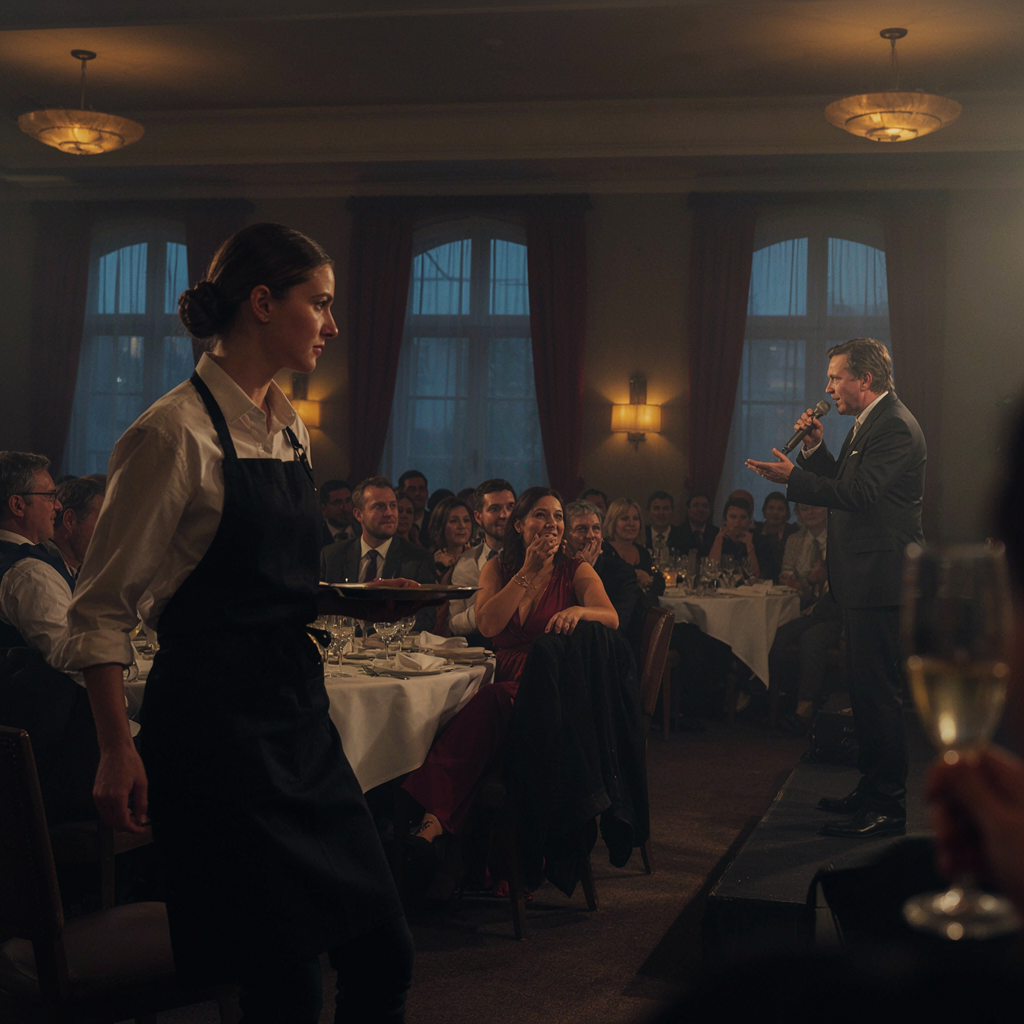
I balanced the silver pot in one hand and a tray of clean cups in the other as I walked into the banquet hall where my high school reunion was being held.
Class of 1986.
Forty years.
Forty years since we had stood beneath a banner that said Congratulations, Seniors! and promised each other that none of us would ever forget where we came from.
Most of us had forgotten.Or at least, they had forgotten me.I had spent six years working at the Riverside Banquet Hall.I knew which doors squeaked.
I knew which table had a leg that needed a folded napkin underneath it.
I knew how long the coffee could sit before it turned bitter.
And I knew how to smile when someone looked at my uniform and then looked away.That night, I was serving the same people who had once sat beside me in chemistry class.People who had borrowed my homework.
People who had copied my answers.People who had laughed with me in the cafeteria.People who had once known my name.
Now, most of them didn’t even recognize me.
And somehow, that hurt less than the ones who did.My husband, Daniel, had died eight months earlier.Cancer had taken him slowly.First, it took his strength.Then his ability to work.Then our retirement savings.
Then the house we had spent thirty years paying for.Then, finally, it took him.Daniel had always told me that he was sorry.
Every time another medical bill arrived, he’d stare at it and whisper, “I’m sorry, Margaret.”
I always told him the same thing.
“You don’t apologize for getting sick.”
But after he died, I realized something.
Grief doesn’t only break your heart.
It rearranges your entire life.
The morning after his funeral, I woke up in a house that was no longer ours.
The mortgage was behind.
The savings were gone.
The pension barely covered utilities.
So I sold what I could.
I moved into a small apartment.
And I tied an apron around my waist.
There was no shame in working.
I knew that.
But knowing something and feeling it are two different things.
Especially when the people laughing at you are the same people you once dreamed about impressing.
That evening, I entered the ballroom through the service entrance.
I didn’t expect anyone from my class to notice.
Then I heard a voice.
“Wait.”
I froze.
The voice belonged to Heather Whitmore.
Everyone remembered Heather.
She had been the queen bee of our class.
Perfect hair.
Perfect clothes.
Perfect smile.
Perfectly cruel.
In 1986, she had been the girl everyone wanted to be.
Forty years later, she was still dressed like she was trying to prove it.
She wore a sparkling black dress, a diamond bracelet, and an expression that said the room belonged to her.
She stared at me.
Then her eyes widened.
“Oh my God.”
A few women around her turned.
Heather laughed.
“Is that you, Margaret?”
I smiled politely.
“Hi, Heather.”
She looked at my apron.
Then at the coffee pot.
Then back at my face.
“No.”
Someone beside her laughed.
Heather covered her mouth.
“Girls, look who’s serving us!”
More laughter.
I lowered my eyes.
She stepped closer.
“I honestly didn’t recognize you.”
“You’ve changed,” I said.
“So have you.”
She looked me up and down.
“I heard you married Daniel Parker.”
“I did.”
“He’s…?”
“Passed away.”
For half a second, her expression softened.
Then it disappeared.
“Oh.”
Just one word.
No sympathy.
No apology.
No hug.
Just oh.
Then she smiled.
“Well, some of us made something of ourselves.”
She gestured toward the ballroom.
“And some are still clearing plates.”
The women around her laughed again.
I felt something tighten in my chest.
But I smiled.
“Would you like cream with your coffee?”
Heather blinked.
Then she laughed harder.
“Yes. Actually, I would.”
I poured her coffee.
“Don’t forget the cream.”
“I won’t.”
“And make sure my glass stays full.”
“Of course.”
She leaned toward her friends.
“See? Still obedient.”
I walked away.
I didn’t cry.
Not then.
I had cried enough in hospitals.
I had cried enough beside Daniel’s empty bed.
I had cried enough while selling our wedding china because I needed money for groceries.
I wasn’t going to give Heather Whitmore my tears.
Instead, I went back to work.
For the next three hours, I refilled glasses.
I carried plates.
I cleared dishes.
I smiled.
And slowly, people began recognizing me.
Some reacted with surprise.
Others pretended not to notice.
One man, Kevin Marshall, stared at me for almost a minute before saying, “Margaret?”
“Hi, Kevin.”
He looked uncomfortable.
“I heard about Daniel.”
“Thank you.”
“I’m sorry.”
“Thank you.”
He nodded.
Then he looked at the floor.
“I should’ve stayed in touch.”
I smiled.
“Most people should have.”
He looked up.
For a second, we were sixteen again.
Then someone called his name, and the moment disappeared.
Around nine-thirty, dinner was finished.
The band had started playing old songs.
People were drinking.
Laughing.
Dancing.
Taking pictures.
I stood near the service station, folding napkins.
Then I heard a familiar voice behind me.
“You’ve really come down in the world.”
I didn’t need to turn around.
Heather.
I continued folding.
“Good evening to you too.”
She stepped beside me.
“I was wondering something.”
“What?”
“Do you ever think about how different your life could’ve been?”
I stopped.
She smiled.
“Because I do.”
“What do you mean?”
“1986.”
My hands went still.
Heather leaned closer.
“You know what I mean.”
I turned toward her.
“I don’t.”
She laughed softly.
“Of course you don’t.”
Then she walked away.
My heart was pounding.
For forty years, I had tried not to think about that year.
Not because it was bad.
Because it was complicated.
Because there was something about that year that nobody had ever explained.
Something I had buried.
Something I had convinced myself didn’t matter.
But it did.
More than I knew.
I was seventeen again.
June 1986.
Graduation was three days away.
I had been accepted into a nursing program with a scholarship.
It was everything I wanted.
My parents couldn’t afford college.
The scholarship was my escape.
My future.
My chance to become something.
Then, one afternoon, I was called into the principal’s office.
Mr. Reynolds sat behind his desk.
Heather was there.
So was our class president, Thomas Bennett.
Thomas had been my best friend.
Maybe more than a friend.
We had spent years together.
Study sessions.
Football games.
Late-night phone calls.
He was the only person who knew how badly I wanted to leave our small town and become a nurse.
When I walked into the office, Heather was crying.
“I don’t understand,” she said.
The principal looked at me.
“Margaret, did you steal the answer key for the final exam?”
I stared at him.
“What?”
Heather sobbed.
“I saw her.”
My stomach dropped.
“You saw me?”
“You were in the teacher’s lounge.”
“I wasn’t.”
Thomas said nothing.
I looked at him.
“Thomas?”
He wouldn’t meet my eyes.
The principal showed me a typed statement.
It said I had stolen the exam answers and sold copies to other students.
I couldn’t believe it.
I denied everything.
But the school board was already convinced.
My scholarship was suspended pending investigation.
The police were contacted.
My father was furious.
My mother cried.
And Thomas?
He disappeared.
Two days later, I was told the scholarship had been revoked.
The investigation ended without criminal charges, but the damage was done.
I didn’t go to nursing school.
I took a job at the factory.
Three months later, I married Daniel.
He was kind.
Steady.
He loved me.
And I loved him.
We built a good life.
But sometimes, late at night, I wondered what might have happened if I’d become a nurse.
If I had gone to college.
If someone had believed me.
If Thomas had spoken.
That was the secret I had carried for forty years.
Not because I knew what happened.
Because I never knew.
Until that night.
At ten-fifteen, the music stopped.
The lights dimmed.
Everyone turned toward the stage.
Our class president, Thomas Bennett, walked to the microphone.
He was older now.
Gray hair.
Glasses.
A little heavier.
But I recognized him instantly.
My heart began pounding.
He looked out at the room.
“Forty years,” he said.
People clapped.
“Forty years since we graduated.”
He smiled.
“We’ve spent tonight talking about where we ended up.”
He paused.
“Doctors. Lawyers. Teachers. Business owners. Parents. Grandparents.”
People laughed.
Then his expression changed.
“But while organizing this reunion, I found something.”
The room grew quiet.
“Something I had completely forgotten.”
He held up a small cardboard box.
“It was in an old storage cabinet at the school.”
I stared at it.
Thomas looked down at the box.
“Inside were documents from our senior year.”
He pulled out a yellowed envelope.
“Disciplinary records.”
My stomach dropped.
Thomas looked directly at me.
“Margaret?”
The room turned.
Hundreds of eyes.
Mine met his.
“I owe you an apology.”
Someone whispered.
Heather’s face went pale.
Thomas continued.
“In 1986, Margaret was accused of stealing our final exam.”
A murmur moved through the ballroom.
“She wasn’t guilty.”
Silence.
“You heard me.”
Thomas’s voice shook.
“She wasn’t guilty.”
Heather stood up.
“Thomas—”
He raised a hand.
“Please let me finish.”
He opened the envelope.
“The original report was here.”
He held up a document.
“The handwriting on the statement accusing Margaret wasn’t hers.”
He looked toward Heather.
“It was yours.”
The room exploded.
“What?”
“No way.”
“Are you serious?”
Heather’s face went white.
Thomas continued.
“I found another document.”
He held up a second page.
“A note written by Heather to the principal.”
He swallowed.
“She admitted she had taken the exam answers.”
I couldn’t breathe.
Thomas looked at me.
“But there’s more.”
The room went silent again.
“She didn’t do it alone.”
He turned toward himself.
“I helped her.”
A collective gasp.
I stared at him.
“No.”
Thomas nodded.
“Yes.”
I could barely hear him.
“Why?”
His eyes filled with tears.
“Because Heather threatened to expose me.”
“Expose you for what?”
He looked down.
“I had stolen money from the student council fund.”
The room erupted again.
“I was seventeen,” he said. “I was scared. Heather found out. She told me that if I didn’t help her frame someone, she’d tell the principal.”
He looked at me.
“And she chose you.”
Heather shook her head.
“That’s not true.”
Thomas turned toward her.
“It is.”
“You promised!”
“I promised forty years ago.”
His voice broke.
“But I’m not going to die carrying this.”
The ballroom went silent.
Heather began crying.
“I was seventeen.”
“So was I,” I said.
Everyone turned toward me.
I hadn’t realized I’d spoken aloud.
Heather stared at me.
I stepped forward.
“So was I.”
She wiped her eyes.
“You don’t understand.”
“I understand perfectly.”
“No, you don’t.”
She shook her head.
“You had everything.”
I laughed once.
It wasn’t a happy laugh.
“Everything?”
“You were smart. Teachers loved you. You were going to college.”
“You mean the college you stopped me from attending?”
She looked away.
“I was jealous.”
“Jealous?”
“I was terrified.”
“Of me?”
“Of being ordinary.”
The room was silent.
Heather took a breath.
“You were going to leave. You were going to become someone. Everyone knew it.”
She looked at me.
“And I couldn’t stand the thought that you would succeed while I stayed here.”
I stared at her.
Forty years.
Forty years I had wondered whether I had somehow failed.
Whether I wasn’t smart enough.
Whether I hadn’t been brave enough.
Whether my life had simply been destined to become what it became.
And the truth was so much uglier.
Someone had stolen my future.
Not fate.
Not bad luck.
Jealousy.
I looked at Thomas.
“And you?”
He lowered his head.
“I was a coward.”
“Yes.”
He nodded.
“You were.”
No one spoke.
Then Thomas said something that changed everything.
“I didn’t just find the confession.”
He reached into the box.
“I found the scholarship committee’s original letter.”
He handed it to me.
My hands shook as I opened it.
I read the faded words.
My scholarship had never actually been revoked.
It had been placed on temporary hold pending the investigation.
But three days later, the committee had cleared me.
The letter said they had tried to contact me.
They had sent another letter.
Then another.
But none had reached me.
Thomas looked at me.
“Because Heather intercepted them.”
Heather began sobbing.
I closed my eyes.
For forty years, I had believed the door had closed.
It hadn’t.
Someone had locked it.
I looked at Heather.
“Why didn’t you ever tell me?”
She couldn’t answer.
“Why?”
Finally she whispered.
“Because after a while, I was too ashamed.”
I shook my head.
“No.”
She looked up.
“You weren’t ashamed.”
“What?”
“You were afraid.”
I folded the letter.
“You were afraid that if you told the truth, everyone would see who you really were.”
She cried harder.
I felt no triumph.
That surprised me.
I had imagined this moment many times.
I had imagined screaming.
I had imagined humiliating her.
I had imagined telling everyone exactly what she had done.
But standing there, I felt something else.
Sadness.
Not for Heather.
For seventeen-year-old me.
The girl who had once dreamed of wearing a white nursing uniform.
The girl who had believed hard work was enough.
The girl who had lost a future and never even knew why.
Thomas stepped toward me.
“Margaret, I’m sorry.”
I looked at him.
“You should have told me forty years ago.”
“I know.”
“You could have changed my life.”
“I know.”
“Daniel and I struggled financially for years.”
His eyes filled.
“I know.”
“My husband died believing we had done the best we could.”
Thomas nodded.
“And you did.”
I looked at the scholarship letter again.
Then I smiled sadly.
“Yes.”
I handed it back.
He stared at me.
“You don’t want it?”
“It’s forty years old.”
“I can still help you.”
“No.”
“But—”
“I don’t want money.”
The room went quiet.
“I wanted the truth.”
Thomas nodded.
“And now you have it.”
I looked around the ballroom.
All those faces.
People who had once known me.
People who had laughed at me.
People who had ignored me.
People who had forgotten me.
And suddenly I realized something.
I wasn’t ashamed of the apron anymore.
I looked down at it.
This apron had fed my family.
It had paid my rent.
It had helped me survive.
It had carried me through the worst year of my life.
There was no shame in it.
I turned toward the microphone.
“Can I say something?”
Thomas stepped aside.
I walked onto the stage.
My hands trembled as I took the microphone.
I looked at my classmates.
“Forty years ago, I thought my life was over.”
No one moved.
“I thought losing that scholarship meant I wasn’t meant to become a nurse.”
I swallowed.
“I thought maybe I wasn’t good enough.”
I looked at Heather.
“Tonight I learned that I was never the problem.”
Someone began crying.
I continued.
“But here’s what I want you to understand.”
I looked around the room.
“Your life doesn’t always turn out the way you planned.”
I thought about Daniel.
“You lose people.”
I thought about the hospital.
“You lose money.”
I thought about the house.
“You lose opportunities.”
I thought about the scholarship.
“And sometimes, people hurt you.”
I looked at Heather.
“But you don’t have to spend the rest of your life letting them decide who you are.”
The room was completely silent.
“I didn’t become a nurse.”
My voice cracked.
“But I became a wife.”
I smiled.
“A mother.”
Another smile.
“A caregiver.”
I looked down.
“And now I’m a woman who knows that surviving something doesn’t make you a failure.”
I looked at my apron.
“It makes you strong.”
For several seconds, nobody moved.
Then someone stood.
It was Kevin.
He began clapping.
Then another person stood.
Then another.
Within seconds, the entire room was on its feet.
Applause filled the ballroom.
I stood there, overwhelmed.
Not because they were applauding me.
Because for the first time in forty years, I wasn’t standing in the shadow of what had happened.
I was standing in my own life.
After the reunion ended, I walked through the empty ballroom.
Chairs were scattered.
Half-empty glasses sat on tables.
The band was packing up.
Heather was gone.
Thomas remained.
He approached me quietly.
“I meant what I said.”
“I know.”
“I wish I could go back.”
“So do I.”
He looked at me.
“Would you have become a nurse?”
I smiled.
“I don’t know.”
Then I thought about Daniel.
“I might have.”
He nodded.
“I hope someday you can forgive me.”
I looked at him.
“I already did.”
His eyes widened.
“Really?”
“No.”
He laughed through his tears.
“Fair enough.”
I smiled.
“Maybe someday.”
He nodded.
“That’s more than I deserve.”
I watched him leave.
Then I picked up my coffee pot.
The next morning, I went back to work.
Same apron.
Same coffee.
Same banquet hall.
But something had changed.
When I walked into the kitchen, my manager, Susan, looked at me.
“How was the reunion?”
I smiled.
“Interesting.”
She raised an eyebrow.
“That’s all you’re going to say?”
I laughed.
“Let’s just say I finally got my answer.”
Three weeks later, something unexpected happened.
A letter arrived.
It was from a local community college.
Someone had told them about my story.
They were offering me a place in an adult nursing program.
Tuition assistance included.
I stared at the letter for a long time.
Then I laughed.
At seventy-one years old, I was going back to school.
I called my daughter.
“Mom?”
“I got into nursing school.”
There was silence.
Then she screamed.
“What?”
I laughed.
“I think your mother is finally going to finish something she started forty years ago.”
She began crying.
So did I.
A year later, I walked across a stage wearing a white nursing uniform.
My classmates were twenty, thirty, forty years younger than me.
But when they called my name, I didn’t feel old.
I felt seventeen.
Only this time, nobody could take the future away from me.
After graduation, I found a job at a hospice center.
It was the perfect place.
I understood the patients.
I understood their families.
I understood what it meant to lose someone.
I understood that sometimes the greatest gift you can give another person isn’t medicine.
It’s presence.
One evening, I sat beside an elderly woman whose husband was dying.
She held his hand.
“I’m afraid,” she whispered.
I squeezed her shoulder.
“I know.”
She looked at me.
“How do you know?”
I smiled.
“Because I’ve been afraid too.”
She looked at my name badge.
“You’re a nurse?”
“Yes.”
She smiled.
“You don’t look like one.”
I laughed.
“Forty years ago, someone told me I wasn’t going to become one.”
She frowned.
“What happened?”
I looked at her husband sleeping peacefully.
“Someone was wrong.”
She smiled.
I smiled back.
And for the first time, I realized something.
Heather had stolen four years from my life.
But she hadn’t stolen all of it.
Daniel had died.
My savings were gone.
My house was gone.
My youth was gone.
But I was still here.
Still standing.
Still learning.
Still becoming.
And sometimes the greatest revenge isn’t watching the person who hurt you suffer.
Sometimes it’s waking up one morning and realizing they no longer have any power over you.
Years later, I kept one thing from that reunion.
Not the photograph.
Not the scholarship letter.
Not the old newspaper article.
I kept the coffee pot.
The same silver coffee pot I had carried that night.
I polished it and placed it on a shelf in my kitchen.
Whenever someone asked why I kept it, I smiled.
“Because once upon a time, I thought serving coffee was proof that I’d failed.”
Then I’d tell them the truth.
“It turned out it was just the job I had before I found my way back to myself.”
And every August, on the anniversary of our graduation, I would look at that coffee pot and remember the girl I had been.
Seventeen.
Scared.
Dreaming.
Wrongly accused.
And I would whisper the words I wish someone had told her back then.
“You didn’t fail, Margaret.”
“You were delayed.”
“There’s a difference.”
Because sometimes life doesn’t give you the future you planned.
Sometimes it takes forty years to uncover the truth.
Sometimes the people who laugh at you today have no idea what you’ll become tomorrow.
And sometimes…
The person carrying the coffee pot is the strongest person in the room.