My name is Emily Reynolds, and for fourteen years, I thought I had the kind of marriage people envied.Mark and I met when we were twenty-six. He was charming, ambitious, and had a way of making everyone feel like the most important person in the room. He remembered birthdays, brought flowers home for no reason, and never forgot to kiss me before leaving for work.When my father warned me not to confuse charm with character, I laughed.”Dad,” I’d told him, “you’re just overprotective.”
He sighed but didn’t argue.
“I hope I’m wrong.”
For years, it seemed he was.Mark became a successful financial consultant while I taught third grade at the local elementary school. We bought a beautiful colonial-style home in Cedar Grove, built a comfortable savings account, and talked endlessly about someday having children.Life wasn’t perfect, but it was ours.Or so I thought.The first crack appeared after my father died.Dad had been an attorney for nearly forty years, specializing in estate law. He wasn’t wealthy by billionaire standards, but he’d lived carefully, invested wisely, and believed in preparing for every possibility.
A week before he passed away, he asked to speak with me alone.
The hospital room smelled faintly of antiseptic and lilies from visitors.
His voice was weak.”Emily.””I’m here, Dad.”He reached toward the bedside drawer.”Take this.”Inside was a thick manila folder sealed with a strip of red tape.”Don’t open it unless you absolutely have to.”I frowned.”What is it?””Insurance.”He smiled softly.”Not the kind you buy.””Dad…””If your life stays happy, you’ll never need it.”His eyes became serious.”But if anyone ever betrays you…especially financially…promise me you’ll remember this folder.”
I laughed nervously.
“Mark would never do that.”
Dad didn’t answer.He simply squeezed my hand.”Promise.””I promise.”Those were the last coherent words he ever spoke.For almost two years, the folder stayed untouched inside my safe.I forgot about it.Until one rainy Tuesday afternoon.Mark walked into the kitchen unusually cheerful.”Good news.””What happened?””Our accountant found a way to save us thousands in taxes.”He placed several documents on the counter.”I just need your signature.”I skimmed the first page.
Legal language.
Dense paragraphs.
“What exactly is this?”
He chuckled.
“You know how much tax paperwork there is. It’s transferring some ownership percentages for liability protection.”
I hesitated.
“Shouldn’t I read it?”
He kissed my forehead.
“Babe.”
He laughed.
“You trust me, don’t you?”
Fourteen years.
One mortgage.
Shared bank accounts.
Vacations.
Christmas mornings.
Birthdays.
Why wouldn’t I?
I signed.
Every page.
Three months later, I stopped by our bank to withdraw money for a school fundraiser.
The teller frowned.
“I’m sorry.”
She typed again.
“There seems to be an issue.”
“What kind of issue?”
“The account has been closed.”
I blinked.
“That’s impossible.”
She looked uncomfortable.
“It was closed six weeks ago.”
I laughed.
“No.”
She turned the monitor slightly.
The paperwork carried my husband’s signature.
Only his.
Balance transferred.
$182,437.18.
Zero remaining.
My hands started shaking.
“There has to be some mistake.”
“I’m sorry.”
I called Mark immediately.
No answer.
Again.
Voicemail.
Again.
Nothing.
When I drove home, the locks had been changed.
A moving truck sat in the driveway.
His mother, Diane, stood on the porch.
She folded her arms.
“You shouldn’t be here.”
“What are you talking about?”
“This house belongs to me.”
I laughed.
“No.”
She held up paperwork.
“Actually…”
She smiled.
“It legally does.”
I hired an attorney the next morning.
Within an hour, he looked pale.
“I’m afraid…”
He rubbed his forehead.
“Emily.”
“What?”
“You signed a quitclaim deed.”
My stomach dropped.
“What?”
“You transferred your ownership interest in the house.”
“No.”
“You did.”
He slid the document toward me.
My signature.
Every initial.
Every page.
“I thought it was tax paperwork.”
He closed his eyes.
“I’m sorry.”
It got worse.
Mark had also convinced me to sign financial authorization documents hidden inside the same stack.
Perfectly legal.
Perfectly devastating.
Two weeks later, divorce papers arrived.
Irreconcilable differences.
No request for spousal support.
No property division.
Because…
There was supposedly nothing left to divide.
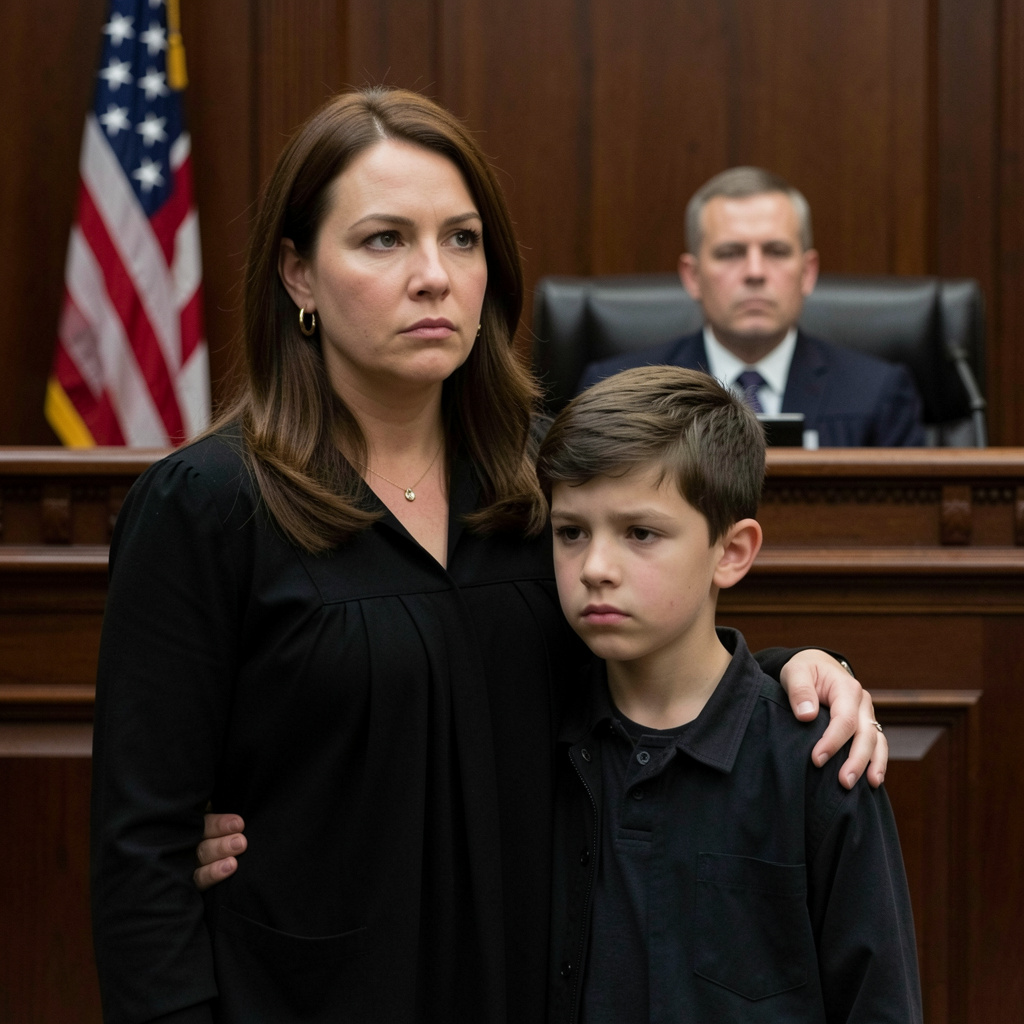
Court day arrived on a cold November morning.
Mark looked expensive.
Tailored navy suit.
New watch.
Confident smile.
His lawyer practically glowed.
“This will be quick.”
I sat alone.
No attorney.
I’d spent nearly everything fighting just to understand what had happened.
The judge reviewed the file.
“Mrs. Reynolds.”
“Yes, Your Honor.”
“Do you have legal representation today?”
“No, sir.”
Across the room, Mark’s attorney stood.
“My client has complied fully with disclosure requirements.”
He smiled politely.
“The marital residence is owned by Mr. Reynolds’ mother.”
He gestured toward Diane.
“My client possesses no joint savings.”
He looked directly at me.
“There are essentially no marital assets.”
Mark avoided my eyes.
The judge sighed.
“This appears straightforward.”
Then he looked back at me.
“Mrs. Reynolds.”
“Is there anything you’d like the court to know before we proceed?”
I remembered my father.
The folder.
Still sitting inside my safe.
“I need five minutes.”
The courtroom granted a brief recess.
I ran to my car.
Opened the trunk.
Inside was my emergency bag.
The folder rested exactly where I’d left it.
Still sealed.
My hands trembled as I peeled away the faded red tape.
Inside were several documents.
A handwritten letter.
A flash drive.
Certified copies of legal filings.
And one envelope labeled:
ONLY IF MARK BETRAYS YOU.
I froze.
How?
I opened it.
Emily.
If you’re reading this, then I was right.
I prayed I wouldn’t be.
I never trusted Mark.
Not because of anything obvious.
Because I spent forty years reading people who smiled while planning theft.
Three years before my death, I quietly hired a private investigator.
My breathing stopped.
The investigator discovered Mark had attempted similar financial schemes during a previous engagement.
A copy of that report is enclosed.
I turned pages frantically.
Statements.
Interviews.
Emails.
Then another paragraph.
More importantly…
When you and Mark bought your home, I contributed nearly seventy percent of the down payment.
I frowned.
I knew he’d helped.
I hadn’t realized how much.
My contribution wasn’t a gift.
It was documented as a secured family investment with conditions protecting my daughter against fraudulent transfer.
I stared.
Attached was a notarized agreement.
Signed.
Recorded.
Filed with the county.
I’d completely forgotten signing anything years ago.
Dad had handled the paperwork.
Apparently Mark had signed too.
Another document followed.
A recorded lien.
Against the property.
One requiring Dad—or his estate—to approve ownership transfers.
Approval that had never been given.
Meaning…
The transfer to Diane…
Was invalid.
Then I plugged the flash drive into my laptop.
It contained something unexpected.
A video.
Dad appeared on screen.
“If this reaches a courtroom…”
He smiled sadly.
“…hello, Judge.”
He explained everything.
Every legal safeguard.
Every filing.
Every concern he’d quietly documented.
Then came the final sentence.
“If Mark Reynolds has transferred property without satisfying the recorded security interest, he has likely committed fraud upon both the lender and this court.”
My heart pounded.
I walked back inside.
Court resumed.
The judge looked impatient.
“Mrs. Reynolds?”
I placed the folder on the bench.
“My father asked me to give you this if this day ever came.”
He adjusted his glasses.
Opened the folder.
Silence filled the courtroom.
He read one page.
Then another.
Then another.
His expression changed completely.
He looked toward Mark.
“Mr. Reynolds.”
Mark smiled nervously.
“Yes, Your Honor?”
The judge held up the recorded lien.
“Did you disclose this security interest?”
Mark’s attorney frowned.
“What security interest?”
The judge continued reading.
His face hardened.
He examined the investigator’s report.
The notarized investment agreement.
The county recording receipt.
Finally, he watched part of Dad’s video using headphones provided by the clerk.
When he finished…
He removed them very slowly.
Then looked directly at Mark.
“Sir.”
The courtroom became perfectly silent.
“You have a very serious problem.”
Mark’s confidence disappeared instantly.
“My attorney—”
The judge interrupted.
“No.”
He tapped the documents.
“If these filings are authentic—and they appear to be—you transferred encumbered property without authorization.”
He flipped another page.
“You also failed to disclose material financial interests during these proceedings.”
Mark’s lawyer whispered urgently.
“What didn’t you tell me?”
Mark couldn’t answer.
The judge ordered an immediate recess while the documents were verified through county records.
It took less than thirty minutes.
Every filing was genuine.
Every signature valid.
Every recording properly indexed.
The lien had existed for twelve years.
Mark had known.
He’d signed it himself.
When court resumed, everything changed.
The judge vacated the fraudulent property transfer pending further litigation.
He froze all disputed financial assets.
He referred the case to the district attorney for investigation into potential fraud, perjury, and fraudulent conveyance.
Then he looked at Diane.
“Mrs. Reynolds.”
She stood shakily.
“Yes?”
“You may wish to obtain independent legal counsel.”
Her face turned white.
Mark’s attorney quietly withdrew from representing him that afternoon.
“I was never informed about these documents.”
Over the following year, investigators uncovered far more than anyone expected.
The $180,000 hadn’t disappeared.
It had been moved through accounts controlled by Mark and his mother.
Emails revealed they had planned the scheme nearly eight months before asking me to sign the papers.
One message read:
“She never reads anything.”
Another:
“Once the house is in Mom’s name, she’ll walk away with nothing.”
The jury saw every word.
The criminal trial lasted three weeks.
Mark was convicted of multiple fraud-related offenses.
Diane avoided prison by cooperating fully and returning every asset she had received.
The house was restored to the marital estate.
The stolen savings were recovered with interest.
Because of the fraudulent conduct, the divorce court awarded me nearly everything.
Not as revenge.
As justice.
Months later, I sat alone in my restored living room.
The evening sun spilled across the hardwood floors.
Dad’s folder rested beside me.
Inside was one final handwritten note I hadn’t noticed before.
Folded into the back cover.
It simply said:
“A parent cannot protect a child forever.”
“But sometimes…”
“We can protect them long enough.”
I cried harder than I had at his funeral.
Not because of the money.
Not because I had won.
Because even after he was gone…
My father had still been looking after me.
Today, the folder sits in my own safe.
Not because I expect betrayal.
But because it reminds me of something far more valuable than legal documents.
Trust is precious.
Love is beautiful.
But neither should ever require blindness.
If someone truly loves you, they’ll never pressure you to sign something you don’t understand.
And if they ever say, “Don’t even read it,” that’s the moment you should read every single word.
Because sometimes the smallest signature can cost everything.
And sometimes, thanks to the quiet wisdom of someone who loved you long before the lies began, it can also become the very thing that saves you.