I never told my daughter’s school that I was a judge.
It wasn’t a secret I kept out of shame. It was a test I’d run my whole life, ever since law school, ever since the bench: watch what people do when they think no one with power is watching.
People show you who they are in the gap between how they treat someone they fear and someone they don’t. I wanted to know who was teaching my daughter Mia in that gap.
So on the enrollment forms, under “Occupation,” I wrote administrative work, family court services.
True enough. Vague enough. To the front office, to the homeroom teacher, to the woman who ran the after-school program, I was just Ms. Lindqvist — a single mother, polite, a little tired-looking, easy to slot into the category of parent who won’t make trouble.
I’d been a family court judge for eleven years. I had sat across from men who screamed at their ex-wives in my courtroom and women who lied about custody violations with their hands folded sweetly in their laps. I had learned, in that time, that the people who hurt children rarely look like monsters in the moment.
They look bored. They look entitled. They look like they believe, completely, that no one is going to do anything about it.
I found out exactly what that boredom looked like on a Tuesday in October.
I was supposed to pick Mia up at three-fifteen. I left chambers early — a custody mediation had collapsed and the afternoon opened up unexpectedly — and I got to Brookhaven Primary at two-forty.
I parked at the far end of the lot, out of habit, the same way I always parked at the far end of every lot, the same way I always sat with my back to a wall in restaurants. Old instincts. A judge develops a particular kind of paranoia.
The front office was empty. The secretary, Mrs. Polk, was at lunch or in the bathroom or wherever secretaries go in the gap between the lunch bell and pickup, and the door to the hallway was propped open with a rubber wedge, the way it always was for the after-school aides to wheel their carts through. I walked in without anyone stopping me, because no one ever stopped me. I was the easy-to-dismiss mother. I had spent eight months cultivating that.
Mia’s classroom was the third door on the left. It was empty. No coats on the hooks, no backpacks under the cubbies. For a half-second my stomach dropped the way it does when you can’t immediately locate a child, that animal lurch that every parent knows, and then I heard it — not crying, not yet, just a single voice, raised, coming from down the corridor, from the door marked SUPPLY ROOM in stenciled black letters.
I didn’t run. Running announces you. I walked, fast, and I took my phone out of my coat pocket and I was already recording before I reached the door, because some part of my brain — the part that had spent eleven years building cases out of fragments of evidence, the part that had watched a thousand witnesses describe things that happened in rooms where no one else was supposed to be — already understood what I was about to find.
The door wasn’t locked. It didn’t need to be. A child doesn’t know that doors without locks can still be doors she isn’t allowed to open.
Mia was sitting on an overturned plastic crate between a shelf of construction paper and a rack of mops, her knees pulled up to her chest, her eyes red but dry — she’d stopped crying, or she was holding it in, the way she did, the way that always broke something in me because eight-year-olds shouldn’t already know how to hold it in. Ms. Halvorsen, her teacher, was standing over her with one hand braced on the shelf, finishing a sentence I’d walked in on the tail end of.
“—and you’ll sit there until you remember how to listen, because clearly nothing else works with you.”
I said her name. Just that. “Ms. Halvorsen.”
She turned, and I watched her face do the calculation every person like her does — assess the threat level of the parent in the doorway, decide how much performance is required. She looked at me, at my cardigan, my flat shoes, my generally unthreatening countenance, and she did not see a problem. She saw an inconvenience.
“Mrs. Lindqvist.” Not even Ms. “Your daughter was disruptive during reading group. I needed a quiet space to —”
“How long has she been in here.”
“Twenty minutes, maybe. It’s not a punishment, it’s a —”
“It’s a closet.” I kept my voice level. This is a skill, by the way — the flat, unhurried voice. I’d used it from the bench for over a decade, the voice that doesn’t rise no matter what’s said to it, because the moment a judge raises her voice she’s lost the room. “There’s no window. There’s no ventilation. There’s a mop bucket eighteen inches from my daughter’s face.”
“She’s fine.” And here is where Ms. Halvorsen made the mistake that ended her career, although she didn’t know it yet, because people who have never been held accountable for anything cannot imagine the specific shape accountability takes until it’s already closed around them. She rolled her eyes — actually rolled them, an arc visible even from the doorway — and said, “Your daughter is too slow to understand. This is how I deal with students like her. If you spent more time with her instead of whatever it is you do all day, maybe she’d —”
“You can stop there.” I crossed the room and crouched in front of Mia, checked her hands, her arms, the crease of her elbow where I knew to look first, because that’s where it shows. Nothing visible. I would learn later, from Mia, in the gentle unhurried way I drew it out of her over the following week with a child psychologist named Dr. Anh Pham, that this was not the first time. It was the fourth. The room was apparently a known tool, used quietly, used on “students like her” — a phrase that, I would discover, Ms. Halvorsen had used about at least three other children that year, all of whom shared a particular profile: quiet, parents who didn’t volunteer at school events, parents who never showed up to challenge anything.
I am very good, professionally, at not showing what I am feeling. I have sat through testimony about things done to children that would make most people leave the room. I did not feel calm in that supply closet. I felt something with teeth. But I have also learned, the hard way, in courtrooms, that the version of yourself that wins is never the version that screams.
I stood up. I held my phone, screen dark now, recording light still glowing faint red at the top.
“I want to speak with the principal,” I said.
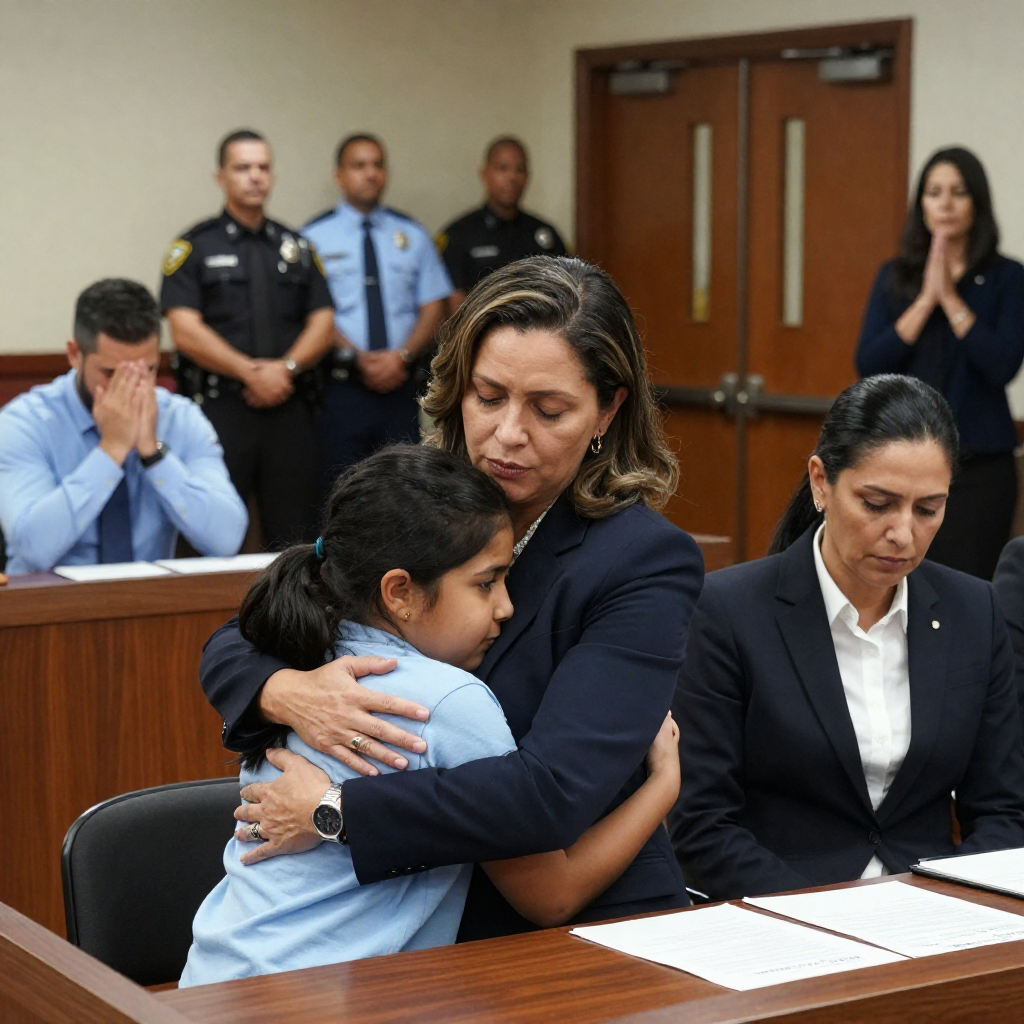
Principal Greaves’s office had a framed needlepoint on the wall that read Every Child Blooms in Their Own Time, which I noted with the specific, cold attention I usually reserved for reading a defendant’s prior record. Ms. Halvorsen sat in the chair beside me, arms crossed, jaw set in the particular posture of someone rehearsing her own innocence. Greaves sat behind his desk with the practiced concern of a man who has had this meeting before and developed a script for it.
I played the video. The whole two minutes and forty seconds of it — Mia on the crate, Halvorsen’s voice, the sentence about students like her, all of it, full volume, on the desk between us where neither of them could pretend not to have heard it clearly.
Greaves’s face did something complicated. He looked, for about four seconds, like a man who understood the severity of what he’d just watched. Then he looked at Ms. Halvorsen, then back at me, and I watched him make a decision that told me everything about the actual hierarchy of values in that building — not children first, not even law first, but liability first, and liability, in his calculation, meant protecting the institution from me rather than protecting my daughter from his employee.
“Mrs. Lindqvist.” He folded his hands. “I understand you’re upset. But I’d ask you to consider the position you’re putting this school in. Ms. Halvorsen has been with us for eleven years. She has an excellent record.”
“She just told my eight-year-old she’s too slow to understand,” I said. “On video.”
“Context matters. Mia has had — behavioral incidents. There have been notes home about —”
“There have been no notes home.” This was true. I would have remembered. I remember everything; it is, professionally, sort of the point of me.
He didn’t pause long enough to recalibrate. That was his second mistake. “Regardless. I want to be direct with you, because I think it’s better for everyone if we’re direct.” He leaned forward slightly. “If that video were to circulate — if it were to, say, end up online, or with the district, or with other families — it would be very damaging. Not just to Ms. Halvorsen. To the school. And I want you to understand that we would have no choice but to revisit Mia’s enrollment here. And I think you should also understand that Brookhaven has relationships with every private school in this part of the county. A withdrawal under contested circumstances — that’s the kind of thing that follows a family. I’d hate for Mia to start somewhere new under a cloud like that.”
There it was. Stated almost gently, almost as a kindness, the way men like Greaves always state their threats — as though they’re doing you a favor by explaining the cost of your own daughter’s safety in advance.
I want to be honest about what happened inside me in that moment, because I think it matters more than what happened on my face, which was nothing. What happened inside me was a kind of settling. The unclenching you feel right before a verdict, when all the uncertainty of a long trial resolves into the plain, simple shape of what you already know you’re going to do. I had spent eleven years on the other side of exactly this dynamic — watching powerful institutions explain to powerless people, gently, reasonably, almost kindly, exactly how much it would cost them to insist on the truth. I had spent eleven years ruling against that exact maneuver from the bench.
I had simply never had it aimed at me before. It was educational.
“Mr. Greaves,” I said, “I’d like you to look something up before you finish that thought. My full legal name is on Mia’s enrollment file. Would you mind pulling it up?”
He blinked, but he did it — turned to his computer, typed, found the file. I watched his eyes move down the screen, watched them stop.
“You’re a —”
“Family court judge. Eleven years, this circuit.” I let that sit exactly as long as it needed to and not one second longer. “I want to be very clear about what just happened in this room, because I think precision matters and I don’t want either of you walking away with the wrong impression of your situation.
“First: what you just did, Mr. Greaves, is witness intimidation and an attempt to coerce a parent into suppressing evidence of suspected child abuse, made in the presence of the accused. I am not speaking colloquially. I am using those phrases because they are the legal terms for what you just said, and they are terms I have used from the bench more times than I can count, generally while ruling against people who did exactly what you just did to me.
“Second: that room has no egress window, which makes its use as a disciplinary enclosure a fire code and licensing violation independent of anything else we’re discussing — that’s a call to the state Department of Education’s facilities division, not even a child welfare matter, just a straightforward regulatory one, and it alone could suspend this school’s operating license pending inspection.
“Third — and Ms. Halvorsen, this is for you — the comment about my daughter being, in your words, too slow to understand, paired with a four-time pattern of isolating a specific category of student that I intend to find every instance of by Friday, is not a disciplinary infraction. It’s the kind of statement that ends up read aloud in a deposition. I have read a great many statements aloud in depositions. They tend to land differently once a parent’s lawyer is the one holding the transcript instead of the teacher who said them.”
Neither of them spoke. Halvorsen had uncrossed her arms. Greaves had the particular pallor of a man recalculating every assumption he’d made in the last six minutes.
“I am not going to threaten you,” I went on, “because I don’t need to, and because threats are what people make when they don’t actually have the leverage to follow through. I have the leverage. So here is what is actually going to happen, factually, regardless of how either of you feels about it.
“I am filing a formal complaint with the district and the state licensing board tonight, attaching the video. I am separately requesting the personnel file and disciplinary history of Ms. Halvorsen through my attorney, along with the records of any prior incidents involving the supply room, which I suspect — given how casually she referenced it as a known method — will not be hard to find once other parents are asked the right question. I am contacting Dr. Anh Pham tomorrow morning to begin a formal evaluation of Mia, both for her wellbeing and because a documented evaluation will matter later. And I am withdrawing Mia from this school by the end of the week, not because you’re forcing me to, but because no child should spend one more day in a building where the principal’s first instinct, on watching a child get called too slow to understand, was to calculate how to protect the institution rather than the child.”
Greaves found something like his voice. “Judge Lindqvist, I — we can certainly revisit how this was handled, I think there’s room here for —”
“There isn’t, actually. Not the kind of room you mean. You offered me a trade twelve minutes ago: my silence for my daughter’s enrollment record. I’d like you to sit with how that sounded, because I expect to hear a version of that sentence again, read back to you, by people whose job titles you’ll like considerably less than mine.” I stood, and I picked up my phone off the desk, and I did not raise my voice once, not for the whole exchange, because the version of me that wins is never the version that screams. “I’ll have my office send over the formal complaint by tomorrow morning. I’d suggest you retain counsel before then. Not Ms. Halvorsen’s union rep. Your own.”
What followed was less dramatic than people probably want it to be when I tell this story, and I think that’s worth saying honestly, because revenge fantasies tend to skip the part where justice is mostly paperwork. There was no scene where Halvorsen wept and begged. There was a licensing board investigation that took four months and substantiated three prior incidents involving two other children, both of whom had IEPs, both of whose parents had been too frightened of exactly Greaves’s brand of leverage to escalate it themselves. There was a teaching license suspended pending a hearing, and from what I understand secondhand, not reinstated. There was a school district that quietly settled with two of the families before it ever reached a courtroom, because no superintendent wants a judge’s name attached to a complaint that’s already substantiated by video.
Greaves resigned in December, framed as a “transition to new opportunities,” which is the specific dialect institutions use when they mean we asked him to leave before we had to fire him publicly.
Mia is at a new school now, smaller, with a counselor who actually called me the second week to flag — gently, correctly — that Mia flinched at closed doors, and asked whether we wanted to bring in outside support rather than handle it in-house. I cried a little in the parking lot after that call, not from grief, but from something more like relief: this is what it looks like when an institution’s first instinct is the child instead of itself. It is not a high bar. It should not feel like a miracle when a school clears it.
I still don’t tell people what I do. Not because I need the test anymore — I learned what I needed to learn, the hard way, in a supply closet with a mop bucket eighteen inches from my daughter’s face — but because I think there’s something worth preserving in being underestimated. The polite single mother who’s easy to dismiss has access to rooms that the obviously powerful never get to see honestly. People show you who they are when they think no one capable of doing anything about it is watching.
I just don’t let them know, anymore, that I’m always capable of doing something about it.