Chapter 1: The Crack in the Foundation
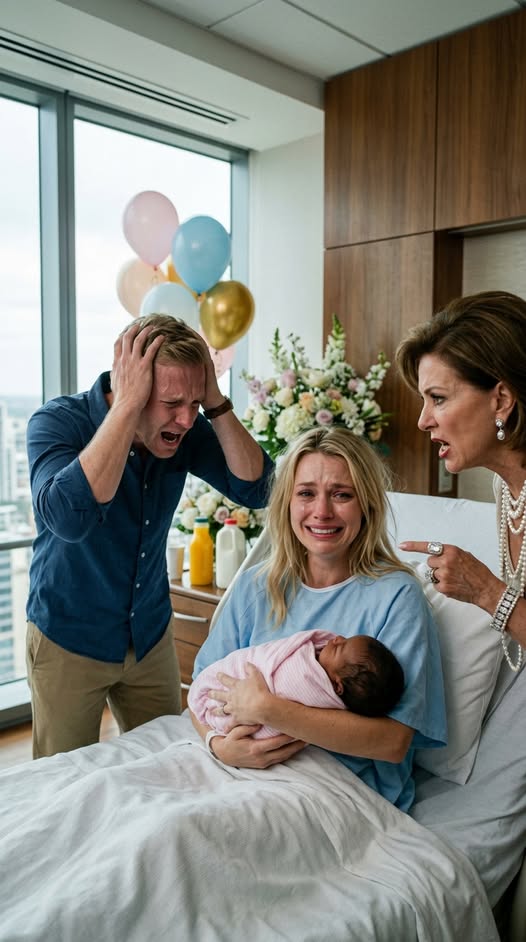
I was lying in the adjustable bed, my body aching from a grueling thirty-hour labor. My husband, Declan, sat beside me in a stiff plastic chair. In his arms rested our newborn daughter, Violet.
After six agonizing years of negative pregnancy tests, silent tears in bathroom stalls, and invasive fertility treatments, she was finally here. To me, Violet was a masterpiece. She was tiny, radiating a fierce, localized heat, her little fists clenched beneath a swaddle of pink hospital cotton. She had a full head of striking, raven-black hair and beautiful, warm olive skin that stood in stark contrast to Declan’s fair, freckled complexion and my own pale, light-brown features.
I was drifting in that euphoric, exhausted haze of new motherhood when the heavy wooden door swung open.
My mother-in-law, Eleanor, marched in.
She didn’t carry flowers. She didn’t offer a soft, maternal smile. She wore a sharply tailored tweed blazer, her blonde hair stiff with expensive lacquer, and her eyes were immediately drawn not to me, but to the bundle in her son’s arms.
Declan beamed, standing up to show her. “Mom. Meet your granddaughter.”
Eleanor stepped closer to the acrylic bassinet. The expression that crawled across her pale face is one I will carry to my grave. It wasn’t the tender curiosity of a grandmother. It wasn’t affection. It was a cold, clinical suspicion.
She leaned down, her icy blue eyes darting over Violet’s sleeping face. Then, she straightened her posture, folded her arms, and delivered the blow.
“That baby’s features are far too dark to be part of this family.”
Declan froze. The proud, exhausted smile slid right off his face. “Mom, what are you talking about?”
Eleanor didn’t even blink. “Look at her, Declan. The jet-black hair. The olive skin. We are a fair-haired, fair-skinned family. Neither you nor Madeline look anything like that. So, I have to ask… where exactly did she get those dark features from?”
The accusation didn’t just sting; it struck me like a physical punch to the ribs. All the air left my lungs. A cold dread coiled tightly in my gut. My own mother-in-law was suggesting—standing mere feet from the bed where I had just been sliced open to deliver this child—that I had been unfaithful.
“Genetics are complex, Eleanor,” I replied, my voice raspy and trembling despite my desperate attempt to keep it steady. “My maternal grandfather was of Sicilian descent. There are much darker features on my mother’s side of the family.”
She let out a sharp, mocking laugh that bounced off the sterile hospital tiles.
“Of course,” she sneered, waving a manicured hand weighted with a massive diamond ring. “Whenever it’s convenient for the narrative, everything suddenly becomes genetics.”
Declan’s face flushed a deep, violent crimson. He gently placed Violet back into my arms, grabbed his mother by the elbow, and practically dragged her out into the hallway. Through the thick door, I could hear the muffled, sharp tones of his anger.
When he returned, his chest was heaving. He sat on the edge of my bed, took my trembling hand, and kissed my knuckles. “Don’t listen to a single word she says, Maddie. She’s bitter. She’s always been cruel, and she just wants to poison our happiness. I know she’s mine.”
I nodded, burying my face in Violet’s soft neck, breathing in the sweet, milky scent of her skin. I wanted to believe Declan. I wanted to brush it off as just another one of Eleanor’s theatrical southern-belle cruelties. For years, I had swallowed her passive-aggressive venom. She had criticized my career as an architect, claiming a “respectable wife” shouldn’t out-earn her husband. She complained my cooking lacked the refinement of a true hostess.
I had tolerated it all to keep the peace. But this was different. This wasn’t about my pot roast or my salary. She was attacking the legitimacy of my child.
As I lay there in the quiet hum of the maternity ward, staring at the closed door, a sickening realization washed over me. Eleanor hadn’t just spoken out of turn. She had planted a seed of doubt, and I knew with terrifying certainty that she was going to water it until it choked the life out of my family.
How far would she go to destroy me, and would my husband’s love be enough to withstand the poison she was about to unleash?
Chapter 2: The Campaign of Shadows
The hospital room was only the opening skirmish. Over the next few months, Eleanor transformed her suspicion into a relentless, suffocating campaign.
Whenever we attended Sunday dinners at her sprawling, historic estate on the Charleston Battery, I could feel the hostile architecture of the room shifting against me. Eleanor would sit on the veranda with Declan’s two older aunts, sipping sweet tea beneath the Spanish moss and staring at me. They didn’t shout. They whispered. And whispers are always heavier than screams.
The tipping point occurred on a humid afternoon when Violet was three months old.
We were seated around a massive mahogany dining table. I was bouncing a fussy Violet on my knee. Eleanor leaned over to one of the aunts, her voice just loud enough to slice through the clinking of fine silver.
“You know,” the aunt chuckled, eyeing my daughter’s dark hair, “two cups of pale cream mixed together don’t miraculously make a dark roast.”
The trio of older women burst into a chorus of sharp, synchronized laughter.
My jaw tightened so hard my teeth ached. My palms grew slick with sweat. I didn’t shout. I didn’t throw my crystal water glass. I simply stood up, pressing Violet tightly to my chest, my chair scraping loudly against the polished heart-pine floors.
“Excuse me,” I said quietly, the silence of the rest of the table instantly deafening. I walked out to the car and locked the doors.
Declan tore into his mother that night. I could hear him shouting into his phone from our back porch, his voice cracking with fury. But Eleanor never apologized. Instead, she pivoted. She began calling cousins, uncles, and family friends, spinning a narrative that I was “hysterical” and playing the victim because, as she put it, “the truth always makes a guilty woman uncomfortable.”
The definitive rupture arrived exactly when Violet turned six months old.
We had decided to host a small, intimate milestone celebration at our home. It was a joyful afternoon filled with pink pastel balloons, freshly baked vanilla cake, and the pure, uncomplicated thrill of watching our baby girl sit upright on a rug all by herself for the first time.
Then, the front door swung open.
Eleanor arrived uninvited, clutching a ridiculously oversized gift bag. She wore that stiff, predatory smile she always plastered on when she wanted an audience to think she was a saint.
She glided into the living room, completely ignoring me, and crouched down in front of Violet. The chatter of our friends slowly died away, replaced by a tense, heavy static.
“Well,” Eleanor announced, her voice projecting like an actress on a stage. “Six months have passed. I was told her complexion and hair would have settled by now. That she would lighten up to look like the rest of us.”
She reached out, picked up my daughter, and held her at arm’s length, rotating her slightly as if examining a defective piece of merchandise.
“Nope,” she sighed theatrically, looking around the room at our horrified guests. “Still just as dark and Mediterranean. Fascinating.”
Something deep inside my chest—a load-bearing wall I had spent years reinforcing—finally snapped.
“Put my daughter down. Now.”
My voice wasn’t loud, but it possessed a terrifying, low vibration that made the glass of water on the coffee table tremble.
Declan rushed out of the kitchen, wiping his hands on a towel, catching the lethal atmosphere of the room. “Mom. Put her down.”
Eleanor dramatically lowered Violet back onto the rug, placing a hand over her pearl necklace as if she were the one being assaulted. “Oh, please. I am simply stating a biological observation! If you have nothing to hide, Madeline, you wouldn’t be shaking like a leaf.”
Then, she delivered the ultimatum that set my world on fire.
“I am formally requesting a DNA test,” Eleanor demanded, looking directly at Declan. “If that little girl is not my son’s true blood, she does not deserve to carry our family name. I will not have my legacy polluted by some stranger’s genes.”
Declan’s face contorted in absolute rage. He pointed a trembling finger at the front door. “Get out. Get out of my house, and do not ever come back!”
Eleanor gasped, squeezing out a few crocodile tears for the benefit of the audience, and stormed out, slamming the door so hard a picture frame rattled off the wall and shattered on the hardwood floor.
That night, the house was painfully quiet. Declan was sitting in the dark living room, nursing a glass of neat bourbon. I was in the nursery, sitting in the rocking chair with Violet sleeping peacefully on my chest. Her little heartbeat thumped rhythmically against mine.
As I stroked her soft, dark hair, I made a decision I had sworn to myself I would never, ever entertain.
I was going to order the DNA test.
I wasn’t doing it because I doubted myself. I wasn’t doing it because Declan needed proof—he had fought for me fiercely today.
I was going to do it so I could print the results on heavy-stock paper, drive to the Battery, and force Eleanor to swallow every single cruel, venomous syllable she had spat at my child.
But as I swabbed my daughter’s cheek the next morning, I had no idea that the envelope arriving in the mail wouldn’t just clear my name—it was going to awaken a monster that had been sleeping in this family for thirty years.
Chapter 3: The Blueprint of Truth
The waiting period was agonizing. Every time the mail carrier’s truck rumbled down our street, my pulse skyrocketed. It wasn’t anxiety over the scientific outcome—I knew the truth of my own body—but the anticipation of the war that would follow.
Two weeks later, a thick, discreet white envelope arrived.
I stood in the kitchen, staring at it as if it were a live grenade. Declan walked in, saw the logo of the laboratory in the corner, and immediately took it from the counter. He looked at me, his eyes softening, and held the envelope out, completely unopened.
“Throw it away,” he said softly. “I don’t need a piece of paper to tell me who my daughter is. I know you, Maddie. I love you.”
My throat tightened, tears pricking the corners of my eyes. “I know you don’t need it, Declan. But she does. She needs to be silenced, permanently.”
My hands shook slightly as I tore along the perforated edge. I pulled out the crisp, official document. I scanned past the complex genetic markers, my eyes locking onto the bold text at the very bottom of the page.
Probability of Paternity: 99.999%
A massive, ragged breath escaped my lips. Declan wrapped his arms around me from behind, resting his chin on my shoulder, looking at the numbers. “Are you satisfied?” he whispered.
“Not yet,” I replied, a cold determination settling over my bones.
Declan pulled his phone from his pocket and dialed his mother. “Mom. We have the results. Come to the house. Now.”
An hour later, Eleanor arrived. She didn’t come alone. She brought her two sisters—the whispering aunts from the veranda—clearly expecting to witness the grand spectacle of my absolute ruin. They walked into our living room with smug, expectant expressions.
I didn’t offer them water. I didn’t ask them to sit.
I simply walked over, the heavy silence ringing in my ears, and handed the lab report directly to Eleanor.
She snatched it from my hand, adjusting her tortoiseshell reading glasses. She read the bottom line. Then she read it again. Her eyes darted back to the top of the page, searching for a typo, a loophole, a mistake.
The smugness evaporated. All the color drained from her face, leaving her a sickly, ashen gray.
“Well?” I asked, my voice echoing in the quiet room. “Are you going to apologize to my daughter now?”
Eleanor’s hands began to tremble. The paper rustled aggressively in her grip. She looked at her sisters, then at Declan, before her face hardened into a mask of pure, stubborn delusion.
“This… this is impossible,” she stammered, her voice lacking its usual haughty authority. “The laboratory must have made a mistake. Or you paid someone off. These things happen all the time!”
For the first time in his entire life, Declan’s patience with his mother completely snapped.
“Enough!” he roared. The sheer volume of his voice made all three women flinch violently. “There is no mistake, Mom! The only mistake here is you. You let your own toxic, twisted paranoia blind you. You are no longer welcome in this house. Get out.”
Eleanor tried to argue, tried to play the wounded mother, but Declan physically stepped toward her, and she backed away, practically fleeing out the front door with her sisters trailing behind like frightened pigeons.
That evening, I sat at my laptop. I scanned the official DNA results into a high-resolution PDF. I composed a calm, factual email detailing the cruel accusations Eleanor had made against me while I was still bleeding in a hospital bed. I attached the PDF. And then, I hit ‘Send’ to every single cousin, aunt, and uncle in the family directory.
The fallout was instantaneous. My phone buzzed constantly for two days. Apologies poured in. Several relatives confessed they had been profoundly uncomfortable with Eleanor’s rumors but were too afraid of her to speak up. The matriarch’s fortress was cracking.
But amidst the flood of apologies, a single, cryptic text message arrived that made the blood freeze in my veins.
It was from Aunt Beatrice, the quiet, observant sister of my father-in-law, Arthur.
“Madeline, you need to understand something,” the message read. “Eleanor has always accused other women of infidelity because she is projecting her own guilt. Ask her about Julian.”
I stared at the glowing screen, the letters burning into my retinas.
Julian.
I had been married to Declan for six years. I knew the family tree inside and out. I knew the names of second cousins and great-uncles from Ohio to Georgia.
But I had never, ever heard the name Julian.
Who was the ghost in Eleanor’s closet, and what terrifying truth was Beatrice pointing me toward?
Chapter 4: The Architect of Lies
The next morning, I drove to a quiet café in the historic district to meet Beatrice.
She was a woman who spoke carefully, always measuring the weight of her words before letting them fall. She stirred her Earl Grey tea, avoiding my gaze for a long time.
“I shouldn’t be telling you this,” Beatrice murmured, the steam rising between us. “It’s a ghost story we all agreed to bury. But watching what Eleanor tried to do to your little girl… I can’t stay silent anymore.”
“Who is Julian?” I pressed, leaning over the small wooden table.
Beatrice sighed heavily. “Thirty-two years ago, my brother Arthur was deployed. He was a Naval officer, stationed overseas in the Mediterranean for almost nine months. Eleanor was left alone here in Charleston. During that time, she began spending a highly suspicious amount of time with a man. A local real estate developer with very dark hair and olive skin. His name was Julian.”
My breath hitched. Thirty-two years ago. Declan was thirty-one.
“People talked,” Beatrice continued, her eyes dark with old memories. “High society gossiped. When Arthur finally came home, the rumors were everywhere. Eleanor screamed, cried, and swore on a family Bible that nothing had happened. She played the victim so perfectly that Arthur, who loved her blindly, chose to believe her. A few weeks later, she announced she was pregnant with Declan.”
“And no one ever questioned it?” I asked, horrified.
“We couldn’t,” Beatrice replied. “Arthur forbade it. But the shadow never left her. Eleanor has lived her entire life terrified that someone will do to her exactly what she did to Arthur. That’s why she attacked you, Madeline. She looked at Violet’s dark features, saw a shadow of a doubt, and her own suffocating guilt drove her insane.”
I left the café feeling as though the cobblestones beneath my feet had turned to liquid. My mind raced. Declan’s entire existence, his identity, the man he called his father… it could all be a lie built on a rotting foundation.
Two weeks later, the family was forced to gather for the funeral of a distant great-uncle. It was raining, a slow, miserable coastal drizzle that made the cemetery smell of wet earth and crushed magnolias.
I stood under a large black umbrella with Declan. Eleanor was standing across the open grave, surrounded by a few relatives who hadn’t completely iced her out. She looked haggard, the stress of the last few weeks eating away at her polished veneer.
When the service ended and people began walking back toward their cars, Eleanor purposely walked past me. She couldn’t help herself. The venom was too deeply ingrained in her soul.
“Don’t think you’ve won,” she muttered, loud enough for the surrounding family members to hear. “A woman who knows how to cheat knows how to fake paperwork, too. That test proves absolutely nothing.”
Everyone froze. The audacity of her cruelty was breathtaking.
But this time, I didn’t feel a shred of embarrassment. I didn’t feel defensive. I felt an absolute, terrifying certainty. I lowered my umbrella slightly, looking her dead in the icy blue eyes.
“You know, Eleanor, you’re absolutely right,” I said, my voice carrying clearly through the damp air. “Sometimes, a piece of paper isn’t enough. Sometimes, test results can reveal very, very uncomfortable truths that people have spent their whole lives hiding.”
For one fraction of a second, the mask slipped. Pure, unadulterated terror flashed across her face. She swallowed hard, taking an unsteady step back.
That was all the confirmation I needed.
Later that evening, the family gathered at Arthur and Eleanor’s sprawling home for the traditional mourning dinner. The tension in the air was thick enough to choke on.
I stood in the center of the living room and asked for everyone’s attention. I looked at Arthur—a kind, honorable man who had always treated me with respect. My heart broke for what I was about to do, but the infection in this family had to be lanced.
“Arthur,” I said softly but firmly. “Eleanor continues to publicly claim that my daughter does not belong in this family. I am exhausted from defending my honor. So, I will only attend another family gathering under one strict condition.”
Arthur looked stunned, holding a crystal glass of bourbon halfway to his mouth. “What condition, Maddie?”
“I want you, Declan, and his sister Paige to take a commercial DNA ancestry and paternity test.”
The room went dead silent. You could hear the rain tapping heavily against the windowpanes.
Declan looked confused but supportive. Paige, Declan’s younger sister, frowned. “Why on earth would we do that?”
“Because,” I replied, staring directly at Eleanor, who was gripping the edge of the velvet sofa so hard her knuckles were white. “For six months, everyone demanded that I prove my child belonged to this bloodline. Now, I think it’s only fair that someone else takes a turn proving their foundation is solid.”
The reaction was explosive.
The very next morning, my phone rang. It was Eleanor. She wasn’t whispering or making snide remarks. She was screaming in absolute panic.
“Cancel this nonsense, Madeline! Cancel it right now! You are tearing this family apart! I absolutely forbid it!”
I pulled the phone away from my ear, listening to the shrill desperation in her voice.
“I didn’t order the tests, Eleanor,” I replied coldly. “Arthur did. If you want them cancelled, you tell your husband why.”
I hung up the phone. We had finally found the crack in her fortress.
And in just a few days, the walls were going to come crashing down.
Chapter 5: The Collapse
The DNA collection kits arrived, and to my surprise, Arthur pushed the issue forward with a quiet, grim determination. Perhaps, deep down in places he never talked about, the ghost of the rumors from thirty-two years ago had always haunted him.
The swabs were mailed off. The agonizing wait began again, but this time, the anxiety didn’t belong to me. Eleanor aged ten years in three weeks. She stopped attending her country club luncheons. She stopped calling Declan. She barricaded herself in her historic home, waiting for the executioner’s axe to fall.
Paige’s results arrived first via email.
She forwarded them to the family group chat. She was Arthur’s biological daughter, sharing the exact expected percentage of DNA. A wave of relief washed over Arthur, but it was dreadfully short-lived.
Two days later, Declan’s email notification chimed.
I told Declan to wait. I insisted we drive to his parents’ house. This wasn’t a conversation for a phone call.
We sat in their opulent living room. The central air was humming loudly, but the room felt suffocatingly hot. Arthur sat in his leather armchair. Eleanor stood near the grand fireplace, refusing to sit, her arms crossed defensively, her eyes darting like a cornered animal.
Declan pulled out his phone, opened the encrypted email, and typed in his password.
I watched his eyes scan the screen. I watched the exact moment his reality fractured. His eyebrows furrowed in deep confusion, his mouth parting slightly.
Without saying a single word, his hand trembling violently, he passed the phone across the antique coffee table to Arthur.
Arthur put on his reading glasses. He looked at the screen.
Probability of Paternity (Arthur Sterling): 0.9%
Not his father.
The silence that descended upon the room was absolute, crushing, and unbearable. It was the sound of a thirty-year-old lie detonating.
Arthur’s hands began to shake so severely he had to place the phone down on the glass table. The clack of the device echoed like a gunshot. He looked up, staring into the middle distance, processing the profound betrayal of his entire adult life.
I broke the silence. My voice was calm, devoid of any pity.
“Who is Julian?” I asked.
Eleanor whipped her head toward me, her face contorted in sheer panic and hatred. “Be quiet! You little witch, shut your mouth!”
“No,” Arthur’s voice cut through the room. It wasn’t a shout. It was a low, devastating growl that commanded the space. He slowly stood up, turning to face his wife of thirty-five years. “You talk. Now.”
Eleanor backed up against the brick fireplace. She tried deploying her usual tactics. She denied everything. She claimed the lab mixed up the samples. She pointed a shaking finger at me, shrieking that I had hacked the system, that I had manipulated the results to destroy her.
Nobody moved. Nobody believed her. The evidence of her deceit was written in the very blood of the son sitting in the room.
Finally, under the crushing weight of Arthur’s unblinking stare, she broke.
Her knees buckled, and she slid down the brickwork to the floor. Through hysterical, ugly tears, the truth poured out like a dark, infected sludge.
She confessed. While Arthur was deployed in the Navy, sweating in a uniform thousands of miles away, she had engaged in a passionate, reckless affair with Julian. When she discovered she was pregnant, Julian wanted nothing to do with it. So, she hid the timeline. She faked her due date. She chose to let a good, honorable man raise another man’s child, building her entire life of southern luxury and social status on a foundation of profound deceit.
For decades, she kept the secret buried in the deepest vault of her mind.
And yet, her own guilt had mutated into a terrifying paranoia. She spent years accusing me of the very betrayal she had committed herself, terrified that the universe was preparing to exact its karmic revenge when she saw those dark features in her granddaughter.
Declan didn’t yell. He didn’t demand explanations. He simply stood up, his face devoid of all color, and walked out of his childhood home without uttering a single syllable.
I followed him.
Hours later, long after the sun had set, I found my husband sitting on the floor of our dark bedroom, leaning against the closet door. In his hands, he held a framed, faded photograph. It was a picture of a five-year-old Declan, sitting on Arthur’s shoulders at a Fourth of July parade, both of them laughing into the camera.
I sat down next to him, resting my head against his shoulder.
“You already suspected it, didn’t you?” Declan said quietly, his voice hollow. “When you asked about Julian.”
I nodded slowly. “Aunt Beatrice told me the rumor. But I didn’t want to hurt you, Declan. I swear to you, I didn’t want to break your heart.”
He reached out and took my hand, squeezing it tight. “I know. You were protecting our daughter. You did what you had to do.”
Then, the dam broke. Declan cried.
It was a guttural, soul-tearing sound. He wasn’t crying because of biology. He didn’t care about a man named Julian whom he had never met.
He wept because of Arthur. The man who had bandaged his scraped knees. The man who had patiently taught him how to cast a fishing line off the pier. The man who had sat shivering in the rain at every single one of his childhood baseball games. The man who had been his compass, his hero, his father.
With the truth finally dragged into the light, how could a father and son possibly reconstruct a bond built on someone else’s lie?
Chapter 6: The True Foundation of Family
The aftermath of the revelation was a violent earthquake that reshaped our entire world.
The next afternoon, the doorbell rang. I opened it to find Arthur standing on our porch. He looked as though he hadn’t slept in a week. His eyes were red-rimmed, his shoulders slumped under the invisible weight of thirty years of betrayal.
Declan walked out of the kitchen. They stood staring at each other for a long, agonizing moment across the entryway.
“I… I don’t know what this makes me anymore,” Arthur whispered, his voice cracking, looking at the floor. “I don’t know my place in your life.”
Declan didn’t hesitate. He closed the distance in three massive strides and wrapped his arms around the older man, pulling him into a fierce, desperate embrace.
“You’re my dad,” Declan said fiercely, burying his face in Arthur’s shoulder. “You’ve always been my dad, and nothing on a piece of paper is ever going to change that. I am your son.”
Watching them hold each other, weeping in the hallway, I realized that Eleanor’s lies hadn’t destroyed them. It had only proven that the foundation of their love was entirely real, built on decades of action, not just genetics.
A few weeks later, Arthur formally filed for divorce. The proceedings were swift and unforgiving. Paige, disgusted by her mother’s lifelong deceit and cruelty toward me, cut off all contact. The carefully guarded secret leaked into the extended family, and Eleanor was entirely excommunicated from the high-society circles she had once ruled with an iron fist.
But true to her nature, Eleanor refused to go quietly into the night.
Instead of seeking redemption, she doubled down on her madness. Anonymous, fake social media accounts began popping up on Facebook, leaving vicious comments on my photos. They called me a manipulative home-wrecker. They accused me of forging the DNA tests to steal Arthur’s fortune.
I didn’t engage. I quietly collected the screenshots.
During a cousin’s wedding a few months later, I discreetly showed the evidence to Arthur and a few key aunts. The IP addresses and email recovery details on one of the clumsy accounts were directly linked to Eleanor’s personal phone number.
Nobody believed her paranoid denials anymore.
Her final act was a desperate, unhinged spectacle. She showed up at our house one Sunday morning, disheveled, her makeup smeared, screaming from the sidewalk. She accused the neighbors, the government, and the laboratory of conspiring against her. She was a woman who had spent her life terrified of being exposed, and the reality of it had completely fractured her mind.
Declan had to call an ambulance. The paramedics gently placed her in the back of the vehicle, recommending a full psychiatric evaluation.
As I watched the flashing lights pull away down the street, I felt a fleeting pang of sorrow for her. But pity does not erase damage. A mental breakdown might explain a person’s behavior, but it absolutely does not excuse years of calculated, relentless cruelty.
Eleanor had been given countless opportunities to change course. She could have simply apologized in that hospital room. She could have chosen to love her beautiful, innocent granddaughter. Instead, she chose suspicion, vicious gossip, and hatred. She built her own cage, and now, she had to live in it.
Epilogue: The Light of the Truth
Today, the sun is shining warmly through the large windows of our living room.
Violet just turned one year old. She is a whirlwind of joy—happy, thriving, and deeply, unconditionally loved. She has Declan’s brilliant smile and my striking, dark features.
Every single Sunday, without fail, Arthur comes over for dinner. He sits on the floor, playing wooden blocks with Violet, laughing as she crawls over his legs. Declan sits beside them, handing him puzzle pieces, still casually calling him “Dad.”
Because the truth is, blood can reveal the secrets of our biology. It can tell you where a shadow on the skin or the color of your hair comes from. But blood does not create a family. Love, sacrifice, and showing up every single day—that is what builds a foundation that won’t collapse.
Sometimes, friends who hear the abridged version of our story tell me that I went too far. They say forcing the paternity test on my father-in-law was cruel, a step too far in a petty family feud.
When they say that, I close my eyes and remember standing in that sterile hospital room. I remember holding my tiny, helpless newborn daughter, while a grown woman looked at her beautiful features as if they were a disease, something shameful to be scrubbed away.
And then I realize something deeply important.
I didn’t destroy Eleanor’s family. I didn’t blow up her marriage.
All I did was walk into a dark, rotting room and turn on the light. The truth did all the rest.