At nineteen, Hannah came home with a pregnancy test tucked inside the pocket of her jacket.
They lived in a quiet neighborhood in Albany, in a modest but carefully kept house — the kind of place where neighbors noticed what time you came home and who you came home with. The porch light was always on by six. The lawn was always mowed in straight lines. Diane took pride in that. Frank took pride in not having to think about it.
Her mother, Diane, was folding laundry in the living room, the television murmuring low in the corner.
Her father, Frank, was sitting in his armchair watching the news, still wearing his gray factory uniform, his hands marked with grease he hadn’t bothered to scrub off yet. It was a Tuesday. Hannah remembered that detail forever after — that it had been an ordinary Tuesday, that the world had not given her any warning that this was the night everything would split into a before and an after.
She stood in the doorway of the living room for a long moment before either of them looked up.
“You’re home early,” Diane said, not turning around, a towel half-folded in her hands.
Hannah opened her mouth. Closed it. Opened it again.
“I need to tell you both something.”
Frank lowered the volume on the television with the remote, his eyes still on the screen for one more second before he finally turned them on his daughter. Something in her voice had cut through the noise of the broadcast.
“I’m pregnant.”
The towel stopped moving in Diane’s hands. The room went so quiet that Hannah could hear the refrigerator humming in the kitchen, the tick of the clock above the mantel, her own heartbeat in her ears.
“You’re joking,” Diane said. It wasn’t really a question.
“I’m not.”
Frank stood up slowly from the armchair, the way men stand up when they are trying to keep something in their chest from spilling out too fast. “Whose is it?”
“His name is Marcus. We’ve been together almost a year. I was going to tell you about him eventually, I just—”
“You were going to tell us about him eventually,” Diane repeated, and there was something sharp now under the disbelief, something that had been waiting a long time for an excuse to come out. “After you got pregnant by him.”
“Mom—”
“Don’t,” Frank said. His voice wasn’t loud. That was the worst part, Hannah would think later — he never raised his voice, not once, the whole time. “Don’t ‘Mom’ her right now. Do you understand what you’ve done? Do you understand what people are going to say about this family?”
“I understand that I’m scared, and I came home to tell my parents, because that’s what you do,” Hannah said, her voice cracking on the last word despite every effort to keep it steady.
“Nineteen years old,” Diane said, mostly to herself, staring at some fixed point past her daughter’s shoulder. “Nineteen years old and no job, no degree, and now a baby. Do you have any idea what we sacrificed so you wouldn’t end up like this?”
“Like what, Mom? Pregnant? It’s not a disease.”
“It’s a choice,” Frank cut in. “You had a choice, and you made it without thinking about anyone but yourself. You made it without thinking about us, about your future, about what this is going to do to this family’s name in this neighborhood.”
That was when Hannah understood, with a clarity that felt almost peaceful in its cruelty, that this conversation had stopped being about her the moment it started. It was about what people on Maple Street would whisper at the mailbox. It was about Diane’s church friends. It was about Frank’s brothers, who had always quietly judged him for raising “a girl who thinks she’s better than everyone.”
“I’m not asking you to be happy about it,” Hannah said. “I’m asking you not to throw me away.”
Diane’s hands had finally stopped moving entirely. She set the towel down on the arm of the couch with a precision that felt more violent than if she’d thrown it. “Then don’t make us choose between you and everything we’ve built.”
“It’s not a choice you have to make. I’m your daughter. The baby is your grandchild.”
“The baby,” Frank said, “is a mistake you made because you didn’t listen to a single thing we ever told you.”
There was a silence after that, the kind that has a texture to it, almost a weight, settling over the living room like dust. Hannah looked at her father’s face — the face she had loved her whole life, the face that had taught her to ride a bike in the cul-de-sac, that had cried, quietly, at her middle school graduation — and she watched it close like a door.
“Pack a bag,” Frank said. “You can stay with Marcus, or with a friend, or wherever you decide. But you’re not staying here. Not like this.”
“Dad—”
“I said pack a bag, Hannah.”
Diane didn’t argue. Diane didn’t cry. Diane picked the towel back up and resumed folding it, her movements stiff and mechanical, as if folding laundry was the only thing left in the world she still had control over.
Hannah stood there for one more moment, waiting — for an apology, a softening, anything. It didn’t come. She went upstairs, packed two duffel bags with the things that mattered most, and walked out of the house she’d grown up in without either of her parents following her to the door.
Marcus didn’t last. He wanted to be a father in theory more than in practice, and by the time their son, Eli, was eight months old, Marcus had moved three states away to “figure things out,” and the child support checks came, when they came, sporadically and without warning. Hannah didn’t chase him for it. She didn’t have the energy to chase anyone for anything. She had Eli, a community college schedule she rearranged four times, and two jobs — one at a diner during the day and one cleaning offices at night, three nights a week, while a neighbor named Rosa, a retired schoolteacher who’d taken a strange, fierce liking to Hannah from the moment she moved into the building, watched Eli for nearly nothing.
The first two years were the hardest. There were nights Hannah cried in the bathroom with the faucet running so Eli wouldn’t hear her through the thin apartment walls. There were months she ate cereal for dinner so there’d be enough for him. There was one Christmas, when Eli was three, where she sat alone after he’d fallen asleep and allowed herself, just for an hour, to hate her parents with everything she had — not for kicking her out, but for never once calling to check if she was alive.
But somewhere around year four, things began, slowly, to turn.
She finished her associate’s degree in accounting. She got a job as a bookkeeper for a small construction firm, and the owner, a blunt, fair man named Tom Reyes, saw something in her — a sharpness with numbers, a relentlessness with deadlines — and started giving her more responsibility than her title technically called for. By year six, she was managing the firm’s books entirely on her own, and Tom paid her like it. By year eight, she’d taken night classes and gotten her CPA license, and Tom made her a partner, because, as he put it, “I’d rather split the pie with you than lose you to someone smarter than me.”
Eli grew up watching his mother build something out of nothing. He grew up calling Rosa “Grandma” because she was the only grandmother he’d ever known, and he grew up believing, with the simple faith of a child, that his mother could fix anything, because in his world, she always had.
Hannah never spoke badly about her parents to him. She told him, when he was old enough to ask, that she and his grandparents had “a disagreement a long time ago” and that sometimes families grow apart. She didn’t tell him the truth — that disagreement was a generous word for being told to pack a bag at nineteen and never once being called, in ten years, on a birthday, a holiday, an emergency room visit, a single ordinary Tuesday.
She built a life instead of dwelling in the wreckage of the one she’d lost. That had always been Hannah’s particular gift — not forgiving, not forgetting, but moving, the way a river moves around a rock it cannot break.
Ten years to the month after she’d stood in that living room with a pregnancy test in her jacket pocket, Hannah found herself driving back to Albany.
It wasn’t her idea, not really. Rosa had passed away eight months earlier — quietly, in her sleep, the kindest way the universe could have managed it — and going through Rosa’s old letters and photo albums while helping the family clear out her apartment had done something to Hannah she hadn’t expected. It had made the years feel suddenly, achingly finite. It had made her think, against every instinct she had, about her own parents getting older in that house on Maple Street, about the math of how much time anyone actually has.
She told herself she wasn’t going back to reconcile. She was going back to see. To know, for her own peace, what was left.
Eli, now ten — sharp-eyed, quiet in the way of kids who’d grown up watching adults solve problems and learned to do the same — sat in the passenger seat with a backpack of comic books at his feet.
“Are they going to be mean to you?” he asked, somewhere around the New York state line, with the unsettling directness only children manage.
“I don’t know,” Hannah said honestly. “I haven’t talked to them in ten years.”
“Then why are we going?”
“Because I think I need to see something for myself. And because you should know where half of you comes from, even if it’s complicated.”
The house looked almost exactly the same. The porch light was on, even though it was the middle of the afternoon. The lawn was still mowed in straight lines, though Hannah noticed, with a small unexpected ache, that the lines weren’t quite as straight as they used to be — that whoever was pushing the mower now did it with less strength than Frank once had.
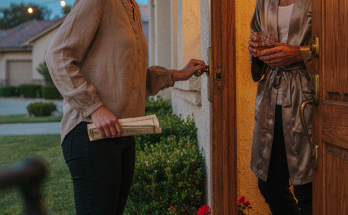
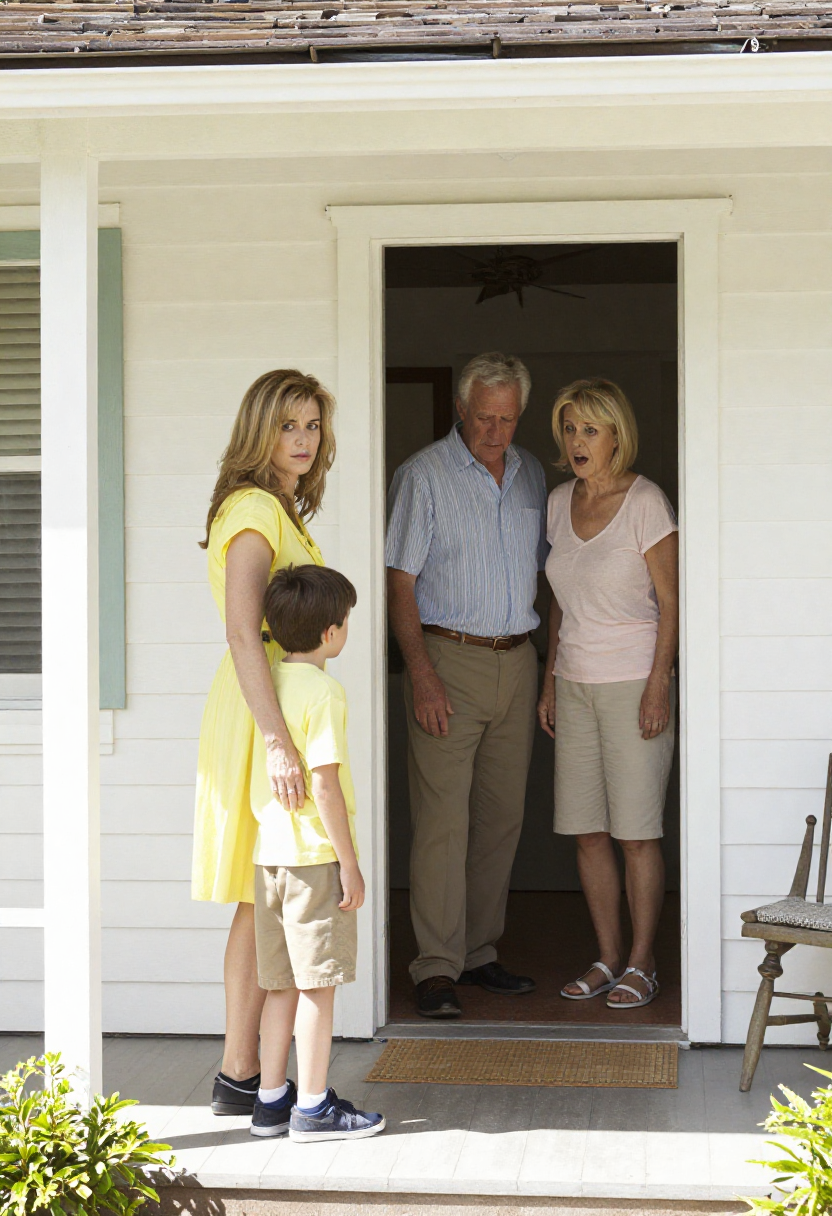
Diane answered the door. She had aged the way people age when life has been mostly comfortable but quietly disappointing — softer in the face, grayer at the roots, a posture that had folded inward slightly, like a flower closing for the evening. For one long second, neither of them said anything at all.
“Hannah,” Diane finally said, and her voice cracked on the single syllable.
“Hi, Mom.”
Diane’s eyes moved past her daughter to the boy standing slightly behind her, holding his backpack strap with both hands. “Is this—”
“This is Eli.”
Diane brought a hand to her mouth. Frank’s voice came from somewhere inside the house — “Diane, who is it?” — and then he appeared in the hallway behind her, and Hannah watched her father’s face do something she had spent ten years imagining and had never quite been able to picture: it broke open, all at once, the careful composure of a man who’d spent a decade telling himself he’d done the right thing.
“You should come in,” Diane said.
The inside of the house was achingly familiar — the same couch, reupholstered once but in nearly the same fabric; the same clock on the mantel, a few minutes slow, the same as it always had been. Hannah sat where she used to sit. Eli sat beside her, watching the two strangers who were apparently his grandparents with the cautious curiosity of a kid sizing up new territory.
There was a long stretch of small talk that wasn’t really small talk at all — questions about the drive, the weather, Eli’s age, his school — the kind of conversation people have when the real conversation is too large to start directly. Diane brought out lemonade nobody really wanted. Frank sat in the same armchair, looking at his grandson like a man trying to memorize something he knew he might never get to see again.
“We think about you all the time,” Diane finally said, her hands wrapped tightly around her glass. “We almost called, so many times. I don’t know why we didn’t.”
“Pride, probably,” Hannah said. Not cruelly. Just honestly.
“We were wrong,” Frank said. The words came out rough, unpracticed, like a language he hadn’t spoken in years. “We were wrong to throw you out. We’ve known it for a long time. We just didn’t know how to say it, and the longer we waited, the harder it got to say at all.”
Hannah felt something in her chest loosen, just slightly — not forgiveness yet, but the door to it, cracked open for the first time in a decade.
“I didn’t come here for an apology,” she said. “I came because Rosa died, and it made me realize how much time actually slips away while people are busy being stubborn. I wanted Eli to know you. I wanted to know if there was anything left worth knowing.”
“There is,” Diane said quickly, too quickly, the way people speak when they’re afraid the door might close again before they can get through it. “There’s so much we want to make up for. We could be in his life. We could be in yours. We could finally be a family again, the way we should have been all along.”
It was Frank who, perhaps trying too hard to prove how much he had changed, perhaps simply unable to stop himself from circling back to the old scorekeeping that had defined so much of Hannah’s childhood, said the sentence that ended everything before it had really begun.
“And honestly,” he said, leaning forward, his voice warming with something that sounded almost like relief, like a man finally allowed to say the thing he’d rehearsed, “it’s good timing too — your cousin Janelle just had a baby and froze us out the second the shower started, so it would be nice to have a grandchild in the picture who actually visits.”
The room went still in a way Hannah recognized immediately, because she had lived inside that exact stillness once before, ten years earlier, in this same room, on a Tuesday she had never been able to forget.
“What did you just say?” she asked quietly.
Frank blinked, sensing too late the shift in the air but not yet understanding it. “I just meant — it would be good to have you both around. Properly. The way a family should be.”
“You said it would be good timing,” Hannah repeated, each word deliberate, “because Janelle’s not giving you what you want. You’re not apologizing because you missed me. You’re apologizing because you have an opening to fill.”
“Hannah, that’s not—”
“It’s exactly that,” she said, standing up, her voice level in a way that was somehow more devastating than if she’d shouted. “Ten years, Dad. Ten years of nothing — no calls, no birthdays, no ‘are you alive,’ nothing — and you finally let me back in the door, and the very first real thing you say isn’t that you missed your grandson’s first decade. It’s that I’m convenient now because someone else in the family disappointed you first.”
“That isn’t what I meant,” Frank said, and to his credit, he looked genuinely stricken, the older man’s face folding into something like panic. “I phrased it wrong. I just — I didn’t mean it like that.”
“You didn’t mean it like that,” Hannah said softly, “but you thought it like that. That’s the part that matters. That’s the part that was always true. We were never the people you wanted us to be — until we became useful, or convenient, or the only option left on the table.”
Diane was crying now, openly, her hand reaching toward Hannah’s arm. “Please. Please don’t leave like this. We can fix it. We can talk it through.”
“I came here today already willing to forgive you,” Hannah said, and her voice finally wavered, just slightly, just enough to reveal how much the next words cost her. “I drove three hours with my son in the passenger seat, telling myself I was ready to let the past be the past. And in twenty minutes, you both showed me exactly why I shouldn’t have come.”
She looked at her father, who had stood and was reaching toward her, his hand stopping somewhere in the empty air between them, as if he understood, finally, too late, that there was no version of this moment where reaching further would help.
“Eli,” Hannah said gently, turning to her son, who had gone very quiet on the couch, watching the adults around him with the wide, careful eyes of a child absorbing something he wasn’t sure yet how to name. “Get your bag.”
“Hannah, please,” Diane said. “Don’t take him away again.”
“I’m not taking anything away,” Hannah said, and there was no anger left in her voice now, only a tired, settled clarity. “You did that yourselves, ten years ago, in this exact room. I just finally believed you the second time.”
She took Eli’s hand. He didn’t ask questions in the car this time, not for the first twenty minutes, just looked out the window at Albany sliding past in reverse, the same houses, the same trees, going the other direction now.
“Mom?” he finally said, somewhere past the state line.
“Yeah, baby?”
“I think I understand now. Why you didn’t talk to them.”
Hannah reached over and squeezed his hand once, her eyes on the road, the porch light of that house — and everything it had once meant to her, and everything it had just proven all over again — fading further behind them with every mile.
“I think I finally do too,” she said.
And for the first time in ten years, driving home with her son beside her and nothing behind her but a house full of people who had shown her, twice now, exactly who they were, Hannah felt something settle inside her chest that she hadn’t expected to feel.
Not grief. Not anger.
Relief.