The dashcam cost seventy-nine dollars at the AutoZone on Route 9, the one with the flickering sign that’s been missing its first letter so long people just call it “the Zone.” I bought it on a Saturday in March, paid cash, and the kid at the register asked if I wanted the extended warranty. I said no. I told him I only needed it to work for a little while.
I’d been married to Russ for thirty-one years. We met at a Methodist church potluck when I was twenty-two and he was twenty-four, and he’d brought a casserole his mother made because he couldn’t cook, and I’d brought deviled eggs because that’s what you brought in 1995 if you wanted to seem like a woman who had her life together.
We danced once, badly, to a song neither of us could name afterward. He asked for my number on a paper napkin because he didn’t have anything else to write on. I still have that napkin. It’s in a shoebox in the closet with our wedding invitation and the hospital bracelet from when our son Danny was born and a movie ticket from our first date, which was Forrest Gump, which Russ cried at and pretended he didn’t.
Thirteen months ago, he started working late on Tuesdays and Thursdays.
It wasn’t dramatic at first. A dentist appointment that ran long. A project at the plant that needed extra hands. He’s a supervisor at a packaging facility forty minutes from our house in Marrow Creek, Ohio, a town so small the welcome sign and the goodbye sign are the same piece of plywood, just read from different directions. I believed him because I’d known him since I was twenty-two, and you don’t think to doubt a man you’ve watched age forty pounds and lose most of his hair and still snore exactly the same way he did on our wedding night.
But there’s a kind of knowing that lives in your hands before it reaches your head. I noticed I was checking his coat pockets. I noticed I’d started smelling his shirts before I put them in the wash, not even sure what I was smelling for. I noticed that on Tuesday and Thursday nights, he’d come home freshly showered, and he never showered at work.
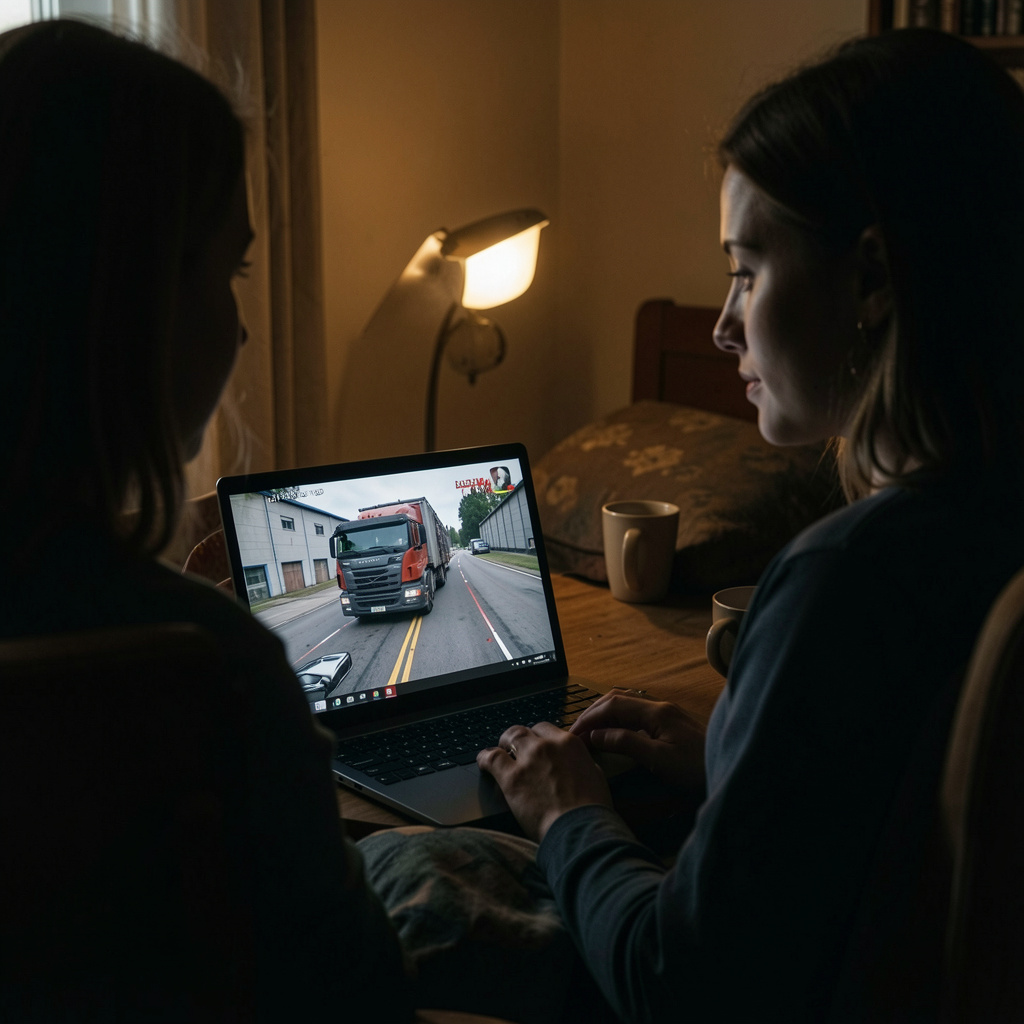
So I bought the dashcam. I told myself it was for the insurance, in case of an accident. I installed it myself, watching a YouTube video twice, my hands shaking so bad I dropped the little screwdriver three times into the gap between the seat and the console of his Silverado. It has a memory card. It saves loop footage and you can pull the card and watch it on a laptop. It was almost insultingly easy.
The first week, nothing. He drove to work and came home at the regular time, and I felt something close to grief at how disappointed I was to have nothing to be angry about. I almost returned the camera.
Then a Tuesday. The footage showed him pulling out of the packaging plant’s lot at 4:47, same as always — except he didn’t turn left toward home. He turned right.
Twenty-two miles. I watched the odometer crawl across the bottom corner of the screen like a slow-moving accusation. Past the Sheetz, past the Lutheran cemetery, out along the lake road where the houses get bigger and the mailboxes get fancier, the kind with little brass numbers instead of stickers. He pulled into a gravel driveway in front of a gray-shingled house with green shutters and a porch that wrapped around the side, the kind of porch I’d always wanted and never gotten, because Russ said porches were just rooms you couldn’t heat.
A woman came out onto that porch in jean shorts and a flannel shirt, barefoot, holding a glass of iced tea like she’d been expecting him for exactly as long as it took to pour it. She was maybe ten years younger than me. Dark hair, going gray at the temples in a way that looked deliberate instead of inevitable, the way mine never has.
He got out of the truck. He walked up the steps. And he kissed her.
I want to be precise about this because precision is the only thing I have left that feels like control: it was not a peck. It was not the kiss you give your neighbor’s wife at a Fourth of July barbecue. It was slow, and his hand came up to the side of her face, his thumb resting just below her ear, and I knew that kiss. I knew it because he kissed me that exact way, hand and thumb and all, on October 14th, 1995, on the steps of First Methodist, in front of ninety-one guests and a photographer named Carl who is, as far as I know, still in business.
I watched that fourteen-second clip eleven times. Then I closed the laptop and sat in the dark kitchen until the numbers on the microwave clock turned over from one hour to the next.
I didn’t confront him that night. I want to explain why, because I think people who haven’t lived it imagine confrontation is a door you walk through the second you have the key. It isn’t. I needed to know how big the room behind the door was before I walked into it. So for four weeks, I kept driving him to believe that nothing in our kitchen had changed, while every Tuesday and Thursday I pulled that little card out of his truck and fed it into my laptop at the library, because I didn’t trust myself not to throw something if I watched it at home.
Same woman. Same house. Same route, down to the same gas station he always stopped at, like a man who’d built himself a second life with the same compulsive tidiness he brought to his sock drawer.
Her name, I learned from a real estate sign that had been in the yard the first week and gone by the third — sold, apparently — was Deborah Lynn Castellano. I looked her up. Divorced, no kids, worked from home doing something with insurance claims. The lake house had been her grandmother’s. I found this out the way you find out everything now, which is to say I spent an unconscionable number of nights doing what I can only call detective work from my phone in the bathroom with the fan running so Russ wouldn’t hear me crying.
What broke something loose in me — more than the kiss, even — was the groceries.
I do the books in our house. I always have. Russ says numbers make his eyes cross, which is one of those marriage jokes that you laugh at for thirty years until one day you realize it was never a joke, it was a job description, and you were the only one who applied for it. Our grocery budget is a hundred and twenty dollars a week. I know this number the way I know my own birthday. I built it, line by line, after Danny moved out and we didn’t need to feed a nineteen-year-old’s appetite anymore, after Russ’s blood pressure medication got bumped up and we had to find room for the co-pay.
On the dashcam audio — and I want to say, I almost turned the sound off entirely, almost couldn’t stand to hear his voice in that other life, but some compulsive part of me needed to hear if he sounded like himself — I heard him on the phone with someone from a grocery delivery service, confirming an order. A hundred and eighty dollars. Steaks. Wine. Some kind of cheese plate. He read off a card number that I recognized, because it’s the card linked to an account I thought was for Danny’s old orthodontist payments, an account that still had eleven dollars a month coming out of it and that I had simply never closed because closing things felt like admitting they were over.
A hundred and eighty dollars, every week, for someone else’s table. Sixty dollars more than my entire budget for our table. I did that math in the library parking lot and felt something in my chest fold up small and put itself away, the way you fold up a letter you’ve decided not to send.
I picked a Thursday.
I made his favorite, pork chops with the apple-onion thing he likes, the recipe his mother gave me the year we got married, written on a recipe card in handwriting so shaky near the end of her life that the last few ingredients are basically guesses I’ve made for fifteen years. I set the table the way I set it for company — cloth napkins, the good plates, the ones with the gold rim that we got as a wedding gift from his aunt Patrice and have used maybe nine times in three decades.
And I set the laptop at the head of the table, where I usually sit, screen closed, like a guest we were waiting on.
He came in smelling like a shower he hadn’t needed to take for work. He saw the cloth napkins and I watched something in his face try to decide whether to be pleased or suspicious, and it landed somewhere in between, which I think now is the truest expression I’d seen on him in over a year.
We ate. He told me about a forklift incident at the plant that I’m fairly sure he invented on the spot, the way men do when they need filler and don’t yet know they need an alibi. I asked about his day. I asked if he was tired. I asked all the small, ordinary questions a wife asks, and I watched him answer them with the easy, practiced dishonesty of someone who has gotten good — too good — at being two men in one body.
When he was almost finished, I opened the laptop and pressed play.
The footage filled the screen, small and gray and merciless: his own truck, his own hands on the wheel, the lake road, the gravel driveway, the porch, the iced tea, the kiss.
His fork stopped halfway between the plate and his mouth. A piece of apple slid off it and landed on the gold rim of his mother’s china. He didn’t pick it up. He didn’t look up, either — not at me, and not at the screen again, like he already knew every frame of it by heart and didn’t need a second viewing to know exactly how it ended.
I said, “Thirty-one years.”
I’d planned to say more. I’d rehearsed an entire speech in the bathroom mirror, something about vows and Danny’s childhood and the fact that I’d nursed him through gallbladder surgery in 2019 and held a bucket under his chin in a Motel 6 outside of Pittsburgh once when food poisoning hit him on a trip to see his brother. I had a whole speech, and it evaporated the second his fork hit the plate, and all that was left standing in the wreckage of it were those three words. Thirty-one years.
He didn’t deny it. I’ll give him that, the way you give a drowning man credit for not also setting the boat on fire. He set his fork down slow, like the silverware had become something he didn’t trust himself to hold, and he was quiet long enough that I thought maybe this was it, maybe this was the part where he told me he was sorry, or that it had stopped meaning anything to him, or that it had never started meaning anything, some lie shaped like comfort.
Instead he said, “Ask your sister.”
I said, “What?”
“Ask your sister,” he said again, and his voice had gone strange — not cruel, exactly, but flat, the voice of a man reading off the last page of an instruction manual he’d been dreading. “She knows exactly when. She’s the one who told me about your—”
He stopped.
I want to tell you that I demanded he finish the sentence right there at the table, that I am the kind of woman who doesn’t let a man leave a knife halfway in. But the truth is I sat very still, the way you sit still around something that might still be capable of stinging you, and I said, “Finish it.”
He looked at the gold-rimmed plate, at the apple slice sitting there accusingly, and he said, “She told me about your scans. The mammogram. The one from fourteen months ago, the one you didn’t tell me about because you said you ‘didn’t want to worry me until you knew something for sure.'”
The room did something strange then — tilted, very slightly, the way a boat tilts when you’re not the one who moved.
Fourteen months ago. I had found a thing in the shower, a small hard thing the size of a pencil eraser, and I had gone in for the mammogram alone on a Tuesday morning because Russ had a shift and because some superstitious, foolish part of me believed that if I didn’t tell anyone, it couldn’t be real yet. The radiologist had called me back for an ultrasound. I had sat in a paper gown in a cold room and thought about Danny’s wedding, which hadn’t happened yet, and whether I’d be alive to see it. It came back benign. A cyst, nothing more, drained with a needle so thin I barely felt it. I told exactly one person, because I needed to tell someone or I thought I might split open from the holding of it, and that person was my sister Carol, who lives two towns over and has never in her life kept a secret longer than the drive home.
“She told you,” I said, “about my mammogram.”
“She told me you were sick and scared and didn’t think you could lean on me,” Russ said. “She told me thirteen months ago, at Danny’s engagement party, in the kitchen, while you were out on the deck. She said—” and here his voice cracked in a way I hadn’t heard since his mother’s funeral— “she said, ‘My sister’s been carrying something alone for months and you haven’t even noticed, what kind of husband doesn’t notice that.’ And I didn’t know what to say to that, because I hadn’t noticed. I’d been working overtime and watching football and I genuinely had not noticed that my wife thought she might have cancer and decided I wasn’t someone she could tell.”
I sat there with thirty-one years of marriage doing something complicated and ugly in my chest, because here is the thing nobody warns you about betrayal: it rarely arrives as one clean wound. It arrives as several wounds at once, layered over each other like wallpaper nobody stripped before the next coat, and you can’t always tell, in the moment, which one is bleeding.
Because he wasn’t wrong. I hadn’t told him. I’d told Carol instead, in a moment of fear in somebody else’s kitchen, because some old, worn-down part of me had already decided, long before any porch or any lake house, that Russ was not a man you ran to with your fear. I’d decided that maybe back when Danny was born and Russ fainted in the hallway and I labored for nineteen hours essentially alone with a nurse named Theresa holding my hand. Or maybe back when his mother died and he disappeared into the garage for six days and I planned the funeral by myself with a three-year-old on my hip. I don’t know exactly when I decided it. I only know that by the time the lump showed up in the shower, the decision had already calcified into something I didn’t even register as a decision anymore. It just felt like fact. Like weather.
“That’s not a reason,” I said, and my voice came out steadier than I expected. “That doesn’t get you a porch and a woman in flannel and a hundred and eighty dollars in steaks while I’m counting out sixty cents at the grocery store deciding between coffee and dish soap.”
“No,” he said. “It’s not a reason. It’s just — it’s the start of it. I felt like a stranger in my own house and I went looking for somewhere I wasn’t one. That’s the truth, and it’s a pathetic truth, and I know it doesn’t fix the math.”
I asked him how long he’d known Deborah before that party. He said three months — they’d met when his truck broke down outside her place on the lake road and she’d let him use her phone because his battery was dead, and they’d talked for forty minutes while waiting for the tow, and it had felt, he said, like talking to someone who was just glad he existed, which is a thing he said he hadn’t felt from me in a long time, and which I did not have the energy that night to argue against, because some shameful, exhausted corner of myself thought: I haven’t felt glad you exist in a long time either, and I never said that out loud either.
We didn’t resolve anything that night. I want to tell you we did, because I think people want endings that close like a door — either it slams or it locks, one or the other, final. Ours didn’t do either. He slept in Danny’s old room. I sat up until 2 a.m. with my sister on the phone, and yes, I called Carol that very night, because thirty-one years of marriage had just cracked open and I needed to know what was inside the part I hadn’t seen.
Carol cried before I even finished the sentence. She said she’d told Russ because she was scared for me and angry at him and it had felt, in that moment in the kitchen, like the only weapon she had to make him pay attention to his own wife. She said she never imagined — and here her voice did something I’d never heard it do, something small and broken — she never imagined it would become the hinge a whole other life swung open on. She apologized in the particular, over-explaining way people apologize when the apology is really for themselves. I told her I needed to think. I did not tell her I forgave her, because I didn’t, not that night, and I have decided I am no longer going to perform forgiveness on a schedule that makes other people comfortable.
It’s been six weeks now. Russ moved into an apartment above the hardware store in town — not, he was careful to specify, the lake house, though I notice he was careful to specify it the way a man is careful about a hundred small things when he’s hoping you’ll notice the carefulness and mistake it for character. I don’t know yet if I’m filing. My lawyer, a brisk, kind woman named Patricia Oyelaran who has handled half the divorces in this county, says there’s no rush, that Ohio doesn’t make you decide anything quickly, that grief has its own clock and the law can wait on it.
I still have the dashcam. I took it out of the Silverado — which is, technically, in both our names, a fact my lawyer found almost funny — and it sits in the shoebox now, on top of the napkin from the potluck, on top of the wedding invitation, on top of Danny’s hospital bracelet. I don’t know why I kept it there instead of throwing it out. I think some part of me understands that it belongs with the other artifacts of this marriage, not separate from them — that the seventy-nine-dollar camera and the cloth napkins from our wedding registry are, in some terrible way, both true things about the same thirty-one years, and you don’t get to keep only the version of the story that doesn’t hurt.
Carol comes by most days now. We don’t talk about the party in the kitchen. We talk about small things — her grandkids, my garden, whether the tomatoes are coming in early this year. I think we’re rebuilding something, brick by ordinary brick, the way you rebuild anything that’s cracked but not gone: slowly, and without looking directly at the crack, because looking at it too long makes you doubt the whole foundation.
Danny calls every Sunday now, which he didn’t used to. I think word got around, the way word does in a town with one welcome sign. He doesn’t ask about his father directly. He asks if I’m eating. He asks if I want him to drive down some weekend. Last Sunday he asked, very carefully, the way you’d ask someone if a wound still hurts, whether I was doing okay, and I told him the truth, which is that some days the missing him — the him before the lake house, the him from the napkin and the deviled eggs — feels bigger than the anger, and some days it’s the other way around, and I haven’t yet found the day where neither one shows up.
I think about that mammogram a lot now, more than I think about the porch, honestly. I think about sitting in that cold room in a paper gown, deciding alone that I could carry it alone, and how that decision — small, private, made in fear — turned out to be load-bearing in ways I never could have guessed. I think about how Carol meant to protect me and instead handed Russ a door he was already looking for. I think about how Russ took a kitchen conversation about his negligence and turned it, eventually, into a justification for a deeper one. Everyone in this story believed they were the wronged party at some point along the way, and I suppose that’s the ugliest, most human thing about it — not that there was a villain, but that there were several people, including me, who each told themselves a true story that happened to leave out one essential, damning detail.
I don’t know what I’ll decide. Some mornings I wake up in the bed we’ve shared since 1996 and reach for a side that isn’t warm anymore and feel something like relief. Other mornings I reach for it and feel only the cold, flat fact of an empty mattress, and I let myself cry into Patrice’s gold-rimmed pillowcase until the feeling passes, because I’ve decided that’s allowed now too — feeling two true things at once, neither one canceling the other out.
What I know for certain is only this: I bought a seventy-nine-dollar camera to catch a truck driving somewhere it shouldn’t, and what it caught, in the end, was something much larger than a truck and a porch and a woman in flannel. It caught thirty-one years’ worth of two people quietly deciding, separately, in a hundred small unspoken moments, that the other one couldn’t be trusted with the truth — until one Tuesday, the truth simply got tired of waiting to be told, and drove itself, at 4:47 in the afternoon, twenty-two miles down the lake road, and let itself in.