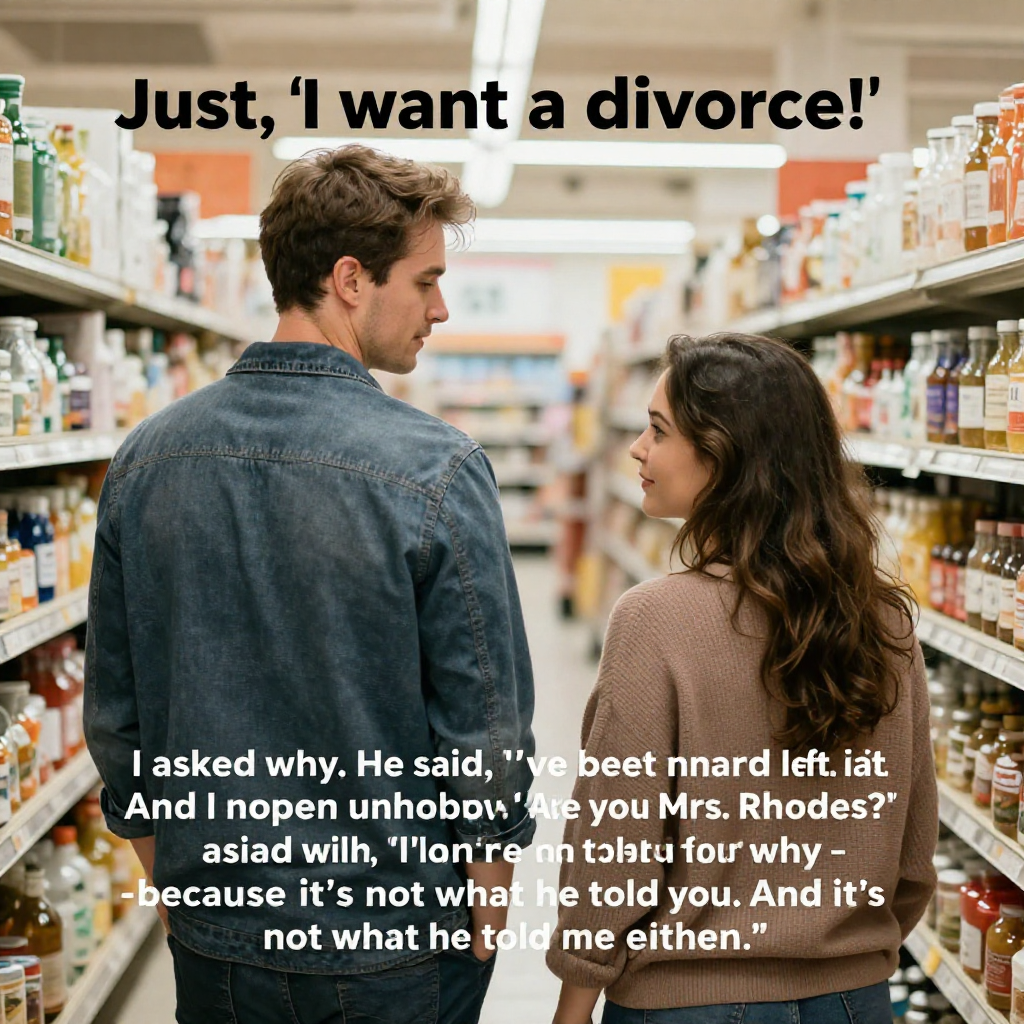
The frozen food aisle was the last place Margaret Rhodes expected her marriage to come apart a second time.
She had thought, six months ago, that there was only one way to lose a husband — the fast way, the way that arrives without warning on a Tuesday evening while you’re still wearing your work blazer, holding a wooden spoon, asking what he wants for dinner. Eric had not raised his voice. He had not paced. He had simply set down the newspaper he wasn’t really reading and said, “I want a divorce,” in the same even tone he used to tell her the recycling was full.
She’d asked why. Some part of her, even then, had braced for an affair, for a confession, for something with edges she could grab onto and fight. Instead he’d said, I’ve been unhappy, four words with no history attached, no timeline, nothing she could push against. When she asked since when, his face had closed like a shop at the end of a long shift. I don’t want to talk about it. He’d moved out the following week, taking his side of the closet, his side of the bookshelves, his side of seventeen years, and leaving her with a house that echoed in places it never used to.
She had spent six months building a kind of peace out of that silence. Not understanding — she’d given up on understanding somewhere around month two — but a workable peace, the kind you make when a question goes unanswered long enough that you simply stop expecting it to be answered at all. She had started sleeping through the night again. She had started, on good days, to forget to check his side of the bed before remembering there was no reason to check it anymore.
She had a bag of peas in one hand and a list in the other — peas, chicken thighs, the good coffee, ask about the leak in the garage — a list that still had his name penciled at the bottom in her own handwriting, a habit six months hadn’t broken yet. She was reaching for a second bag when she felt the tap on her shoulder, light, almost apologetic, the kind of touch that wants permission to exist.
“Are you Mrs. Rhodes?”
Margaret turned. The woman was younger than her, but not by much — late thirties, maybe, with the kind of tired, careful face that suggested she’d rehearsed this sentence in the car. She had her own cart, half-full, a child’s juice boxes wedged between paper towels and a rotisserie chicken still warm in its plastic dome.
“Yes,” Margaret said, because there was no version of this conversation where lying helped.
“I’m Dana.” The woman’s hands tightened on the cart handle. “I’m the reason your husband left.”
Margaret had imagined this moment in the bad hours, the three a.m. hours, more times than she would ever admit. She had imagined fury. She had imagined herself frozen, unable to speak, peas melting in her grip while some glossy, guiltless stranger explained that she was simply better — younger, freer, unencumbered by seventeen years of someone else’s laundry. She had never imagined the woman’s voice shaking.
“And I need to tell you why,” Dana said, “because it’s not what he told you. And it’s not what he told me, either.”
Margaret’s first instinct was to leave. Her second was to ask Dana to leave. Her third — the one that won — was to ask, in a voice she didn’t fully recognize as her own, “Do you want to get a coffee?”
It surprised them both, that question. Dana blinked like she’d expected to be screamed at, or slapped, or at the very least ignored, and had a whole separate set of responses rehearsed for those outcomes that she now had to set aside. Margaret surprised herself most of all. Some quieter, more practical part of her — the part that had spent seventeen years smoothing over small disasters before they became large ones — had simply taken stock of the situation: a stranger crying in a grocery store, the beginnings of a scene, a truth that clearly wanted somewhere private to land. Better a coffee shop than aisle six.
They left their carts, abandoned like small monuments to ordinary life, and walked two doors down to a coffee shop that smelled like burnt sugar and printer toner. Dana ordered tea and didn’t drink it. Margaret ordered coffee and held the cup with both hands like it was the only solid thing left in the room. Outside the window, a teenager was trying to parallel park a hatchback into a space clearly too small for it, and Margaret found herself watching the attempt with strange, total focus, grateful for anything that wasn’t the woman across from her.
“I should probably start somewhere,” Dana said finally, twisting a napkin into a tight, useless rope. “I’ve thought about how to say this so many times in the car, and every version sounds worse out loud.”
She took a breath, the kind that comes before a confession you’ve been carrying alone too long. “I met him at a conference. Eight months ago. Logistics — boring, you know how it is. I almost didn’t go to the welcome dinner. I keep thinking about that. How small the decision was, and how much came out of it.”
Margaret did know. Eric had gone to three conferences a year for as long as she’d known him. She’d packed his garment bag for each one, tucked breath mints into the side pocket, kissed him at the door like it meant nothing because, for sixteen years, it hadn’t.
“We talked. Just talked, at first. He was funny. Self-deprecating. He kept making this joke about being middle management in his own marriage — said it like it was nothing, like everyone says things like that.” Dana paused, turning her cup a quarter turn on the table, an old habit she seemed to do for comfort rather than purpose. “He told me his wife had checked out years ago. That you two hadn’t really talked, not really, since your youngest left for college. That you slept in different rooms because of his snoring, but really because there wasn’t anything left to stay awake for together.”
Margaret felt something in her chest fold in on itself, quiet, like a paper crane being made wrong. None of that was a lie, exactly. She and Eric had drifted into separate rooms three years ago — his back, the snoring, the practical math of two working adults who needed sleep. But the framing of it, the story of it, was something she’d never agreed to. She hadn’t checked out. She’d just stopped narrating her presence out loud, the way you stop announcing you’re breathing.
She thought of all the small, undramatic Tuesdays that had made up their marriage in those last years. The way she’d leave his coffee made before he woke, not because anyone asked her to, but because it was a kind of sentence she knew how to write without words. The way he’d fix the loose hinge on the pantry door without being asked, his own quiet sentence back. They had built an entire second language out of small chores and small mercies, and somewhere along the way they had both, separately, decided that language didn’t count as talking. Maybe it had never been enough. But it had not been nothing, and hearing it reduced to checked out felt like watching someone describe a house fire as “a bit of smoke.”
“I’m not telling you this to hurt you,” Dana said. “I’m telling you because I believed him. For months, I believed I was a kindness in his life. That I was helping a man who’d already lost his marriage understand he still mattered to somebody.” Her eyes were wet now, and angry, in the particular combination that comes from being lied to twice — once by the man, and once by your own hope. “There were nights I genuinely thought I was the better choice for him. Not better than you, exactly — I tried not to think about you as a person with a name, which I realize now was its own kind of cruelty. Better than the loneliness he described. I thought I was rescuing someone. It’s a very seductive thing to be told you’re a rescue.” She laughed, short and joyless. “And then, about a month ago, I found out he told his brother something completely different.”
Margaret’s coffee had gone cold in her hands. “What did he tell his brother?”
“That you’d never gotten over the miscarriage.”
The words landed in the small, ordinary coffee shop like something dropped from a height. Margaret’s body went very still, the way it used to when Eric came home in a mood she couldn’t name yet, before she learned to read the set of his shoulders from across a room.
“The one before your son,” Dana said carefully, watching Margaret’s face for permission to continue. “He told his brother that you grieved it for years and never let him grieve it with you. That every time he tried to talk about it, you shut him out, and somewhere in there he just—” She stopped. “He said he learned to stop needing things from you, because you’d already decided you didn’t need things from him. He told his brother he didn’t leave because he was unhappy. He left because he’d been lonely inside the marriage for over a decade, and he didn’t know how to say that without it sounding like your fault, so he just said the smallest, safest version instead. ‘I’ve been unhappy.’ Four words. No history. No blame.”
Margaret had not thought about that miscarriage in years, not on purpose, not in any way she let herself notice. It had happened the spring before their son Theo was born, eleven weeks, no name, no funeral, just a D&C and a box of crackers Eric had bought because someone told him ginger helped with nausea, except there was no nausea by then, just absence. She remembered being furious that he went back to work three days later. She remembered deciding, in the particular silent fury of new grief, that if he could move on that fast, she would simply move on faster, so he’d never see how much it had taken from her.
She had never told him that was a decision. She had let him believe it was just who she was.
What she remembered now, sitting across from Dana with her coffee gone cold, was the morning after, when Eric had stood in the bathroom doorway holding the box of crackers he hadn’t yet had the chance to give her, and how she’d looked at him and said, brightly, terribly, “I’m fine. Really. We’ll try again.” She remembered the look on his face — not relief, she understood now, but a kind of flinch, like a door closing somewhere just out of his reach. At the time she’d read it as him being glad she was handling it well. She had never once considered that he might have wanted to be handed something to hold, the way she was holding her own grief so tightly that there was no room in her arms for his.
“He never said any of that to me,” Margaret said quietly. “He said, ‘I’ve been unhappy,’ and when I asked since when, he said he didn’t want to talk about it.”
“He didn’t want to talk about it with me, either,” Dana said. “Not really. He wanted someone who made him feel like the unhappiness wasn’t his fault to manage. I was that, for a while. A place to put something down without having to explain what it weighed.” She finally drank some of her tea, grimacing slightly at the temperature. “I ended it three weeks ago. Not because of guilt, exactly — though there’s plenty of that — but because I realized he was never going to tell either of us the truth at the same time. He gave you a sentence with no past in it. He gave me a story with no future in it. And he gave his brother the version with all the weight, because his brother was the only one who was never going to ask him to do anything about it.”
“How did you find out what he told his brother?” Margaret asked. It mattered, suddenly, in a way she couldn’t fully explain — as if the mechanism of the truth reaching her was itself part of the truth.
“His brother called me,” Dana said. “After Eric told him about us — I don’t know why, guilt, or wanting someone in the family to know, maybe just wanting to say it out loud to a person who wouldn’t immediately judge him. His brother was furious. Not at me, particularly. At Eric, for letting two women carry two different versions of the same year and never once checking whether either of them matched what actually happened. He called me because he said somebody ought to know the truth had more than one half-truth living inside it, and he didn’t trust Eric to ever say it himself.” She shrugged, a small, exhausted gesture. “He gave me your number, actually. I didn’t use it. I didn’t want this conversation to happen over a phone, like one more easy thing said from a safe distance. I wanted to see your face when I said it.”
Margaret thought of every conversation in the last decade that had almost gone somewhere and hadn’t. The fights that ended in let’s just go to bed. The Saturday mornings he spent in the garage, ostensibly fixing things, while she ran errands she didn’t need to run. She had told herself it was contentment. Low conflict. A good, quiet marriage. She had never once asked herself if quiet and good were the same thing, or if they were just two words for the same long held breath.
“Why are you telling me this?” Margaret asked. “What do you get out of it?”
Dana looked, for the first time, genuinely uncertain. “Nothing, I think. I’m not trying to win anything back, if that’s what you’re asking — there’s nothing left between him and me to salvage, and I wouldn’t want it if there were.” She wrapped both hands around her cup. “I think I just couldn’t stand being a chapter in a book where everyone got a different first page. You deserved to know your marriage didn’t end because you stopped mattering to him. It ended because he stopped believing he was allowed to ask you to matter to him. Those aren’t the same thing, even though they look the same from across a kitchen table.”
Margaret drove home with the groceries melting in the trunk and didn’t notice until she was pulling into the driveway, the peas long past frozen, a small green puddle forming in the bag. She carried them inside anyway, set them on the counter, and sat down at the kitchen table where, for seventeen years, she and Eric had eaten dinner across from each other in the comfortable, eroding silence of two people who’d run out of new things to ask.
The house was the same house it had been that morning — same chipped mug in the drying rack, same calendar on the fridge with a dentist appointment circled in red that was hers alone now — and yet it felt entirely rearranged, as if someone had come through while she was out and quietly swapped every piece of furniture for an identical one facing a slightly different direction. She kept waiting for the anger to arrive, the clean, simple anger she’d expected in the coffee shop and never quite gotten. It didn’t come. What came instead was something more like vertigo — the sense of having spent six months walking confidently through a story that had, it turned out, several rooms she’d never been shown.
She thought about calling him. She thought about the years she’d spent narrating her own steadiness to herself — I’m the strong one, I’m the one who doesn’t fall apart — without once asking whether steadiness was something he’d needed protecting from. She had built a kind of fortress out of not needing things, brick by brick, starting with eleven weeks and a box of ginger crackers, and she had never once noticed that the fortress had two people locked inside it, both pretending they preferred the cold.
She got up at one point and went looking for the box itself — she still had it, somewhere, in the closet shelf where she kept things she couldn’t use and couldn’t throw away. It took her twenty minutes to find it behind old tax folders and a shoebox of Theo’s baby shoes. The crackers, of course, were long gone, eaten or expired and discarded sometime in the intervening years, but the box remained, flattened slightly, the cardboard soft at the corners from handling. She held it for a while at the kitchen table, this small, absurd artifact of a kindness she had never once acknowledged as a kindness, and she let herself cry — not for the marriage, not yet, but for the eleven weeks, properly, finally, eleven years late.
She did not call him that night. She sat with the rotting peas and the list with his name on the bottom, and she let herself, for the first time in six months, feel something other than confusion about why he’d left. Not forgiveness — that was its own separate country, and she wasn’t sure yet if she had a passport for it. Just clarity. The specific, exhausting clarity of understanding that grief is not a private property line; that you can build a wall to keep your own pain from spilling over and not notice you’ve also kept someone out who might have helped you carry it.
Two days later, she called Eric and asked him to meet her — not at the house, not anywhere either of them had history with, just a bench outside the library where neither of them had ever sat. He came. He looked smaller than she remembered, or maybe just more tired, the particular tiredness of a man who has spent six months being someone’s villain in a story he half-wrote himself. He’d lost weight, she noticed, in that way men do when no one is cooking for them and they haven’t yet learned to cook for themselves.
“Dana found me at the grocery store,” Margaret said, without preamble, because there had been enough years of careful preambles between them already.
Eric’s face did something complicated — fear, then something closer to relief, the look of a man finally being asked the question he’d spent a decade preparing not to be asked. “Okay,” he said, and then, after a long pause, “How is she?”
“Honest,” Margaret said. “Late, but honest.” She watched a sparrow worry at a piece of bread someone had dropped near the bike rack. “She didn’t come to apologize, exactly. I don’t think she came for me at all, really. I think she came because she couldn’t carry it by herself anymore, and you’d made sure there was no good way for her to put it down.”
“That’s fair,” Eric said quietly, and the quickness of his agreement told her more than an argument would have.
“I know about the miscarriage. What you told your brother.” She watched him flinch, not at the words, but at being known. “I’m not calling you here to fight about it. I’m calling you here because I think we both told each other a smaller story than the true one, for a really long time, and I’d like to know if there’s any version of us that can tell the bigger one. Even now. Even separated. I don’t know what we’d be rebuilding toward — I’m not assuming it’s the marriage. But I don’t think I can let the last word between us be ‘I don’t want to talk about it.'”
Eric was quiet for a long time, long enough that a man walked past with a dog, and the dog stopped to sniff Margaret’s shoe, and she let it, grateful for something small and uncomplicated in her hands for a moment.
“I didn’t know how to tell you I was grieving too,” he finally said. “You seemed so finished with it. So fast. And I thought — if I bring it up, I’m reopening something she’s already closed, and that makes me the one who can’t let go. So I just let go of bringing it up instead. And then I think I just kept doing that. With everything. Smaller and smaller things, until there wasn’t much left to say that felt safe.”
“I wasn’t finished with it,” Margaret said. “I was just better at pretending than you were. I found the cracker box, by the way. Still have it. I cried over a flattened cardboard box in my kitchen two nights ago, eleven years late, because some stranger in a grocery store knew more about my own grief than I’d ever let myself say out loud to the person who was actually there for it.”
Eric’s eyes were wet now too, the first time she’d seen that in years — not the careful, contained sadness he allowed himself in arguments, but something rawer, less managed. “I bought those crackers in the parking lot of the hospital,” he said. “I sat in the car for ten minutes before I came up, because I didn’t know what version of me you needed me to be when I walked through that door. Strong, or sad, or just quiet. I picked quiet. I think I’ve been picking quiet for a decade since.”
“We were both picking quiet,” Margaret said. “At each other. For so long it started to look like peace.”
They sat on the bench for a long time after that, not solving anything, not deciding anything, just finally occupying the same true sentence instead of two separate smaller ones. It wasn’t a reconciliation. Margaret wasn’t sure yet what it was. But it was the first conversation in years that hadn’t been edited down to something safer before either of them spoke it out loud, and there was a strange, unfamiliar relief in that — the relief of finally putting down something heavy, even if you don’t yet know if you have the strength to pick anything else up.
“What happens now?” Eric asked, eventually, and for once it didn’t sound like a man trying to manage an outcome. It sounded like a real question, the kind that admits it doesn’t already know its own answer.
“I don’t know,” Margaret said. “I think we figure that out the slow way. The true way. Maybe separately, for a while — I’m not in a hurry to undo six months just because I understand them better now. But I’d like to keep talking. Actually talking. Not the kind where one of us says four careful words and the other one just nods and goes back to the dishes.”
“I can do that,” Eric said. “I think I can, anyway. I’d like to try.”
“That’s all either of us can promise right now,” Margaret said. “Trying. I think that’s where we both stopped, a long time before the divorce. I think that’s the real thing Dana told me, underneath everything else — that we didn’t fail at love. We failed at trying out loud.”
Whatever came next — and neither of them knew yet whether next meant separately or together — it would not be built, this time, out of four careful words and a closed door. It would have to be built out of the whole, complicated, eleven-week, sixteen-year truth, or it wouldn’t be built at all.
Margaret walked back to her car alone. The peas were still in the trunk, ruined beyond saving. She didn’t mind. Some things, she was learning, you simply had to throw out and buy again — not because they’d failed, but because they’d never had a chance to be anything other than what the cold had made of them, sealed in silence, waiting for someone to finally open the bag.