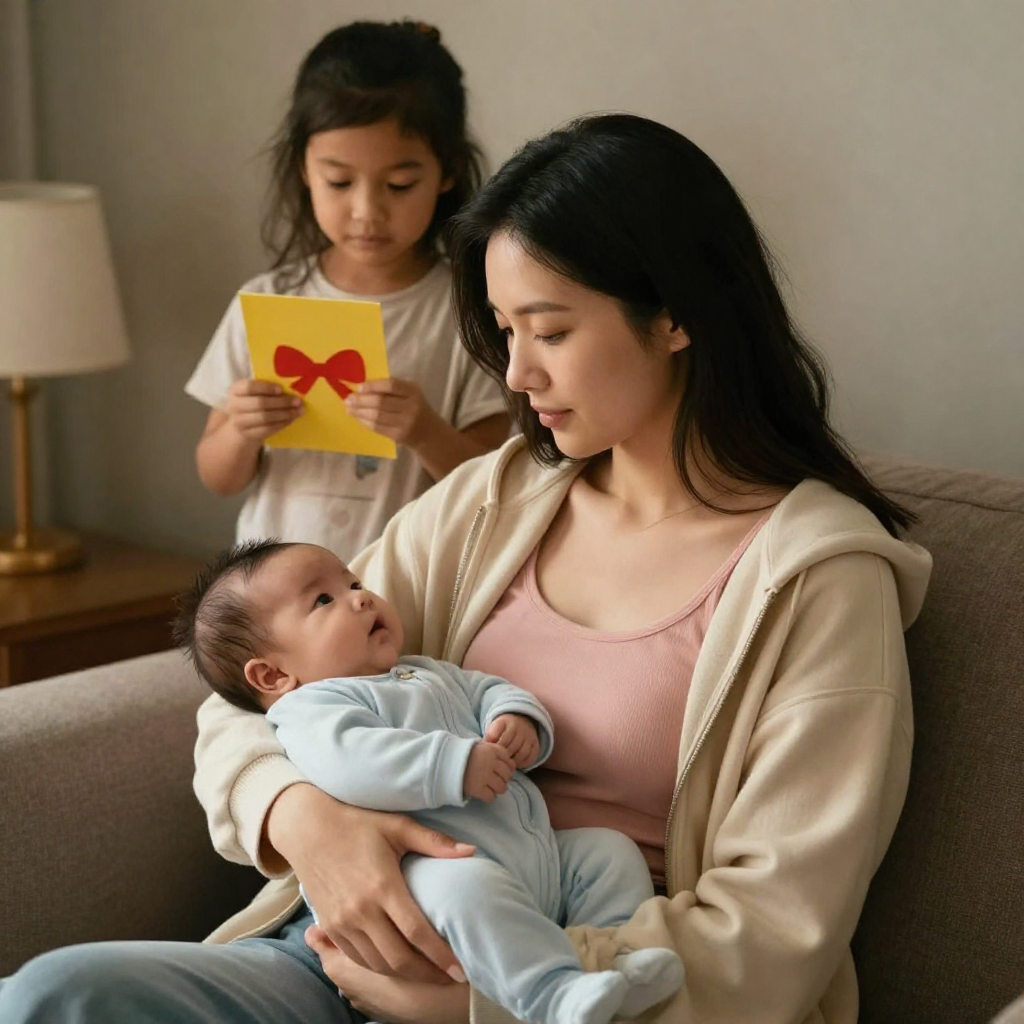
The card was light blue construction paper, folded twice, with a crayon drawing of two stick figures holding hands under a sun that took up half the sky. I had practiced writing “I love you Mom” in my best handwriting, the kind I used when I wanted a teacher to notice I’d tried hard. I was eleven years old and I had saved four dollars of allowance to buy a glitter pen at the drugstore so the letters would catch the light.
I remember the drive to that “family dinner” more clearly than almost anything else from my childhood. Grandma drove me in her old Buick that smelled like peppermint and rosewater, and she kept glancing over at me in the passenger seat like she was trying to memorize something. “You don’t have to go, you know,” she said at a red light. “We can turn around right now and get ice cream instead and nobody would blame you.”
“I want to go,” I said. “I made her something.”
Grandma didn’t say anything else, but her knuckles were white on the wheel the rest of the way.
The house wasn’t even my mother’s old house. It was the new one, the one with the wraparound porch and the swing set in the back that I never got to use. My brother answered the door — well, he didn’t answer it, he just appeared in the doorway behind my mother like a small, smug satellite — and he was wearing a sweater vest, an actual sweater vest, at eight years old, like he’d been dressed by a catalog. My mother’s hand was on his shoulder before she even looked at me.
“There she is,” she said, like I was a delivery she’d been expecting and was mildly inconvenienced by.
Dinner was lasagna. I remember because my brother didn’t like the edges, so my mother cut around them and gave him the center pieces, and nobody asked if I liked the edges or the center or anything at all. I sat there with the card in my lap under the table, working up the nerve, feeling it get warm and slightly damp from my hands.
After dinner, when the plates were being cleared and my brother was building something out of the saltshaker and a coaster, I finally stood up and walked around the table to her.
“I made this for you,” I said, and held it out.
She took it. For one half of one second, I thought it was going to be fine. I thought she might open it.
Then my brother said, “What’s that?” and she turned and handed it to him, without looking at it, without looking at me, like she was passing a napkin.
“Look what your sister made,” she said to him, in the bright, performing voice adults use when they want a moment witnessed rather than felt.
He opened it. He didn’t even really look at the drawing. He set it down on the table next to the saltshaker contraption and went back to his project.
“I got that for you,” I said. My voice came out smaller than I meant it to.
She looked at me then — really looked, for the first time all night — and there was something almost like irritation in her face, like I’d interrupted something. “Oh, what would I need it for?” she said, waving a hand. “I have everything I want.”
I have thought about that sentence more times than I can count in the twenty-one years since. I have turned it over the way you turn over a stone looking for the bug underneath. I have everything I want. Not “thank you.” Not even “that’s sweet.” Just an inventory check, conducted out loud, in front of me, concluding that I was not on the list.
I didn’t cry at the table. I want that on the record. I didn’t cry until we were back in the Buick, and Grandma didn’t say “I told you so” or “I’m sorry” or any of the things people say to fill space. She just reached over without taking her eyes off the road and held my hand the entire way home, and when we got there she made me hot cocoa with too many marshmallows and we watched a movie I don’t remember the name of and she let me stay up an hour past my bedtime, and neither of us mentioned the card again.
My mother moved two states away the following spring. I don’t think the timing was about me. I don’t think anything about her was ever about me, which I eventually understood was its own kind of mercy, in a backwards way — it meant I could stop looking for the thing I’d done wrong, because there wasn’t one. There was just a woman who had decided, at some point before I was even old enough to remember deciding things, that I was the chapter of her life she wanted to close, and my brother was the one she wanted to keep writing.
Grandma never tried to explain her to me. She never said “she loves you, she just doesn’t know how to show it,” which I am grateful for, because it would have been a lie and I would have spent years trying to find the love underneath the not-showing-it, the way you dig at frozen ground because you’re sure there’s something alive under there if you just keep at it. Instead Grandma said, the night of the lasagna, with her hands wrapped around her own mug of cocoa, “Some people only have so much love in them, and they spend it all in one place. That’s not a math problem you did wrong. That’s just where the love went.”
I asked her once, years later, maybe sixteen, why she took me in so easily, so completely, no hesitation, no resentment, no martyrdom about it.
“Because love doesn’t pick favorites,” she said. “If it does, it’s not love. It’s something else wearing love’s coat.”
That sentence became something like scripture to me. I built my whole adult life around it without quite realizing I was doing it. I chose a husband who didn’t ration his attention. I chose friends who showed up. When I had my own daughter, I made sure she never had to wonder, not once, not for a single bedtime, whether she was on the list of things I wanted.
Grandma raised me from eleven to eighteen and then kept raising me long after that, the way grandmothers do when they’ve quietly become the architecture of your whole life. She came to my college graduation in a hat that was, by her own admission, “too much hat,” and cried louder than anyone in the auditorium. She walked me down the aisle when I got married, because there was no one else I wanted to do it, and when the officiant asked “who gives this woman,” Grandma said “I do” in a voice that did not shake even a little, daring anyone in that room to think it was strange.
She died when I was thirty-two. Heart failure, mercifully quick, in her sleep, in the house with the peppermint smell that had become, over the years, simply the smell of safety. I was the one who found her, because I still came by every Sunday for tea even after I had my own house and my own family, because some habits are really just love wearing a schedule.
I will not pretend the days after were anything but ruined. I do not have a more articulate word for it. I went through her closets in a fog. I found the blue construction-paper card — that card — tucked into the back of her Bible, twenty-one years old, the crayon faded to the color of old butter, the glitter mostly gone except for a few stubborn flecks caught in the folds. She had kept it. She had taken it from the table that night, I realized — I’d never even noticed her do it — folded it into her purse while my mother and brother weren’t looking, and carried it home, and kept it for two decades in the one book she read every single day of her life.
I was holding that card, sitting on the floor of her closet with her cardigans still smelling like her, when someone knocked on my own front door, three streets away, four days after the funeral.
It was my mother.
I had not seen her in person in eleven years. We’d exchanged maybe six emails in that time, all logistical, all initiated by me, mostly about Grandma’s health in the last stretch, which my mother had absorbed with the same detached courtesy you’d extend to news about a neighbor’s surgery. She looked older in the way that surprises you — not gracefully older, just tired-older, the kind of older that comes from a life spent managing rather than living. She was wearing a black dress that looked recently purchased, the tags-just-cut kind of black.
“I’m sorry about your grandmother,” she said, standing on my porch like she wasn’t sure she was allowed past the welcome mat.
“Thank you for coming to the funeral,” I said, because she had, in fact, come — sat in the back, left before the reception, didn’t speak to anyone, including me. I had noticed and said nothing at the time. I was saying something now only because there was nothing else to open with.
“Can I come in?”
I let her in. I want to be honest about why: not because I’d forgiven anything, not because eleven years had softened me, but because some animal part of me was curious, in the specific way you’re curious about a wound you haven’t looked at directly in a long time. I wanted to see what she would say. I think some part of me, even at thirty-two, even after everything, was still eleven years old in a sweater I’d ironed myself, holding out a card.
She sat at my kitchen table — the same table where, an hour earlier, I’d been picking through estate paperwork — and she looked around at my house, at the photos on my fridge of my daughter, at the general evidence of a life she had no part in, and she said, “I heard your grandmother left everything to you.”
There it was. I felt something in my chest go very still and very cold, the way water does right before it freezes.
“She did,” I said.
“The house, the savings, all of it?”
“All of it.”
My mother nodded slowly, like she was confirming something she’d already calculated on the drive over. “I think that’s not entirely fair,” she said. “I’m her daughter. I have a right to some of that, legally, probably, and even if I don’t, morally — she was my mother too.”
I let that sit in the air for a moment. The audacity of it was almost beautiful, in the way certain kinds of audacity are — so total, so unselfconscious, that you almost have to admire the architecture of it.
“You haven’t spoken to her in fifteen years,” I said. “You didn’t call when she had the first heart scare. You didn’t call when I told you, over email, that she was declining. You came to the funeral and left before anyone could even say hello to you.”
“That doesn’t erase the fact that she’s my mother.”
“She raised me,” I said. “Not you. Her. From the time I was eleven years old, in the bedroom that used to be a sewing room, with the quilt she made me herself because she said store quilts didn’t have enough love sewn into the stitching. She paid for my braces and my prom dress and my college textbooks and she sat in waiting rooms with me and she was at every single thing that mattered in my life, including things you were invited to and didn’t come to. She didn’t leave me anything because she was my grandmother. She left me everything because she was my mother. The actual one. The one who did the job.”
My mother’s jaw tightened, that old tell I remembered from childhood, the one that used to precede a redirection, a deflection, a turning of the conversation toward whatever made her comfortable. “I had a hard situation back then,” she said. “You don’t understand what it’s like to start over, to build something new, to—”
“I have everything I want,” I said.
She stopped. I watched the sentence land, watched some flicker of recognition cross her face, and I understood, with a strange and total clarity, that she did remember it. She remembered the card. She remembered the dinner. She had simply filed it away as a small unimportant thing that happened once, the way you’d file away stepping on someone’s foot in a crowded elevator — regrettable, forgettable, certainly not something that should still be standing between you and money two decades later.
“That’s not fair,” she said. “You’re bringing up something I said when you were a child. People say things.”
“You’re right,” I said. “People do say things. And then sometimes they spend the next twenty-one years living exactly according to what they said. You said you had everything you wanted. You did. You had your husband, your new house, your son in his little vest. You built the life you wanted, and you built it specifically by setting me down outside the door of it, gently, like you were putting down something you’d accidentally picked up at the store. And then Grandma picked me back up. That’s the whole story. That’s the entire transaction of my childhood, and I am not interested in renegotiating its terms now that there’s an inheritance involved.”
“I’m still your mother.”
“You’re the woman who gave birth to me,” I said. “Grandma was my mother. There’s a difference, and you taught me what it was, and then she spent twenty-one years showing me what the other thing actually looks like, in case I ever doubted there was a difference. I don’t doubt it anymore. I don’t think I ever will again.”
She sat very still for a long moment, and for one disorienting second I thought I saw something genuine move across her face — not guilt exactly, but maybe the closest thing she had to it, a kind of dim recognition of a door that had been closing for two decades and was now, audibly, finally, clicking shut. Whatever it was, it didn’t last. It never had, with her. The clouds always passed and the sun of her own certainty came back out.
“So that’s it,” she said. “You’re not going to give me anything.”
“No,” I said. “I’m not.”
“Even though I’m your mother.”
“You keep saying that like it’s an argument,” I said. “It isn’t one. It’s just a fact about biology. Grandma proved that the other thing — the actual mothering — was never about biology to begin with. It’s about who shows up. You didn’t. She did. I’m not punishing you. I’m just finally, after a very long time, agreeing with the math you did yourself, out loud, at a dinner table, when I was eleven. You said you had everything you wanted. I believed you. I still do.”
She left without another word, the tags-just-cut black dress disappearing down my front steps, into a car I didn’t recognize, and I did not watch her drive away because I was already turning back toward the kitchen table, toward the faded blue card with the stubborn flecks of glitter still catching the light, the one piece of evidence that someone had loved me enough to keep what someone else had thrown away.
I put it in a frame that night. It hangs in my daughter’s room now, next to a photo of her and the woman she calls Great-Grandma even though she only knew her for six years, because I wanted my daughter to understand, as early and as plainly as I could make it, that love isn’t the thing you’re handed by the people whose job it technically was. Sometimes it’s the thing someone else picks up off the table when nobody’s looking, and carries home, and keeps for twenty-one years in the book they read every day, just in case the person who made it ever needs to be reminded that it was wanted after all.