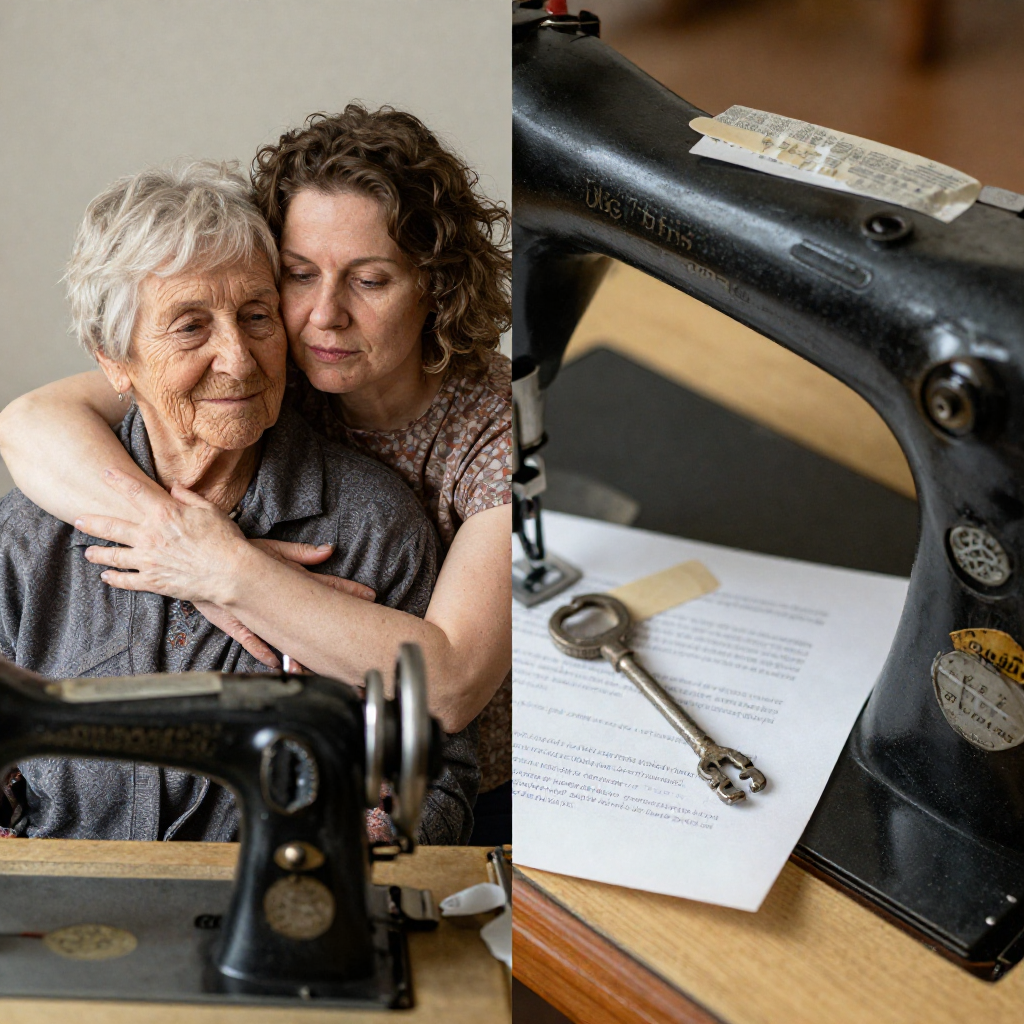
The dish by my door had been holding the key for two months, and every time I walked past it I felt a small, specific failure, the kind that doesn’t ache so much as itch. My grandmother, Edith Calloway, had been a woman who did nothing by accident. She labeled her spice jars in a hand so neat it looked typed. She kept a ledger of every dollar she’d ever spent on the house, going back to 1968. So when her lawyer, a soft-spoken man named Mr. Pruitt with liver-spotted hands, slid the brass key across his desk to me and said she had insisted I receive it in person, I understood that this was not a forgotten thing. This was a placed thing. She had wanted me, specifically, to have it, and to be confused by it, and—I suspected, knowing her—to work for the answer.
I am forty-one years old. I have a job in claims adjustment that I do not love and do not hate, an apartment two towns over that I was already in the process of leaving, and a habit, formed over thirty years of Sunday dinners, of noticing things. Edith taught me that. She’d catch me staring at the wallpaper in her hallway, a pattern of cornflowers that had faded to the color of skim milk, and she’d say, what do you see, Margaret, not because she wanted an answer about wallpaper but because she wanted to know if I was paying attention to the world or just passing through it.
I tried to pay attention to the key the way she would have wanted. It was small, no longer than my thumb, brass gone a little green at the bow, with a single ward cut into the blade — not a modern key, not a safe-deposit key, not anything from a hardware store this century. The kind of key you’d find described in a Victorian inventory. I tried it in the shed where she kept her trowels and her bags of bone meal. I tried it in the cellar, in a padlock so old it crumbled rust onto my fingers. I pried open the hope chest at the foot of her bed, the one that held her wedding dress wrapped in tissue gone the color of weak tea, hoping for a hidden compartment, and found nothing but more tissue. I even walked the quarter mile to the road and tried it in the mailbox, feeling foolish before I’d even gotten the key out of my pocket.
Nothing. For two months, nothing.
I moved into the house in March, partly because my lease was up and partly because I couldn’t stand the thought of her rooms sitting empty, the way a held breath sits in a chest. I told myself I’d sell eventually. I told myself that every week, and every week I found another reason to stay one more month — the garden needed weeding, the roof needed looking at, her good china needed someone to use it instead of admire it through glass. The truth, which I did not say out loud to anyone, was that the house still smelled like her. Lemon oil and the particular mustiness of old books and, faintly, always, the lavender sachets she kept in every drawer. I was not ready to let a stranger paint over that smell.
Which is, in a roundabant way, how I came to be holding a paint roller in her bedroom on a Saturday in May, attempting to cover thirty years of cigarette-yellowed cream with something called “Quiet Dove.” I’d pulled the furniture to the center of the room and taped the baseboards and gotten as far as the wall behind where her bed used to stand when I noticed the heating vent.
It was an old one, cast iron, painted over so many times the scrollwork had gone soft and blurred, like a photograph left in the sun. I’d seen it a hundred times growing up and never thought about it once. But this time, kneeling to tape around it, I noticed the screws. Four of them, holding the vent cover to the wall, and they were not the slotted, soft-headed screws you’d expect from 1962, the kind that strip if you look at them wrong. They were newer. Phillips head. Bright, like they’d been replaced sometime in the last decade and never painted over, which was strange, because Edith painted over everything, on principle, the way some people pray.
And vents, in my experience, are not screwed shut. They’re held with a single screw, or a clip, so you can pull them off to vacuum out the dust bunnies and dead spiders. This one had four screws sunk deep, like someone wanted it to never come off again, or wanted to make very sure it would only come off on purpose.
I sat on the floor for a long moment looking at it. Outside, a mourning dove was making its low, three-note complaint, the sound that had been background music to every Sunday of my childhood. I thought about Edith’s hands, age-spotted and surprisingly strong, holding a screwdriver. I thought about the key sitting twenty feet away in a dish by the front door, and I thought, she said you’d know what to do, and for the first time in two months I believed I might.
It took me forty minutes to find a screwdriver in her toolbox that fit, and another twenty to back the screws out, because they’d been set with something like real intention, real torque, and my hands were shaking in a way that had nothing to do with effort.
Behind the vent cover, where there should have been ductwork — a dark metal throat leading down into the walls — there was instead a flat plate. Steel, not iron, and newer than the house around it. A real door, no bigger than a paperback novel, set into a frame that had been mortared into the brick of the chimney breast the vent was mounted on. There was a keyhole in the center of it, the kind that takes an old-fashioned key, not a modern lock at all.
I went and got the key from the dish. My hand, I noticed, was not quite steady.
It slid in like it had been waiting, the way a key does when it’s the right key, that particular silken give that has nothing in common with the grinding non-fit of a wrong one. I turned it. Something inside the mechanism gave a soft, oiled click, far quieter than I expected from a lock that old, which told me someone — Edith, it had to be Edith — had maintained it. Had oiled it. Recently enough that it still worked like new.
I pulled the little door open, and what I found made me sit down hard on the paint-spattered floor, because inside that space, no bigger than a shoebox, was not money, and was not jewelry, and was not a deed to some other house I’d never heard of, all of which I had, somewhere in the last two months, allowed myself to imagine.
It was a stack of letters, tied with white ribbon gone the color of old teeth, and on top of them, a photograph of a young woman who was not my grandmother, standing in front of this very house, pregnant, and smiling in a way I had never once seen Edith Calloway smile in forty-one years of knowing her.
I want to tell you that I opened the letters immediately, that I sat on that paint-flecked floor and read them straight through like something out of a movie. I didn’t. I sat with the photograph in my lap for almost an hour, just looking at it, because I needed, first, to understand what I was looking at, and the truth is I didn’t, not yet, except that the woman in the photograph had Edith’s chin and Edith’s stubborn, deep-set eyes, but was not Edith. Was younger than Edith had ever been in any photo I’d seen of her, even the ones from her wedding. Was wearing a dress that belonged to a decade before Edith was born.
It was, I would learn over the following days, my great-grandmother. Edith’s mother. A woman named Vivian, who I had heard mentioned perhaps four times in my life, always briefly, always followed by Edith changing the subject with the practiced ease of a woman who had spent sixty years changing that particular subject.
The letters were between Vivian and a man whose name was not my great-grandfather’s. They spanned three years, 1947 to 1950, written in a looping, urgent hand that pressed hard enough into the paper that you could feel the words on the back of each page like braille. They were not letters about nothing. They were letters about a man named Joseph, who worked the rail line that used to run through town before it was torn up in the sixties, and who Vivian had loved with a specificity and a heat that made me feel, reading them, like I was trespassing on something that had nothing to do with me at all.
Except it did. Because in the eleventh letter, dated September of 1949, Vivian wrote to Joseph that she was carrying his child, and that her husband — my great-grandfather, a man named Calvin Reyes who I knew only from a single dour photograph on the parlor wall — did not know, and that she did not know what she would do.
That child was Edith.
I sat with that for a long time. Longer than I’d sat with anything in my life, I think, including the morning I got the call that Edith had died in her sleep, eighty-nine years old, in the bed not ten feet from where I was now sitting with her secrets in my lap.
The rest of the letters told me the rest of it, in pieces, the way letters do, because they were never written to explain themselves to a stranger forty years later. Joseph had wanted Vivian to leave Calvin. Vivian, it seemed, had wanted that too, in the aching, useless way you want a thing you’ve already decided you can’t have. There was a last letter, shorter than the others, dated the spring of 1950, in which Joseph told her he was being transferred to a rail yard three states away and that he would wait for her if she would come, and that if she didn’t come by the first of June he would understand, and would not write again.
There was no twelfth letter. Whatever Vivian decided, she decided it without writing it down, or she wrote it down and it never made it into this box.
What was in the box, instead — beneath the letters, which I almost missed because by then my hands were unsteady and I was not being careful — was a single sheet of paper in handwriting I recognized instantly, because it was the same hand that had labeled every spice jar in that kitchen for forty years. Edith’s hand. Dated eleven years ago, which would have made her seventy-eight when she wrote it.
To whoever finds this — and I expect it will be you, Margaret, because you are the only one who ever asked me real questions instead of comfortable ones —
My mother kept these for forty years in a hatbox in her own closet, and gave them to me three weeks before she died, because she said a secret that dies with you isn’t honesty, it’s just hiding with better timing. I have kept them for thirty-one years since, trying to decide if she was right.
I am not going to tell you what to think of her. I have spent half my life angry at her and the other half grateful, and I have never managed to settle on one feeling longer than a season. What I will tell you is this: Calvin Reyes raised me as his own and never once, not in word or look, made me feel like anything less than his daughter, and I loved him for it the way you love a person who chooses you on purpose, every day, instead of by accident of blood. I do not know if Joseph ever knew I existed past that last letter. I never tried to find out. There were years I wanted to, and years I was glad I hadn’t, and I could not tell you, even now, which years were the right ones.
I am giving you this key and not the box itself, because if you are the kind of person I think you are, you will not stop until you understand why a door this small needed a lock this serious, and you will find your own way to the rest. I wanted you to have to work for it a little. Not to be cruel. Because the things you have to work for are the things you actually keep.
The house is yours because you showed up, fifty-two Sundays a year, every year, when no one made you and nothing was in it for you except an old woman’s company and a slice of whatever pie I’d managed not to burn. That kind of showing up is rarer than people think, and I noticed every single time, even the Sundays I pretended I hadn’t, because I have never been a woman who likes to be seen being moved.
Do with this whatever you decide is right. I trust you with it more than I ever trusted myself.
I did not cry right away. That came later, in the strange delayed way grief works, arriving in the shower three days later over something unrelated, a bar of soap that smelled like her hand cream. What I did, sitting on that floor in May with paint drying stiff on the roller beside me, was laugh, once, a short startled sound, because of course she had done this. Of course she had spent eleven years deciding whether to leave me a stack of letters that would unmake and remake my understanding of three generations of women, and had decided, in the end, not to leave them to me directly, but to leave me a key, and a vent screwed shut with four bright new screws, because she wanted to know — even from inside a coffin she hadn’t yet been buried in — that I would notice. That I would be the kind of person who pays attention to a thing that doesn’t fit.
I thought about Vivian, twenty-six years old in that photograph, smiling a smile I’d never seen on her daughter’s face, carrying a secret that would take three generations and one badly painted bedroom to surface. I thought about Calvin Reyes on the parlor wall, dour and unsmiling, who had apparently loved a child that wasn’t his with the kind of constancy that doesn’t make for good photographs but makes, it turns out, for an entire life of being someone’s real father in every way that counted. I thought about Joseph, whoever he’d been, who might have lived out his whole life three states away never knowing he had a daughter who’d live to be eighty-nine, who’d plant dahlias every spring and serve a Sunday roast for thirty years, who’d hide a stack of letters behind a vent and trust a single granddaughter to find them.
I did not, in the end, look for Joseph’s family, though I thought about it for the better part of a year. I decided — and I think this was the right decision, though I am less sure of most things now than I used to be — that the letters belonged to the dead, and that the living got to decide what to do with what was left behind, and what I chose to do was keep them. Not hide them. Just keep them, the way you keep a photograph of someone you never met but who is, somehow, half the reason you exist.
I finished painting the bedroom. Quiet Dove, in the end, looked almost exactly like the cream it replaced, which felt, when I stood back to look at the finished wall, like exactly the right kind of joke for that house to play on me.
I put the vent cover back on with the same four bright screws, because some doors are meant to be found once and then left alone, and I put the little steel door behind it, locked, with the letters back inside in their white ribbon, and the photograph of Vivian on top, smiling out at whatever darkness she’d be sitting in until someone — my own daughter, maybe, if I ever have one, or a stranger who buys this house long after I’m gone — decides to ask what a vent like that one might be hiding.
The brass key, I kept. Not in the dish by the door anymore. I wear it now, most days, on a chain, the way you’d wear something that had finally answered the question it was made to ask. Some Sundays, when I’m out in the garden Edith planted forty years ago, deadheading the same dahlias she used to deadhead, I take it out and look at it, and I think about a woman who insisted, even from beyond the reach of insisting on anything at all, that I would know what to do.
I think, mostly, that she was right to trust me. I think that’s the part that matters most, more than Vivian, more than Joseph, more than Calvin’s quiet, undeclared love. She trusted me to find it, and to be careful with it, and to decide, on my own, what kind of keeper of secrets I wanted to be.
I have not decided everything yet. But I know what to do with the key. I always have. It just took a screwed-shut vent and a dead woman’s patience to teach me that knowing isn’t always the same as understanding, and that some doors are worth thirty years of Sundays before anyone hands you the right key to open them.