The morning Daniel disappeared, the coffee maker was still warm.
That detail stayed with Marisol longer than almost anything else from those three days—the way the carafe held its heat for an hour after she found the bed empty, as if Daniel had only stepped out to grab the paper, as if he might walk back through the kitchen door any second smelling like cut grass and saying something about the Hendersons’ fence again. She’d stood there at six-forty in the morning in her robe, staring at a coffee maker that proved he’d been alive and moving and making decisions less than an hour before she woke up, and somehow that proof made the empty house worse, not better.
His side of the bed wasn’t just empty. It was made—badly, the way he always made it, with the comforter pulled up crooked because he never lined up the corners. He’d gotten up, made the bed half-heartedly like he did every morning, and then left. Not run out the door in a panic. Not been taken. Left, the way a person leaves when they intend to come back in twenty minutes.
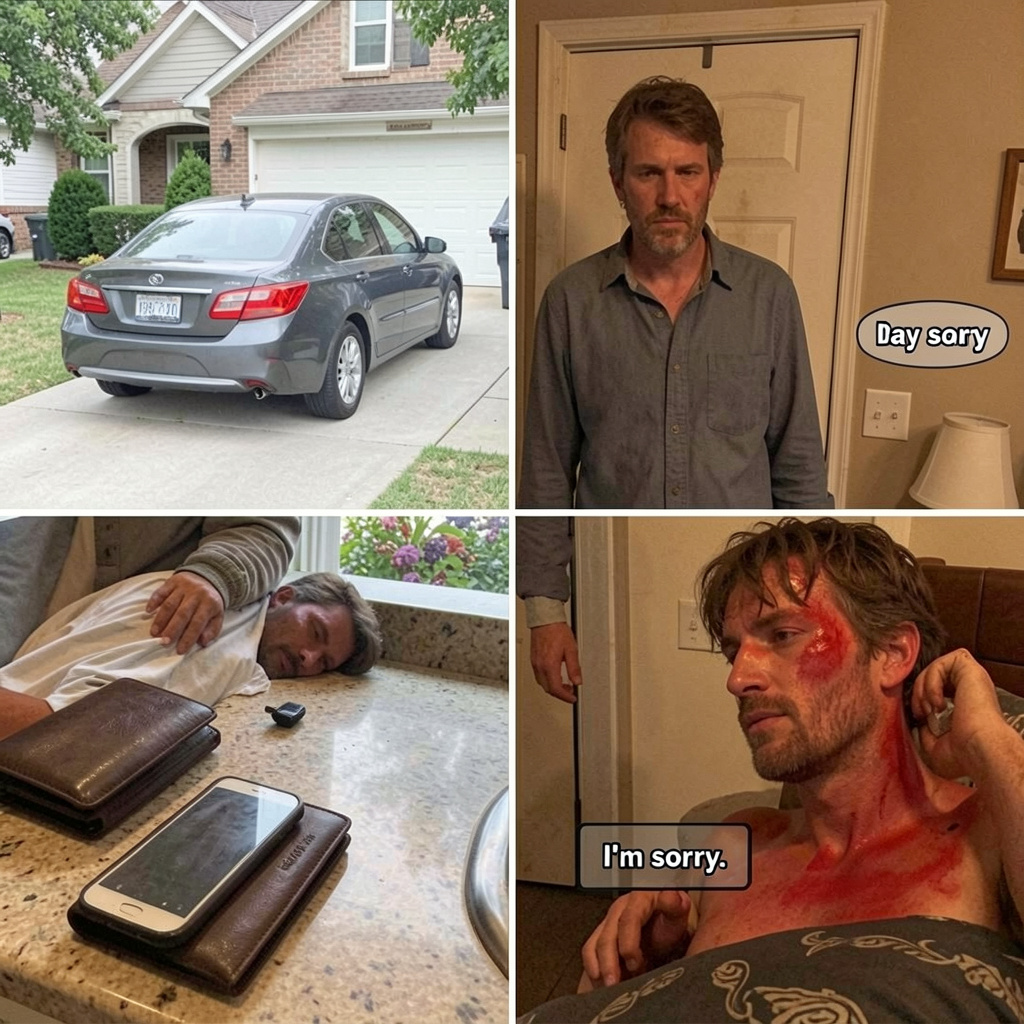
His phone was on the nightstand, screen dark, battery at sixty-one percent. His wallet sat on the kitchen counter next to the fruit bowl, exactly where he dropped it every night when he came home from the hardware store he managed off Route 9. His car—the gray Tacoma he’d had since before they were married—sat in the driveway with dew still beaded on the windshield.
Marisol called his name through the house first, feeling foolish even as she did it, the way you call for a cat you know isn’t there. Then she checked the garage, the backyard, the bathroom, as if a grown man could be hiding behind the shower curtain. Then she called his brother, Theo, who answered on the second ring sounding like she’d woken him, which she hadn’t, because it was past seven by then.
“Have you heard from Daniel?”
“No, why?”
That “why” was the first crack. Theo didn’t ask it the way you’d ask if your brother had simply gone for an early run. He asked it the way you ask when something in your sister-in-law’s voice tells you the question isn’t casual.
By nine, she’d called his mother, Carol, a soft-spoken woman who lived forty minutes north in the house Daniel grew up in. Carol’s voice did something strange when Marisol explained—it went quiet in a way that, looking back, Marisol would later understand wasn’t shock. It was something else. Something closer to dread recognizing itself.
“He’s probably just out,” Carol said. “He does that sometimes.”
“Carol, his wallet is on the counter. His phone’s still here. The truck hasn’t moved.”
A pause. “Give him a little time.”
It was such an odd thing to say that Marisol almost didn’t register it in the moment, too busy spiraling through her own panic to notice that her mother-in-law hadn’t asked a single follow-up question. Hadn’t asked if Marisol had called the hospitals. Hadn’t asked if there’d been a fight. Hadn’t asked anything a frightened mother should ask. She’d simply said give him time, like she already had a private theory she wasn’t sharing.
Marisol didn’t have the bandwidth to notice the strangeness of it. Not yet.
By noon she’d called his friends—Marcus from the gym, his old college roommate Paul, two guys from the store. Nobody had heard from him. Nobody had plans with him. His coworker Denise said he hadn’t shown up for his ten o’clock shift, which was the first time in six years he’d no-showed without a text.
By two, she called the police.
The officer who came to the house was younger than her, polite in the careful, distant way of someone trained to manage a stranger’s worst day. He asked the standard questions. Any history of mental health struggles? No. Any indication of an affair, a debt, a problem at work? Not that she knew of. Any history of him walking away before? No, never, not once in eleven years of marriage. The officer wrote it all down with a kind of practiced neutrality that made Marisol feel like she was reciting a script for a show she hadn’t auditioned for.
“Most of these resolve themselves within forty-eight hours,” he told her, not unkindly. “People go through things. They come back.”
She wanted to ask him what kind of thing a person goes through that requires leaving their phone, their wallet, and their truck behind. But she didn’t, because some small animal part of her brain had already started circling that very question, and she didn’t want to hear it spoken aloud by a stranger in a county uniform standing in her kitchen.
The first night, she didn’t sleep. She sat at the kitchen table with Daniel’s phone in front of her, the passcode useless because she didn’t know it, just turning the dark rectangle over and over in her hands like it might whisper something if she held it right.
The second day brought search efforts—Theo drove the back roads near the reservoir, because Daniel liked to walk out there sometimes when he needed to think. Marcus checked the gym, the diner, even the bar Daniel hadn’t set foot in since they got married. Nothing. No sightings. No charges on his cards, because his cards were sitting in his wallet on the counter, untouched. No activity on his phone, because his phone was untouched too. It was as if he’d evaporated and left behind every trace of the life he was supposed to be living.
Carol called once that day, and again her questions were strange. Not “Did you find him,” but “Has anyone called you.” Not “Where do you think he is,” but “Is anyone with you right now.” Marisol, exhausted and raw, asked her outright: “Carol, do you know something?”
A long pause on the line. “I just want you to not be alone,” Carol said, which wasn’t an answer, and somehow felt worse than if she’d simply said no.
The third day was the worst. The police had filed it as an official missing persons case by then, which sounds like progress but mostly meant more forms, more waiting, more strangers asking Marisol to describe her husband’s temperament as if grief could be itemized. She slept maybe two hours that night, sitting up on the couch with every light in the house on, because the dark felt unbearable when she didn’t know if her husband was alive in it somewhere.
On the morning of the fourth day, just past ten, the back door opened.
Marisol was standing at the sink. She heard the screen door creak—the one Daniel always meant to oil and never did—and she turned around so fast she knocked a glass off the counter, and it shattered against the tile, and neither of them looked at it.
He looked terrible. Not hurt-terrible, not bloodied or broken, but worn in a way she’d never seen on him. His shirt wasn’t his—an old, faded blue T-shirt that didn’t belong to anything in their closets, two sizes too big, with a logo so washed out she couldn’t make it out. His jeans were stiff with dried mud at the hem. His face and forearms were sunburned dark red-brown, the kind of burn that comes from days outside with no shade, and there was a raw, peeling line across the back of his neck. His hair was greasy and flattened on one side like he’d been sleeping rough.
“Where—” Marisol started, and her voice broke in half before she could finish the sentence. “Where were you? Daniel, where the hell were you? I called the police. I called your mother. I called everyone. Three days. Three days.”
He stood in the doorway with his hand still on the frame, like he needed it to hold himself up, and he looked at her—not past her, not away from her, right at her—and he said, “I’m sorry.”
That was it. Two words. No explanation trailing behind them. No “I’m sorry, I was—” No clause to finish the thought.
“That’s not an answer,” she said. “Daniel. Where were you.”
He didn’t answer. He walked past her, close enough that she caught a smell off him she didn’t recognize—not sweat exactly, something earthier, like a campfire that had gone out wet. He went upstairs. She heard the shower running for almost forty minutes. Then she heard the bedroom door close, and when she finally went up an hour later, he was asleep, or pretending to be, on his side of the badly made bed, the same bed he’d left four mornings before.
She didn’t sleep next to him that night. She sat in the doorway of their bedroom on a kitchen chair she’d dragged up the stairs, watching him breathe, trying to decide if she was angry or relieved or something with no name that sat underneath both.
In the weeks after, she tried everything. She asked gently. She asked furiously. She asked in the middle of the night when his guard might be down. She asked their couples’ therapist to ask, sitting in a beige office with a box of tissues between them, and Daniel had looked at the therapist with the same flat, closed expression he’d given Marisol on the back porch and said, “I can’t.”
Not I won’t. I can’t.
She noticed things over the following months. He flinched at sudden silence, the way some people flinch at sudden noise. He started keeping a flashlight on his nightstand, the heavy aluminum kind, though he never explained why. He stopped drinking, completely, overnight, with no announcement, just an empty space in the fridge door where beer used to live. He started locking the back door even during the day, even when they were both home. Once, watching a documentary about wilderness survival, he got up halfway through and left the room and didn’t come back until she’d turned the TV off.
The police case was closed within a week of his return—he was an adult, he’d come back unharmed, no crime had occurred that anyone could point to, and he refused to give a statement beyond confirming he was safe and hadn’t been the victim of foul play. Case closed. File stamped. Life, apparently, was supposed to continue.
It did, in its way. They stayed married. They were, for the most part, happy—or happy enough, the way long marriages settle into a happiness that’s more architecture than feeling, load-bearing walls built years ago still holding the roof up. But there was a door in their relationship that never opened again, three days wide, and Marisol learned to walk around it the way you learn to walk around a piece of furniture in the dark.
Carol knew. Marisol became sure of that within the first year—sure in the way you become sure of things you can’t prove, just from the texture of silences and the careful way Carol redirected certain conversations. But Carol wouldn’t talk either, not for years, guarding whatever she knew like it belonged to someone else and wasn’t hers to give away.
It was eleven years later, the spring Carol turned seventy-eight and her mind had begun loosening its grip on the careful sorting of what should and shouldn’t be said, that she finally told Marisol.
They were at Carol’s kitchen table, the same table Daniel had grown up doing homework at, drinking tea that had gone lukewarm because they’d both forgotten to drink it while talking. Carol had been telling stories about Daniel as a boy—nothing unusual, the ordinary inventory of a mother’s memory—when she said, almost as an aside, “He gets that fear from his father, you know. The flashlight by the bed. Same thing his father used to do.”
Marisol set her cup down carefully. “Carol. What happened? When he disappeared. You know. You’ve always known.”
For a long moment, Carol looked like she might do what she’d always done—deflect, soften, change the subject to something safer. But then something in her face gave way, the way old dams give way not with drama but with a quiet, final yielding.
“He called me,” Carol said. “The second night. Not you. Me.”
Marisol felt something cold move through her chest. “He called you and you didn’t tell anyone? The police were—”
“I know what the police were doing,” Carol said sharply, and then, gentler: “I know, sweetheart. I’ve carried that for eleven years and I’m not proud of it. But he begged me. He said if I told a single soul where he was, he’d never speak to me again, and I believed him, because I had never in my life heard him sound like that.”
“Where was he.”
Carol was quiet for a long moment, turning her cup in slow circles on the table.
“You remember his father left when Daniel was nine,” she said. “You know that part. What you don’t know is how he left.”
Marisol did know the bare fact—Daniel’s father, a man named Russell, had walked out on the family decades ago and was, as far as anyone knew, still alive somewhere in Arizona, a name spoken maybe twice a year and always with a flattened, careful tone. Daniel rarely mentioned him. When he did, it was never more than a sentence.
“Russell didn’t just leave,” Carol said. “He took Daniel with him first. For three days. Without telling me where. Without my permission. I didn’t know if my son was alive for three days, Marisol, and when Russell finally brought him back, Daniel wouldn’t speak for almost a week. Nine years old, and he just—shut down. Russell never told me what happened on that trip, and a month later he was gone for good, and I never saw him again, and Daniel never told me what those three days were, not once, not in thirty years.”
Marisol felt the floor of the conversation tilt under her. “I don’t understand. What does that have to do with—”
“Because eleven years ago,” Carol said, “on the third night Daniel was missing from your house, he called me from a payphone—do you know there’s still a payphone out by the Route 12 rest stop? I didn’t either. And he was sobbing, Marisol. A grown man, sobbing like he was nine years old again. He said he’d found out where his father had taken him all those years ago. He’d been trying to find Russell for almost a year by then—quietly, behind your back, I think because he was ashamed of needing to—and somebody finally gave him an address. A cabin. Out past the Adirondacks, deep in, no service, nothing.”
“He went to find his father?”
Carol nodded slowly. “He drove through the night to get there. He told me he needed to ask him one question, and only one. He wanted to know what happened during those three days when he was nine. He’d spent his whole life with this—this hole in his memory, Marisol. Just blank. Three days he couldn’t account for, that his own mind had locked away somewhere he couldn’t reach, and it had haunted him his entire adult life, this feeling that something had happened to him that he wasn’t allowed to remember.”
Marisol thought of the flashlight. The flinching at silence. The sudden disappearance from the living room during the documentary. Eleven years of small, quiet evidence she’d misread as nothing, or as everything, or as some private grief she wasn’t permitted to ask about.
“What did Russell tell him?”
Carol’s eyes filled, and for a moment she didn’t speak. “Russell was dying. Lung cancer, very advanced, hospice care in that cabin because he didn’t want to die in a hospital surrounded by strangers. Daniel found him three days before he passed. And Russell told him everything. He told him that thirty years ago, when Daniel was nine, he’d taken him out to those same woods because Russell himself had been a frightened, broken man planning to take his own life, and at the last moment, with Daniel asleep in the tent beside him, he hadn’t been able to go through with it. So instead he’d just—stayed out there. Three days. Trying to find a reason to come back. Daniel was there the whole time, nine years old, terrified, watching his father disappear inside himself in a tent in the woods, not understanding any of it, just knowing something was deeply wrong and that he wasn’t supposed to ask.”
The kitchen was very quiet. Somewhere outside, a lawnmower started up two yards over.
“Daniel spent thirty years not remembering it,” Carol said, “and one phone call finding out the worst version of it possible. And then he sat with his dying father for three days while Russell tried, badly, to apologize for all of it. For taking him out there as a child. For never explaining it. For thirty years of silence. Daniel held that man’s hand while he died, Marisol, the same man who’d put him through the worst three days of his childhood, and then he drove home and the only thing he could say to you was I’m sorry. Because by then, that was the only thing he had any practice saying. It was the last thing he’d heard his own father say, over and over, in that cabin. He told me later it was the only sentence that felt true enough to use.”
Marisol sat with that for a long time, feeling something in her chest reorganize itself slowly, painfully, into a different shape than the one it had held for eleven years.
“Why didn’t he ever tell me?” she finally asked. “Even after. Even years later, when it might have been easier.”
Carol reached across the table and took her hand. “Because telling you meant becoming, for a while, the nine-year-old boy in that tent again. And he’d already done that once, alone, in those three days. He didn’t have it in him to do it twice. I think some part of him decided that carrying it silently was a kind of mercy—to you, and maybe to himself too. He let the question stay unanswered because the answer cost more than the silence did.”
Marisol drove home that evening with the windows down, the spring air moving through the car in a way that felt, oddly, like the first real breath she’d taken in eleven years. Daniel was in the garage when she got there, sanding down an old dresser they’d been meaning to refinish, sawdust dusted across his forearms in the evening light.
She didn’t tell him what she knew. Not that night, and not for a while after. But she sat down on the old stool beside his workbench, the one with the wobbly leg he kept meaning to fix, and she stayed there while he worked, not asking anything, not needing him to explain anything anymore.
After a while, without looking up from the dresser, he said, “You went to see my mom today.”
“I did.”
He kept sanding, slow even strokes with the grain. “She tell you something?”
Marisol considered every version of the answer she could give. In the end, she gave him the truest one.
“She told me you’re a good man who survived something nobody should have had to survive twice,” she said. “That’s all I need to know.”
Daniel’s hands stopped moving. He set the sandpaper down on the dresser, very carefully, like it might break, and for the first time in eleven years, he let himself cry in front of her—not loudly, not dramatically, just a quiet unraveling at the edges, the kind of crying that comes when a weight finally gets to set itself down. Marisol moved off the stool and put her arms around him, sawdust and sunburn-scarred skin and all, and didn’t ask him to say anything else.
He never did tell her the full story himself. Not in his own words, not directly, not ever. But he didn’t need to anymore. Some truths, she’d come to understand, aren’t meant to be spoken twice. Sometimes the kindest thing you can do for the people who love you is let someone else carry the telling, so that the person who lived it only ever has to live it once.
And every year, on the anniversary of those three days, Daniel goes out to the back porch alone for exactly one hour, just before dark, and sits with something Marisol no longer needs explained. She brings him coffee. She doesn’t ask where he is, because by now, she finally understands. He isn’t anywhere. He’s just remembering how to come back—the way he always eventually does, the way his father, in the end, could not.