The Amazon package sat on my doorstep like a mistake the universe had made and not yet noticed. It was a Tuesday, the kind of flat, grey Tuesday that doesn’t warn you. The kind that just is, right up until it isn’t.
I almost left it. I had grading to finish — twenty-six seventh-grade essays on To Kill a Mockingbird — and a lasagna in the oven, and a glass of Pinot Grigio that had been waiting patiently on my kitchen counter for forty minutes. I almost left it and went back inside.
But the name on the label stopped me.
Hartwell. My name. Or rather, the name I had been practicing writing in my head for three years without telling a single soul, because that felt like the kind of private foolishness you kept to yourself until you were sure. Sara Hartwell. I’d even said it out loud once, alone in my car in a parking garage, and then felt so embarrassed by myself that I’d turned the radio up loud.
The address, though. The address was wrong. Not my street. Not my zip code. Fourteen miles away, in Briar Glen, the neighborhood with the wide driveways and the basketball hoops and the mailboxes shaped like lighthouses.
I looked at the sender. Zales.
I didn’t think anything of it. I want to be clear about that, because afterward people kept asking me if I had a feeling, if some part of me knew, and the honest answer is no. I thought: what a coincidence, another Hartwell. I thought: Michael must have a cousin out that way. I thought: I’ll drop it off on my way to the pharmacy, it’ll take ten minutes.
I thought all the wrong things, and I drove fourteen miles, and I knocked on a door.
The house was a Colonial, butter-yellow with black shutters. A wreath on the door made of fake autumn leaves, even though it was March. Two bikes leaned against the garage — one pink with streamers, one blue with a dented fender. A basketball hoop at the end of the driveway with a net that had seen better days.
I remember all of this. I remember it the way you remember the details of an accident scene: not because you tried, but because your brain, sensing catastrophe, suddenly decided to start recording everything.
I knocked.
She answered in maybe thirty seconds. Late thirties, dark hair pulled back, flour on her left forearm like she’d been baking. Pretty in the way that people are pretty when they don’t think about it — reading glasses pushed up on her head, a smear of something on her college sweatshirt. Behind her, two kids materialized the way children do, magnetically drawn to any open door.
She smiled at me. A normal, neighborly smile.
“Hi — can I help you?”
“I think this came to my address by mistake,” I said, holding up the package. “Hartwell? I’m on Pembrook Lane.”
Her smile widened. She reached for the box. “Oh, thank you so much. Michael must have used the wrong address again — he does this thing where he autocompletes and doesn’t check.” She laughed, a small, fond, exasperated laugh. The laugh of someone who has been tolerating a particular habit for a long time. “I keep telling him to slow down.”
I should have handed her the box and left. I know that. I’ve run it back a hundred times. I should have smiled, said no problem, and driven away and never known. Maybe that would have been better. I don’t know. I’m still not sure.
Instead I said: “How do you know Michael?”
She looked at me the way you look at someone who has said something slightly odd. Amused, a little puzzled. “He’s my husband.” A small laugh. “Eleven years this June.”
The box slipped in my hands. I caught it.
“Eleven years,” I repeated.
“Eleven years.” She tilted her head. “Are you all right?”
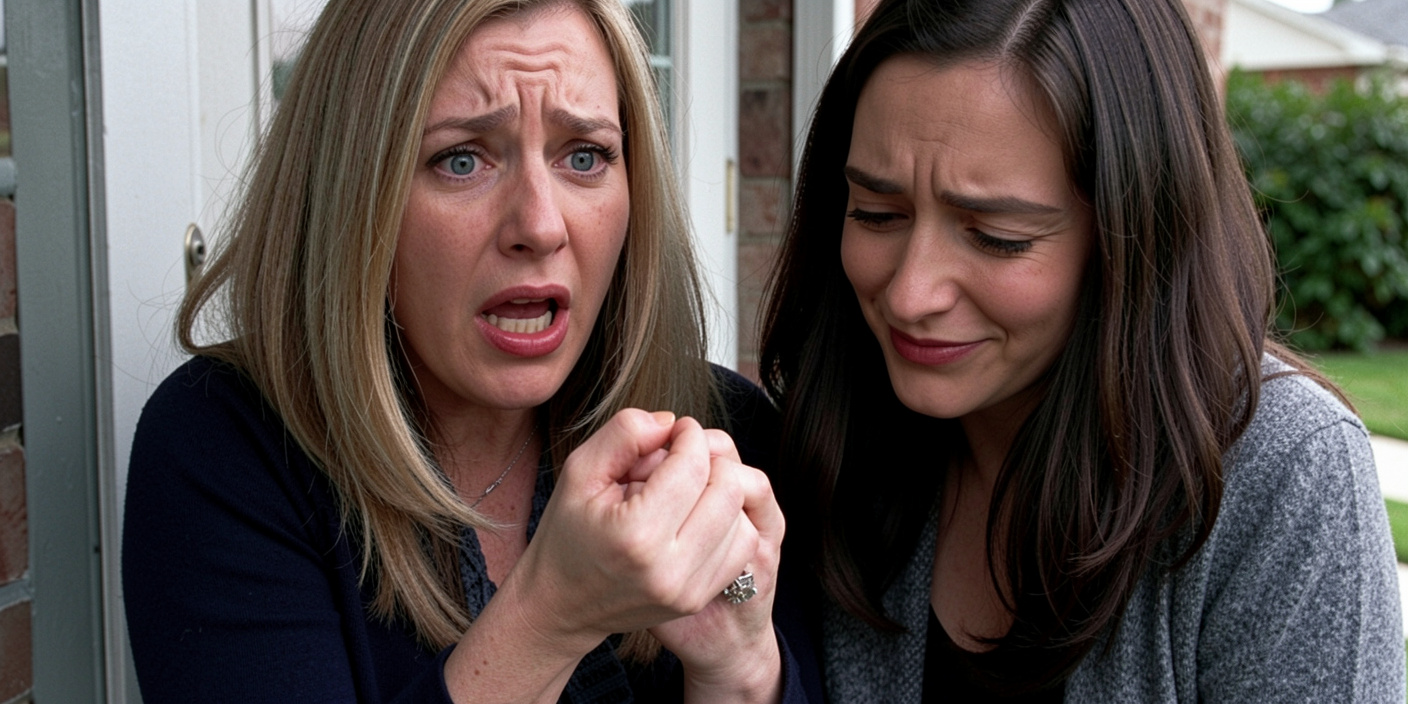
My left hand moved before my brain told it to. It just — rose. Like it had its own decision to make. And I held it up between us, and the ring caught the grey March light, and I watched her face.
The smile didn’t fall slowly. It collapsed, all at once, like a building coming down.
She looked at the ring. She looked at my face. She looked at the ring again.
“He bought you the same ring,” she whispered. It wasn’t a question.
“He told me,” I said — and my voice was very calm, which surprised me, because I could feel the lasagna, the essays, the Pinot Grigio, the three years, all of it, sliding away from me like furniture in a flood — “he told me you were dead.”
Her name was Claire.
She invited me in. I don’t know why she did that, and I don’t know why I went, but we both seemed to understand that the doorstep was not a place where this conversation could happen. The two kids — a girl, eight, named Rosie, and a boy, six, named Theo — were sent upstairs with the bribe of screen time, no questions asked. Claire closed the kitchen door.
She put the kettle on. I sat at a kitchen table that had a fruit bowl in the middle and a permission slip stuck to the refrigerator with a magnet shaped like a sunflower. Normal things. Ordinary things. The architecture of a life.
“How long?” she asked. Her back was to me.
“Three years. We met at a conference. Educational publishing — I’m a curriculum editor. He said he was in sales.” I paused. “He is in sales.”
“Yes.” Flat. “He is.”
“He told me his wife — that you — breast cancer. 2019. He cried.” I stopped. “He cried a lot, actually. About you. I thought it meant he was someone who knew how to love.”
Claire turned around. She had two mugs in her hands and her eyes were dry, which I found both admirable and frightening.
“He told me he traveled for work. Three, four nights a week sometimes. I—” She set the mugs down. “I believed him because there was no reason not to. We have a mortgage. We have kids in school. I thought our biggest problem was that he forgot to check the address when he ordered things online.”
She sat down across from me.
We looked at each other — two women at a kitchen table, drinking tea neither of us wanted, wearing the same ring.
“I’m sorry,” I said.
“Don’t,” she said, not unkindly. “You didn’t know.”
“No. But I’m still sorry.”
She turned her mug in her hands. “He proposed to you.”
“Eight months ago. At a restaurant. He got down on one knee. The whole thing.” I looked at my hand. “I thought it was the most beautiful ring I’d ever seen. He let me pick it out. He said he wanted me to have exactly what I wanted.”
Something moved across Claire’s face. “He let me pick mine out too.”
We sat with that for a moment.
“I want to ask you something,” I said, “and you can tell me it’s none of my business.”
“Ask.”
“Are you happy? Were you — before today — were you happy?”
She was quiet for a long time. Long enough that the kettle, having already boiled, began to cool.
“I thought I was,” she finally said. “I thought we were going through a quiet patch. That’s what I called it. A quiet patch. He was distracted, a little distant, but we’ve been together eleven years and we have two kids and a house and a dog, and I thought — I thought that was just what long marriages looked like sometimes. I thought it was something you moved through.” She looked at me. “Was he happy? With you?”
“I thought so,” I said. “I thought we were—” I stopped. “Yes. I thought so.”
I drove home in the dark.
I sat in my car in my driveway for a long time before going inside. The lasagna had burned. The smoke alarm had gone off at some point, and I hadn’t been home to hear it. I opened the windows and threw the lasagna away and stood in my kitchen with the cold air coming in and tried to locate my feelings.
I found them eventually. They were all there, waiting. Grief and rage and humiliation and something else, something harder to name — a kind of vertigo, like the ground you’ve been standing on has not moved but has been revealed to have always been water, and you have been walking on it for three years without knowing.
He called at 9:17. I watched the phone light up on the counter. Michael <3, said the screen. I had put that little heart there myself, eight months ago, right after he proposed, in the giddy stupid warmth of thinking you have been chosen.
I let it ring.
He called again at 9:34. Then 9:51. Then a text: Hey, you okay? Lasagna night, right? 😊
The emoji undid me a little. The casual, ordinary emoji. The complete lack of any awareness that fourteen miles away, his whole architecture had come apart.
Or maybe he knew. Maybe Claire had called him. Maybe he was texting me from his car in his own driveway, trying to manage the situation, trying to figure out which direction the fire was coming from.
I thought about calling my sister. I thought about calling my friend Dana, who had never fully trusted Michael anyway and who would experience this as a complicated mixture of grief for me and vindication for herself. I thought about calling my mother, who would cry in a way that would require me to comfort her.
I didn’t call anyone. I poured the Pinot Grigio down the sink. I picked up the twenty-six essays on To Kill a Mockingbird and I sat on my couch and I started grading them, because what else do you do with a Tuesday?
He came to my apartment on Thursday.
I had been expecting him since Wednesday. He had left fourteen voicemails. The voicemails progressed through stages: confusion, then concern, then a long silence in the middle of one that I listened to four times trying to understand what it meant, then something that sounded almost like confession before he seemed to decide against it and hung up.
I opened the door when he knocked. I let him in. I thought it was important to let him in, to see his face when he had to say it to me directly.
He looked terrible. He hadn’t shaved. There were shadows under his eyes that were real, this time — I knew what his manufactured grief looked like, and this was different. This was the face of a man confronting consequences.
“Sara—”
“Don’t,” I said. “Sit down.”
He sat.
I remained standing. I wasn’t sure I planned it that way, but it felt right.
“What’s her name?” I asked.
A pause. “Claire.”
“I know her name. I sat at her kitchen table on Tuesday. I want to know if you’ll say it.”
“Claire,” he said again. He looked at his hands. “We’ve been—”
“Married eleven years. I know. She told me.” I crossed my arms. “She seems like a good person.”
Something moved across his face that I couldn’t interpret. “She is.”
“And your children? Rosie and Theo?”
He flinched. “Sara.”
“Are they good too?”
“Please—”
“I’m not asking to hurt you. I’m actually asking.” I moved to the chair across from him and sat down. “I need to understand what I was in the context of. I need to know if there are more. I need to know — and take your time, because I want the truth and I believe you know what that is — I need to know what any of this was.”
He looked up at me. His eyes were wet.
“Don’t,” I said. “Don’t cry. I need you to not do that right now. I need you to just talk.”
He took a breath.
And then he talked.
He talked for almost two hours. I didn’t interrupt much. I had questions, and I asked them when the silences came, but mostly I let him lay it out, because I had learned from those twenty-six seventh-graders that you understand a story better when you resist the urge to jump ahead.
There was no third woman. He wanted me to know that. No fourth, no fifth. Only me and Claire, for three years, a double life maintained through frequent travel and careful scheduling and the very ordinary fact that people, when they love someone, tend not to look for reasons to disbelieve them.
He said he loved Claire. He said he loved me. He said both of these things in the same breath and watched me and I watched him back, and I thought about how a word could be stretched until it covered things that had no right to be covered by it.
He said he’d been going to end it. With me, not with her. He said he’d been building up to it for months. He said the ring — my ring, my identical ring — had been a way of buying time, which was perhaps the most honest thing he said all night and the most damaging.
He cried. Eventually, he cried.
I handed him a box of tissues and waited.
“I know this doesn’t help,” he said. “I know there’s nothing I can say.”
“There isn’t,” I agreed. “But I’m glad you said things anyway.”
He looked at me. “I’m sorry, Sara. For all of it. For lying. For—” He stopped. “You deserved better than this.”
“Yes,” I said. “I did.” I stood up. “I think you should go now.”
He stood. He looked around my apartment the way people look around places they know they’re seeing for the last time. The bookshelves I’d built myself. The photograph of my grandmother on the mantel. The reading chair where he used to sit on Sunday mornings and drink coffee while I made eggs.
He took the ring off my finger himself. I let him. He held it for a moment, and then he set it on the kitchen counter, and then he left.
I called Dana on Friday.
I told her everything, and she said all the right things, and she was over in forty minutes with wine and takeout and the contained fury of someone who loves you and has been wronged on your behalf. She stayed until midnight. She wanted to stay longer, but I told her I was okay, which was partly true and partly the kind of thing you say because some griefs need to be private, need to be sat with alone.
What I did not expect — what I could not have predicted — was the letter that arrived ten days later.
Not from Michael. From Claire.
It was handwritten, three pages, in the careful cursive of someone who had thought very hard about every word.
She wrote that she had asked Michael to leave the house. She wrote that she was angry, but that the anger was still organizing itself and she expected it would take time. She wrote that she had told her children their father was staying somewhere else for a while, and that Rosie had cried and Theo had asked if he could still come to his soccer game, and that she had said yes, because however furious she was at Michael, she had no desire to burn down what her children loved.
Then she wrote this:
I’ve been thinking about you a great deal. I know we are strangers, and I know what happened on Tuesday must have been as devastating for you as it was for me, perhaps more so, because at least I have the house and the kids and the life we built before he unmade it. You gave him three years and a future and got none of those anchors in return. I want you to know that I don’t blame you. I think you were looking for the same thing I was, eleven years ago — someone who seemed to really see you. I think he was good at that, for a while. I think maybe that’s the worst part.
I read it four times. Then I folded it up and put it in the drawer of my nightstand, where I keep the things I want to keep close without quite knowing why.
I still have the ring. He left it on the counter, and I put it in a box, and the box is in the back of my closet. I’m not sure what to do with it. You can sell a ring, technically. You can take it back to Zales with the receipt — and he gave me the receipt, back in August, in a gesture of romantic practicality I had found endearing — and exchange it for something else, or the money, or nothing.
But I haven’t yet. Not because I want it, but because it’s real. It’s a real thing that happened. It’s heavier than a piece of jewelry has any right to be, and I’m not sure I’m ready to make it light.
Dana says I’ll be fine. My sister says the same. My mother cried for forty-five minutes and then told me I was better off, which is probably true and also completely beside the point. The point is not that I’m better off. The point is that I had a life I believed in, and I don’t anymore, and the process of building a new one — of trusting your own judgment again, of letting some new version of Tuesday be ordinary — is slow and unannounced. It doesn’t come with a schedule.
I went back to the essays on To Kill a Mockingbird. Twenty-six essays, twelve-year-olds, all of them writing about fairness and truth and what it costs to see people clearly. I read them all carefully. I left comments. I gave them back.
One of my students — a girl named Maya, who sits in the third row and argues with me pleasantly about almost everything — wrote: Atticus knows that doing the right thing won’t fix what’s broken. He just does it anyway. I think that’s what courage actually is.
I read it three times. I wrote in the margin: This is exactly right.
Then I poured myself a glass of wine and I sat in my reading chair and I thought about Claire, fourteen miles away, talking to her children, keeping the soccer schedule, being angry in the organized way she had described. I thought about Michael, wherever he was. I thought about how people build their lives on the stories other people tell them, and how much depends, always, on the quality of those stories, and the character of the one doing the telling.
I thought about Rosie crying. I thought about Theo asking about the soccer game.
I thought: some damage doesn’t stay where you put it.
I finished the wine. I washed the glass. I went to bed.
Outside, the March cold was finally, slowly, loosening — the way things do when the season turns, almost without you noticing, until one morning the light is different and you realize that something that was frozen has started, quietly, to move.
I was looking forward to that morning.
I was going to need a little more time.