The Hargrove house was the kind of place that looked like a life well-lived from the outside. A two-story colonial on Maple Street, with a porch swing that rarely got used and a flower bed that Elena tended on Sunday mornings while Daniel slept in. The neighbors knew them as the couple who waved from the driveway, who threw a good Fourth of July barbecue, whose kids — both grown and gone now — had turned out decent and kind.
What the neighbors didn’t see was the slow erosion. The kind that doesn’t happen in a single dramatic flood, but in the quiet drip of years — a comment here, a dismissal there, a joke that wasn’t quite a joke.
Elena Hargrove was fifty-two years old and had spent the last twenty-six of those years building a life that, by most measures, looked full. She had raised two children, kept a home, managed the family’s finances with the quiet competence of someone who never needed to be thanked for it, and somewhere along the way had also built a career — part-time at first, then full-time — as a landscape architect whose work appeared in three regional magazines and one national one.
She was not a small woman, and she had never pretended to be. After two pregnancies, a thyroid condition in her forties, and a genuine love of her mother’s cooking, her body had become something rounder than it had been at twenty-five. She had, over the years, made a kind of peace with it — not a perfect peace, not the unshakeable body positivity of a wellness influencer, but a real and functional peace. She could look in the mirror in the morning and feel, most days, like the woman in the reflection was someone she recognized and did not dislike.
Daniel Hargrove was fifty-five, still had most of his hair, and worked in commercial real estate in a way that had made them comfortable without making them rich. He was not a cruel man. That was the thing Elena had always told herself, and she believed it. He was not cruel. He was careless. There was a difference, and she had spent years deciding whether that difference mattered.
He made jokes. He’d always made jokes. In the early years, they were funny — dry and quick, aimed at the absurdities of the world, rarely at her. But somewhere in the middle stretch of the marriage, the jokes had begun to redirect. Toward her cooking when she tried a new recipe. Toward her parallel parking. Toward, more and more often, her body.
He never yelled. He never called her names in earnest. He would simply smile and deliver something sharp in a light tone, and then look faintly wounded if she didn’t laugh along. It’s just a joke, El. Can’t you take a joke?
She could take a joke. She had been taking jokes for years.
It was a Tuesday in October when it happened — when something shifted in the architecture of Elena Hargrove’s patience.
They’d had a good evening, actually. Dinner had been pasta with a tomato cream sauce she’d made from scratch, and Daniel had eaten two bowls without comment, which she’d quietly noted as a form of praise. They’d settled on the couch together, close enough that their shoulders touched, and found something mindless on television — one of those competition shows where strangers renovated rooms for cash prizes.
Elena had felt, for a brief window, that particular comfort of an ordinary evening. The dishes were done. The house was warm. The kids had both called that week. She was not unhappy.
Then the pasta settled, and she felt the mild pull of wanting something cold to drink.
She stood, stretched, and looked at him with the easy familiarity of two and a half decades. “I’m going to the kitchen — want anything?”
Daniel didn’t look away from the screen. He had the particular expression of a man who found himself very entertaining, a small smirk already forming before the words were out.
“Yeah,” he said. “Grab me a soda. And while you’re up — maybe lose a little weight too.”
The television continued. Someone on screen shrieked with delight about crown molding.
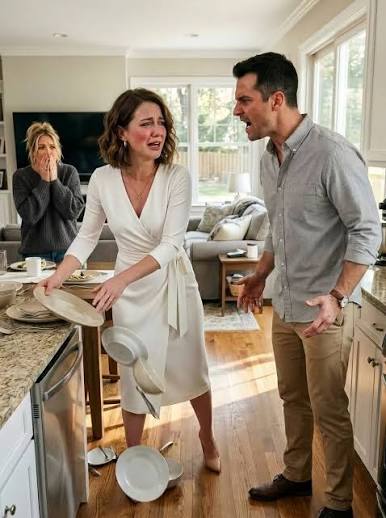
Elena did not gasp. She did not cry. She did not say anything at all. She stood there for a moment — one beat, two — and looked at the side of her husband’s face, at his smirk, at the ease with which he sat in the aftermath of his own words. Then she turned and walked to the kitchen.
The kitchen was quiet. The under-cabinet lights were on, throwing a warm yellow strip across the counter. Elena stood at the refrigerator with one hand on the handle and did not open it for a long moment.
She was not, in this moment, merely hurt. She was calculating.
There was the version of this evening where she came back with his soda and said nothing. She had lived that version before. She knew how it ended: he’d feel vaguely sheepish for ten minutes, maybe pat her knee, and they’d watch the rest of the show in a silence that would be described, if anyone asked, as comfortable.
There was the version where she came back and said, That wasn’t funny, Daniel. She had lived that version too. That one ended with him saying she was too sensitive, or that he was just kidding, or — his favorite — that she used to be able to take a joke.
Neither of those versions felt available to her tonight.
She opened the refrigerator. She looked at the row of sodas on the door shelf. She looked at the pitcher of water she kept filtered and cold. She thought about twenty-six years. She thought about her thyroid. She thought about her mother’s cooking and her daughter’s voice on the phone last week saying, Mom, you sound tired. She thought about the landscape architecture award sitting in her office upstairs, the one Daniel had said “nice job” about and then never mentioned again.
She took out the pitcher of water.
She poured a single glass, clean and cold. She put the pitcher back. She did not take out a soda.
She walked back to the living room.
Daniel glanced up when she set the glass down in front of him. He looked at it. He looked at the absence of a can beside it. He looked at her face, which wore an expression he did not immediately recognize — calm, but concentrated, the way she looked when she was about to explain something to a contractor who had made a mistake.
“I asked for a soda,” he said.
Elena sat down beside him. She smoothed her hand over her knee. The television was still going, but neither of them was watching it now.
“I know,” she said. And then she smiled — genuinely, without malice, the way you smile at someone you have known long enough to see clearly. She looked at him directly, and she said:
“I’ve been carrying your drinks for twenty-six years, Daniel. I think it’s time you got your own.”
She said it lightly. She said it the way he said things — casual, almost offhand, with a smile that left just enough room for it to be a joke if he needed it to be. But it wasn’t a joke, and they both knew it. The silence that followed was different from the one after his remark. His had been the silence of a room absorbing a small cruelty. This was the silence of a room absorbing a truth.
The smirk was gone.
He opened his mouth. He closed it. He looked at the glass of water.
“El—”
“I’m watching the show,” she said pleasantly, and turned back to the television.
He sat with it. She could feel him sitting with it — the particular discomfort of a person who has made a joke at someone else’s expense for so long that they’ve forgotten the other person has a tab running. She did not look at him. She watched the show. A woman on screen burst into tears of joy over a kitchen backsplash.
After a few minutes, Daniel got up and went to the kitchen. She heard the refrigerator open. She heard the pull-tab crack on a can of soda. She heard him come back and sit down.
He didn’t say anything. He drank his soda.
But something had changed in the room, and they both felt it — the way you feel a change in atmospheric pressure before weather arrives.
That night, after the show ended and the lights were turned off and they lay in the dark in the way of people who have shared a bed so long they can feel the shape of each other’s breathing, Daniel said, “I was just joking, you know.”
“I know,” Elena said.
“You’re not — I don’t actually think you need to —”
“Daniel.”
“Yeah.”
“Go to sleep.”
He did. She lay awake for a while longer, looking at the ceiling, thinking not about him but about herself — about the version of herself at twenty-six, newly married and bright-edged, who would have cried at that comment on the couch. About the version at thirty-eight, exhausted with two kids and a part-time job and a thyroid that was quietly staging a rebellion, who would have made a self-deprecating joke back to smooth it over. About the version at forty-five who had started, quietly and without announcement, to stop smoothing things over.
And now this version. Fifty-two, with an award upstairs and a marriage she was not ready to leave but was no longer willing to quietly diminish herself inside of.
She felt, she realized, almost fine. That was the strange part.
Over the following week, Daniel was different in the small ways that only a spouse would notice.
He got his own drinks.
He did not make any comments about her body.
He started, for no reason she could identify, doing the dishes after dinner without being asked — not every night, but more nights than before. On Thursday he said her pasta sauce was “actually incredible” with a specificity that suggested he had been thinking about what to say.
On Saturday morning, he brought her coffee while she was in the garden. He stood at the edge of the flower bed holding the mug, and he looked slightly embarrassed to be there, which she found unexpectedly endearing.
“I’ve been kind of a jerk,” he said. Not grandly. Just plainly, the way he used to say things before they’d been married long enough to stop trying.
Elena took the coffee. She looked up at him — this man she had chosen, this man who was careless but not cruel, who had become lazy in the specific way that people become lazy when they feel too certain of something.
“You’ve been a lot of things,” she said. “Kind of a jerk is one of them.” She took a sip. “Good coffee.”
He laughed. It was a small laugh, the slightly abashed kind. He sat down on the garden wall and didn’t leave right away, which was unusual. Normally on Saturdays he would drift toward the television or the newspaper with the certainty of a man who had earned a day of nothing.
“When did I get like that?” he asked. He wasn’t performing the question. He seemed genuinely puzzled by himself.
Elena considered this honestly. “Gradually,” she said. “The way most things happen.”
She did not tell him about the conversation she’d had with her daughter, Nadia, three days after the couch incident. Nadia was twenty-four, sharp and perceptive in the way of children who have spent a lifetime observing their parents, and she had called on her weekly schedule and immediately said, “Mom, you sound different. Good different. What happened?”
Elena had told her. Not to gossip about Daniel, but because Nadia was the kind of daughter you could be honest with, and because she had asked.
Nadia had been quiet for a moment, and then she had said: “Mom, I used to watch him make those comments and watch you laugh along and I never said anything because I thought maybe it was just how you guys were. But it always bothered me.”
Elena had felt something clench in her chest at that — not grief exactly, but the particular feeling of learning that something you had tried to hide had not been hidden, only left unaddressed.
“He’s not a bad man,” Elena said.
“No,” Nadia agreed. “But you’re not a bad woman either. And you should probably both remember that at the same time.”
The real conversation happened on a Sunday night, three weeks after the glass of water.
They were in the kitchen together, which had become more frequent lately — Daniel had started lingering after dinner in a way he hadn’t for years, helping put away leftovers or leaning against the counter while Elena made tea. It felt like a tentative rebuilding of something, though neither of them had named it yet.
Elena set down her mug and looked at him.
“I want to tell you something,” she said, “and I want you to actually hear it.”
He straightened slightly. “Okay.”
“I have spent years absorbing jokes about my body, Daniel. Small ones. Offhand ones. The kind you can always explain away as nothing.” She kept her voice even. This was not an ambush. She had thought about how to say this for a long time. “And I know you think they’re nothing. But they accumulate. Every single one of them became part of how I understood what you thought of me. And what you thought of me became part of how I thought of myself.”
He said nothing. He was listening — really listening, she could tell, in the way he listened when something mattered.
“I am not asking for a perfect husband,” she continued. “I’m asking for one who looks at me and sees a person rather than a punchline.” She picked up her tea. “I’m also asking, while I’m at it, that you occasionally get your own soda.”
He laughed, and it broke the tension, but not in the way that laughter breaks things to avoid them — in the way that laughter sometimes acknowledges the truth of something.
“I hear you,” he said. Then, after a beat: “I hear you, and I’m sorry. Not sorry like — I’m-saying-this-to-end-the-conversation sorry. Actually sorry.”
She looked at him. She believed him. Not because he was suddenly a changed man, not because one conversation rewrites twenty-six years, but because she had spent half a lifetime learning his face and she could see, right now, that he meant it.
“Good,” she said. “Don’t make me pour another glass of water.”
The thing that nobody tells you about long marriages — or about any relationship that has run long enough to develop deep grooves — is that repair is quiet. It doesn’t arrive in a single dramatic gesture, in flowers or a speech or a transformed overnight into someone different. It arrives in the accumulated small decisions of a person choosing, again and again, to do better.
Daniel chose, over the following months, to do better. Not perfectly. He slipped occasionally — caught himself mid-comment once and stopped, actually stopped, and said, “That was about to be a stupid thing to say,” which Elena thought was possibly the most emotionally mature thing she’d heard him say in a decade. He started noticing things: the award upstairs, which he finally asked about in genuine detail. The magazine with her project. The way she moved through a room with the easy competence of a person who had always known what she was doing.
And Elena chose, over the same months, to stop absorbing quietly. To say, when something landed wrong, that landed wrong. To take up the space she was entitled to take up — in the conversation, in the kitchen, in her own sense of herself.
They started taking walks after dinner. This had been, early in the marriage, a habit they’d kept for years and then slowly abandoned to the gravity of busyness and television. It came back tentatively, a few nights a week, and then more often, until it was simply what they did — bundled up against the fall air, walking the neighborhood they’d lived in for nineteen years, talking about the things people talk about when they remember they like each other.
One evening in December, Nadia came home for a long weekend, and on the first night she sat in the kitchen with her parents after dinner and noticed, in the way she noticed things, that her mother was laughing more. Not the polite, smoothing-over laughter she remembered. Something more genuine, more full.
She noticed that when her mother got up to refill her wine, her father said, “I’ll get it, sit down,” and got up and got it, and her mother sat down without protest, and they looked at each other briefly in a way that communicated something Nadia couldn’t quite decode but felt like warmth.
Later that night, when her father had gone to bed and she and Elena were sitting with tea the way they often did, Nadia said, “You two seem good.”
Elena smiled into her mug. “We’re working on it.”
“What changed?”
Elena thought about how to answer this. She thought about the glass of water, and the smirk that had fallen off Daniel’s face, and the long quiet conversation in the kitchen, and the walks, and the award he’d finally asked about, and the morning in the garden with the coffee.
“I stopped carrying things that weren’t mine to carry,” she said finally. “And I handed a few of them back.”
Nadia nodded, understanding this in the way of someone who had watched it unfold from the outside. “Good,” she said.
“It usually is,” Elena said, “once you figure out how.”
The Hargrove house still looked the same from the outside. The porch swing still rarely got used. The flower bed was dormant now, waiting for spring, which Elena was already planning — she had sketches on her desk upstairs, and she was thinking about a new variety of climbing rose for the east-facing wall, something with endurance.
Inside, the house was warmer than it had been. Not in temperature, but in the quality of the air — the particular warmth of a place where two people have decided, without fanfare and without the benefit of anyone watching, to treat each other better.
It had started with a glass of water. Not a speech. Not a confrontation. Not a crisis. Just a woman, standing in her kitchen in the quiet after an unkind joke, choosing — with complete calm and perfect clarity — not to carry the soda back.
Sometimes the smallest acts of self-possession are the most powerful.
Sometimes the most important thing you can hand a person is exactly what they asked for — and nothing more than that.
And on some Tuesday nights, when they’re settled on the couch and the show is on and one of them needs something from the kitchen, they take turns getting up.
It sounds simple. It is simple.