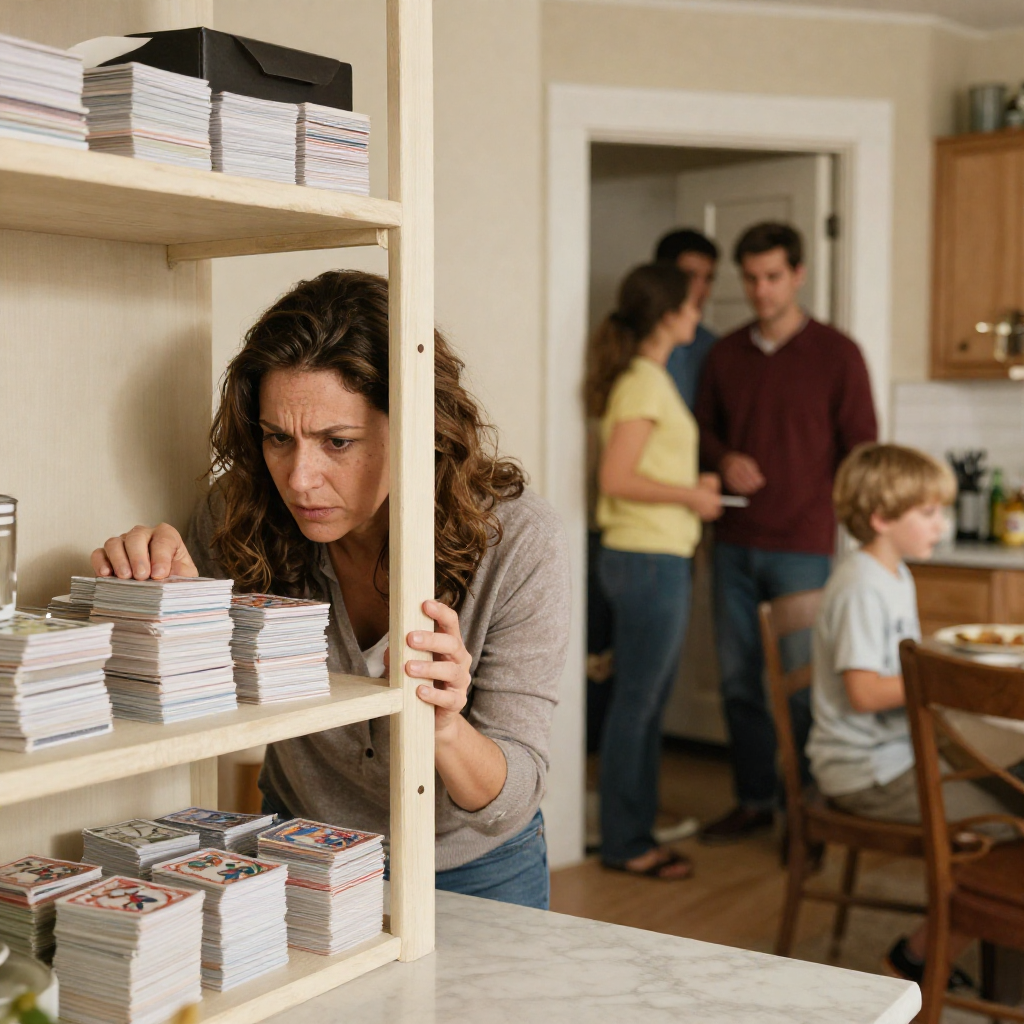
Every Sunday for three years, I made dinner for four.
That sounds simple enough. Roast chicken, maybe, or a pot of beef stew when the weather turned. A green salad, bread from the bakery two blocks over, a bottle of something decent from the wine rack Daniel kept organized by region. Four plates. Four glasses. A table set the way my mother taught me — forks on the left, knives facing inward, napkins folded into triangles, not cranes, because cranes were for company and Sundays were just us.
Except Sundays were never just us.
I don’t know when it started, exactly. The first time felt like a surprise — a pleasant one, even. Daniel’s parents, Gerald and Maureen, appearing at the door with flushed cheeks and a story about being in the neighborhood, and me saying of course, of course, stay, there’s plenty. Because there was plenty. That first time, there genuinely was. I’d made a big pot of chili and cornbread, and it felt warm and good, the way a full table is supposed to feel. I’d refilled everyone’s wine and laughed at Gerald’s long story about his college roommate, and when they left, Daniel had squeezed my hand and said, “You’re so good at this.”
I’d believed him.
By the fourth or fifth Sunday, Daniel’s brother Todd had started coming too, usually with whatever woman he was seeing that particular month. By summer, it was understood — not stated, never stated, just understood — that Sunday dinner at our house was a standing arrangement. There was no invitation. There was no contribution. There was simply the door, and then the voices, and then the coats draped over our chairs and the television turned on in the living room while I stood in the kitchen doing math.
How much further can the chicken go? Can I add another can of beans without anyone noticing? Does the bread stretch if I slice it thin?
I became very good at the math.
What I never became good at was the silence. My silence, specifically. The way I nodded when Maureen commented that the sauce was “a little saltier than last week,” as if she were a food critic returning for a follow-up review of an establishment she hadn’t paid to enter. The way I laughed, genuinely laughed, the first six times Gerald told the same story about the college roommate, and then produced a reasonable facsimile of a laugh for the next dozen. The way I stood at the stove, back to the room, and let my face do whatever it needed to do where no one could see it.
Daniel saw none of it.
Or perhaps he saw all of it and chose the same silence I did, only his was easier to maintain because he was sitting down.
“Just let it go,” he’d say, if I brought it up afterward. “It’s family.”
As if family were a diagnosis. As if it explained everything and required no further examination.
“They could call ahead,” I said once.
“They’re spontaneous.”
“They could bring something. Wine, even. A loaf of bread.”
“They’re not thinking about it like that. They’re just coming to see us.”
“They’re coming to eat,” I said. “There’s a difference.”
He’d looked at me with an expression I’d come to recognize — not unkind, not dismissive exactly, but tired in a way that seemed to precede any real conversation. “Claire,” he’d said, “you love cooking. You always make plenty. Why make it into a thing?”
Because it is a thing, I hadn’t said. Because I do love cooking, and they have taken that love and used it like a coupon. Because every Sunday I spend two hours on my feet preparing a meal that I’ve planned and purchased and executed, and they walk in like it was always meant for them, and they leave without so much as carrying a dish to the sink, and you sit at the head of the table smiling, and you say nothing.
I hadn’t said any of it. I’d gone to bed with the words still folded inside me.
This particular Sunday, the October light was coming in sideways through the kitchen window the way I liked it, copper and long, and I had made a proper soup. Not stretched soup, not odds-and-ends soup, but a real French onion — three hours of caramelizing onions until they were silk and amber, a good beef stock, a splash of brandy, toasted baguette, and Gruyère broiled until it blistered and pulled. I’d made it for four. I’d meant it for four. Daniel was going to open the Burgundy he’d been saving, and we were going to sit down while the light lasted and eat something I’d actually made with care.
I heard the car in the driveway.
I heard the familiar pattern: two doors, then a third, then voices identifying themselves to one another as though narrating their own arrival. Gerald’s laugh. Maureen calling out something I couldn’t make out. Todd.
And then the door — our door, to our home — opened without a knock.
“Hope you made plenty!”
Gerald’s voice filled the hallway. I heard the zip of his coat, the particular sound of him settling into the house like sediment.
I stood at the stove. The soup was perfect. I had made exactly enough soup for four people, and there were now, by my count, seven. I watched the surface of it, the slow breath of steam, the blistered cheese on the four perfect bowls I’d already ladled and arranged.
Daniel appeared in the kitchen doorway. He had the look. I knew the look.
“Hey,” he said, quiet. “Just let it go. It’s family.”
I didn’t sigh.
I’d used up all my sighs somewhere around year two.
I didn’t water down the soup, either.
Instead, I turned off the burner, set down the ladle, wiped my hands on the dish towel, and walked past Daniel into the hallway, past Gerald who was telling a story already, past Maureen who was examining the side table the way she always did, as if cataloguing our possessions, past Todd and the woman he’d brought who I’d never seen before.
I walked to the linen closet.
It was a narrow door at the end of the hall, the kind of closet that exists in older houses as an afterthought — deep enough to be useful, awkward enough that you had to decide deliberately to use it. Daniel never touched it. It was one of those unspoken domestic divisions: the linen closet was mine, the garage was his, and neither of us had ever needed to renegotiate the treaty.
I opened the door and reached behind the second shelf, where the everyday pillowcases lived, folded into neat thirds.
My hand found the stack of cards.
I’d started collecting them eight months ago. I hadn’t known I was collecting them, at first — I’d just started keeping the evidence.
The first one had come from Maureen. A birthday card, actually, for my thirty-fourth birthday, inside which she had written — in her looped, schoolteacher cursive — Wishing you a wonderful year, and thank you as always for your generous hospitality. Our Sundays wouldn’t be the same without you. I’d read it three times. The third time, I’d felt something clarify inside me, the way a snow globe clarifies after you stop shaking it. She knew. She had always known. She was grateful, even. She simply saw no reason to change the arrangement.
I’d put the card behind the shelf.
Over the months that followed, I’d added to the stack quietly and without ceremony. A text exchange I’d printed out — Daniel to his mother, in which she’d written Is Claire making that lamb again this Sunday? Todd is bringing someone new and I want to impress her — and Daniel had written back I’ll mention it to her, which he had not. A receipt I’d started keeping from the grocery store, beginning in March, for the additional food I purchased each week. The amounts were not large individually. Over eight months, they were not small.
There were also the notes I’d written to myself. I’d started doing this the previous winter, late at night, when I couldn’t sleep. Just facts. Just the record. February 3: seven people for dinner, made four servings of chicken piccata into six by using smaller portions, no one offered to bring anything, Gerald spilled red wine on the tablecloth and did not offer to have it cleaned, Maureen suggested I try a different brand of pasta. Night after night, the small accumulated weight of it. I had not written these notes out of rage — I want to be clear about that. I’d written them because the situation had begun to feel unreal to me, the way certain things do when they’re treated as normal for long enough, and the notes were how I remembered what was real.
The final item in the stack was a piece of paper I’d printed from my laptop three weeks ago. It was a listing. A rental listing, for an apartment on the other side of the city — a one-bedroom in a building with a good kitchen and a doorbell.
I hadn’t told Daniel about the listing. I hadn’t told anyone.
I stood in the hallway with the stack of cards in my hands, and I listened to Gerald laughing about something in the living room, and I made a decision.
Not a dramatic decision. Not a door-slamming, voice-raising, years-of-grievance-in-a-single-speech decision. Those were satisfying in films and tended to produce nothing useful in life.
A quiet decision. The kind that had already been made somewhere deeper than thought and was only now being acknowledged.
I walked back to the kitchen. Daniel was at the counter, opening the Burgundy with the slightly self-important air he had around wine he cared about.
“Claire,” he said without looking up, “I was thinking we could stretch the soup with some bread and—”
“I’m going to go have dinner,” I said.
He looked up.
“The soup is on the stove,” I said. “There’s enough for four if you stretch it. There’s baguette in the bread box.” I picked up my bag from the hook by the back door, my coat from the chair. “I’ll be at Rosa’s. I have my phone.”
The silence between us was the most honest thing we’d managed in a long time.
“Claire.” His voice was careful. “What is this?”
I thought about explaining. I thought about the stack of cards and the grocery receipts and the eight months of notes and the rental listing. I thought about how long I had practiced patience, how long I had believed that patience was the same thing as love, and how somewhere along the way I’d begun to understand that they were not the same thing at all.
“Dinner,” I said. “I’m going to have dinner.”
I walked out the back door.
Rosa lived four blocks away. She was my oldest friend, which is to say that she was the person who knew all my stories in the order they had actually happened, rather than the edited versions I presented to the world. She had been listening to the Sunday dinner installments for three years and had expressed, with increasing directness, her opinion on the matter.
When I knocked — knocked, on her door, the way people do — she opened it and took in my coat and bag and expression and simply stepped aside.
“Soup?” she said.
“Please.”
We sat in her kitchen, which was small and warm and smelled of cumin and something baking. She heated a can of lentil soup without comment and put bread on the table and poured two glasses of wine, and we sat.
I put the stack of cards on the table between us.
“What’s this?” she asked.
“Evidence,” I said.
She picked up the birthday card, read it, set it down. She looked through the grocery receipts, the printed text exchange, a few of the handwritten notes. She did all of this without speaking, which was one of the many things I loved about her.
Finally she picked up the rental listing.
She looked at it for a long moment.
“How long have you been carrying this?” she said.
“Three weeks.”
“And before that?”
“Longer,” I said. “Just not on paper.”
We ate the soup. The bread was good. The wine was the comfortable, unfussy kind Rosa always kept.
“He’s not a bad man,” I said eventually, because it felt important to say.
“No,” she agreed.
“He just thinks love means absorbing inconvenience quietly.”
“A lot of people think that,” she said. “It usually only works if both people are doing the absorbing.”
I looked down at my glass. “I’ve tried to tell him.”
“I know.”
“Maybe I didn’t tell him clearly enough.”
Rosa looked at me with the patience of someone who has had this conversation before. “Claire. You have been telling him clearly. He’s been hearing you quietly.” She paused. “Those are not the same thing either.”
I thought about the look on Daniel’s face when I’d walked out the back door. Not anger. Not understanding. Something in between — the beginning of a reckoning, maybe, or the resistance to one. I didn’t know yet which it would be.
My phone had been buzzing in my pocket. I’d silenced it without looking.
After dinner — Rosa’s soup, Rosa’s bread, Rosa’s uncomplicated kitchen — I finally took my phone out. Eleven messages. Three from Daniel, which I left unread for now. One from Maureen, which read, Claire, honey, we didn’t mean to put you out. Are you all right? — and even that, I noticed, framed my absence as a personal difficulty of mine rather than a consequence of anything they’d done. One from Todd. One from a number I didn’t recognize, which turned out to be Todd’s new girlfriend, apparently in possession of my number, asking if the soup was still available.
I put my phone face-down.
“What are you going to do?” Rosa asked.
“Go home,” I said. “Tonight.”
“And after that?”
“Talk,” I said. “Actually talk. Not hint. Not endure. Not perform patience.” I looked at the rental listing, still on her table. “I’m going to put it down as a possibility, and I’m going to tell him I’ve put it down as a possibility. I think he needs to understand that I am a person with a limit, not a resource without one.”
Rosa nodded slowly. “And if he hears you quietly again?”
I didn’t answer right away. The question deserved the silence.
“Then I stop stretching the soup,” I said finally. “Across the board.”
He was still up when I got home.
The family had gone — the house had that particular quality of recent departure, glasses rinsed but not quite put away, chairs not quite pushed back to their original positions. Daniel was sitting at the kitchen table with the Burgundy, half-empty now, and two glasses. He’d poured one for me.
The soup pot had been washed and dried and put away. The baguette was gone. I chose not to think about the four perfect bowls I’d prepared, where they’d gone, whether anyone had noticed they were already made.
I sat down.
He pushed my glass toward me.
We sat in silence for a moment that didn’t feel hostile, exactly. It felt like the silence before something gets said that should have been said years ago.
“I found the cards,” he said. “The stack. I wasn’t snooping — I was looking for the extra blanket.”
“I know,” I said. “I left the closet open.”
He absorbed this. “You wanted me to find them.”
“Eventually,” I said. “Yes.”
He was quiet. Then: “The grocery receipts.”
“Eight months,” I said. “Not to make a point. To keep track of something that was real when it started to feel unreal.”
He stared at the table. “I didn’t know.”
“I tried to tell you.”
“I know.” A pause. “I thought you were — I thought you were venting. The way people vent. I didn’t think you were—” He stopped.
“Documenting?”
He nodded, and in his expression I saw it land differently than I’d expected — not defensiveness, but something quieter. Something that might have been shame.
“Claire,” he said. “Is there a—” He stopped again. Tried again. “The listing.”
“Yes,” I said.
“Are you—”
“I don’t know,” I said honestly. “I printed it three weeks ago because I needed to know I had an option. Not because I wanted to use it. But you needed to know it exists.”
He was very still. In three years of marriage, I had never watched Daniel be very still. He was a pacer, a hand-talker, a person who processed things in motion. The stillness told me the landing had been real.
“I haven’t been fair to you,” he said.
Three years of Sundays. Three years of stretched meals and swallowed sighs and notes in the dark and a stack of cards behind the shelf he never touched.
“No,” I said.
“I kept thinking—” He turned his glass in his hands. “I kept thinking you loved it. The big table. You’re so good at it. Everyone loves coming here because of you.”
“I know,” I said. “That’s the part that made it so hard to name. I do love cooking. I love a full table. But those aren’t my feelings to be used without asking.”
He looked up. And for the first time in longer than I could trace, I felt that he was actually looking at me — not at the version of me that was convenient to see, the capable one, the one who always managed, the one who could stretch a dinner for four into enough for eight and make it look like abundance. He was looking at the person underneath that, the one who’d been keeping notes in the dark.
“I need it to change,” I said. “Not to end. I don’t want to stop cooking for people I care about. But I need to be asked. I need them to contribute something. I need you to back me up.”
“Okay,” he said.
Just that. Not explanation, not negotiation. Just the word, offered without condition.
I picked up my wine glass.
“Next Sunday,” I said, “I’m cooking for four. If your family calls ahead, and asks if they can come, and offers to bring something — they’re welcome.”
He nodded.
“If the door opens without a knock,” I said, “I won’t be in the kitchen.”
“Okay,” he said again.
We sat for a while in the copper remains of the October evening, the kitchen quiet around us, the two glasses between us, the conversation finally taking up the space it had always been owed.
Outside, somewhere down the block, a door opened and closed. Someone coming home. Someone expected, probably.
Someone who had been asked.
The following Sunday, I made dinner for four.
At noon, my phone buzzed. It was Maureen.
Would it be all right if we came for supper? I was going to bring that apple cake you mentioned liking. Gerald wants to bring wine.
I looked at the message for a long moment.
I looked at the roast in the oven, the potatoes waiting to go in, the table set for four.
I thought about the stack of cards, which I had not thrown away and did not intend to — not as a weapon, but as a record. A record that something had been real, and had been seen, and had been allowed to change.
I typed back: That sounds lovely. Come at six. There’s plenty.
And for the first time in three years, that was the truth.