“Emma is your daughter’s sister.” The family tree hung on the refrigerator with a sunflower magnet.
Mara had put it there herself, with the careful pride of a woman who arranges things neatly — grocery lists by aisle, shoes by season, feelings by whether or not they were useful. She’d looked at it every morning for three days before she really looked at it.
Six figures. Crayon. The tallest ones held hands.
Her daughter Sophie had drawn herself in yellow — always yellow, that was her signature — standing between two larger figures she’d labeled Mommy and Daddy in the looping, back-slanted script of someone who’d only recently learned that letters could mean anything at all. Above Daddy, a string of crayon-blue connected to a woman Sophie had drawn with gray hair and a triangle skirt. Daddy’s other mommy, she’d written, running out of space, so it became Daddy’s othr momy.
Mara had assumed it was confusion. Children that age folded things into one another — dreams and cartoons and overheard conversations compressed into a single reality without seams. She’d smiled at it. She’d refrigerated it.
Then there was Emma. Drawn in pink, about the same height as Sophie. And beside Emma, a small round figure with a disproportionate head and stick fingers spread wide, the way children draw joy.
Baby Lukas, it said. The c swapped for a k, which Sophie would have gotten from hearing it, not reading it.
She’d asked Sophie on a Tuesday evening while they were folding laundry. Sophie had answered the way five-year-olds answer things — without ceremony, without the understanding that some information is a grenade.
“That’s Emma. She has the same daddy. And baby Lucas cries a lot, Emma says.”
Mara had folded a towel. Then another. She’d asked where Emma lived.
“Far away,” Sophie said. “But not too far. Daddy drives.”
She had not slept that night. She lay beside her husband Daniel and listened to him breathe and thought about how breathing is involuntary, which means it tells you nothing. A man could be a complete stranger and still breathe like someone you know.
In the morning, she called the school.
Sophie’s teacher, Ms. Aldridge, was a careful woman who chose her words with both hands, as though she was afraid of dropping them. She spoke slowly when she said that Mr. Vasquez — that was Daniel, Mara’s Daniel, Daniel who made her coffee before she woke and texted her pictures of clouds he found interesting — had come in for Career Day on the fourteenth.
He’d told her he had a conflict.
A work thing. She’d written it in her planner under Things Daniel Can’t Make — the page that had been growing longer without her noticing.
“He brought two children,” Ms. Aldridge said. “Introduced them as his. A girl, maybe seven. And a toddler. Boy, around three. He signed the volunteer sheet and made a donation. Under your last name.” A pause. “The girl — Emma — she sat next to Sophie during snack time. They seemed to know each other a little.”
Mara thanked her. Hung up. Stood in the kitchen holding the phone against her chest like it was something that needed warming.
They seemed to know each other a little.
She looked at the family tree on the refrigerator. Sophie had used a whole crayon drawing their house. There was a sun with exactly twelve rays. There was a dog they didn’t own. Children drew the world they wanted alongside the world they had, and Mara had never, until this moment, wondered if her daughter’s world was bigger than she’d been allowed to see.
She drove home from the school parking lot without remembering the route. The brain does that — it manages the body when the mind is otherwise occupied, keeps the car in its lane while the person inside it is falling through something without a floor.
Daniel’s car was in the driveway.
He’d taken a half day. He’d mentioned it — I’ll be home early, we can have a real dinner — and she’d thought that was a gift. Now she understood that everything she’d believed was a gift might need to be re-examined in better light.
She sat in the car for four minutes. She watched him move past the kitchen window. He was making something on the stovetop and he was — she could hear it faintly, the window cracked — whistling.
She had always loved that about him. The whistling. He whistled when he was content, tuneless and unselfconscious, the sound of a man who believed himself to be home.
She went inside.
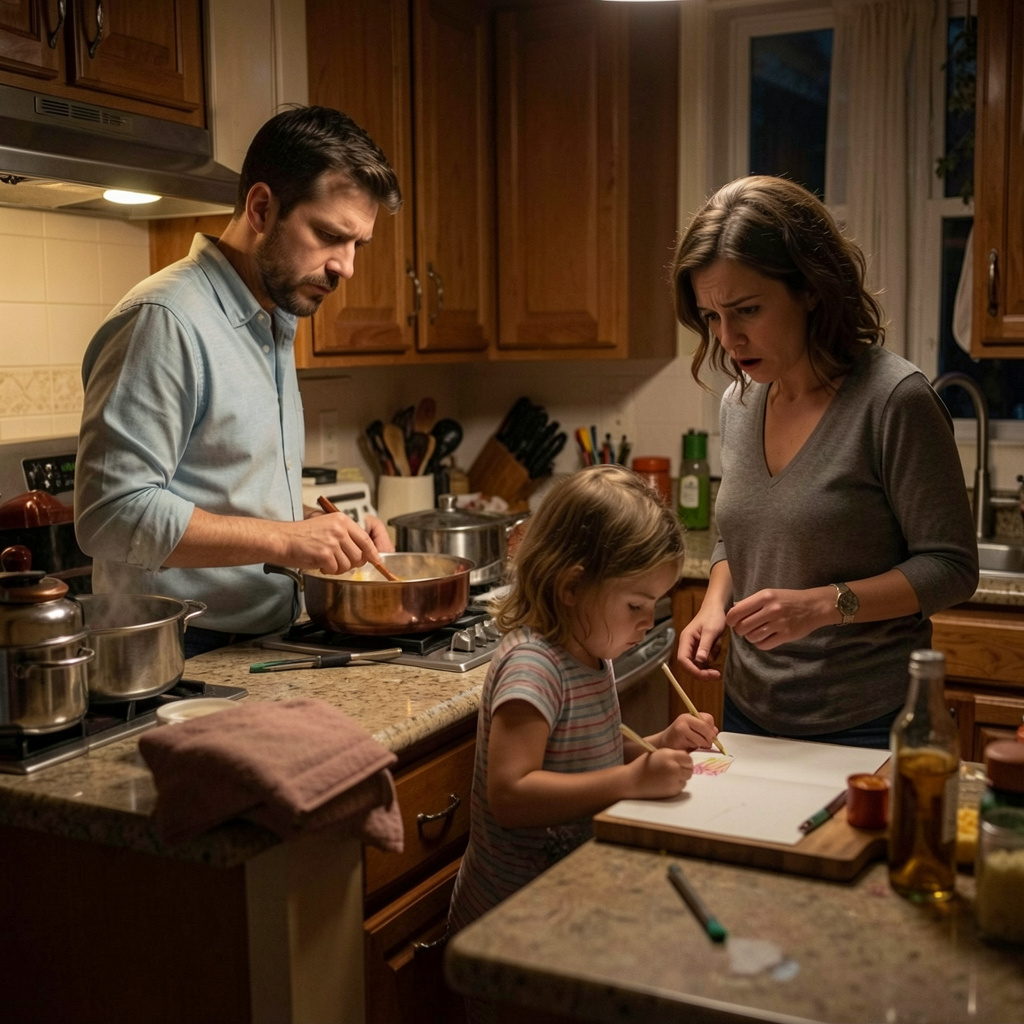
Sophie was at the table with her crayons. She didn’t look up. She was drawing something new — a house, by the look of it, or maybe a castle, the distinction unclear at this stage of artistic development.
Daniel turned from the stove. He smiled at her, the ordinary smile, the one she’d watched change over eleven years from something effortful into something reflex, and she felt, for a moment, a grief so clean and specific that it almost didn’t hurt.
Almost.
She said: “Who is Emma?”
The smile didn’t leave his face all at once. It left the way light leaves a room when the sun moves — gradually, and then completely, and then you can’t remember what the light looked like.
His hand stopped on the spatula.
He set it down on the rest, the small ceramic thing shaped like a fish that she’d bought at a market years ago, and she thought: I bought that. The thought was strange and specific and she didn’t know why it came to her then.
He looked at Sophie. Sophie was coloring, unbothered, the red crayon moving in tight circles that might have been roses or wheels or suns in another color.
He looked back at Mara.
He whispered: “Emma is your daughter’s sister.”
The sentence reorganized the room.
Not the furniture — the furniture stayed exactly where it was, sensibly arranged, the table she’d found at an estate sale, the chairs she’d repainted twice, the window with the fern she kept almost killing and then saving at the last minute, as though the plant and she had an understanding about last minutes. All of it stayed. But the room reorganized itself around a new center of gravity, and Mara felt the floor shift to accommodate it.
“How old,” she said.
“Seven.” He did not look away from her. She would later think about this — that he didn’t look away. She didn’t know yet if it was courage or something else.
“And the boy.”
“Three. He’s — Lucas is three.” He exhaled. “I was going to—”
“Don’t tell me when you were going to tell me,” she said. “Don’t tell me that first.”
He closed his eyes. When he opened them, he had changed slightly, the way faces change when they stop performing and start simply existing. He looked older. She didn’t know if that made her feel worse or less alone.
“Her name is Renata. We met—”
“I don’t want a timeline right now.”
“Okay.”
“I want to know if Sophie knows.”
“Sophie knows Emma. Not — she doesn’t know the context. Renata lives forty minutes away. When Sophie would stay with my mother on weekends—” He stopped.
“You’d see them.”
“Yes.”
“With our daughter sometimes.”
A silence. “Once or twice. I didn’t plan it. Emma asked to meet Sophie and I—” He shook his head. “That’s not an excuse. I know that’s not an excuse.”
Mara looked at her daughter, who was now selecting a blue crayon with the focused deliberation of an artist who knows exactly what the piece needs next.
Sophie had sat with Emma at snack time. They seemed to know each other a little. A seven-year-old and a five-year-old, sharing crackers and apple slices, connected by a man who whistled in kitchens and couldn’t be in two places at once no matter how hard he tried to live as though he could.
“Does she know about us?” Mara asked. “Renata.”
Daniel was quiet for a beat too long.
“She knows you exist,” he said finally.
“That’s not the same thing.”
“No,” he said. “It’s not.”
She slept in the guest room that night. She lay on the floral duvet that had belonged to her mother-in-law, original Daniel’s mother, the real grandmother — she caught herself making that distinction and then hated that the distinction existed — and she looked at the ceiling and let herself feel the full weight of it.
Not the betrayal, yet. That would take longer to arrive, would come in waves over weeks and months like a tide that had no intention of going out. What she felt first was simpler and more physical: the sensation of a world that had looked solid turning out to be a painted backdrop, and what was behind it being not nothing, but something else. Another world. Running parallel. Sharing a man, a last name on a volunteer sheet, a daughter who reached her small hand across a snack table toward a sister she didn’t have a word for yet.
She thought about the family tree.
Six figures. Sophie had drawn the truth before any adult in the room had found the courage to speak it. Children do that — they draw what they see, unedited, without the narrative control that adults spend years developing. They have not yet learned that some things are kept in separate rooms. They put everything on one page, in crayon, and stick it on the refrigerator with a sunflower magnet.
That’s Daddy’s other mommy. And Emma. And baby Lucas.
Said the way you’d say that’s a cloud or that’s a bird or that’s just how it is.
She did not make any decisions that night.
Some women would have. Some women keep a bag packed in their hearts, metaphorically speaking — they know the moment they would leave, have traced the route before the emergency arrived. Mara was not that woman. She was the woman who fixed things, who repainted the chairs twice, who kept the fern alive against the odds of her own inattention.
She did not know yet if a marriage was a fern. She did not know if it could survive a winter this specific.
What she knew was the morning.
Sophie woke up at six-fifteen and padded into the guest room without knocking, the way children enter any space they believe is theirs, and climbed under the duvet and pressed her warm, sleep-heavy body against Mara’s side and said, without preamble, “Mama, I think Emma would like you.”
Mara looked at the ceiling.
She thought about a seven-year-old girl who didn’t know what she was in the middle of. A three-year-old who only knew that his father drove toward him sometimes. A woman forty minutes away who had made her own set of choices and her own set of rationalizations and her own private peace, however fractured, with the shape of her life.
She thought about Sophie, who had drawn them all on one page because to her, there was only one page.
“Maybe she would,” Mara said.
Sophie curled closer and was quiet for a while, and then said, “I’m hungry.”
“Okay,” Mara said. “Let’s go eat.”
She got up. She put one foot in front of the other across the cold floor of a house that was still, for now, her house — still the table she’d found, the chairs she’d repainted, the window with the fern she kept almost losing.
She went into the kitchen.
The family tree was still on the refrigerator. Six figures in crayon. The sun had twelve rays. The house had a red door.
She looked at it for a long moment.
Then she made her daughter breakfast.
Some truths live in crayon before they live in words. The hardest part is not the drawing. It’s deciding what to do once the picture is finished.