The word hung in the cold morning air like smoke.
“I’m your—”
And then a car horn blared two streets over, a dog erupted into barking somewhere behind me, and the syllable dissolved. The woman in the Honda looked down at her hands on the steering wheel as if she’d startled herself. As if she hadn’t planned to say anything at all. As if forty-one years of silence had cracked open without her permission, and now she didn’t know what to do with the light coming through.
My name is Delia. I was holding a mug of coffee when I walked outside. I don’t know why I remember that — the mug, navy blue, a chip on the handle from when I dropped it during the first year of the pandemic. I was holding it when my life rearranged itself.
Three days before, I had been pulling wallpaper in my mother’s bedroom. Rosemary — that was her name, Rosemary, though she was never quite as soft as the herb — had died six weeks prior, on a Tuesday morning in early March, while I was forty minutes away on a call about quarterly projections. The hospice nurse called. I drove there and held her hand, which was already cooling, and said things into the quiet room that I hoped had somewhere to go.
She was eighty-nine. She had been fierce and practical and not particularly demonstrative. She made excellent pie crust. She kept her emotions the way some people keep money — in places I was never quite shown. I had loved her completely and felt, in some untranslatable way, that I had never entirely known her.
The house was a 1960s ranch on Ember Street, the kind of place that holds its history in layers. I was pulling the wallpaper in her bedroom — pale yellow, fading to the color of old newspaper at the seams — when I found the envelope.
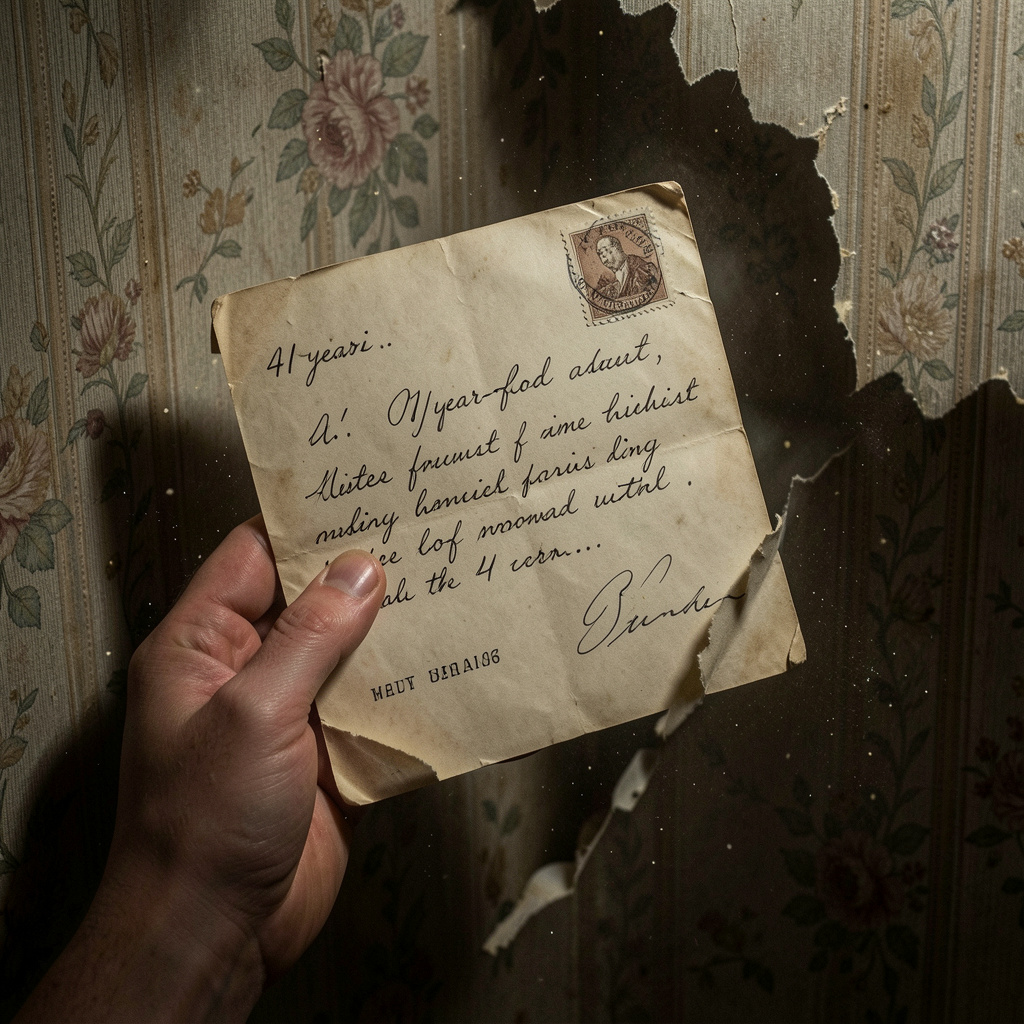
It was behind a section near the window, tucked between plaster and paper as deliberately as a bookmark. The envelope was cream-colored once, now the shade of weak tea. My name in her handwriting. Delia. And a date: April 4th, forty-one years ago.
I was three years old on that date. I was sitting on the floor of the room where my mother had slept for six decades, and I opened a letter she had written when I was three, and the world I thought I understood began very slowly to tilt.
If you’re reading this, I’m gone. The handwriting was her handwriting — the sharp, slightly backward slant she gave to every capital letter. You were always going to find out one way or another. You are too curious and too stubborn not to. I wanted you to hear it from me.
When you were six weeks old, a woman came to our door. Crying. She begged me to take you. She said your father was dangerous. She said she had nowhere else to go and no one else to trust. I don’t know why she chose our door — we had never met. Maybe she had watched us. Maybe she chose us the way you choose a house in the dark: by the light in the window.
Your father and I had lost a baby the year before. A boy. We had stopped talking about it by then, stopped in the way that people stop talking about something because the alternative is being swallowed by it.
She handed you to me, and you looked at me, and that was that. She was gone before I could ask all the questions I had. I didn’t call anyone. I called no one. I told your father I had arranged a private adoption through the church. He never asked more than that. He was not the asking sort.
She visits every year on your birthday. She sits in a car across the street. I see her from the window and I don’t go out. That is my cowardice, and I own it. I should have told you. I should have let you choose.
I love you. That sentence contains everything I was never able to say aloud.
I read the letter four times on the floor of her bedroom. Then I sat in the silence of the empty house and felt something large and nameless move through me.
I checked the Ring footage that evening. Three days ago now.
I have the camera positioned to cover the driveway and the stretch of street directly in front of the house — I installed it after a package theft two winters ago and mostly forget it exists. I went back through the archive for my most recent birthday and found it in under a minute: a blue Honda Civic, parked half a block down, visible in the upper left corner of the frame. It arrived at 11:04 in the morning. It left at 1:18 in the afternoon.
Then I went back further. The app saves ninety days of footage, so I couldn’t see every year — but the camera had been installed long enough that I could check the last three birthdays. The Honda was there each time. Same model, same color. I couldn’t make out a license plate, the angle was too oblique, but I could see the driver’s silhouette, and something about the way she sat — hands in her lap, completely still — gave her the quality of a person in prayer.
The bracelet had arrived on my forty-third birthday. I remembered finding it on the porch — a gold bracelet, delicate, with a small oval clasp. I had assumed my friend Marguerite had left it without a note, which was not out of character for her. I had texted her about it. She said she had no idea what I was talking about. I put it in the drawer of my nightstand and forgot about it, the way you set aside a mystery when you don’t know where to begin.
I found the footage from that birthday. The Honda parked. Forty minutes later, the figure got out of the car, walked to the porch — head down, moving quickly — left something, and walked back. I watched it five times. She moved like someone who had practiced doing a thing invisibly for a very long time.
I couldn’t sleep. I lay in the dark in my mother’s house — I’d been sleeping there since the funeral, unable to face the paperwork of it, the returning of a life to the world that lent it — and I thought about what it means to watch someone from a distance for decades. What it costs. What you must feel, sitting in a car for two hours on a day that you know is not yours, watching a life you did not get to keep.
The next morning, I made coffee, and when I looked out the front window, the blue Honda was parked across the street.
It was ten in the morning. Not my birthday. No occasion that I knew of.
I think she had seen the lights on at night. I think she knew someone had finally moved back into the house. I think forty-one years of distance had become, with Rosemary’s death, a door left slightly ajar, and she was sitting outside it not knowing whether to knock.
I put on my shoes. I picked up my mug — navy blue, chipped handle — and I walked outside.
The air was cold for April, the sky that particular shade of white that isn’t quite overcast but has put the sun away somewhere. I walked down the porch steps and across the small yard and into the street. I walked slowly. I wanted her to see me coming. I wanted her to have time to decide.
She didn’t drive away.
She was sitting with both hands on the wheel even though the engine was off. I could see her face through the windshield as I got closer, and then I understood why the recognition in my chest felt physical, like pressing on a bruise. She had my eyes. The exact shape of them — slightly wider at the outer corners, the brows a little higher than they should be, which always makes me look either surprised or interested, sometimes both at once. The jaw was different. The nose. But the eyes were mine, or I suppose more accurately, mine were hers.
She was older than I expected, though I don’t know what I had expected. She would have been young when she came to the door of this house. She was old now in the way that has earned it — the kind of face that has been through weather and kept its structure.
I stopped beside the driver’s window. She looked up at me. Her eyes were bright and panicked and absolutely steady at the same time.
She said: “I’m your—”
And the horn blared and the dog barked and the word dissolved.
We looked at each other in the ringing quiet that followed. Her hands were still on the wheel. Mine were wrapped around the mug.
I said, “Do you want to come inside?”
Her breath caught. She looked at the house — Rosemary’s house, the house I had grown up in, the house with the roses along the front walk that needed cutting back and the roof that needed at least two new shingles and the bedroom where a letter had waited behind yellow wallpaper for forty-one years.
She said, “Are you sure?”
I was not sure of anything. I was not sure who I was in the way that I had been sure of it the day before. I was not sure what conversation was about to happen to me, or whether I was ready for it, or whether readiness was even the right concept.
But I thought of Rosemary, who had kept this secret not out of cruelty but out of love, and who had also written it down and left it where she knew I would find it — both things true, both acts of love, complicated as all love is. I thought of the bracelet in my nightstand drawer. I thought of a woman sitting in a parked car for two hours on a stranger’s birthday, every year, for decades — not wanting anything, or wanting everything, or not knowing the difference.
“Yes,” I said. “I’m sure.”
She opened the car door.
Her name, she would tell me — sitting across from me at Rosemary’s kitchen table with her hands wrapped around her own mug of coffee, both of us cautious, both of us undone in different ways — was June. She was seventy-one. She had left a dangerous man. She had done the only thing she could think of and then spent forty-one years wondering if it was the right thing, which is the particular agony of a decision you can never fully test.
She had other children, two of them, a son and a daughter, and she had told them about me six years ago, when the keeping of secrets began to feel like a weight she couldn’t lift anymore. They knew she drove to this street on my birthday. They had not tried to stop her. The bracelet had been her daughter’s idea.
I told her about Rosemary. About the letter. I watched her face while I spoke and saw grief and relief moving through it in the complicated way that things move through you when you have waited a very long time for a particular sentence.
She said: “She was good to you?”
I thought about it honestly. “Yes,” I said. “She was good to me. She wasn’t — she wasn’t easy. But she was good.”
June nodded. She looked at the kitchen, the house, the evidence of a life well-kept. Something settled in her face.
We didn’t resolve anything that morning. You don’t resolve forty-one years over a cup of coffee. You don’t recover the past or edit it or make it less true than it is. But we sat at the table for two hours, and then she said she should go, and I walked her to the door, and before she stepped off the porch she turned and looked at me.
“I’m your mother,” she said. All three words, finally, in order.
I stood in the cold April air holding my mug and looked at this woman with my eyes.
“I know,” I said.
She walked to the blue Honda. She drove away slowly. At the corner she paused, and I thought for a moment she might stop — and then she turned, and she was gone.
I stayed on the porch for a long time. Above the roof of the house across the street, a single bird was crossing an enormous sky, moving with that absolute certainty that birds have, needing nothing from the world but the shape of the air beneath them.
I thought: There is a drawer in my nightstand with a gold bracelet in it.
I thought: There is a room inside this house where someone loved me for forty-one years in secret.
I thought: The word mother contains more rooms than I knew.
I went inside.
I put on a second pot of coffee.
I started to figure out what comes next.