Full Story: The dry cleaning receipt was printed on pale yellow paper, the kind that goes soft in a coat pocket after a few washes of accidental laundering.
Eleanor found it on a Saturday morning in October, her hands deep in the pockets of her husband’s winter coat as she hung it in the hallway closet after his business trip.
She had done this a thousand times — the small domesticities of a fourteen-year marriage, the habit of checking pockets before dry cleaning, finding loose change and gas station receipts and the occasional forgotten mint. She had done it without thinking. She almost put it in the trash without looking.
$47.00. Prestige Dry Cleaning, 1840 Westbrook Avenue.
She stood in the hallway for a moment. Daniel used Sutton’s, two blocks from their home. Twelve dollars for a shirt. They had argued about it once — she’d suggested he try somewhere cheaper, and he’d said Sutton’s knew how to press a collar. It had been the kind of small marital argument that dissolves before dinner.
She looked at the address. Westbrook Avenue was not a business trip destination. Westbrook Avenue was in Briarfield, forty minutes away, a suburb she had no particular reason to visit and, as far as she knew, neither did Daniel.
She put the receipt on the kitchen counter. She made coffee. She drank half of it standing at the window watching the neighbor’s dog nose through the fallen leaves in the yard next door. Then she picked up the phone and called Prestige Dry Cleaning.
The woman who answered had the warm, unhurried voice of someone who had worked the same counter for twenty years.
“Hi,” Eleanor said. “I’m calling because I think my husband may have left some items with you. Under the name Daniel Marsh?”
A pause. The sound of a keyboard.
“Oh yes, we have Mr. Marsh. Six suits currently. He’ll be in Tuesday as usual.”
Eleanor set her coffee mug down very carefully on the granite counter. She heard the small click it made.
“Six suits,” she said.
“That’s right. He’s had a monthly account with us since — let me see — 2021.”
“Thank you,” Eleanor said. “I’ll let him know.”
She hung up and stood in the kitchen for a very long time. Daniel owned two suits. She knew this the way she knew most things about her husband — not from any particular inventory of him, but because fourteen years of shared laundry and shared closets and shared lives had given her an unconscious archive of his possessions, his habits, his rhythms. Two suits. One charcoal, one navy. Both from a shop on Clement Street that had since closed.
She drove to Briarfield on a Tuesday.
Prestige Dry Cleaning occupied the ground floor of a small strip mall between a nail salon and a Vietnamese restaurant. The windows were clean. A bell chimed when she pushed open the door. Behind the counter stood a woman Eleanor’s age, maybe a few years younger, with dark hair pinned back and reading glasses on a chain around her neck.
“Can I help you?” the woman said.
“I’m here about my husband’s account,” Eleanor said. “Daniel Marsh.”
Something moved across the woman’s face — not guilt, exactly. More like the expression of someone who has just realized they are standing in the middle of a situation they cannot safely exit.
“Of course,” the woman said carefully.
“He picks up on Tuesdays,” Eleanor said. It wasn’t a question. The woman on the phone had told her that much.
“Yes, that’s right.”
“With his wife,” Eleanor said.
The woman behind the counter went very still.
“I’m his wife,” Eleanor said.
The silence that followed was the loudest thing Eleanor had heard in years. It lasted perhaps four seconds. It contained, she would later think, the entire architecture of the last three years — all the Tuesday evenings she hadn’t questioned, the business trips that blurred together, the particular quality of Daniel’s exhaustion when he came home, which she had attributed to work and never to a second life assembled forty minutes away in a suburb she had no reason to visit.
“I’m sorry,” the woman behind the counter finally said.
“Don’t be,” Eleanor said. “You didn’t do anything wrong.”
She drove home and did not cry. This surprised her. She had always imagined, in the abstract way that married people sometimes allow themselves to imagine catastrophe, that if something like this happened she would come apart. Instead she felt something colder and more functional move through her — a clarity she recognized distantly as the thing that happened to her in professional crises, when a project collapsed or a client threatened to walk. The part of her that solved problems coming online.
She sat at her kitchen table with a notepad and wrote down what she knew. Then she wrote down what she needed to know.
She called a forensic accountant on Wednesday morning. She found him through her divorce attorney — she called the divorce attorney first, which was either methodical or ruthless depending on how you looked at it, and she was past caring which. His name was Gerald Foss. He was sixty-two, semi-retired, and had thirty years of experience finding money that husbands thought they had hidden.
“Give me three weeks,” he said.
He needed two and a half.
The report arrived in a manila envelope on a Friday afternoon. Eleanor sat at the kitchen table — her kitchen table, she thought, in her kitchen, in her house — and read it from beginning to end without stopping. It had the quality of a document that has been assembled with great care to be impossible to misunderstand.
A second checking account, opened in 2020, eleven months before the dry cleaning account in Briarfield. Current balance: eighty-seven thousand dollars. Deposits made in regular intervals, always from Daniel’s business account, always in amounts below the threshold that would trigger automated flags. He had been careful. He had not been careful enough.
An apartment lease on Fenwick Street in Briarfield. Two bedrooms. The lease in his name. The utilities — electricity, gas, internet — in the name of a woman named Claire Hennessey. The lease had been renewed three times.
Eleanor read the name twice. Then she looked at the deposits again. Then she read Gerald Foss’s summary on the final page, which laid out the total in clear, professional language that contained no judgment and no pity, only numbers.
Three years. Roughly two hundred and thirty thousand dollars. Redirected, concealed, structured to avoid detection. A parallel life funded by their shared money, their shared future, the retirement accounts they had argued about maximizing, the investment portfolio she had spent hours on the phone with their financial advisor building. Half of her life’s financial security, quietly siphoned into a two-bedroom apartment in Briarfield and six suits at a dry cleaner forty minutes from their home.
She put the report down and looked out the window. The neighbor’s dog was in the yard again. It was the same dog, the same yard, the same falling October light. The world had not moved.
She picked up the phone and called her attorney.
“Read me the part about the fraud total,” Eleanor said.
Her attorney, a woman named Sandra Park who had been recommended to Eleanor by three separate people as someone you wanted on your side, read it clearly and without inflection.
“Okay,” Eleanor said. “What do we do first?”
What they did first was file. Sandra filed on a Monday, moving with a speed that Eleanor had paid for specifically and appreciated abstractly. Before the filing, on the Sunday night, Eleanor transferred two hundred and fourteen thousand dollars from their joint savings account. She did this after consulting Sandra, who told her what was permissible and what the limits were and what the documentation would need to show. Eleanor transferred exactly what Sandra told her to transfer and not a dollar more.
She changed the locks on Tuesday morning. She’d hired a locksmith named Terry who arrived at seven-thirty with a toolbox and no particular interest in why she was changing the locks on a Tuesday morning, and she appreciated that about him. She paid him in cash and gave him an extra twenty for the early hour.
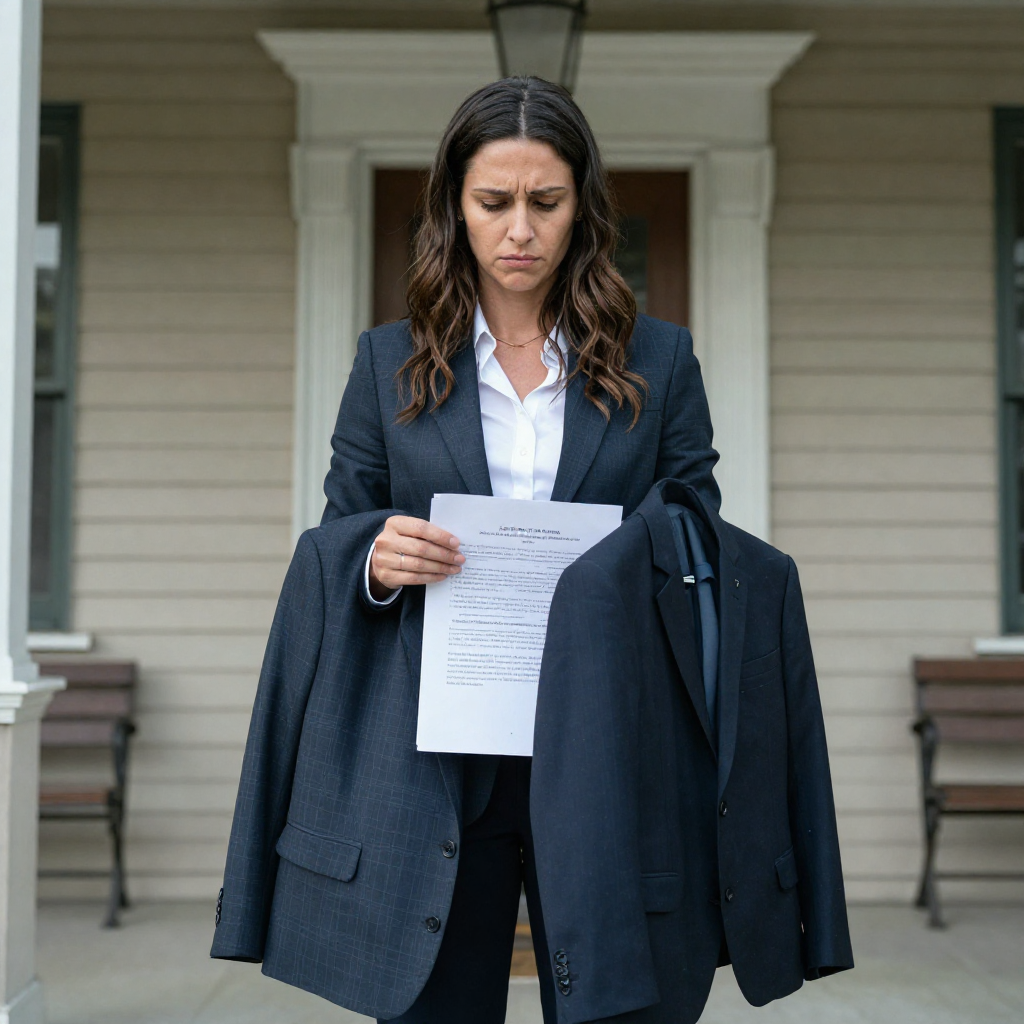
Daniel’s two suits — the charcoal and the navy — she folded carefully and placed in a dry cleaning bag she’d saved. She left them on the front porch with a note that said only: Your suits. Please do not ring the bell.
She had not cried yet. She would, eventually — she knew this the way she knew all the things she couldn’t quite access yet, feelings queued up and waiting for when she had the bandwidth. Right now she was in the other mode. The problem-solving mode. The mode that had gotten her through the project collapses and the difficult clients and the six months after her mother died when she had been the only one keeping things moving because her brother had fallen apart and her father hadn’t understood what there was to do.
She made coffee. She sat at her kitchen table. She read the forensic report one more time, not because she needed to but because she wanted to understand it completely, the way she had always wanted to understand things completely before she decided what to do with them.
The woman at the dry cleaning counter had said: I’m sorry.
Eleanor had said: You didn’t do anything wrong.
This was true. The woman at the counter had taken the suits and pressed them and hung them and handed them back on Tuesdays. She had not created the problem. She had only, inadvertently, been the place where the problem became visible — the $47 receipt that should have been $12, the extra $35 that was not the cost of a shirt but the cost of a secret, and like all secrets it had been maintained by its smallness, its ordinariness, its plausible invisibility.
Except that secrets are not invisible. They are only unlooked-at. And you can go years without looking at something that is in your peripheral vision, in your coat pocket, in the rhythm of Tuesday evenings and business trips that blur together — and then one morning you hang up a coat and put your hands in the pockets and the paper is there, pale yellow and soft, and you hold it up to the kitchen light and read it.
Forty-seven dollars.
Everything, for forty-seven dollars.
She thought about Claire Hennessey. She had looked her up — of course she had, she was thorough — and found her on LinkedIn and then found her photograph, and she had looked at it for a long moment and then closed the tab. She felt no particular anger toward Claire Hennessey. This surprised her too. Maybe it was the money. The money made it concrete in a way that grief alone wasn’t — you couldn’t hold grief in your hands and show it to a judge, but you could show a judge two hundred and thirty thousand dollars that had moved, methodically and deliberately, from a joint account into a separate one, and you could watch the judge look at it the way judges look at things that are not ambiguous.
Sandra had said: The judge will see he’s been committing financial fraud totaling…
And Eleanor had let the number hang in the air between them, had let it sit there like something enormous and real, and then she had said: Yes.
She sat at her kitchen table now and the morning was bright and the neighbor’s dog was somewhere in the leaves and the coffee was good and the kitchen was hers. The house was hers. The money was in her account, documented and legal and not going anywhere.
She had not cried yet. She opened her laptop and started a new document and at the top she wrote: To do. Then she began to write. She was good at this — at knowing what came next, at putting things in order, at looking at a problem and finding its shape and working through it from one side to the other. Fourteen years had not taken that from her. Three years of lies had not taken it. A dry cleaning receipt and six suits and a woman named Claire Hennessey and an apartment on Fenwick Street — none of it had taken the thing that made her Eleanor, which was that she always knew what to do next.
She drank her coffee and she wrote her list. Outside the leaves kept falling. The dog kept nosing through them looking for something small and hidden and worth finding.
She thought: I know how that feels.
Then she went back to her list.