The porch light had been burning out for weeks. Marcus kept meaning to replace it, but there was always something else—the gutters, the truck’s alternator, the slow leak under the kitchen sink that left rust stains on the cabinet floor. Small failures accumulating the way small failures do, invisible until they aren’t.
He remembered the bulb flickering the night Kayla came home.
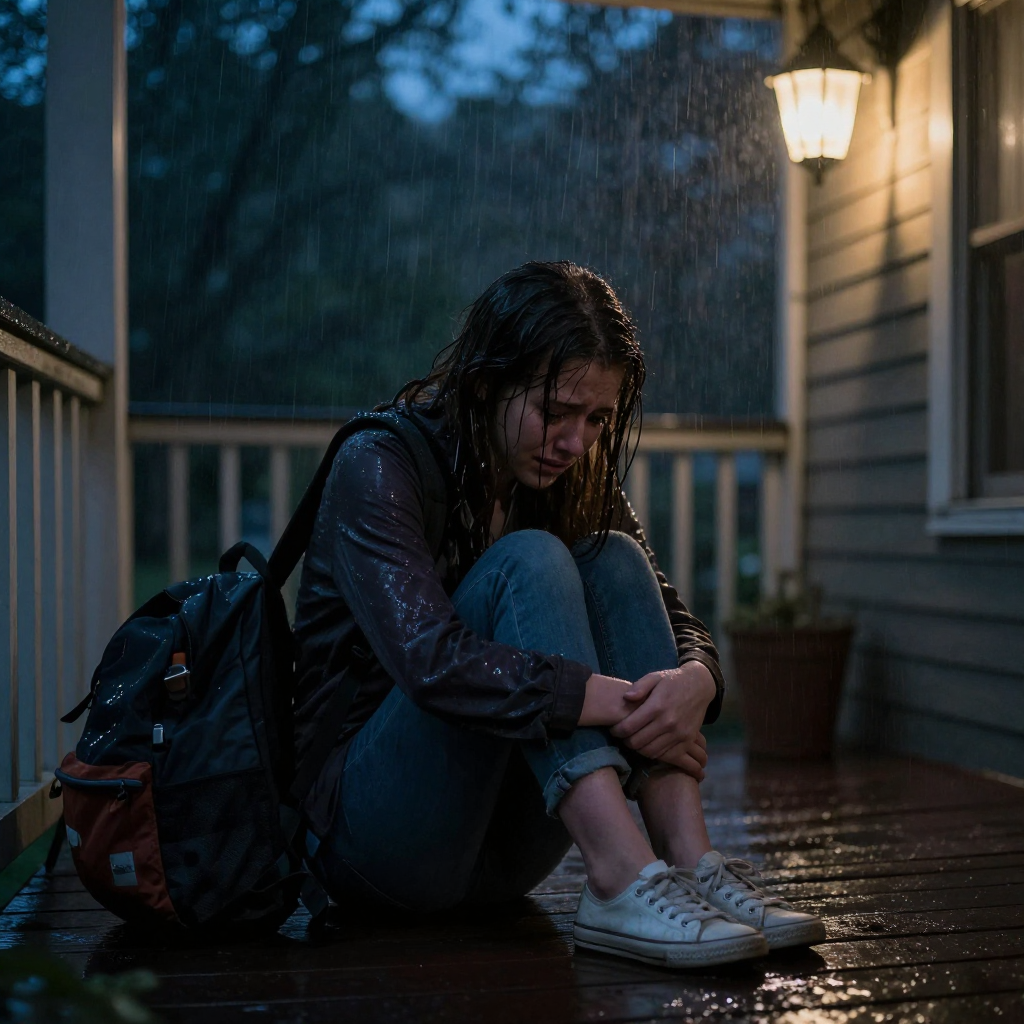
2:17 AM. He’d been awake, the way parents of teenagers are always half-awake, one ear tuned to the frequency of the front door. He’d heard her on the porch steps before she made it inside—the particular stumble, the keys dropped and retrieved with exaggerated care. He’d smelled her before she reached the hallway. Vodka and rain and something else he couldn’t name, something that wasn’t quite fear but lived next door to it.
He’d stood in the kitchen doorway in his undershirt, arms crossed. Waiting.
She’d looked up and seen him. Seventeen years old, his daughter’s face—the one that still carried, if you knew where to look, the ghost of the five-year-old who used to fall asleep in his lap during football games. That night, under the flickering porch light bleeding through the window, she’d looked at him like she was about to say something important.
“Dad—” she’d started.
“Don’t,” he’d said.
He could still hear how clean that word came out. How certain. Twenty-three years of working construction had given Marcus Hale a voice built for finality. He’d used it on sites when someone was about to do something stupid and dangerous. He’d never meant to use it on her.
“You’re drunk,” he said.
“I know, but I have to tell you something—”
“Not tonight.”
“Dad, please, it’s important, I—”
“Where did you get it? The vodka.”
She’d looked down. “It doesn’t matter.”
“The hell it doesn’t. You’re seventeen years old, Kayla.”
“I know how old I am.” And there—the flash of defiance. The thing that always made him double down. He recognized it now for what it was: she was terrified, and terror in his daughter came out sideways, sharpened into something that looked like attitude, and he’d never once stopped to ask why.
“Not under my roof,” he’d said. The sentence that would become the monument to his worst hour. “You want to drink like an adult, you can find an adult place to do it.”
Her eyes went wide. “Dad—”
“I mean it.”
“Where am I supposed to go? It’s two in the morning.”
“That’s not my problem right now.”
The word now was supposed to be a safety valve. It was supposed to mean tonight, until you sober up, we’ll deal with this in the morning. At least that’s what he told himself in the months that followed. But the word now didn’t come with an asterisk. It came with a door, and then the sound of a deadbolt, and then the small desperate knocking that went on for eleven minutes—he counted, standing on the other side with his hand flat on the wood—before it stopped.
In the morning, Linda had looked at him from across the kitchen with an expression he’d never seen on her face before. Not anger. Worse than anger.
“She’s gone,” Linda said.
“She’ll come back when she’s ready to apologize.”
“For what, Marcus? For being a teenager who made a mistake?”
“For drinking. For coming home at two in the morning. For—”
“She was trying to tell you something.”
“She was drunk.”
“She was scared.” Linda set down her coffee cup. Very carefully. “She called me from a payphone at three AM. Did you know there’s still a payphone outside the 7-Eleven on Route 9? I didn’t know that. I learned it at three in the morning when my daughter used it to call me crying because her father changed the locks.”
Marcus had felt something move through him then, quick and cold, like stepping off a curb you didn’t see. “You talked to her?”
“I begged her to come home. She said she couldn’t.”
“She wouldn’t.”
“No.” Linda picked up her cup again. Her hands weren’t steady. “She couldn’t. There’s a difference, Marcus. There’s always been a difference, and you’ve never—” She stopped. Set the cup down again. “I’m sleeping at my sister’s tonight. I need you to think about some things.”
He’d thought she meant for one night. Maybe two.
She took her clothes on a Tuesday.
For eight months, Marcus Hale lived alone in a house that had been built for four. He cooked for one and ate standing over the sink. He fixed the porch light—finally, in October—and stood under it in the cold for a long time, not sure why he’d done it. He went to work. He came home. He watched television without watching it.
His son Deon moved between Marcus’s house and Linda’s apartment like a small ambassador between warring nations, thirteen then fourteen, carrying the weight of the silence in his backpack along with his schoolbooks. Marcus tried not to ask about Kayla. He tried because every time he did, Deon’s face did something complicated and pained, and Marcus had already caused enough of that expression in the people he loved.
He told himself she was fine. He told himself that consequences were real and necessary, that the world was not gentle, that the kindest thing a parent could do was prepare a child for hardness. He’d been raised that way. His own father had been a man of locked doors and crossed arms, and Marcus had turned out all right. Hadn’t he? He had a truck and a trade and he’d raised two kids and coached Little League and never missed a mortgage payment.
He told himself these things the way you press on a bruise to confirm it’s still there.
The night Deon came home shaking, it was raining.
Marcus noticed the rain first—the particular irony of it—before he registered his son’s face, before he understood that something had shifted in the world, permanently and without permission.
Deon was standing in the doorway with his phone in both hands, the way teenagers hold phones when the thing on the screen is too heavy to hold with one. He was wearing his basketball practice clothes and his sneakers were wet and he was fourteen years old and trying very hard not to cry in front of his father, which meant he’d learned that particular performance from watching Marcus.
“Dad,” he said. “I found Kayla.”
The sentence hit Marcus somewhere behind the sternum. “What do you mean you found—”
“Facebook. There’s a post. From a shelter.” Deon held out the phone like it was evidence. Like he was turning himself in for something.
Marcus took it.
The shelter was called Desert Cross. It was in Phoenix. There was a photograph—one of those human interest posts that shelters share to demonstrate impact, to solicit donations, to put a face on the abstraction of homelessness—and the face in it was his daughter’s.
Twenty-two pounds lighter. He knew her weight because he’d teased her about it once, something stupid about her eating him out of house and home, and she’d laughed and said 169, Dad, I weighed myself this morning, for the record, and he’d said for the record, you’re perfect, which was one of the few genuinely right things he remembered saying to her in that last year. The face in the shelter’s photograph was the face of a girl who had lost twenty-two pounds and replaced them with something harder and more careful and very, very tired.
She was wearing a Waffle House visor.
She was almost smiling. The almost was the thing that broke something loose in Marcus’s chest.
There was text below the photograph. The shelter director had written something about resilience and community, the standard language of institutional hope, but below that was a quoted passage in italics—in her own words—and Marcus read it standing in his own doorway with his son watching him and the rain coming down outside.
My dad threw me out over one mistake. I wasn’t drunk to rebel. I was trying to tell him that night that I was—
The post was cut off. Shared from a longer piece that had been taken down or set to private. He could see the shape of the sentence but not where it went. The cruelest kind of cliff. He stared at the truncation for a long time, pressing on it mentally, trying to read what wasn’t there.
I was trying to tell him that night that I was—
That I was what.
That I was scared. That I was failing school. That I was in trouble. That I was being hurt by someone. That I was sick. That I was something he could have helped with if he had stood on the right side of the door.
Marcus handed the phone back to his son. He walked to the kitchen and stood at the sink and gripped the edges of it and looked out the window at the backyard and the rain.
He heard Deon behind him, very quiet. “Dad.”
“Give me a minute.”
He took the minute. He took it like a man being measured for something.
Then he said, “Will you help me find her?”
It took four days. He wasn’t on Facebook. Linda was—he called Linda, the first real conversation they’d had in months, and she cried and he almost did and they set that aside because there was something more urgent now. Linda found the shelter’s contact page. Marcus called it from the parking lot of a Home Depot at seven in the morning, sitting in his truck, rehearsing nothing because there was nothing he could rehearse for this.
The woman who answered had the voice of someone who had fielded many difficult calls from many difficult people. She told him she couldn’t confirm or deny whether any individual was a resident. He understood. He gave his name. He said: I’m her father. I know I don’t deserve anything from you or from her. If there’s any way to pass along a message, I would be grateful.
Silence on the line. Then: “You can write to this address. I can’t promise anything.”
He wrote seven letters. He threw six of them away. The seventh was one page, front only, and it said:
Kayla. I have been wrong in ways I am still learning to measure. I changed the locks because I was afraid and I didn’t know I was afraid and I called it discipline, which is what men like me call things when we don’t understand them. You tried to tell me something that night. I didn’t let you. I would like to hear it now, whenever and however you are willing to tell me. There is no version of the rest of my life that isn’t waiting for that. I love you. I’m sorry. Come home if you want to. Don’t come home if you don’t. But know that the porch light is on.
— Dad
He mailed it. Then he went home and sat in the house that had been built for four and waited.
She called on a Thursday, six weeks later.
He was under the kitchen sink fixing the leak he’d been ignoring since before everything fell apart. He heard the phone from inside the cabinet and cracked his head getting out to answer it and said son of a— and then saw the Arizona area code and stopped.
He answered.
“Dad.” Her voice was the same. Older. The same.
He sat down on the kitchen floor, back against the cabinet, eyes on the ceiling. “Hey, sweetheart.”
A long pause. He let it be long. He was learning, slowly and badly, how to let things be what they needed to be instead of what he needed them to be.
“I got your letter,” she said.
“Okay.”
“I’ve been thinking about it for six weeks.”
“Okay.”
Another pause. Then: “I was pregnant, Dad. That night. I’d found out that afternoon. I went to Jamie’s house and I took a drink because I didn’t know what else to do and then I came home to tell you and you—” She stopped. He heard her breathing. “I miscarried three weeks later. Alone. In a shelter in Albuquerque. I was eighteen.”
Marcus Hale sat on the kitchen floor of the house he’d built his life in and felt the full weight of what he’d done—not the disciplinarian’s version, not the narrative of tough love and consequences, but the real weight, which was this: his daughter had been seventeen and terrified and holding news too large for her to hold alone, and she had come home in the rain to give it to him, and he had stood on the other side of the door and counted to eleven.
“Kayla,” he said. The word came out wrong. He tried again. “Kayla, I’m—”
“I know,” she said. “I know, Dad.”
“I didn’t—I didn’t know.”
“I know you didn’t.” And this was the thing that undid him entirely—that her voice was not cruel, not even cold, just tired and true and still, somehow, his daughter’s. “But I needed you to not need to know. I needed you to just let me in.”
He didn’t say anything for a while. She didn’t either. The rain had started up again outside—it did that sometimes, came back, the way things do.
“Are you safe?” he finally managed.
“Yeah. I have a room now. Real room. Got a raise at work.”
“Good. That’s—good.”
“I’m not ready to come home,” she said. “I need you to know that’s not what this call is.”
“I know.”
“But I’m not—I don’t want to be done. I don’t think I want that.”
“I don’t want that either.” He pressed the back of his hand against his mouth for a moment. “I’ll go whatever pace you need. I’ll wait as long as—”
“Dad.”
“Yeah.”
“The porch light thing. In your letter.” A pause. He thought he heard something shift in her voice, something small and careful. “Did you actually fix it?”
He laughed. It surprised him—came out rough and broken, but real. “October,” he said. “First thing I did after your mother left.”
Another silence. Then, very quietly: “Okay.”
It was not forgiveness. It was not reunion. It was smaller and more honest than either of those things—it was a door, slightly open, in the dark, with the light on outside it. The beginning of a long and necessary work.
He stayed on the floor until she hung up. Then he got back under the sink and fixed the leak he’d been ignoring for over a year, the one that had been leaving rust stains all that time, and he did it carefully and completely, the way he should have done it from the start.