The coffee at the nurses’ station had been sitting since six a.m., and Renata could tell by the smell alone, burnt and metallic, the kind of coffee that tasted like a double shift already swallowed whole.
She poured a cup anyway. She had forty minutes before her lunch break ended and Mrs. Delacroix in Room 4 needed her afternoon medication logged, and the new inventory system kept flagging her badge for reasons no one in the building could explain.
She was standing at the counter, not quite tasting the coffee, when her phone buzzed.
Maplewood Elementary — Incoming Call.
Renata set the cup down.
She answered before the second buzz finished.
Her daughter’s name was Celia. Five years old, with her mother’s dark eyes and her biological father’s gap-toothed smile, a combination that produced a face so specific, so irreplaceable, that Renata sometimes stopped in the middle of unloading groceries just to look at her. Celia collected rocks she believed were dinosaur eggs. She slept with a flashlight because she was afraid of the dark but also fascinated by it. She had recently decided her favorite color was “the smell after rain,” which she explained was a color even if nobody had painted it yet.
The counselor’s name was Ms. Brea. She had kind eyes and a careful voice, the kind of voice trained not to tip over.
“She described it as a game,” Ms. Brea said.
Those five words rearranged everything.
Renata had met Daniel Marsh at a grocery store, of all the ordinary places. He had been standing in the cereal aisle holding two boxes, genuinely uncertain, and something about that uncertainty had seemed honest to her. A man who didn’t pretend to have answers. She had been twenty-nine, three years out of a marriage that ended not with violence or catastrophe but with a slow and mutual exhaustion, two people who had confused compatibility for love and paid for it in years.
Daniel was funny in a quiet way. He remembered small things. He showed up. For a woman who had spent years with someone who forgot her birthday not out of cruelty but out of simple disregard, someone who showed up felt like a revelation.
He was good with Celia. That was the thing she told her mother. He was good with Celia.
He played games with her. He put her to bed when Renata worked late. He said things like, I know she’s not mine biologically, but I think of her as mine. And Renata had felt something loosen in her chest the first time he said it. Had felt herself believe, with the particular hunger of someone who wants badly to believe, that this was what a family looked like when you built it the second time around. Careful. Intentional. Real.
The hallway floor of Maplewood Elementary was linoleum, pale green, scuffed near the lockers from years of small shoes. Renata noticed these details the way you notice things when your body is no longer fully inside itself. She was sitting on that floor because her legs had made the decision before she did.
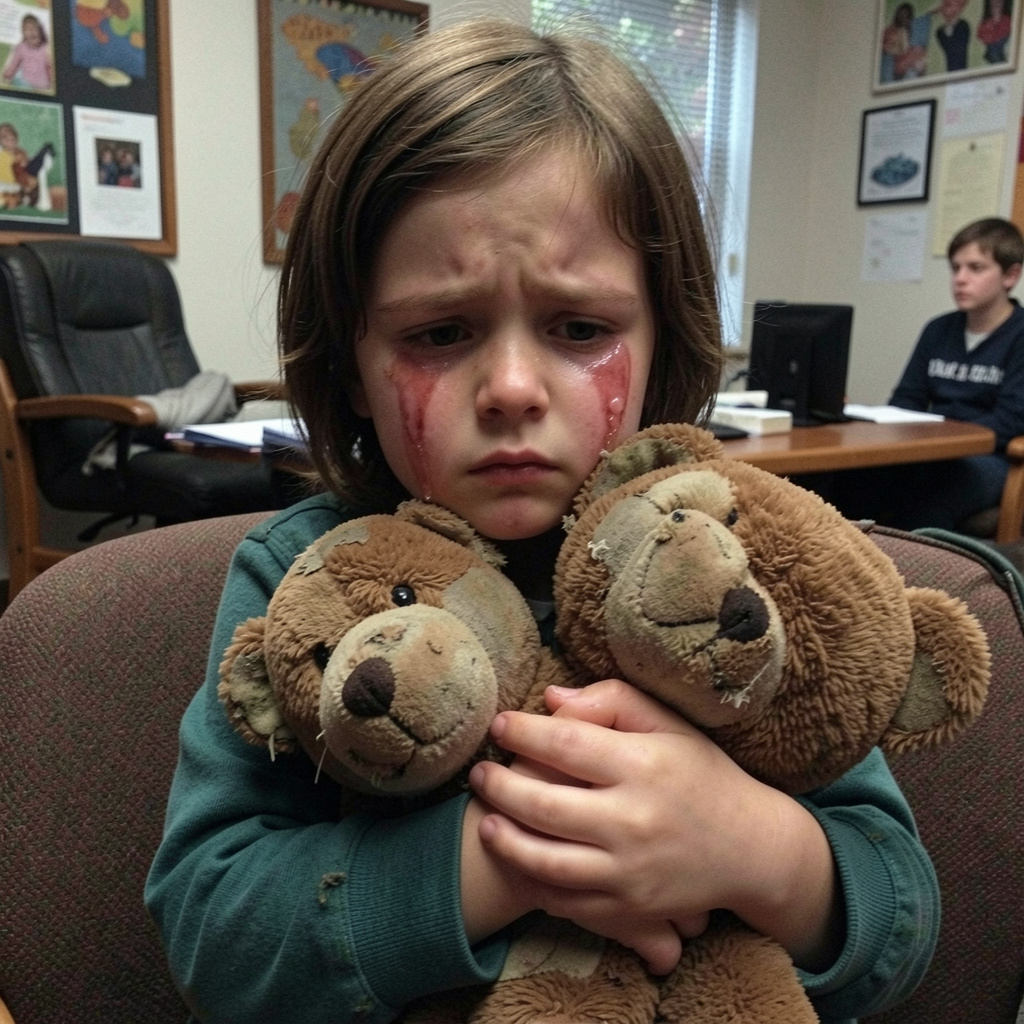
Celia was inside the counselor’s office, visible through the narrow rectangular window in the door. She was holding a brown teddy bear the school kept for this purpose, Renata realized. They kept a teddy bear for this purpose. Someone had understood, before today, that a child might need something soft to hold while adults outside a door stopped being able to stand.
Her husband. Four years married.
She tried to count backwards. Celia was two when they met. Three when Daniel moved in. Four when they married in a small ceremony at her mother’s house, Celia in a yellow dress, throwing rose petals with the focused seriousness of someone performing an important task.
She tried to count how long. She could not.
The officer’s name was Sergeant Devin Morrow. He arrived in eight minutes, which meant he had not driven the speed limit. Renata registered this, filed it somewhere.
He was younger than she expected, late twenties, with a face that had clearly been trained into a professional stillness but hadn’t been doing it long enough to make it look effortless. There was something human still at the edges of his expression. Something that cost him.
He spoke to Celia for eleven minutes. Renata was not in the room. Ms. Brea was. Later, Renata would learn that there was a protocol, a specific language, a way of asking children questions that does not contaminate testimony, that does not lead, that waits.
When Sergeant Morrow came back into the hallway, he did not make her stand up. He crouched down to where she was sitting on the linoleum floor and spoke to her at her level, which she later thought was either training or grace or both.
“Ma’am,” he said. “Based on what your daughter described, your husband has been sexually abusing her.”
She heard every word.
She heard it the way you hear a diagnosis. Complete. Irreversible. The sentence that divides time.
He kept talking. He was telling her things she needed to know. She was nodding. Part of her brain was still functional, still receiving information, still sorting it. Another part of her was standing in her mother’s backyard watching a five-year-old in a yellow dress throw rose petals, standing there knowing what she now knew, trying to reach back through four years and pull her daughter out.
You cannot pull a child out of the past. You can only stand in the present and refuse to leave her.
“I’m not leaving her,” Renata said, interrupting something Sergeant Morrow was saying.
He stopped. “No,” he said. “You don’t have to.”
Daniel was arrested at 3:47 p.m. at the Home Depot on Westfield Avenue, where he worked as a floor supervisor in the hardware section. Renata did not learn this detail until later. At 3:47 she was sitting in a plastic chair beside Celia in the school counselor’s office, her daughter’s head on her lap, both of them quiet.
Celia said, “Are you mad at me?”
“No,” Renata said. “No, baby. No.”
“He said you’d be sad.”
She kept her face even. She had never in her life worked so hard to keep her face even. “I am sad,” she said. “But not at you. Not even a little at you. Not even a molecule.”
Celia considered this. “What’s a molecule?”
“A tiny piece of something.”
“Smaller than a dinosaur egg?”
“Much smaller.”
“Then I’m not even a molecule sad at you either,” Celia said, with the perfect mathematical seriousness of someone age five settling an equation.
Renata pressed her lips to the top of her daughter’s head and breathed.
The weeks that followed existed on a different kind of clock.
There was a forensic interview at the Child Advocacy Center, a place painted in warm colors with murals of animals on the walls, designed to feel like everything it wasn’t, which was the place where children described, in precise and terrible detail, what adults had done to them. Renata sat in a waiting room while a trained interviewer spent forty minutes alone with Celia. She drank three cups of water and read the same paragraph of a magazine four times without it entering her.
There was a detective named Angela Voss, who wore her hair in a low ponytail and brought a notepad everywhere and called Renata every few days with brief, factual updates. Voss was not warm, exactly, but she was constant, and Renata came to understand that constancy was its own form of kindness.
There was a victim’s advocate named Patrick who explained the court process in plain language and sent her documents before she had to ask for them and once, only once, said, You did everything right when you found out. Renata held that sentence for days, held it the way you hold something small and warm in both hands.
There was her mother, who drove four hours from Gainesville and did not say I told you so, not once, even though she had not entirely trusted Daniel in ways she had never been able to articulate, a feeling she’d kept quiet because she did not want to be the mother who couldn’t let her daughter be happy.
There was the $14.50 an hour, which became a problem quickly. She took a week of FMLA, which she was told she was eligible for, which helped, and then she went back to the CVS because the rent was in her name and the car payment was in her name and Celia needed to eat breakfast and also wanted a specific brand of yogurt that came with a small plastic dolphin on the lid.
She went back to work. She smiled at customers. She counted out change.
She came home and made dinner and helped with homework that was mostly coloring and the identification of shapes. She gave baths and read stories and turned on the nightlight and sat on the edge of the bed until Celia’s breathing slowed.
She did not count.
She would never count.
There was therapy. A woman named Dr. Owens who specialized in children, who used play and art and something called narrative therapy, who told Renata after the sixth session, “She’s doing the work. She’s a resilient kid.” And Renata said, “I don’t want her to have to be resilient. I wanted her to have a childhood where she didn’t need to be.” And Dr. Owens said, quietly, “I know. Both things are true.”
There was also therapy for Renata, which she almost did not do, because she kept thinking about cost, kept doing the math in her head, but the advocacy center had a sliding scale and she went on Tuesday evenings while her mother watched Celia, and she sat in a small office and cried in ways she could not cry in front of her daughter, big ugly crying that she had been holding in her body for weeks, stored in her shoulders and her jaw.
She talked about guilt. The therapist, a calm woman named Jill, didn’t argue with the guilt. She just asked questions about it. When did it start? What would you have needed to know? What were you told? The guilt didn’t disappear. But it shifted, slowly, from a wall into something more like weather, something that passed over her and through her and kept moving.
She talked about Daniel. What she thought she’d known. What she hadn’t known. How a person learns to keep a secret in plain sight. How a person can be one thing to you and another thing in a room down the hall, and how that is not a failure of your perception but a success of their concealment. How abusers are often, specifically, people who know how to appear safe.
“He seemed safe,” she said one evening, in that small office.
“Yes,” Jill said. “That’s often how it works.”
“I hate that that’s how it works.”
“I know.”
Daniel Marsh pled guilty on a Tuesday in October. Renata was in the courtroom. She had debated not going, had been told she did not have to, and then had decided that she needed to be there in the same room where the word guilty was spoken, needed to hear it with her own ears, needed her body to receive that information so it could begin to believe it.
He looked smaller than she expected. She had expected to feel something more violent, some operatic rage, and instead she felt something quieter and stranger, something close to grief, not for him, but for the specific architecture of the life she had believed she was building, which had never actually existed.
Celia did not have to testify. Renata had prepared herself for the possibility. It had not been required.
He was sentenced to eleven years.
The night after sentencing, Celia asked if they could have pancakes for dinner.
Renata made pancakes.
Celia put exactly seven chocolate chips in each one, pressing them in with careful fingers before they went on the griddle. She had rules about this. The rules were important.
They sat at the kitchen table and ate pancakes with syrup and Renata watched her daughter eat and thought: here. Right here. This table. This kitchen. This small person with syrup on her chin who is going to need so much and has already survived so much and who yesterday asked if clouds have feelings and who is, above everything, still here, still mine, still whole in ways that matter more than the ways she was broken.
“Mom,” Celia said.
“Yeah, bug.”
“Can we get a dog?”
Renata laughed. It came out of her sudden and real, a full laugh, the kind that surprised her.
“Maybe,” she said.
“I want a small one,” Celia said. “But brave.”
Renata looked at her daughter across the kitchen table, at the chocolate chip on her elbow and the syrup on her chin and the absolute seriousness of her face while she negotiated the terms of a hypothetical dog.
“Small but brave,” Renata said. “I think we can do that.”
Outside, the sun was going down in the way it does in October, early and orange, throwing long light across the linoleum floor. Renata thought about all the phone calls still to come, the court dates, the check-ins, the therapy appointments stacked into the future like coins. She thought about $14.50 an hour and how many hours were in a year. She thought about the teddy bear in the counselor’s office that had been there because someone wise had put it there, understanding that a child would need it.
She thought: I drove to the school in twelve minutes. I sat on the floor. I called 911.
She thought: I did not leave her.
She reached across the table and wiped the syrup off Celia’s chin with her thumb, and Celia squirmed and said Mom, in that specific aggrieved tone that is the sound of a child who feels safe enough to be annoyed, and Renata said, “Hold still,” and held on.