Chapter 1: The Eviction Notice “The house is sold. You’re homeless now.”
Daniel, the man I had shared a bed with for nearly three decades, refused to meet my eyes. He stared intensely at a crack in the driveway concrete.
I remember standing there by the rear bumper of my sedan, my fingers frozen around the handles of my leather purse. I was still practically vibrating with a residual, euphoric energy. I was still physically smiling from the tectonic shift that had occurred in a downtown law office less than an hour earlier.
Seven million dollars.
My late grandmother, Eleanor Bennett, a woman of formidable intellect and surprising secrets, had bequeathed me a staggering seven million dollars in liquid assets, along with the outright ownership of her sprawling, historic estate tucked into the mountains of Aspen.
I had spent the entire forty-minute commute back to Denver weeping behind the steering wheel like a hysterical, lottery-winning teenager. I had furiously composed a dozen different scenarios in my head of how I was going to break the news to Daniel. I vividly pictured him grabbing me by the waist, lifting me clean off the hardwood floor of our foyer, spinning me around as the crushing, suffocating weight of our chronic financial stress finally evaporated. I had imagined us finally, truly breathing again.
Instead, my husband was standing on our porch, flanked by his mother, projecting the aura of a hostile landlord waiting for the sheriff to arrive and forcibly remove a delinquent tenant.
“The movers already came, Claire,” Patricia continued smoothly, her tone slicing through my confusion. “Your personal belongings have been boxed and transported to a secure storage facility.”
I blinked slowly, the wind stinging my eyes. “What?”
Daniel finally forced himself to speak, but the words sounded hollow, regurgitated, as if he were reading a script handed to him just moments before. “It’s over, Claire.”
Over.
Twenty-seven years of marriage. Twenty-seven years of shared history, compromised dreams, and negotiated silences. All of it brutally condensed into two pathetic syllables. Delivered by a man who, a decade prior, had recklessly driven six hours through a blinding, treacherous Rocky Mountain snowstorm just to deliver me a thermos of hot soup when I was battling pneumonia.
I looked past their rigid figures, my gaze drifting toward the house. Our house. Or, at the very least, the physical structure I had foolishly believed belonged to us.
The heavy terracotta flower pots I had painstakingly planted with vibrant geraniums in the early spring were entirely gone from the steps. The oak porch swing—the one Daniel had clumsily but lovingly built with his own hands ten years ago—was missing from its rusted hooks. Even the custom, heavy linen curtains I had hung in the front windows had been stripped away, replaced by stark, cheap white blinds.
A chilling, undeniable realization washed over me, instantly dropping my core temperature.
This eviction hadn’t materialized spontaneously overnight. This execution had been meticulously, silently planned. Carefully orchestrated. Probably engineered for weeks, if not months.
Patricia took a single, deliberate step down the porch stair, physically extending the stack of legal papers toward me like a process server.
“You really should just sign these now, Claire,” she advised, her voice dripping with synthetic maternal concern. “While things between everyone are still… civil.”
Civil. I almost choked on a harsh bark of laughter.
Instead, I gripped my purse tighter and asked the only question that actually mattered in that chaotic moment.
“When exactly,” I asked, staring dead at Daniel, “were you planning on telling me?”
Daniel aggressively rubbed his forehead, a familiar gesture he deployed whenever he felt ‘pressured.’ “Claire, please. Do not make this transition harder than it absolutely has to be.”
Harder?
My mind flashed to the heavy, embossed leather folder currently resting on the passenger seat of my car, securely holding the certified copy of Eleanor’s final will and testament. I thought about the sharp, expensive probate attorney respectfully shaking my hand that morning.
And then, I thought about the very specific, enigmatic smile my grandmother had offered during her final, fading weeks in hospice whenever Patricia’s name was casually mentioned in conversation.
Standing in the freezing driveway, that mysterious, haunting smile suddenly made perfect, terrifying sense.
Patricia aggressively folded her arms across the documents, her patience evaporating. “Oh, stop the theatrics. You’ll land on your feet. Women of your… disposition… always manage to scrape by.”
There was something undeniably, grotesquely impressive about Patricia Whitmore’s ability to sound simultaneously pragmatic and profoundly cruel. She was a grandmaster at wrapping a vicious insult inside the camouflage of a backhanded compliment.
I had been introduced to this woman when I was a naive twenty-four-year-old. She had fundamentally despised me before I had even crossed her threshold.
Not overtly, of course. Patricia was far too polished for vulgar, screaming matches. She was ‘country club refined.’ She weaponized politeness.
“Oh, Claire, sweetheart,” she would purr over holiday dinners, “you are so much… plainer… than Daniel’s usual, flashy type. It is so terribly brave of you to wear your hair cut that short! You’ve always projected such a fierce, independent streak. You know, some fragile men find that terribly intimidating forever.”
A thousand tiny, invisible paper cuts. Microscopic drops of poison administered year after agonizing year.
And Daniel’s response was always an exercise in cowardice. He would defend her intent, never my feelings. “She doesn’t mean it the way it sounds, Claire. That’s just how her generation speaks.”
That pathetic defense had become the suffocating, silent anthem of our marriage.
Patricia glanced impatiently up and down the quiet suburban street. “You really should gather your vehicle and leave before the buyers officially arrive for the walk-through.”
Buyers.
The noun floated through my consciousness like a detached balloon. It didn’t connect to reality.
Then, Daniel finally raised his head and looked directly into my eyes, delivering the killing blow.
“The house officially closed and sold three days ago, Claire.”
Three days.
Three days earlier, I had been sitting in a sterile hospice room, desperately clutching my grandmother’s fragile, bruised hand while she violently struggled to pull oxygen into her failing lungs. Three days earlier, while I was agonizingly watching the only woman who truly understood me die, my husband was apparently finalizing the secret sale of our marital home entirely behind my back.
Something foundational inside my chest should have violently shattered right then and there. I should have collapsed onto the concrete and wept.
But strangely, miraculously, I didn’t.
Because at that precise, devastating second, another incredibly clear memory breached the surface of my mind.
Three months prior, Grandma Eleanor and I had been sitting quietly at her heavy oak kitchen table in Aspen, drinking bitter black tea while a late-season blizzard raged outside the frost-rimmed windows.
“Claire, listen to me very carefully,” she had instructed, her cloudy eyes suddenly razor-sharp. “Never, under any circumstance, allow other people to rush you into signing legal documents. Especially family.”
I remembered chuckling softly, brushing off her intensity. “Grandma, you are starting to sound incredibly paranoid.”
“No, child,” she had replied, her voice eerily calm. “I sound old. And I sound experienced.”
At the time, I foolishly assumed she was merely offering standard, elderly advice regarding generic legal precautions. Now, staring at the divorce papers in Patricia’s manicured hands, I wasn’t so sure.
Patricia rudely interrupted my internal revelation, forcefully shoving the stack of papers closer to my chest. “You can sign them right here on the hood of your car, or you can drag it out and sign them later in a lawyer’s office. It makes absolutely no difference to us.”
Us.
Not Daniel. Us.
That single, plural pronoun illuminated the entire architecture of the betrayal. This was not a failing marriage organically reaching its conclusion. This was a hostile extraction. A strategic, targeted removal. And Patricia had undoubtedly functioned as the chief architect.
Daniel finally let out a heavy, exasperated sigh. “The deed to the house was exclusively under my name, Claire. My mother helped me secure the initial financing years ago. Legally speaking, there is absolutely nothing you can do to stop the transfer.”
That specific sentence almost caused a genuine, manic smile to break across my face immediately. Almost.
Instead, I maintained a mask of total confusion and asked quietly, “You really sold it already? It’s done?”
“Yes,” Daniel nodded firmly, avoiding eye contact again. “The funds have cleared. It’s finalized.”
Patricia offered a vicious, triumphant smirk. “You always were far too trusting for your own good, Claire.”
There it was. The ugly, unvarnished truth exposed to the fading sunlight.
It wasn’t blinding anger driving them. It wasn’t the agonizing heartbreak of a failed romance. It was pure, unadulterated contempt. They fundamentally believed I was weak. They thought I was simple. They assumed I was endlessly manageable.
The funniest part of the entire tragedy? I probably had been exactly that woman.
At least, I was that woman until 9:00 AM this morning. At least until Eleanor’s high-priced estate attorney slid those heavy, watermarked documents across his polished mahogany desk. At least until I finally comprehended that my grandmother had spent the last several years meticulously preparing for a catastrophe I was too blind to see coming.
A bizarre, profound calm aggressively settled over my nervous system. It was the specific, terrifying clarity people describe experiencing milliseconds before a violent car crash. Or the eerie, ringing silence immediately following one.
I looked up at the porch. I looked at the pathetic shell of the man I called my husband. I looked at the venomous woman who had spent nearly three decades desperately attempting to erase my presence from her son’s life.
Then, I smiled.
It wasn’t a nervous, placating smile. It was a real, deeply authentic expression of pure amusement.
Daniel’s brow furrowed instantaneously, his defensive instincts flaring. “What the hell is so funny?”
I slowly shifted my gaze toward the thick stack of divorce papers clutched in Patricia’s hands. Then, I looked past them, toward the empty, hollowed-out house behind them. Toward the valuable property Daniel so proudly, arrogantly believed he had just successfully liquidated.
And softly, almost gently, maintaining unbroken eye contact with my mother-in-law, I said:
“Actually, Daniel… the house you just sold belonged to me.”
Neither of them spoke.
The biting Colorado wind howled through the massive pine trees towering above us. Patricia’s smug, triumphant expression shifted slightly for the absolute first time all afternoon.
It was just a microscopic flicker of genuine confusion. But it was enough to feed my soul.
And standing there in the freezing driveway, with the winter sun rapidly dropping behind the jagged peaks of the Rocky Mountains, I suddenly realized something incredibly, profoundly important.
For the very first time in twenty-seven years, I was not the person standing on the precipice, about to lose absolutely everything.
The execution had been halted. The true owner of the estate was about to claim her territory.
Chapter 2: The Arrival of the Architect
Patricia’s artificial, victorious smile was the first casualty.
It didn’t completely disintegrate, but the arrogant confidence bracketing her eyes tightened noticeably. Beside her, Daniel stared at me with the painfully blank expression of a man desperately attempting to execute complex mental calculus without a calculator.
“What exactly does that mean, Claire?” he demanded, his voice dropping an octave.
I didn’t offer immediate clarification. Brutally honest? I wasn’t entirely certain of the granular legal mechanics myself—not yet. But I knew the broad strokes, and far more importantly, they possessed absolutely no concept of what I knew. That informational asymmetry altered the gravitational pull of the entire driveway.
Patricia, naturally, recovered her footing with terrifying speed. Women of her specific, ruthless pedigree always do. She let out a sharp, dismissive scoff and violently shoved the divorce papers back into Daniel’s chest.
“Oh, for heaven’s sake, please,” she sneered, rolling her eyes. “Do not engage with her, Daniel. Do not let her start with this desperate, dramatic nonsense to stall the inevitable.”
But Daniel ignored her. He remained fixated on me, because after twenty-seven years of cohabitation, he intimately knew the geography of my face. He knew my specific tells when I was bluffing, when I was placating, and when I was terrified.
And he recognized with rising panic that I was not bluffing.
I slowly, deliberately bypassed my vehicle and began walking up the concrete pathway toward the porch steps.
Patricia instantly lunged sideways, physically inserting herself between me and the bottom stair, acting as a human barricade.
“You cannot go inside,” she ordered, her voice sharp and authoritative.
I stopped, looking at her with the clinical detachment of a scientist observing a frantic insect. “My heavy winter coat is still hanging in the hall closet.”
“We will have the movers ship it to your storage unit,” she snapped.
Ship it. As if I were a diseased corpse they were legally obligated to dispose of.
For one, brief, white-hot second, a surge of genuine, violent anger flashed through my chest. It wasn’t fueled by the loss of the real estate. It wasn’t even fueled by Daniel’s cowardly betrayal. It was entirely fueled by the sheer, breathtaking humiliation of it all.
They had plotted this execution so meticulously, so aggressively, that they had physically packed my most intimate belongings into cardboard boxes before I had even returned from burying my own grandmother.
Daniel finally found his voice, though it sounded remarkably weak. “Claire… look, maybe we should step away and talk about this privately.”
Patricia snapped her head toward him so violently I thought she might damage her neck. “Talk about what, exactly?!” she demanded.
There it was. The absolute, unvarnished control. She wasn’t even attempting to mask her dominance over him anymore. The puppet strings were fully exposed.
I suddenly recalled another specific fragment of wisdom Grandma Eleanor had imparted while we sat bundled in heavy blankets on her Aspen porch, watching the snow bury the landscape.
“When a man completely ceases thinking for himself, Claire, always watch the mouth of the woman standing beside him.”
At the time, I assumed she was merely being a cynical, old-fashioned woman harboring outdated views on marital dynamics. Now, standing on my own driveway, those words landed with the concussive force of an artillery shell.
I took a slow, deliberate step backward, creating physical distance from the porch.
“That’s perfectly fine,” I stated, my voice echoing clearly in the cold air. “I don’t actually need the coat.”
Patricia crossed her arms aggressively, clutching her elbows. “Good.”
Then, she delivered the specific, toxic line she had undoubtedly been rehearsing in the mirror all afternoon. “You really should be incredibly grateful that Daniel is handling this extraction so peacefully.”
Peacefully.
I almost genuinely admired the sheer, sociopathic audacity required to frame an ambush eviction as an act of profound grace.
Daniel finally looked physically uncomfortable. He didn’t look consumed by guilt—he was far too deep in denial for guilt—but he looked intensely uncomfortable. He resembled a man who had just realized his expensive dinner reservation was about to be ruined by a loud argument at the adjacent table.
That specific expression of mild inconvenience hurt vastly more than if he had been screaming at me. Because, against all current evidence, there was a time when Daniel Whitmore had loved me deeply. I know he did.
We had collided in the summer of 1994 at a humid, crowded Fourth of July charity fundraiser in downtown Denver. He had clumsily bumped into me, spilling a full glass of sweet iced tea down the front of my pristine white blouse. He spent twenty agonizing minutes profusely, charmingly apologizing, awkwardly attempting to help me clean the stain, and ultimately asked me to dinner before the fireworks even began.
He possessed incredibly kind eyes back then. Warm, anchoring eyes. The specific kind of eyes that made a young woman feel fundamentally safe.
And for the first decade, he truly was a safe harbor.
Until Patricia slowly, insidiously began to metastasize, becoming the uninvited third person in our marriage.
It was never an overt invasion. It was a masterclass in subtle manipulation. Always subtle. She would casually question the expense of every vacation we attempted to take. She offered unsolicited, critical opinions on every minor home renovation. She aggressively scrutinized our financial decisions under the guise of ‘maternal guidance.’ She dominated the scheduling of every single major holiday.
When the brutal recession hit and our finances genuinely struggled, Patricia’s involvement suddenly became significantly more aggressive. She swooped in to ‘help us’ secure a massive refinancing package on the house. She ‘helped’ organize our chaotic paperwork. She ‘helped’ Daniel micromanage our depleted accounts.
Grandma Eleanor had diagnosed the cancer immediately.
“That woman inserts herself into your marriage exactly like toxic smoke creeping under a closed door, Claire,” Eleanor had warned me over the phone.
I had fiercely defended Patricia every single time. I defended Daniel’s reliance on her, too. Because that is exactly what wives of my specific generational conditioning were aggressively taught to do: You protect the sanctity of the marriage. You maintain the peace at all costs. You quietly absorb the discomfort to avoid rocking the boat.
And slowly, agonizingly, without ever fully realizing it is happening… you completely disappear.
The heavy, grinding sound of a large vehicle turning onto our quiet suburban street violently yanked me back into the present reality.
Daniel’s head snapped toward the road, his posture rigid with sudden, nervous energy. A massive, gleaming black SUV was rolling slowly toward the curb directly in front of the house.
Patricia’s aggressive scowl instantly vanished, replaced by a mask of eager anticipation. “That’s them,” she muttered to Daniel, smoothing the front of her expensive coat. “The buyers are here.”
Interesting.
I stood rooted to the driveway, watching Daniel frantically adjust his collar and straighten his posture, practically vibrating with nervous, eager-to-please energy. Patricia forced her trademark, polished country-club smile onto her face, transforming back into the gracious hostess.
The heavy doors of the SUV swung open. Two men stepped out onto the asphalt.
One was significantly younger, clutching a slim leather briefcase—undoubtedly a junior attorney or an aggressive real estate broker.
The other man appeared to be in his early seventies. He wore a stunningly tailored, expensive wool overcoat, possessed thick silver hair, and carried himself with an aura of absolute, terrifying calm. He moved with the specific, unhurried posture of an apex predator accustomed to walking into highly volatile rooms without a shred of fear.
The older man didn’t look at the house. He didn’t look at Daniel, who was eagerly bounding down the porch steps. He didn’t acknowledge Patricia’s blinding smile.
He looked directly, intently at me.
Then, he slowly shifted his gaze toward the empty house.
“Interesting timing,” the older man murmured, his voice a deep, resonant baritone.
Daniel rushed forward, aggressively extending his hand. “Daniel Whitmore! We spoke extensively on the phone regarding the closing logistics.”
The older man accepted the handshake, breaking the grip after a brief, professional second. “Walter Bishop,” he introduced himself.
The younger attorney hovering beside him clicked open his leather folder, pen at the ready.
Patricia immediately swooped down the stairs, operating at maximum charm. “Welcome, Mr. Bishop! We are so thrilled to finalize everything today. We were just… finishing up a very minor, private family matter.”
Walter Bishop’s eyes drifted lazily from Patricia’s frantic smile down to the thick stack of divorce papers Daniel was desperately trying to conceal against his leg.
“Yes,” Walter stated, his voice completely devoid of inflection. “I can plainly see that.”
Something about the absolute chill in his tone caused a knot to tighten violently in my stomach.
Walter turned his imposing frame and focused entirely on me again. “You must be Claire,” he said.
I nodded slowly, unsure of my footing. “I am.”
Walter studied my face with intense, clinical care for several agonizing seconds. The silence in the driveway stretched, heavy and pregnant with implication.
Then, he delivered a sentence that instantly, fundamentally altered the atmospheric pressure of the entire neighborhood.
“Your grandmother, Eleanor, spoke incredibly highly of you.”
Daniel completely froze in his tracks. Patricia blinked rapidly, her smile faltering as if the internal machinery had suddenly jammed.
And suddenly, the freezing Colorado air felt profoundly different.
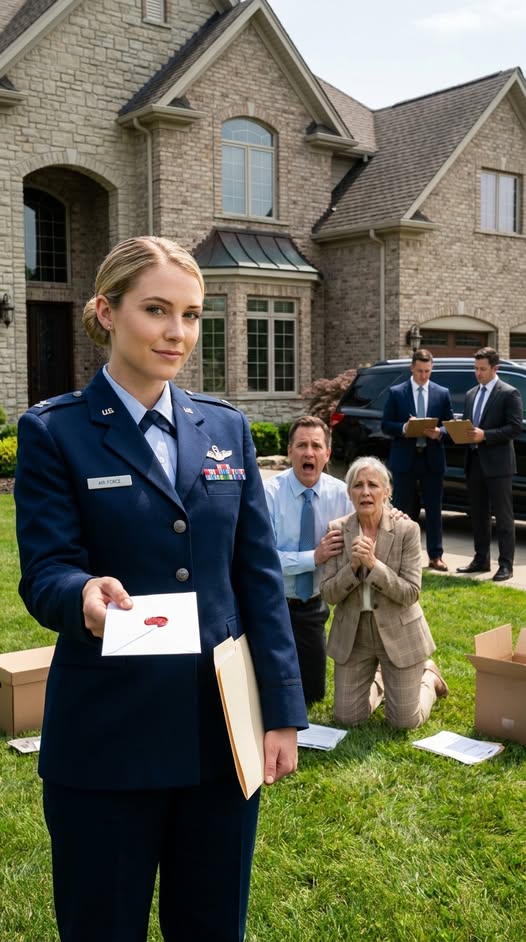
Walter reached into the inner breast pocket of his tailored overcoat and slowly extracted a folded, sealed envelope. It was thick, cream-colored stationery. The handwriting scrawled across the front was elegant, sharp, and unmistakable.
I recognized the script instantly. My heart skipped a violent beat.
Walter held the heavy envelope carefully between his gloved fingers. “Eleanor explicitly instructed me to ensure you received this document personally,” he announced, his voice carrying clearly to the porch. “However, I was ordered to deliver it only under highly specific, trigger circumstances.”
Nobody dared to speak. Even Patricia, the master of filling dead air, remained entirely mute.
Walter continued, his tone methodical and relentless. “She instructed me that if this specific property was ever transferred or sold without your explicit, legally documented knowledge…”
He paused. He slowly turned his head and locked his terrifying gaze directly onto Daniel.
“…there would likely be a significant, catastrophic confusion regarding the actual legal ownership of the estate.”
Daniel let out a high-pitched, incredibly nervous laugh. “What… what confusion are you talking about?”
Walter didn’t even dignify the panic with a glance. He turned his back on my husband and formally extended the envelope toward me.
My fingers were visibly trembling as I reached out and took the heavy paper. I stared down at Eleanor’s unmistakable handwriting slashing across the front.
For Claire. To be opened if Patricia finally, aggressively overplays her hand.
A wave of pure, absolute cold washed slowly through my entire circulatory system. It wasn’t fear. It was profound, staggering recognition.
Grandma Eleanor knew. Somehow, sitting isolated in her mountain estate, she knew exactly what these parasites were planning.
Daniel aggressively stepped into my personal space, his panic spiking. “Claire, what the hell is that?”
I slowly looked up from the envelope. I really, truly looked at him. I examined the frantic, sweating face of the man I had spent almost three decades blindly trusting.
Then, I shifted my gaze to Patricia.
And for the very first time since I was introduced to her at twenty-four, I witnessed genuine, unadulterated fear lurking behind her eyes. It wasn’t the superficial fear of social embarrassment. It wasn’t mere irritation at a delayed closing. It was absolute, primal terror.
Walter’s junior attorney quietly clicked his pen and opened a secondary, much thicker folder.
“I believe,” the young attorney stated calmly, ensuring his voice carried to the porch, “that before any party attempts to occupy or transfer this specific property, we urgently need to discuss the restrictive trust agreement legally bound to this estate.”
Trust agreement?
Daniel’s face instantly lost all remaining color, flushing a sickly, ashen gray.
Patricia took a staggering step backward. “What… what trust?” she whispered.
And standing there on the cracked concrete of the driveway, while the long, dark evening shadows stretched aggressively across the dying suburban lawn, I finally realized the magnitude of my inheritance.
My grandmother Eleanor hadn’t simply left me a staggering sum of money.
She had left me heavily armed protection.
The ambush had failed. The siege was about to begin.
Chapter 3: The Architecture of the Trust
The silence following the words ‘trust agreement’ was profound and suffocating. The suburban neighborhood suddenly felt aggressively, artificially quiet. A lone dog barked frantically three streets over. The bitter wind rustled violently through the towering pine trees lining the sidewalk. Across the asphalt, I noticed Mrs. Hargrove, our perpetually nosy neighbor, aggressively watering her dormant rosebushes while desperately pretending not to eavesdrop on the escalating drama.
Daniel swallowed, the sound loud and wet in his throat. “I… I think there has been a massive legal misunderstanding here.”
Walter Bishop calmly, methodically removed his expensive leather driving gloves, finger by finger. “No, Mr. Whitmore,” he replied smoothly. “I assure you, I do not believe there has been any misunderstanding whatsoever.”
Patricia, driven by pure survival instinct, lunged forward. She forced a harsh, braying laugh that sounded painfully, synthetically brittle in the freezing air.
“This is absolutely absurd!” she declared, pointing a trembling finger at the house. “My son, Daniel, legally and exclusively owned this property! The deed is entirely in his name!”
The younger attorney standing beside Walter finally spoke up, adjusting his wire-rimmed glasses.
“Partially,” he corrected her, his tone clinical. “He partially owned the property.”
I watched Daniel’s face with intense, detached fascination. That single, solitary word—partially—seemed to terrify him more profoundly than anything else that had occurred that afternoon.
Patricia immediately caught his reaction. She whipped her head toward him, her eyes wide with frantic accusation. “Daniel. What the hell does he mean by ‘partially’?”
Daniel didn’t answer her. He couldn’t. His mouth opened and closed silently, like a fish suffocating on the deck of a boat.
Walter Bishop mercifully turned his attention back to me, offering a polite, almost gentle nod. “Mrs. Whitmore—or, rather, Claire. Would you like the opportunity to open your grandmother’s letter now?”
I nodded slowly, my throat tight.
My fingers were stiff from the cold and the adrenaline as I carefully broke the wax seal on the envelope. The heavy stationery immediately released the faint, unmistakable scent of Eleanor’s signature perfume—a complex blend of dry lavender and sharp cedarwood.
For one agonizing, suspended second, the entire chaotic world around me vanished. I forgot the contested house. I forgot Daniel’s betrayal. I forgot Patricia’s venom.
All my mind could focus on was the image of my grandmother. I pictured her sitting completely alone in the dim light of her Aspen study during her agonizing final weeks, fully aware that her body was actively failing her, while she quietly, ruthlessly engineered this exact, devastating counter-strike to protect a granddaughter who was too blind to protect herself.
I unfolded the thick paper carefully and began to read.
Claire,
If you are standing somewhere reading this letter, then my darkest suspicions were tragically correct.
I stopped breathing for a microsecond. The wind bit at my face. Walter remained perfectly, respectfully silent, while Daniel aggressively shifted his weight from foot to foot, radiating impatient panic beside the porch.
I forced my eyes back to the script.
You have always possessed the fatal flaw of believing that offering unconditional love could somehow magically cure fundamental dishonesty. That was exactly your mother’s greatest weakness, too.
A massive, painful lump rose instantly in my throat, threatening to choke me. My mother had passed away when I was nineteen. Eleanor fiercely protected her memory and rarely spoke of her directly, finding the grief too raw to articulate.
The letter continued, the handwriting sharp and unyielding.
Daniel is not inherently an evil man. But you must understand this, Claire: weak men become incredibly, lethally dangerous when stronger, more vicious people are permitted to whisper poison into their ears for long enough.
My eyes instinctively, violently darted up from the page and locked onto Patricia.
She was seething. The mask had completely slipped, revealing the furious, cornered animal beneath the country-club veneer.
“Give me that damn letter,” she snapped, taking an aggressive step toward me, her hand outstretched.
Walter’s junior attorney moved with shocking, fluid speed, instantly inserting his body directly between Patricia and myself, forming a physical barricade.
“No, ma’am,” the attorney stated firmly.
Patricia froze in her tracks. Judging by her stunned expression, it was highly probable that nobody had forcefully told her ‘no’ in three decades.
Daniel aggressively rubbed both his hands over his flushed face, his breathing shallow and rapid. “This is completely insane. This is a circus.”
“No, Mr. Whitmore,” Walter countered, his baritone voice cutting through the panic. “What is genuinely insane is aggressively attempting to execute the sale of a property that is legally entangled with an active, highly restrictive trust, without possessing a fundamental understanding of the legal structure you are bound by.”
Daniel stared at the older man, sheer terror leaking into his voice. “What goddamn trust are you talking about?!”
Walter exchanged a brief, confirming glance with his junior attorney. The younger man nodded and fully opened his thick leather folder.
“Exactly six years ago,” the young attorney explained, reading directly from a heavily notarized document, “Mrs. Eleanor Bennett quietly and legally executed the transfer of a protected, controlling ownership percentage directly connected to the deed of this specific property.”
He paused, looking up at Daniel. “This transfer was initiated immediately following her substantial financial intervention assisting with Mr. Whitmore’s catastrophic business liabilities.”
My mind violently flashed backward in time.
Six years earlier. Daniel’s regional construction business had careened into a catastrophic death spiral following two horrifically mismanaged commercial contracts and a massive, crippling lawsuit involving the installation of faulty roofing materials on a municipal building.
We were drowning. We were weeks away from losing absolutely everything—the business, the cars, the house. Daniel spent months in a state of absolute, manic panic, dodging aggressive debt collectors, desperately begging for predatory loans, and attempting disastrous refinancing schemes.
And then, miraculously, everything abruptly stabilized. The aggressive phone calls stopped. The lawsuit was settled out of court.
When I tearfully asked Daniel how we had survived the impact, he looked me dead in the eye and confidently informed me that Patricia had leveraged her extensive network to secure a private, incredibly favorable financing package.
But standing in the driveway, another, deeply buried memory violently breached the surface.
I recalled a late-night phone call with Grandma Eleanor during the absolute height of the crisis. I was sobbing into the receiver, terrified of impending homelessness.
“Do not spend another second agonizing over the house, Claire,” Eleanor had instructed me softly. “I handled the situation.”
At the time, I foolishly, naively assumed she was offering emotional reassurance. A grandmother comforting a panicked child.
Now, staring at the legal documents in the attorney’s hands, the reality slammed into me. She hadn’t offered emotional support. She had literally, legally, and financially handled the situation.
Daniel looked as though he was going to vomit. He swayed slightly on his feet. “What… what exact percentage did she secure?”
The junior attorney answered immediately, devoid of hesitation. “A percentage more than sufficient to severely complicate, and potentially completely invalidate, any unauthorized sale proceedings initiated without the trust’s explicit consent.”
Patricia exploded. The country club facade was annihilated.
“Oh, for God’s sake, Daniel!” she shrieked, rounding on her son. “What the hell did you sign?!”
“There were literally hundreds of pages of legal jargon!” Daniel shouted back, his voice cracking with defensive rage. “And you explicitly ordered me to sign them without demanding a review! You stood right there and told me the refinancing had to be executed immediately to avoid bankruptcy!”
The silence that descended over the driveway following that confession was almost physically embarrassing to witness.
Because suddenly, the grand illusion was violently stripped away, leaving the truth standing naked and pathetic in front of all of us. They weren’t criminal masterminds executing a flawless heist. They were desperately greedy, incompetent amateurs who had blindly stumbled into a trap set by a woman exponentially smarter than both of them combined.
Walter calmly adjusted the lapels of his expensive overcoat, watching Patricia’s carefully constructed composure disintegrate piece by agonizing piece.
She whipped her head back toward me, her eyes practically bulging out of her skull, and pointed a trembling, accusatory finger. “She knew about this! This little bitch knew about this entire scheme!”
“I didn’t,” I replied. And it was the absolute, unvarnished truth. I genuinely hadn’t known. Not the full, devastating extent of it.
But Grandma had known.
That staggering realization settled deep, deep inside my bones, anchoring me to the earth. Eleanor had spent years silently, patiently observing from her mountain retreat. She had watched Patricia aggressively maneuver through our lives, constantly rearranging the furniture inside a marriage that didn’t belong to her.
And Eleanor had planned her counter-offensive accordingly.
Daniel turned toward me, his eyes wide and desperate, pleading for a lifeline. “Claire, please, listen to me. We can sit down with the lawyers. We can figure this out. We can—”
Interesting.
Ten minutes earlier, I was a discarded, homeless nuisance they were eager to scrape off their boots. Now, suddenly, the word ‘We’ had miraculously re-entered his vocabulary.
I carefully, meticulously re-folded Grandma’s heavy letter and slipped it safely into my purse.
“You already figured things out on your own, Daniel,” I stated, my voice echoing with finality.
“Claire, that is incredibly unfair,” he pleaded, reaching a hand toward me.
I laughed. I couldn’t suppress it. It wasn’t a cruel, triumphant laugh. It was the hollow, exhausted sound of a woman who has finally seen the man behind the curtain.
“You sold our home,” I said, spacing the words out deliberately, “while I was standing in a graveyard, burying my grandmother.”
Patricia immediately interjected, desperate to regain the high ground. “It was legally, exclusively his house to sell!”
Walter Bishop finally turned his full, terrifying attention directly onto Patricia.
“No, ma’am,” Walter stated, his voice dropping into a register that commanded absolute obedience. “And I strongly suspect that arrogant assumption is about to become catastrophically expensive for everyone involved.”
Patricia’s face went chalk-white.
The younger attorney smoothly closed his thick leather folder. “At the absolute, bare minimum,” he announced to the group, “it is highly evident that the prospective buyers were not legally informed regarding the active, highly restrictive trust entanglements fundamentally connected to this property.”
Daniel looked genuinely, physically sick. He grabbed his stomach.
Walter spoke to him carefully, adopting the tone one might use when addressing a terminal patient. “My legal team discovered the massive discrepancy in the title history this afternoon during our final, routine review of the estate assets.”
Patricia aggressively crossed her arms, her knuckles white as she dug her nails into her cashmere sleeves. “So, what exactly happens now?”
Walter slowly turned his head and gazed up at the sprawling suburban house.
“Now,” Walter declared, “we immediately pause all transaction proceedings before someone present makes this disaster exponentially worse.”
Daniel suddenly whipped his head toward me, his eyes blazing with a sudden, frantic realization.
“You knew this would happen,” he accused me, his voice trembling.
“No,” I replied calmly.
“Then why the hell were you smiling when you walked up the driveway?!” he shouted.
I looked at him. I examined the panicked, sweating face of the man who had traded his spine for his mother’s approval. I looked at him in total silence for several, agonizing seconds.
Because the answer had finally crystallized in my mind.
I smiled because, for the very first time in years, I was no longer trapped. I wasn’t trapped in a suffocating financial crisis. I wasn’t trapped in an emotionally barren existence. I wasn’t trapped inside a toxic marriage where every single, solitary decision I made had to be quietly, aggressively vetted and approved by Patricia first.
The realization felt terrifying, incredibly painful, but unimaginably freeing.
Walter gently motioned toward the folded letter I had tucked into my purse. “There is more to the correspondence, Claire,” he encouraged softly.
I retrieved the envelope, unfolded the heavy paper, and continued reading where I had left off.
Claire, if Patricia is currently standing nearby while you read this, then I imagine she still arrogantly believes that money is the sole currency that makes people powerful. But she is a fool. Real power is derived from absolute patience. And people who chronically underestimate quiet women usually live to deeply regret it.
I could practically hear Eleanor’s sharp, aristocratic voice delivering the words.
Patricia looked furious enough to spontaneously combust on the driveway. Daniel suddenly appeared physically smaller, as if the air had been entirely let out of his tires.
Walter spoke softly, addressing me. “Your grandmother explicitly asked me to intervene and assist you today, if the situation proved necessary.”
“Why?” I whispered, my voice finally cracking.
Walter offered a sad, incredibly gentle smile. “Because, Claire, she loved you very deeply.”
That single, simple sentence nearly broke me. Not the revelation of the massive inheritance. Not the sudden leverage over the house. Not the impending, brutal divorce.
That.
The profound, simple certainty that someone had been silently watching the abuse happening around me for years, and loved me enough to meticulously build a fortress to protect me when the walls finally collapsed.
Daniel took a hesitant step down from the porch. “Claire, please—”
I held up a single hand, palm facing him.
“No.”
He stopped dead in his tracks. And for the very first time since our marriage commenced twenty-seven years ago, he actually obeyed my command.
The skirmish in the driveway was over. It was time to move the war room.
Chapter 4: The Lounge and the Ledger
Walter Bishop efficiently took command of the chaotic scene. He suggested, with an authority that brooked absolutely no argument, that we relocate and continue the highly sensitive conversation in a more private, secure environment.
Patricia, naturally, objected instantaneously. Her survival instinct demanded she maintain control of the home turf.
“We are absolutely not sneaking off to some shadowy back room to humor this fabricated, made-up legal nonsense!” she declared, attempting to assert dominance over the driveway.
Walter didn’t even flinch. He didn’t offer a rebuttal. He simply ignored her existence and turned his focus entirely to me. “Claire?”
It struck me with the force of a physical blow right then. Nobody had genuinely asked me what I actually wanted to do in a very, very long time.
Not truly.
In my daily existence, Daniel typically dictated the parameters of our lives, Patricia relentlessly influenced the execution of those parameters, and I seamlessly adapted. I smoothed over the rough edges, I placated the tempers, I aggressively maintained the fragile peace. That had been my designated, unpaid full-time job for nearly three decades.
But standing on the cold concrete, with my grandmother’s brilliant, explosive letter still trembling slightly in my grip, I realized I was utterly exhausted by a ‘peace’ that only existed conditionally—strictly dependent on my prolonged silence.
“I would very much like to hear the rest of what you have to say, Mr. Bishop,” I stated firmly.
Walter nodded once, a crisp, professional gesture. “Excellent. There is a highly discreet hotel lounge located approximately five minutes from here. I have already secured a private table.”
Patricia scoffed, a loud, obnoxious sound designed to humiliate. “Oh, please. This is ridiculous.”
But Daniel abruptly turned on her, his voice cracking with genuine panic. “Mom, stop it!”
The word startled both of us. It hung in the freezing air, awkward and revealing.
Mom.
Not ‘Patricia.’ Not ‘Mother.’ It was the desperate, pleading voice of a terrified little boy, inexplicably hiding inside the decaying shell of a fifty-year-old man.
Patricia looked violently offended by the outburst. Daniel merely looked profoundly, utterly exhausted.
The younger attorney silently handed Walter a secondary, thick manila folder, and I slowly turned and began walking back toward my parked car.
Daniel scrambled halfway down the driveway, desperately pursuing me. “Claire, wait! Please!”
I stopped walking, but I didn’t turn around immediately. I let him stew in the silence.
His voice dropped to a pleading, pathetic register. “You know I would absolutely never, ever intentionally hurt you.”
I closed my eyes briefly, suppressing a wave of nausea.
There it was again. The legendary, cowardly Carter family phrasing. Not ‘I didn’t hurt you.’ Just… not intentionally. It was the ultimate, pathetic escape hatch for a man terrified of accountability.
I turned slowly to face him, pulling my coat tighter against the wind.
“You actively, secretly sold our home,” I stated, my voice a deadpan whisper. “You finalized the paperwork while I was sitting in a lawyer’s office, weeping, listening to the reading of my grandmother’s will.”
His shoulders violently sagged, the posture of a defeated man. “It… it wasn’t supposed to happen like this, Claire.”
“How exactly was it supposed to happen, Daniel?” I challenged him.
He opened his mouth to offer an excuse, then snapped it shut again. Because he finally realized there was absolutely no sequence of words he could string together that didn’t make him sound like a monster.
Suddenly, Patricia’s shrill voice cut through the air from the porch.
“Daniel!”
One single word. Delivered with the sharp, cracking authority of a trainer commanding an obedient dog.
And, acting purely on decades of ingrained instinct, Daniel immediately whipped his head back toward her, seeking her approval.
That pathetic, reflexive movement told me absolutely everything I needed to know. Again.
The hotel lounge was dimly lit, smelling faintly of woodsmoke and expensive bourbon. It was sparsely populated, occupied mostly by affluent older couples enjoying early dinners and weary tourists seeking refuge from the biting mountain cold.
Walter had miraculously reserved a deeply private, oversized corner booth situated near a massive, crackling stone fireplace. As we sat down, his junior attorney began methodically, almost reverently, spreading a series of complex documents across the polished mahogany table.
Daniel practically sprinted to slide into the booth beside me. It was an automatic, habitual movement. Patricia, however, moved even faster, aggressively sliding into the seat directly beside him on his other flank. She clung to him as if she were terrified that allowing physical distance between them might somehow magically sever her psychological control.
I sat rigidly, keeping Grandma Eleanor’s heavy envelope tightly folded in my lap, anchoring myself to reality.
Walter meticulously removed his reading glasses, placing them carefully beside a crystal water glass.
“Before we proceed any further,” Walter began, his voice dropping into a serious, professional register, “I want to explicitly clarify the legal reality of the situation.”
Nobody dared to interrupt him.
“The actual, physical sale of the property itself may not be completely, legally invalid,” Walter stated.
Patricia immediately seized the opening, a vicious, triumphant smirk rapidly re-emerging on her face. She practically vibrated with vindication.
But Walter casually raised a single finger, silencing her. “However,” he continued smoothly, “depending heavily on the specific intent, the lack of full disclosure, and the highly suspicious timing of the transaction… several incredibly severe, potentially catastrophic legal complications currently exist.”
Daniel aggressively rubbed his temples, a headache clearly forming. “What specific complications are we talking about?”
The younger attorney didn’t hesitate. He rattled off the list with brutal efficiency. “Fraudulent failure to disclose protected, active trust interests to a buyer. Massive potential financial concealment executed during active marital dissolution proceedings. Improper, highly questionable transfer timing designed to subvert marital assets.”
Patricia waved her hand dismissively, scoffing at the junior lawyer. “Oh, please. You overpaid lawyers love to make every minor clerical error sound like a dramatic federal crime.”
The young attorney stopped organizing his papers and looked directly, unblinkingly at her.
“No, ma’am,” he replied coldly. “We don’t. Federal courts do.”
That precise, chilling response effectively shut her mouth for the moment.
Walter gently turned his attention back to me. His expression softened considerably.
“Claire,” Walter said softly. “Your grandmother explicitly requested that this secondary envelope only be delivered to you, and subsequently opened, if you personally discovered undeniable evidence of betrayal involving the marital property.”
My stomach tightened into a painful, solid knot.
Second envelope?
Of course there was a second envelope. Eleanor had always firmly believed that truly important matters required intricate layers. I remembered one Christmas when she had painstakingly wrapped my relatively small gift inside five successively larger, nested boxes, simply because she delighted in the psychological suspense.
Walter slid a slightly thicker, sealed envelope slowly across the polished wood toward me.
I stared at it silently, the ambient noise of the lounge fading away. My grandmother’s elegant, slashing handwriting dominated the front.
For Claire. To be opened when the truth finally becomes entirely impossible to ignore.
My chest physically ached reading those words. Because deep, deep down in the most heavily guarded sector of my soul, I think a part of me always knew the truth.
Not about the secret sale of the house. Not about the impending, cowardly divorce.
But about Daniel. About the agonizing reality of my husband slowly, silently disappearing from our marriage year after year, retreating further behind his mother’s skirt, while I desperately, pathetically pretended not to notice his absence.
I broke the heavy wax seal and opened the envelope with extreme care.
Inside the envelope was another piece of thick, handwritten stationery, accompanied by a thick stack of stapled, heavily photocopied documents.
I glanced at the first page of the evidence. Bank transfer logs. Certified property records. Printed emails.
I looked back down at the opening sentence of Eleanor’s letter.
Claire, if you are reading this specific document, then Patricia has finally, irreversibly overplayed her hand.
Patricia aggressively shifted her weight in the booth beside Daniel, clearly uncomfortable with the silence.
I continued reading the letter silently for several long, agonizing seconds. I forced myself to read every single word until my erratic breathing finally slowed, settling into a cold, steady rhythm.
Then, I slowly lifted my head. I looked directly into Daniel’s eyes.
“You used my inheritance from my mother,” I stated. It wasn’t a question.
He blinked hard, visibly startled by the accusation. “What?”
I lifted one of the stapled, photocopied banking ledgers from the pile.
“You explicitly told me,” I said, my voice dangerously even, “that we exclusively drained your personal business savings accounts to survive the impact of the recession.”
Patricia suddenly leaned forward, attempting to hijack the narrative. “Claire, listen to me, now wait just a minute—”
“No.”
The single, sharp command surprised even me. The sheer force behind it was absolute. Patricia instantly froze, her mouth hanging open.
I shifted my intense stare entirely back to Daniel. “You secretly used the money my mother left me when she died.”
He looked completely trapped now. He resembled a cornered, exhausted animal that suddenly, violently realizes that every single locked door surrounding him was constructed by his own cowardly choices.
“It… it was supposed to be strictly temporary,” he muttered weakly, staring at his hands.
“How much of it?” I demanded.
Silence. The crackling fireplace suddenly sounded deafening.
“How much, Daniel?!” I raised my voice, the raw anger finally bleeding through.
He swallowed hard. “Almost… almost all of it.”
The fireplace popped loudly beside us. Somewhere across the dimly lit lounge, a waitress dropped a handful of silverware onto a tray with a clatter. Perfectly ordinary sounds. Ordinary, mundane life relentlessly continuing around me, while my own personal reality was quietly, violently cracking wide open.
My mother had left me exactly eighty thousand dollars when she passed away. It wasn’t an astronomical sum of money. It certainly wasn’t enough capital to fundamentally alter the trajectory of a life. But it was enough to matter profoundly. It was enough to serve as a tangible, lasting memory of her existence.
Daniel reached out a trembling hand across the table, desperately trying to touch my arm. “Claire, please try to understand… I was frantically trying to save the business. I was desperate.”
Patricia immediately lunged into the opening, reverting to her default defense mechanism. “And that exact same business put a roof over your head and fed you for years, Claire!” she snapped aggressively.
Walter Bishop calmly, methodically slid another thick, highlighted document across the mahogany table.
“Actually,” Walter interjected, his voice polite but lethal, “the forensic accounting clearly indicates that the business losses severely accelerated immediately following several massive, undocumented cash withdrawals… withdrawals directly connected to Patricia Whitmore’s personal, high-risk investment accounts.”
The silence that followed that specific revelation felt enormous, heavy enough to crush bone.
Daniel slowly, agonizingly turned his head toward his mother.
Patricia’s face instantly drained of all color, transforming into a sickly, chalky white. “What?” she gasped.
Walter calmly adjusted the document, pointing a manicured finger at a specific column of numbers. “Mrs. Whitmore aggressively encouraged, and subsequently executed, several highly volatile, high-risk investments during the exact same financial quarter that Mr. Whitmore was actively claiming severe financial hardship to his creditors.”
Daniel stared at his mother, absolute shock radiating from his eyes. “You explicitly promised me those specific accounts were entirely protected.”
Patricia snapped instantly, her defensive instincts overriding her panic. “They were supposed to be protected!”
Supposed to be.
There it was. The absolute, unvarnished truth finally dragging its bloody carcass into the harsh daylight.
Daniel wasn’t an innocent, blameless victim in this tragedy. He was fully culpable. But he also wasn’t the criminal mastermind orchestrating the heist. He was simply weak. He was fundamentally weak enough to blindly follow the loudest, most aggressive voice in the room, regardless of the consequences.
Grandma Eleanor had accurately diagnosed his fatal flaw years before I possessed the courage to see it.
I looked back down at her handwritten letter resting in my lap.
You cannot save people who willingly, eagerly hand over their conscience to someone else to manage.
A single, hot tear slid silently down my cheek before I could suppress it. I wasn’t crying because of the stolen eighty thousand dollars. I wasn’t even crying over the loss of the house.
I was crying because I suddenly, brutally realized exactly how many agonizing years I had spent fiercely fighting a solitary war to protect a marriage that Daniel had cowardy stopped fighting for a decade ago.
Walter spoke softly, breaking the heavy silence. “Your grandmother was incredibly adamant that you would not be utterly destroyed financially in the aftermath of this impending divorce.”
Divorce.
Hearing the word spoken aloud by a third party sounded fundamentally different now. It no longer sounded like a death sentence.
It sounded exactly like a release.
Daniel finally broke his stare with his mother and looked at me. “Claire… I am so incredibly sorry.”
And looking at his defeated, miserable face, for the absolute first time all evening, I genuinely believed he meant the apology.
But strangely, tragically, that sincerity no longer possessed the power to change anything.
The structural integrity of their alliance was about to face its ultimate stress test.
Chapter 5: The Collapse of the Alliance
The remarkably strange phenomenon regarding profound betrayal is this: sometimes, the paralyzing pain doesn’t arrive all at once in a massive, crushing wave. Sometimes, it infiltrates your system quietly, stripping away your foundation layer by agonizing layer, until one final, undeniable truth forces the entire, rotten structure to violently collapse in on itself.
That specific night, sitting in the corner booth of that dimly lit hotel lounge, I watched twenty-seven years of marital history unravel into nothingness in less than sixty minutes.
And oddly enough, sitting in the epicenter of the blast radius, I wasn’t the individual falling apart.
Patricia was.
“You are deliberately attempting to make me sound like some sort of common criminal!” Patricia snapped viciously at Walter, her manicured hands trembling slightly where they gripped her expensive leather purse.
Walter Bishop remained perfectly, terrifyingly calm, adjusting his cuffs. “I am absolutely not making you sound criminal, Mrs. Whitmore,” he replied smoothly. “I am simply making you sound thoroughly documented.”
The younger attorney, operating with brutal efficiency, slid yet another thick, organized stack of printed ledgers across the polished mahogany.
Patricia barely afforded the paperwork a passing glance, actively choosing denial.
Daniel, however, leaned forward and began to read.
And as his eyes frantically scanned the highlighted columns of numbers, something fundamental and terrifying changed in his face. It was a rapid, agonizing evolution of emotion. First, profound shock. Then, deep confusion. And finally, the emergence of raw, genuine anger.
But the fury wasn’t directed toward me. It was aimed entirely at the woman sitting beside him.
“You actively, covertly moved massive sums of capital out of the primary business operational account,” Daniel stated, his voice a low, dangerous rumble I had rarely heard him utilize.
Patricia aggressively crossed her arms over her chest, adopting an intensely defensive posture. “It was meant to be a strictly temporary maneuver to secure better returns!”
Daniel let out a single, sharp laugh under his breath. It was a harsh, incredibly bitter sound. “That is exactly the same bullshit lie I fed to Claire.”
Patricia’s eyes narrowed into venomous slits instantaneously. “Do not dare start aggressively blaming me for your own catastrophic business decisions, Daniel.”
“My decisions?!” Daniel roared, his voice spiking loud enough to draw stares from the adjacent tables. He violently slammed his palm onto the table. “You explicitly, repeatedly told me that Claire would aggressively try to take absolutely everything in the divorce if we waited! You told me we needed to hide the capital! And I was blindly trying to protect you from the fallout!”
“No,” Daniel continued, his voice dropping into a register of absolute, chilling clarity. “You weren’t protecting me. You were exclusively protecting yourself.”
That devastating sentence hung heavily, suffocatingly over the table.
I sat perfectly silently beside them, observing the carnage. I watched two people who had spent decades operating as a flawless, toxic, synchronized team suddenly, violently turn on each other like starving wolves the exact moment severe legal consequences materialized.
Grandma Eleanor used to sip her tea on the porch and tell me, “Claire, greed is an incredibly loyal companion… right up until the exact second true fear arrives.”
Sitting in the booth, watching them tear each other apart to save their own skin, I finally, completely understood the profound wisdom of her observation.
Walter methodically, calmly closed one of the thick manila folders, resting his hands atop the leather binding.
“Given the explosive nature of the financial revelations uncovered this evening,” Walter announced, his tone purely clinical, “I would strongly, officially recommend that everyone currently sitting at this table retain separate, independent legal counsel immediately.”
Patricia scoffed loudly, attempting to project an aura of total unbothered superiority. “Oh, please spare me the dramatic legal threats. Absolutely nobody is going to drag this family into a public courtroom over this nonsense.”
The younger attorney looked directly into Patricia’s eyes, entirely unfazed by her posturing.
“Ma’am,” the young lawyer stated, his voice lethal. “I assure you, there is already more than enough verified, documented evidence sitting on this table to initiate massive, crippling civil litigation for fraud.”
Daniel’s face instantly drained of all remaining color, turning a sickly, translucent white.
Patricia snapped her head toward him, recognizing the terror blooming in his eyes. “Stop looking so damn frightened, Daniel! I am the one whose accounts are being scrutinized, I should be the one who is frightened. No. You need to stay perfectly calm and let the experienced professionals handle this minor hiccup.”
Daniel suddenly laughed again. This time, the sound was significantly louder, bordering on hysterical.
“Professionals, Mom?!” Daniel demanded, his voice cracking. “You explicitly promised me this entire extraction process would be incredibly easy! You promised me it was foolproof!”
Every single older couple seated in the lounge had entirely abandoned their meals and was now openly, blatantly staring at our corner booth.
Patricia leaned in close, aggressively lowering her voice to a sharp, serpentine hiss. “Keep your damn voice down, Daniel. You are creating a public spectacle.”
But Daniel had finally, irrevocably reached that dangerous, volatile emotional precipice. It is the specific psychological breaking point a human being arrives at when the sheer weight of public humiliation finally overpowers the deeply ingrained habit of denial.
“No,” Daniel stated, shaking his head furiously. “You actively pushed for this specific timeline. You demanded the aggressive execution.”
Patricia leaned even closer, invading his personal space, her voice dripping with venom. “And who exactly physically signed the legal transfer papers, Daniel? You did. You explicitly assured me that Claire was too naive and would never discover the discrepancy. You arrogantly claimed the trust wasn’t a significant roadblock. You promised the house was legally safe to liquidate. You said a hell of a lot of things.”
Each accusatory sentence was delivered harder, sharper, functioning as a brutal physical strike.
Decades of Daniel’s blind, desperate obedience were violently cracking wide open, all at once, in the middle of a hotel bar.
And observing the carnage, I suddenly saw the core dynamic with absolute, terrifying clarity.
Daniel had spent the entirety of his pathetic life desperately, exhaustingly attempting to earn Patricia’s elusive approval. Even now, even sitting deep in the catastrophic wreckage of his own monumental failures, a fractured, broken part of his psyche still desperately craved for her to pat his hand and assure him that everything would miraculously be okay.
But Patricia wasn’t offering comfort anymore. Because terrified, cornered people instantly stop protecting their pawns. They exclusively protect themselves.
I quietly, meticulously folded Grandma Eleanor’s letters, smoothing the creases, and placed them securely back inside the inner pocket of my leather purse.
Walter noticed the subtle movement. He looked at me, genuine concern in his eyes. “Are you holding up all right, Claire?”
I nodded slowly.
And surprisingly, miraculously, I was.
I wasn’t happy. I wasn’t emotionally untouched by the devastation. But I was incredibly, profoundly steady.
For agonizing years, I had harbored the secret terror that losing my marriage would entirely destroy my identity. Now, sitting in the aftermath of the explosion, I realized a far more terrifying truth. Something infinitely worse had already occurred a long time ago.
I had squandered decades of my one, precious life violently shrinking my own existence, dulling my own shine, and muting my own voice, simply to keep the illusion of that marriage alive. The true destruction of my soul had already happened. I had just been too cowardly to call the demolition by its real name.
Daniel suddenly whipped his head toward me, desperation radiating from his posture. “Claire, please. You have to say something.”
I looked at him carefully.
I examined the face of the man who had once playfully danced with me, barefoot and laughing, in our tiny first kitchen at midnight. The man who had held my trembling hand with fierce devotion during my mother’s funeral.
The man who now sat pathetically trapped in a purgatory between crushing guilt and paralyzing fear, while his own mother sat rigidly beside him, silently calculating the most efficient escape routes that abandoned him to the wolves.
“What exactly do you want me to say to you, Daniel?” I asked quietly. “Do you want me to say that I’m sorry this is happening?”
“You already said you were sorry,” he pleaded.
“I mean it, Claire. I truly do.”
“I know you do.”
My calm, even response seemed to confuse and agitate him far more than if I had screamed obscenities at him. Because guilt feels somewhat manageable, almost justified, when the victim is screaming and raging. It provides the betrayer with an excuse to be defensive.
Quiet, absolute acceptance feels like a death sentence. It feels final.
Patricia abruptly shoved her chair backward, standing up forcefully from the booth. “This entire, ridiculous conversation is officially finished.”
Walter remained perfectly seated, looking up at her with mild amusement. “No, ma’am,” he countered softly. “The conversation is just beginning.”
She aggressively snatched her designer purse from the table, gripping it like a weapon. “I am absolutely not sitting in this establishment for another second while total strangers hurl baseless legal threats at my family.”
Family.
It was an incredibly interesting choice of vocabulary. Because Patricia had spent the last thirty years treating me like a hostile intruder who had illegally breached the perimeter of hers.
Daniel slowly looked up at his mother, his expression hollow. “You stole money from my business, Mom.”
Patricia exhaled a sharp, dramatic sigh of pure exasperation. “Oh, stop acting so incredibly shocked and victimized, Daniel. I was proactively trying to protect our financial future because you were failing to do so!”
“You deliberately hid the transactions from me,” he accused her.
“I managed the crisis,” she corrected him haughtily.
“That is absolutely not the same thing, and you know it.”
Patricia looked down at her son with an expression of profound, withering disappointment. “You always, predictably panic the exact second things become remotely uncomfortable, Daniel. It is a pathetic trait.”
The brutal assessment hit him with the force of a physical blow. I could actually see the impact register in his posture.
Because for the very first time in his life, he realized the terrifying truth. His mother didn’t actually love him unconditionally, either. She didn’t value him as a son. She exclusively valued his usefulness. His control. His blind compliance to her narrative.
And now that he had publicly, catastrophically failed her, her supposed ‘loyalty’ was evaporating faster than water on a hot stove.
Walter slowly stood up, smoothing his tailored jacket. “I believe this evening has been sufficiently, emotionally exhausting for absolutely everyone involved.”
He turned his gentle focus toward me. “Claire, my private driver is waiting outside. He can transport you directly to the estate in Aspen tonight, if you would prefer to leave immediately.”
Patricia let out a loud, incredibly cold, hacking laugh. “Of course,” she sneered venomously. “Send the little princess off to hide in her new mansion.”
But the vicious insult landed completely differently this time. It lacked its usual, penetrating sting. Because underneath the thick layer of manufactured bitterness, I distinctly heard the underlying emotion.
Envy. Pure, raw, unadulterated envy.
Daniel looked at me, completely stunned by the development. “You’re… you’re actually leaving tonight?”
I nodded once, firmly. “There is absolutely nothing left for me here.”
The words surprised even me with their profound, undeniable truth. It wasn’t merely the loss of the physical house. The entire city of Denver suddenly felt incredibly heavy to me. It felt suffocatingly dense, packed with decades of accumulated memories and compromises that simply no longer belonged to the woman I was becoming.
Daniel scrambled to his feet, panic flooding his eyes. “Claire, wait. Please.”
His voice cracked slightly on the final word.
That subtle, desperate fracture in his tone almost hurt me more than the initial betrayal. Because, once upon a time in a different life, I would have stayed. I would have set my bags down. I would have patiently explained my feelings, offered comfort for his panic, and exhausted myself trying to repair the unfixable.
But Grandma Eleanor’s ultimate, final gift to me wasn’t the seven million dollars. It wasn’t the sprawling mountain estate.
Her true gift was absolute, terrifying clarity. And clarity changes the molecular structure of a person permanently.
Patricia aggressively grabbed Daniel’s arm, her fingernails digging into his jacket. “Just let her go, Daniel. She isn’t worth the groveling.”
He violently yanked his arm out of her vice-like grip, stepping away from her.
For the very first time in his entire life, he told his mother, “No.”
Patricia blinked rapidly, her mouth opening and closing in absolute shock, unable to process the rejection.
Daniel looked at me, his eyes wide and desperate, pleading for a reprieve. “Please, Claire. Don’t leave us like this.”
I slowly picked up my leather purse, hoisting the strap onto my shoulder.
“I am not leaving you, Daniel,” I stated quietly, ensuring the words landed with absolute precision. “You already left me a very long time ago.”
Silence. Heavy, suffocating, absolute silence.
The specific kind of silence that people remember vividly, echoing in their nightmares, years after the event has passed.
Walter respectfully placed a hand on the small of my back, guiding me toward the hotel lobby exit, while the younger attorney remained stationed at the booth to manage Daniel and Patricia.
As I stepped outside, the freezing, crisp mountain air aggressively filled my lungs. The Colorado night smelled sharply of pine needles and impending snow. It was intoxicating.
Walter gently opened the rear door of the idling black town car for me.
Before stepping inside the heated cabin, I paused. I turned around and looked back through the massive, illuminated glass windows of the hotel lounge one final time.
Patricia was aggressively pacing the floor beside the booth, gesturing wildly, her face contorted in furious, panicked speech.
Daniel remained seated at the table. He was entirely motionless. He wasn’t passionately defending his mother’s actions anymore. He wasn’t desperately defending his own choices, either. He was simply staring blankly at the polished mahogany wood, looking exactly like a broken man who was finally, brutally being forced to survey the catastrophic ruins of his own cowardice.
And for the absolute first time in nearly three decades, I felt entirely, unequivocally certain about walking away.
The journey to the mountain was long, but the destination promised a resurrection.
Chapter 6: The Ghost in the Study
I arrived in Aspen shortly after two o’clock in the morning.
A heavy, late-season snowstorm had aggressively blanketed the long, winding private driveway leading up toward Eleanor’s sprawling estate. The thick accumulation of fresh powder transformed the entire, massive property into a glowing, silver sanctuary beneath the brilliant light of the full moon.
The estate’s dedicated caretaker, a quiet, intensely loyal older man named Benji, was waiting by the heavy iron gates. He immediately triggered the electronic mechanism to grant us entry, having been alerted to my impending arrival by Walter Bishop’s earlier phone call.
“Miss Claire,” Benji greeted me softly, his breath pluming in the freezing air as I stepped out of the warm town car. “I am so incredibly sorry to hear about the passing of your grandmother.”
Those simple, genuine words of condolence nearly broke my composure far harder than the entirety of the evening’s chaotic events combined.
Because for the preceding twelve agonizing hours, absolutely nobody had actually spoken about Eleanor as a human being. The discourse had been exclusively dominated by cold, sterile nouns: money, property, trust funds, divorce, legal ownership, extraction.
But Grandma Eleanor wasn’t a stack of notarized paperwork.
She was the vibrant, formidable woman who had patiently taught a clumsy teenager how to bake the perfect peach cobbler from scratch. She was the fiercely loyal matriarch who meticulously mailed a beautifully handwritten birthday card every single year, regardless of where I was currently residing. She was the unrelenting force of nature who had once stubbornly driven twelve treacherous hours through a blinding, apocalyptic snowstorm immediately following my mother’s death, simply because she adamantly refused to permit me to grieve in an empty apartment alone.
And now, that monumental presence was permanently gone from the earth.
The sprawling estate looked exactly, comfortingly the same as it always had. Warm, amber light spilled invitingly from the towering, vaulted windows. Plumes of thick, gray woodsmoke rose lazily from the massive stone chimney, perfuming the crisp air. The heavy oak porch swing creaked a gentle, rhythmic welcome as the mountain wind caught it.
For one bizarre, disorienting second of magical thinking, my brain fully expected the heavy oak front door to swing open, revealing Eleanor standing on the threshold, clutching two steaming teacups, and demanding to know why I had taken so incredibly long to finally arrive.
Instead, I was greeted only by the profound, heavy silence of an empty house.
Benji quietly carried my small overnight bag inside, setting it near the staircase, while I remained rooted in the grand foyer, staring blankly up at the familiar, sweeping wooden banister.
“You really should try to get some sleep tonight, Miss Claire,” Benji advised kindly, sensing my fragile state.
But sleep felt physically impossible. Every single molecule inside my nervous system still felt violently rearranged, buzzing with residual adrenaline.
So, after Benji offered a polite goodnight and retreated to his private quarters above the garage, I began to wander slowly, aimlessly through the cavernous, silent house.
The antique grandfather clock stationed in the main hallway ticked a soft, steady, anchoring rhythm. The massive, gourmet kitchen still smelled faintly, comfortingly of cinnamon sticks and dried orange peels. A colorful, hand-knitted Afghan blanket that Eleanor perennially kept folded over the arm of the plush reading chair near the roaring fireplace remained exactly, perfectly where she had left it.
It didn’t feel like I was intruding upon a cold, sterile, multi-million-dollar mansion. It felt infinitely more like I was physically walking inside a living, breathing memory.
I eventually found myself standing silently inside the threshold of Eleanor’s private study, her absolute favorite sanctuary in the entire house.
The room was a testament to her intellect: towering, dark mahogany bookshelves overflowing with leather-bound volumes, a massive, worn leather wingback chair, and stacks of vintage, soft jazz vinyl records carefully curated near the frosted windowpanes.
And there, resting perfectly centered on the pristine leather blotter of her massive executive desk, was another sealed envelope.
Of course.
I let out a quiet, exhausted, genuine laugh that rapidly mutated into sudden, stinging tears. Even in death, Grandma Eleanor possessed absolutely flawless, dramatic comedic timing.
I walked over, sat down slowly in her massive leather chair, and carefully broke the seal.
Claire,
If you are currently sitting in my study reading this letter, then I must assume that the situation down in Denver became significantly uglier and more volatile than I had originally hoped.
I smiled a watery smile, despite the heavy ache in my chest. That brilliant, terrifying woman truly knew absolutely everything.
The letter continued, the cursive script demanding attention.
First and foremost, I need you to consciously take a deep breath. You have squandered the vast majority of your adult existence aggressively carrying the emotional baggage of absolutely everyone else in your life, prioritizing their comfort long before you address your own. That specific, toxic habit will eventually kill your spirit if you permit it to continue.
I leaned back slowly into the deep comfort of Eleanor’s chair. Outside the frosted glass, heavy, wet flakes of snow drifted quietly past the mullioned windows, blanketing the world in white. Inside the study, the atmosphere felt profoundly, surprisingly calm. It was a specific quality of peace that my own suburban home in Denver hadn’t possessed in years. Perhaps, if I was being truly honest with myself, it had never possessed it.
The letter commanded my attention again.
You are going to be intensely, biologically tempted to attempt to emotionally rescue Daniel from the wreckage of his own choices. Do not do it, Claire. Do not ever confuse misplaced pity with genuine obligation or responsibility.
That specific sentence struck me with the precision of a guided missile, landing directly in the center of my chest. Because she was terrifyingly accurate.
Even navigating the immediate, raw aftermath of his staggering betrayal, a deeply ingrained, pathetic fragment of my psyche was still actively worrying about how he was coping with the fallout. Not out of lingering romantic love. But out of sheer, conditioned habit.
Women of my specific generational cohort were aggressively, systematically raised to operate as default emotional caretakers. We were the designated soothers. We were the mechanics tasked with repairing the broken egos of the men around us. We absorbed the ambient damage quietly, ensuring the machinery of the household continued functioning smoothly. And after enduring enough years of that silent servitude, you completely cease noticing how incredibly crushing that weight becomes.
I folded the heavy stationery slowly, placing it on the desk, and stared out into the dark, snow-filled room.
Then, my eyes caught something else resting on the corner of Eleanor’s desk. A thick, worn, leather-bound journal. My name, Claire, was elegantly embossed across the front cover in gold lettering.
I reached out and opened it carefully, almost reverently.
Inside the journal were years—decades, perhaps—of meticulously recorded notes, sharp observations, and private thoughts. It was a chronicle of the tiny, significant details Eleanor had silently observed during our visits, but had rarely voiced aloud, choosing instead to document the reality.
One specific page stopped my breath cold.
Date: Thanksgiving, 2012. Claire apologizes constantly, almost reflexively, for minor inconveniences that are absolutely not her fault.
I turned the page, my hands trembling slightly.
Date: Easter, 2015. Daniel exclusively watches Patricia’s facial expressions before formulating an answer to any difficult or contentious questions.
Another page.
Date: Summer Retreat, 2018. Claire tragically still believes that true love is synonymous with silent endurance.
I closed the heavy leather journal gently. I wasn’t angry that she had been studying me. I wasn’t offended by the clinical nature of the observations.
I closed it because I felt profoundly, entirely seen. Completely, uncomfortably witnessed. And perhaps, for the absolute first time in my entire adult life, I felt fundamentally understood by another human being.
The dawn was about to break, bringing with it the harsh, illuminating light of a new reality.
Chapter 7: The Freedom of the Snow
The following morning, Aspen was breathtakingly beautiful, buried beneath a thick, pristine layer of fresh, glittering snow.
I stood in Eleanor’s expansive, gourmet kitchen, brewing a strong pot of dark roast coffee, while the brilliant, blinding morning sunlight aggressively spilled across the jagged peaks of the Rocky Mountains visible through the massive bay windows.
For the first time in what felt like agonizing months, the chronic, burning tension radiating across my shoulders and neck was entirely absent. I hadn’t even consciously realized how rigid and defensive my physical body had become, living in a constant state of low-level emotional warfare, until the pressure was finally, abruptly removed.
By noon, my cell phone began an aggressive, relentless campaign of vibrating against the granite countertop, practically exploding with notifications.
Missed calls. Dozens of them. Daniel. Again, and again, and again. Frantic voicemails left in rapid succession. A deluge of desperate text messages and pleading emails.
I calmly ignored the entire barrage, sipping my coffee, until one specific, lengthy text message finally caught my eye on the lock screen.
Please, Claire. I am begging you. Do not let thirty years of our lives end like this.
I stared at the glowing screen for a very long, suspended moment, allowing the emotional weight of his plea to register.
Then, I quietly, methodically swiped left and permanently deleted the message string.
Because the unvarnished truth was that our marriage hadn’t spectacularly ended in one, chaotic night in a hotel lounge. It had been ending slowly, agonizingly, piece by tiny piece, for over a decade.
It ended every single time he actively chose the safety of silence over the discomfort of honesty. It ended every time he cowardly allowed Patricia to launch a verbal grenade at me during a holiday dinner, simply to avoid initiating a conflict with her. It ended every single day I willingly accepted less than fundamental, basic respect, because I harbored the toxic delusion that true loyalty required infinite self-sacrifice.
Later that afternoon, my phone rang again. It was Walter Bishop.
“I wanted to provide you with a brief update on the tactical situation in Denver,” Walter explained, his voice projecting his usual, calming authority. “The prospective buyers were briefed on the trust complication this morning. They immediately panicked and legally froze all transaction funds. Your husband’s retained attorney is currently frantically requesting to open settlement negotiations.”
“My husband,” I repeated, letting out a soft, humorless chuckle.
“My apologies, Claire. Force of habit,” Walter corrected himself seamlessly.
Oddly enough, hearing the specific noun ‘husband’ applied to Daniel now felt entirely foreign to me. It felt exactly like trying to force myself into an old, ill-fitting article of clothing that I had clearly outgrown years ago.
Walter hesitated for a brief microsecond before continuing. “There is one other, rather significant development you should be made aware of.”
“What is it?” I asked, bracing myself.
“Patricia formally retained separate, independent legal counsel early this morning.”
I slowly closed my eyes, pressing my forehead against the cool glass of the kitchen window. “Of course she did.”
“She is aggressively shifting the entirety of the legal blame onto Daniel for the unauthorized transfer,” Walter confirmed.
“Yes,” I breathed, the absolute predictability of the betrayal washing over me.
I sat quietly in the plush armchair beside the roaring fireplace while the snow began to fall heavily again outside, blanketing the world in white silence.
Then, entirely unexpectedly, I started to laugh.
It wasn’t a cruel, vindictive laugh. It wasn’t the high-pitched, hysterical laughter of a woman having a nervous breakdown. It was simply the deep, exhausted, genuinely amused laughter of a woman who is finally, safely watching a multi-decade campaign of psychological manipulation spectacularly collapse under the crushing weight of its own arrogance.
Walter chuckled softly over the encrypted line, sharing the dark humor of the situation. “Your grandmother explicitly, flawlessly predicted that exact sequence of events in her contingency planning notes.”
“I am not surprised in the slightest,” I replied, a genuine smile touching my lips.
After I terminated the call with the attorney, I grabbed Eleanor’s heavy, oversized wool coat from the hallway hook, wrapped it tightly around myself, and walked out onto the expansive, wraparound wooden porch.
The freezing, thin mountain air aggressively stung my lungs in the most beautiful, invigorating way possible. Everything in my line of sight looked incredibly clean, intensely still, and brutally honest.
And standing there completely alone, engulfed in the profound silence of the mountain, I realized something incredibly, surprisingly important.
I wasn’t lonely. Not even a fraction of an inch.
For agonizing years, I had tragically confused the mere presence of companionship with the feeling of actual safety. But real safety—genuine, enduring peace—doesn’t stem from having another body occupying the same house. It comes from the profound relief of not having to actively, exhausting earn basic human kindness every single day of your life.
That evening, as the brilliant sunset painted the fresh snowfields in vibrant, violent shades of gold, burnt orange, and deep violet across the jagged peaks of the mountains, I finally, officially stopped mourning the death of my marriage.
Because deep down, in the core of my being, I knew the truth. I had actually been silently grieving its loss for years.
Epilogue: The Architect’s Legacy
One full calendar year later, I stood in the exact same spot in Eleanor’s expansive kitchen, watching the brilliant mid-morning sunlight spill like liquid gold across the snow-covered peaks, while a massive, bubbling blueberry cobbler cooled on a wire rack beside the bay window.
The entire estate smelled heavenly—a rich, intoxicating blend of cinnamon, strong dark roast coffee, and burning pine. The house felt profoundly peaceful. It felt warm. It finally felt truly lived in.
For a very long time following the divorce, I harbored the naive assumption that ‘healing’ would manifest as a dramatic, cinematic event. I expected a specific, clarifying moment where the skies would part, everything would suddenly make logical sense, and the accumulated pain of three decades would magically evaporate overnight.
But healing, at least in my personal experience, didn’t arrive with a fanfare of trumpets. It arrived quietly, sneaking in through the back door in tiny, almost imperceptible moments.
It was the very first morning I woke up and realized the familiar, twisting knot of anxiety wasn’t occupying my stomach. It was the first quiet evening I suddenly realized I hadn’t obsessively checked my phone, frantically waiting for Daniel’s volatile mood to arrive and dictate my own emotional state for the night. It was the first major holiday dinner I hosted where absolutely nobody sitting at the table criticized the way I cooked the turkey, the outfit I chose to wear, the topics I spoke about, or the volume of my laughter.
Tiny, barely noticeable freedoms.
That is what true healing actually consists of. Tiny freedoms, fiercely protected and repeated enough times until they eventually fuse together to form an entirely new life.
Outside the windows, fresh, powdery snow drifted gently across the sprawling Aspen property, while my invited guests slowly began navigating the driveway for the evening’s dinner party.
It wasn’t an extravagant, catered affair designed to impress strangers. It was just a small gathering of people who genuinely, unconditionally loved me.
Benji, the caretaker, grumbled good-naturedly as he hauled a massive load of chopped firewood toward the main living room fireplace. My oldest, dearest friend, Mary Ann, who had flown in from Seattle, was cheerfully arranging a chaotic, beautiful explosion of winter flowers across the center of the massive dining table.
Walter Bishop arrived shortly after, shedding his expensive overcoat, carrying two exceedingly expensive bottles of vintage wine, and immediately initiated a loud, passionate, completely pointless argument with Benji regarding the abysmal drafting choices of the Denver Broncos.
Normal, chaotic things. Good, anchoring things.
The exact caliber of mundane, beautiful moments I had spent decades desperately, foolishly believing would eventually materialize inside my marriage, if I just sacrificed a little more, tried a little harder, stayed a little quieter.
But some homes are structurally incapable of ever becoming peaceful, because the perpetual chaos actively benefits the specific people who are intentionally creating it to maintain control.
That was a brutal lesson that required me nearly half a century of living to fully understand.
Mary Ann waltzed into the kitchen, stealing a stray blueberry from the cooling cobbler, and offered a wide, genuine smile. “You look significantly lighter, Claire.”
I laughed softly, leaning against the granite counter. “Is it really that obvious?”
“Yes,” she confirmed emphatically. She leaned in close, kissed my cheek gently, and then dramatically lowered her voice to a conspiratorial whisper. “Have you heard anything from Daniel lately?”
I nodded once, a brief acknowledgment. “Twice, actually.”
The first correspondence had arrived via certified mail approximately six months prior. It was a lengthy, rambling missive overflowing with frantic apologies, profound expressions of regret, and desperate confessions of unbearable loneliness.
The second letter arrived shortly before the Christmas holiday. It was significantly shorter. The frantic excuses had been replaced by a heavy, palpable sadness.
He wrote that Patricia barely spoke a word to him anymore, furious that the ensuing lawsuits had drained her accounts and publicly humiliated her at the country club. He confessed that several of their ‘closest’ friends had completely evaporated the exact second the scandalous details of the attempted fraud had permeated their elite social circles.
The regional construction business, deprived of my invisible financial life support, had eventually collapsed entirely, suffocating under a mountain of insurmountable legal debt and crippling public embarrassment.
In the final, poignant paragraph of his second letter, he had written:
“Your grandmother, Eleanor, truly understood the dark reality of people significantly better than I ever possessed the courage to.”
I never drafted a response to either letter.
It wasn’t because I harbored a burning, vindictive hatred for him. Strangely enough, I truly didn’t. The passage of time and the geographic distance had successfully sanded down the sharpest, most painful edges of my initial fury.
What remained in its wake was something much quieter, much heavier. Absolute acceptance.
Daniel’s life wasn’t spectacularly destroyed by one, singular, terrible decision made in a vacuum. He was destroyed slowly, methodically, by thousands of tiny, cowardly choices made over decades of weakness.
And honestly, viewing it with the brutal clarity of hindsight, so was I. Just in a completely different manifestation.
For the vast majority of my adult existence, I tragically, fatally confused self-sacrifice with genuine love. I firmly believed that silently enduring profound unhappiness somehow made me a fiercely loyal partner. I believed that frantically maintaining the peace at the expense of my own sanity made me wise. I believed that offering endless, unearned forgiveness made me a strong woman.
But Grandma Eleanor understood a fundamental truth that I was blind to.
Love that exists completely devoid of mutual respect eventually mutates into permission. And offering that permission inevitably, always, invites mistreatment.
The heavy front door banged open again as Walter strode into the kitchen, stomping snow from his expensive Italian boots across the pristine hardwood floor.
“I have terrible news to report,” Walter announced dramatically, adjusting his glasses. “Benji remains aggressively, delusionally convinced that the Broncos possess the talent to secure a playoff spot next season.”
I laughed harder at that ridiculous statement than I had laughed in years. It was a real, booming, uninhibited laugh. The specific kind of laughter that rises naturally from the belly, rather than being carefully, nervously curated for an audience.
Walter smiled warmly, his eyes crinkling at the corners as he watched me.
“You know,” Walter said quietly, stepping closer once Mary Ann had darted back into the dining room. “Your grandmother would be incredibly, profoundly proud of the woman you are becoming.”
That simple statement nearly caused me to burst into tears immediately.
Not because of the massive financial inheritance. Not because of the sprawling Aspen estate.
But because, standing in that warm kitchen, for the very first time in my entire life… I finally believed that it might actually be true.
Dinner that evening was a triumph. The conversation stretched for hours, filled with boisterous stories, raucous laughter, and the comfortable sharing of old memories. At one point, Mary Ann became so distracted telling a story that she completely incinerated the dinner rolls in the oven, and we teased her so mercilessly she mock-threatened to abandon the table forever. Walter accidentally spilled red wine down the front of his pristine cashmere sweater and didn’t even care. Benji was caught blatantly cheating at cards during dessert.
Simple, beautiful, chaotic, messy things.
And sitting at the head of that massive oak table, surrounded by genuine warmth instead of suffocating, anxious tension, I suddenly, clearly understood what Eleanor had truly bequeathed to me.
It wasn’t the millions in the bank. It wasn’t the prime real estate. It certainly wasn’t the elaborate mechanism for revenge against Patricia.
She gave me the gift of absolute clarity, delivered just before it was permanently too late for me to rebuild the architecture of my life.
That was the real, lasting inheritance.
Later that night, long after the final guest had departed and the house was quiet, I stepped outside onto the sprawling back porch completely alone, wrapped tightly in Eleanor’s heavy, oversized wool coat.
A fresh layer of snow blanketed the towering mountains, glittering brilliantly beneath the light of the full moon. The entire world looked impossibly soft, clean, and perfectly silent.
I walked over and sat down slowly on the heavy oak porch swing that Daniel had built all those years ago. Ironically enough, Walter had managed to track down the buyer of the swing after the fraudulent house sale in Denver had collapsed, and he had it shipped and installed in Aspen as an inside joke.
I ran my bare hand gently across the smooth, sanded wood.
For decades, I had fundamentally believed that ‘home’ was synonymous with another person. A specific marriage. A curated family unit. A physical location where someone had sworn an oath to stay.
But the brutal passage of time teaches you incredibly difficult truths.
Sometimes, the very people you love the most, the ones you sacrifice everything to protect, ultimately become the exact people you are forced to survive.
And sometimes, permanently losing the wrong people is the absolute first, honest step you must take toward finding true peace.
The freezing, pristine mountain air filled my lungs to capacity as I looked out across the vast expanse of Eleanor’s property one final time before heading inside to sleep.
Then, quietly, speaking mostly to the ghosts and to myself, I whispered into the night:
“For years, I pathetically begged people to love me with the respect I knew I deserved. Now, I finally know that real, authentic love will never, ever ask you to shrink yourself first.”
The winter wind moved softly, musically through the ancient pine trees. Somewhere far below the mountain, the lights of Aspen glowed quietly, warmly in the distance.
And for the absolute first time in a very, very long time, sitting alone in the cold… I felt completely, undeniably at home.
If this chronicle meant something profound to you, if you have ever found yourself staying far too long in toxic environments that slowly, methodically broke your spirit… I desperately hope you remember this truth.
It is absolutely never too late to aggressively choose your own peace over performing for an ungrateful audience. And sometimes, the most devastating, beautiful revenge is simply evolving into someone that nobody can ever control again.
Thank you for spending this time with me. And if this story resonated with your heart, I would be incredibly honored if you shared it with someone who may desperately need the reminder today.