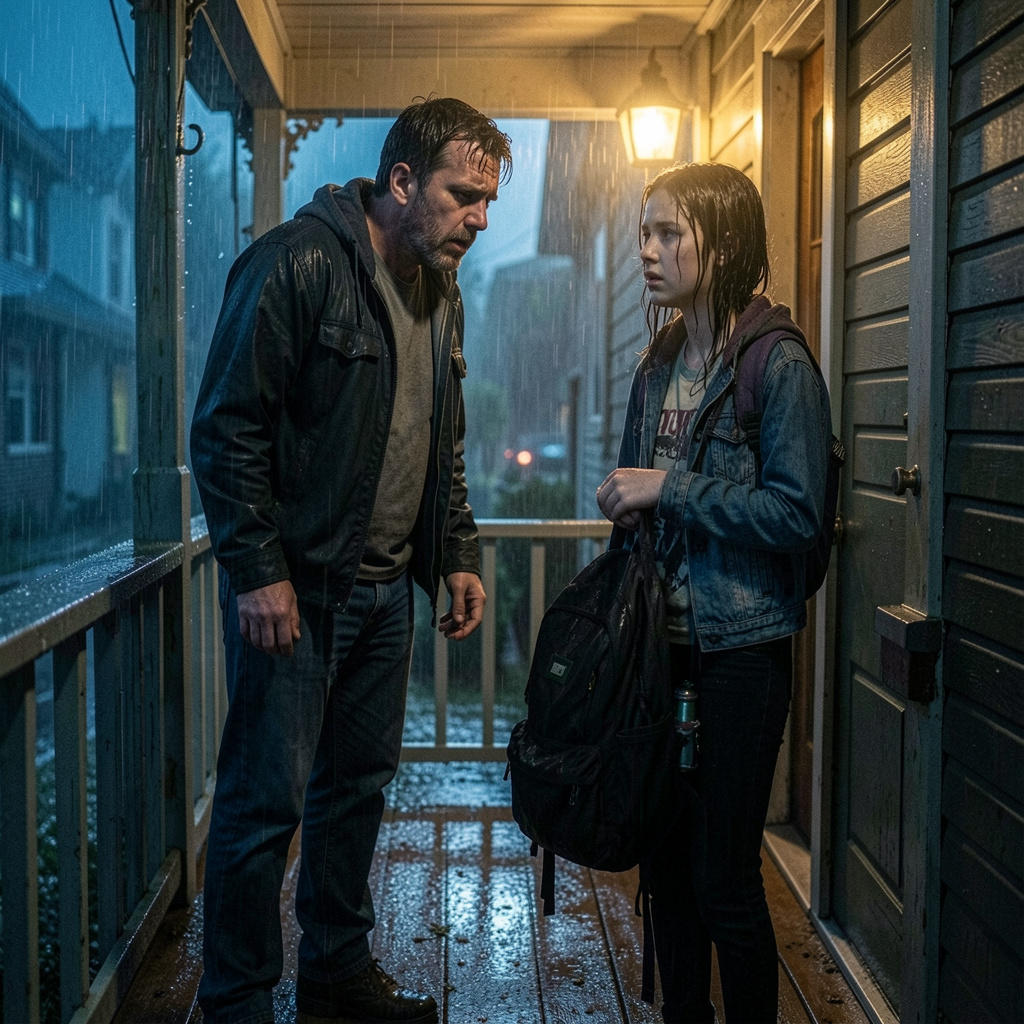
The rain had been falling for three days straight when Marcus Hale finally admitted to himself that he remembered the exact sound the deadbolt made.
Not the heavy, deliberate thud of a man making a righteous decision. Just a small, mechanical sound. The kind a lock makes a thousand times in its life without meaning anything at all. But this one — this particular click, on this particular Tuesday night in October, with his daughter’s fists still wet against the door and the porch light catching the rain in silver threads — this one had rearranged everything.
He was sitting at the kitchen table with a coffee he hadn’t touched when Danny came downstairs. His son moved the way teenage boys do when they’re trying not to be noticed, all slow weight and careful feet. But Marcus noticed. He’d been noticing everything about Danny these past eight months. Overcompensating. Hovering. Leaving the boy’s bedroom door open a crack at night just to hear him breathe.
“You’re up early,” Marcus said.
“Couldn’t sleep.” Danny poured himself a glass of water and stood at the sink with his back turned. Fourteen years old and already carrying something too heavy for his shoulders.
Marcus looked at the empty chair across from him. Elena used to sit there with her tea. Her mug — the blue one with the chipped handle she’d refused to throw away for eleven years — was still in the cabinet. He hadn’t been able to move it. He hadn’t been able to move much of anything.
He’d told the story so many times in his head that it had become mythology.
Kayla, seventeen, stumbling through the front door at 2 AM on a Tuesday. The smell of vodka arriving before she did. The backpack dropped in the hallway, tipping over, a plastic bottle rolling out like a confession. Elena standing at the top of the stairs in her robe. Danny a smaller shadow behind her, watching with those careful eyes.
Marcus had grown up with a father who believed that softness was a form of negligence. Gerald Hale had raised his children the way you’d train a muscle — through resistance, through pain, through the absolute refusal to absorb consequences on their behalf. You make a mess, you clean it up. You break a rule, you live in the wreckage. It had made Marcus organized and disciplined and chronically unable to say I love you without following it with a but.
“This is not what we do in this house,” he’d said that night. Standing in the hallway in his undershirt and pajama bottoms, trying to sound like his father. Trying to sound like a principle rather than a man who was terrified.
“Dad—” Kayla had started.
“No.” He’d cut her off. The way Gerald used to cut him off. Clean. Surgical. “You want to make adult choices, you live with adult consequences. Not under my roof.”
Elena had said his name from the stairs. He’d heard the warning in it. He hadn’t listened.
“You can come back when you’re sober and ready to apologize.”
“Marcus—”
“Marcus.” Just his name. But the way Elena said it contained an entire argument he refused to have.
He’d opened the front door. The rain had been waiting on the other side of it, patient and cold. Kayla had looked at him with her mother’s eyes — that particular shade of brown that turned almost amber in certain light — and she had tried one more time.
“Dad, I need to tell you something. I wasn’t—”
“Not tonight.”
He had genuinely believed she would sleep in the car. Or call a friend. Or spend one uncomfortable night at his mother Ruth’s house three blocks away and come back in the morning, chastened and soft, ready to receive the lesson he was so certain she needed.
He had not considered that she wouldn’t come back at all.
The Facebook post had been shared 847 times by the time Danny showed him.
It came from a place called New Directions Shelter in Phoenix — a long way from Cleveland, a long way from the porch where Marcus had changed the locks. There was a photograph: his daughter at a table, thinner in the face, older in the eyes, wearing a Waffle House apron and looking at something outside the frame of the picture. She looked like herself and completely unlike herself at the same time. The way a place looks after a fire.
The shelter’s social media coordinator had posted it as part of a series about residents rebuilding their lives. Kayla had shared her story. And her story had a sentence in the middle of it that Marcus read seventeen times in the first hour, each time hoping it would mean something different.
My dad threw me out over one mistake. I wasn’t drunk to rebel. I was trying to tell him that night that I was being hurt by someone, and I didn’t know how else to get through the door.
He sat with those words for a long time.
The someone was a boy named Trevor who had been Kayla’s boyfriend for four months — a nineteen-year-old Marcus had met twice and found vaguely unimpressive. What Marcus had not known, because Kayla had been trying to find the courage to tell him for six weeks, was that Trevor had been hurting her. Frightening her. Showing up at her school and saying things that made her hands shake. She had gone to a friend’s house that Tuesday, tried to talk herself into calling the police, failed, and ended up drinking to stop the shaking long enough to come home and tell her father.
She had chosen him. In the specific way that children choose parents — not logically, not after calculating the odds of a good reception, but because he was her father and he was supposed to be the place where things were safe.
He had locked the door.
Marcus had tried calling the shelter four times before someone finally answered.
The woman who picked up had a voice that carried professional warmth and also something else — a practiced patience with people who had caused damage and were only now arriving at the crime scene. She confirmed that Kayla was a resident. She confirmed that Kayla was currently at work. She said, in the careful way of someone who has seen this particular scene before, that she would pass along his contact information but that it would be Kayla’s choice whether to respond.
“Of course,” Marcus said. “Of course it’s her choice.”
He hung up and sat in his car in the parking lot of the grocery store for forty-five minutes. He’d gone to buy bread. He drove home without it.
His mother Ruth called that evening. She’d seen the post — someone in their church had shared it, and now Ruth had called three times in three days and Marcus had not answered any of them. He picked up this time only because his phone had been ringing so long that Danny had appeared in the doorway with a face full of something too close to accusation.
“She’s alive,” Ruth said, when he answered. Just that. As if she’d been afraid to assume it.
“She’s alive,” Marcus confirmed.
Ruth was quiet for a moment. She had called him heartless back in November, and he had said terrible things in return, and they had spent eight months in the cold together without admitting that they were both just scared for the same girl.
“Are you going to go?” she asked.
He hadn’t let himself think about it in those terms yet. Going. The word implied that he deserved to arrive somewhere. That he had a right to stand in front of his daughter after eight months of silence and ask her to receive him.
“I don’t know if she wants that,” he said.
“You won’t know until you ask.”
“She might say no.”
“Marcus.” His mother’s voice, seventy-two years old and still capable of that particular weight. “She might say no. And you would deserve it. And you would go anyway, because she is your child and the thing you do for your children when you have failed them — you show up. You show up and you tell the truth and you do not make them carry the weight of your guilt on top of everything else.”
He thought about Gerald. About all the ways a man could mistake hardness for strength, distance for dignity, silence for wisdom. About the specific damage of a father who never once said I was wrong because he had confused the admission with the collapse.
You show up.
He told Danny he was going on a Thursday morning, standing in the kitchen in the gray November light.
His son had grown three quarters of an inch in the past eight months. Marcus had measured it against the doorframe in the hallway the way Elena used to, and he had stood there for a long time with the pencil mark in his hand, grief-struck by the ordinary accumulation of a child growing up in a damaged house and still growing.
“Can I come?” Danny asked.
Marcus hadn’t expected the question. He turned it over for a moment. His first instinct was to say no — to protect Danny from the possibility that Kayla might not want to see them, or might want to see Danny and not Marcus, or might have built a life that had no room for either of them. His first instinct, he was beginning to understand, was frequently wrong.
“If she’ll see me,” Marcus said. “If she’s open to it. Then yes. I think she’d want to see you.”
Danny nodded. Looked out the window. “I never stopped texting her, you know. She didn’t respond but I kept sending them. Just, like. What I was doing. What was on TV. What the dog did.” He paused. “I didn’t want her to think we’d all just… stopped.”
Marcus’s throat closed.
“I know,” he managed. “I know you didn’t.”
He drove to Phoenix alone. Danny would come if Marcus could establish that there was something to come to. It felt like the only right order of operations — the man who had caused the harm should walk into the harm first, alone, without leaning on a fourteen-year-old boy to soften the reception.
The Waffle House was a ten-minute drive from the shelter.
He sat in the parking lot for twenty minutes first, in the 7 AM heat that Phoenix produces even in November, watching the windows. He could see the yellow of her apron through the glass. Could see her moving behind the counter with the practiced efficiency of someone who had learned to carry plates because plates didn’t ask questions.
He went in.
She saw him before he saw her clearly — before his eyes adjusted to the light — and he knew it because she went still. Very still. The way a person goes still when they’re deciding whether to run.
He did not approach her. He took a stool at the counter, four seats down from the only other customer, and he put his hands flat on the Formica and he waited.
After two full minutes, she walked over.
She was thinner than the photograph had suggested. There were shadows under her eyes that had not been there when she was seventeen, and her hair was shorter, and she looked at him with her mother’s amber eyes and said nothing. Just stood there, pad in hand, waiting.
“I’ll have coffee,” he said. “Please.”
She poured it. Set it down. Turned to go.
“Kayla.”
She stopped. Back still to him.
“I read what you wrote.” He kept his voice low. The other customer wasn’t listening, but this wasn’t for anyone else anyway. “I understand now what was happening that night. What you needed. What I—” He stopped. Tried again. “I locked you out when you were coming to me for help. And I have lived with that every day since your brother showed me your words.”
She was still not looking at him.
“I’m not here to make you forgive me. I don’t deserve that, and it’s not mine to ask for. I’m here because my mother told me that when you fail your child you show up anyway, and because she was right, and because you should know —” His voice broke then, the way it had been threatening to for eight months. He let it break. He had spent enough years believing that a man’s composure was his most important offering. “You should know that I know what I did. And I know what it cost you. And I’m sorry, Kayla. I’m so deeply, irreversibly sorry.”
She turned around.
Her face was doing something complicated — a calculation he couldn’t read, years of practiced protection running up against something older and more stubborn. She looked at him the way you look at a thing you’ve spent months learning not to need.
“He used to wait outside the school,” she said finally. Quietly. “Trevor. He said if I told anyone he’d—” She stopped. Swallowed. “I was scared. I had been scared for weeks. And that night I just thought, if I can just get to my dad.”
“I know,” Marcus said.
“You didn’t let me finish a sentence.”
“I know.”
“You changed the locks.”
“Yes.”
She looked at him for a long moment. Outside, a truck pulled through the parking lot. The other customer folded his newspaper. The world conducted its ordinary business while Marcus Hale sat on a Waffle House stool and waited to see whether his daughter would decide that he was worth the effort of hating or the harder work of something else.
She refilled his coffee.
Not forgiveness. Not yet, and maybe not for a long time, and he understood — he was beginning, finally, to understand — that forgiveness was not the point. The point was a girl who had needed her father and found a locked door, and a man who had to decide, over and over, every day from this one forward, to be something different than the thing the click of that deadbolt had made him.
“Danny wants to see you,” he said.
She said nothing. But she didn’t walk away.
He drank his coffee. Outside, it started to rain — a thin Phoenix rain, nothing like the Cleveland rain that had been falling the night she stood on the porch. But rain is rain. It falls without asking whether you’re ready for it.
This time, Marcus Hale did not lock the door.