Chapter 1: The Desecration of Sanctuary
“You’ll be more comfortable in the garden shed. It’s peaceful out there. Fresh
air might help your attitude.”
final, fraying thread of my humanity.
I am an architect of systems, a senior data engineer for a global logistics
firm. My name is Sarah Vance, and for the past eight months, I had been living
out of a suitcase in a sterile corporate apartment in San Francisco. I survived
on four hours of sleep a night, stale airport coffee, and the sheer, blinding
willpower required to execute a massive corporate merger. I didn’t do it for the
glory. I did it for the wire transfer that hit my bank account last Tuesday—a
bonus large enough to fully pay off the custom-built,
eight-hundred-thousand-dollar smart villa nestled in the hills of Austin.
My villa. My sanctuary. I had designed it to be an impenetrable fortress of
glass, steel, and silence. It was a minimalist masterpiece, equipped with a
localized, closed-loop server system I coded myself. It was the only place in
the world where I could lock the doors, breathe, and simply exist.
Or so I thought.
I arrived home on a Friday evening, the marrow in my bones aching from
exhaustion. I dragged my leather suitcase up the poured-concrete driveway,
anticipating the quiet hum of the central air and the scent of the cedar
diffusers I had left running.
Instead, I was hit by a physical wall of noise and the nauseating stench of
stale beer, fried garlic, and wet dog.
I froze in the doorway. The scene before me was a surreal, horrific violation of
my reality. My pristine, sunken living room was completely unrecognizable. Three
large, muddy dogs I had never seen before were wrestling on my imported white
Italian leather sofa. A group of teenagers—cousins I had met perhaps once at a
wedding—were doing screaming cannonballs into my infinity pool, the chlorinated
water splashing onto the hardwood deck I had hand-selected. Empty pizza boxes
and crushed beer cans littered the quartz kitchen island.
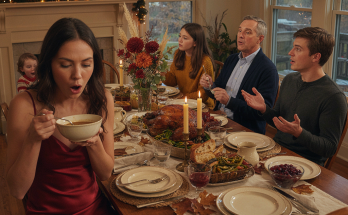
And there, sitting in the center of the chaos, sipping my vintage champagne from
a crystal flute she had dug out of my private reserve, was Eleanor.
My mother-in-law.
Eleanor was a woman who possessed no wealth of her own but carried the
staggering, delusional arrogance of a deposed queen. She believed the world owed
her, and by extension, she believed my bank account belonged to her mediocre
son, Julian.
She spotted me standing in the foyer, my knuckles white around the handle of my
suitcase. She didn’t flinch. She didn’t apologize. She simply smiled—a slow,
reptilian stretching of her lips.
“Don’t look so shocked, sweetheart,” Eleanor purred, her voice dripping with
venomous condescension that managed to slice through the blaring pop music on my
sound system. “Julian earned this lifestyle by putting up with your constant
traveling. A husband needs his family around when his wife abandons him for a
paycheck. So, naturally, this house belongs to his family now. We’re moving in
for the summer.”
I didn’t scream. I didn’t cry. The absolute, staggering audacity of her
statement bypassed my emotional centers entirely and triggered a primal, icy
survival instinct. My mind went dead cold.
I dropped my suitcase. I didn’t say a word to the parasitic matriarch currently
degrading the home I had bled for. I turned and sprinted up the floating glass
staircase toward the master bedroom. It was the one room in the house equipped
with a biometric lock. I just needed to get inside. I needed to lock the door,
call the police, and end this nightmare.
I reached the landing, my heart hammering violently against my ribs. I pressed
my thumb to the scanner.
The light flashed red. Access Denied.
I stared at the panel in disbelief. The system had been manually overridden from
the inside.
I grabbed the heavy oak handles and pulled, but the electronic deadbolts held
firm. And then, beneath the heavy thumping of the bass downstairs, I heard a
sound emanating from beneath the crack in my bedroom door.
It was a sharp, tearing sound. The unmistakable, sickening sound of designer
silk being violently ripped apart.
Chapter 2: Banished to the Wood
I pounded my fists against the oak doors until my knuckles bruised.
“Julian! Open this door right now!” I screamed, my voice cracking, the icy calm
finally fracturing under the weight of sheer panic.
A long, agonizing minute passed. The lock clicked, a heavy, mechanical thud. The
door swung inward.
Julian stood in the doorway. He was wearing one of my expensive silk robes,
clumsily tied over his jeans. His eyes were bloodshot, and he reeked of cheap
gin and unearned arrogance. He didn’t look like the man I had married three
years ago. He looked like a puppet, his strings firmly held by the woman sipping
champagne downstairs.
He didn’t step aside. He blocked the entrance, crossing his arms.
“Keep your voice down, Sarah,” he slurred, a pathetic attempt at asserting
dominance. “You’re upsetting the guests.”
I looked past him into the bedroom, and all the air left my lungs.
The room was a war zone. My bespoke, custom-tailored dresses—garments I had
saved for years to purchase—were piled in the center of the room, shoved into
black trash bags. A few had been ripped down the seams, clearly tried on by
someone far too large to fit them. Two unruly children, Eleanor’s youngest
nephews, were jumping on my ten-thousand-dollar orthopedic mattress with their
muddy sneakers on.
My private sanctuary. My safe haven. Desecrated.
“What is this?” I whispered, my voice trembling so violently I could barely form
the words. “Julian, what have you done?”
Instead of apologizing, instead of showing a single ounce of remorse for the
absolute destruction of my property, Julian puffed out his chest, emboldened by
the chaotic presence of his family downstairs.
“We need the space, Sarah,” he said, waving a hand dismissively. “You’re always
away anyway. You don’t even appreciate this house. My mother needs the master
suite for her back, and the kids need the guest rooms. I cleared your closet out
to make room for her things.”
I stared at him. The man I had shared a bed with. The man whose startup I had
entirely funded. The man who had contributed nothing but complaints to our
marriage. He wasn’t just spineless; he was a traitor.
“Get them out,” I said, my voice dropping an octave, returning to that
terrifying, absolute cold. “Get them out of my house, or I am calling the
police.”
Julian laughed. A short, ugly sound. He took a step forward, towering over me,
trying to use his physical size to intimidate me.
“You’re not calling anyone, and you’re not ruining my family reunion,” he
sneered, pointing a shaking, gin-soaked finger toward the window that overlooked
the backyard. “You’ve been a miserable, absent wife for a year. You don’t get to
come back and bark orders. You’ll be more comfortable in the garden shed. It’s
peaceful out there. Fresh air might help your attitude.”
He expected me to break. I saw it in his eyes. He expected me to collapse into
hysterics, to beg, to cry, to submit to the overwhelming presence of his
invasive family.
He had forgotten who he married. He had forgotten that I built systems designed
to withstand catastrophic failure.
A terrifying, dead-eyed smile slowly spread across my face. I felt the last
lingering ghost of my love for him evaporate into the humid Texas air, leaving
nothing behind but a sharp, hyper-rational tactician.
“The shed,” I repeated softly, my voice dangerously calm. “Okay, Julian.”
I didn’t fight him. I didn’t look at the ruined dresses. I turned on my heel and
walked calmly down the stairs, past Eleanor’s smug face, past the wet dogs, and
out the back door into the dark, sweltering garden. I didn’t take my suitcase.
I took only one thing. My encrypted work laptop, which I had slung over my
shoulder in its messenger bag.
I walked across the manicured lawn to the custom-built, insulated cedar shed
where we kept the pool equipment and the central network servers for the
property. I stepped inside, the smell of chlorine and ozone sharp in the air,
and locked the heavy wooden door behind me.
I sat down on a wooden crate in the pitch-black darkness. From the balcony of
the master suite above, I could hear Eleanor’s shrill voice toasting to her
victory, the clinking of glasses echoing in the night.
They thought they had won. They thought they had banished the queen and claimed
the castle.
I opened my laptop. The blue light from the screen illuminated my unblinking
eyes. I bypassed the standard Wi-Fi and hard-wired directly into the central
server console via an ethernet cable hidden behind a panel.
I slowly typed the master override code—a string of eighty-two alphanumeric
characters I knew by heart—into the terminal.
I hovered my finger over the “Enter” key. I listened to Julian laugh from my
balcony.
I pressed the key.
And with a predator’s deep, profound satisfaction, I watched through the crack
in the shed as every single light in the sprawling,
eight-hundred-thousand-dollar villa violently snapped off, plunging the
parasitic celebration into absolute, suffocating darkness.
Chapter 3: The Ghost in the Machine
The silence that followed the blackout lasted precisely three seconds before the
screaming began.
On my laptop screen, twelve separate, high-definition infrared camera feeds
flickered to life. I had eyes in every room, every hallway, every corner of the
property. I was no longer a wife locked in a shed; I was the ghost in the
machine, an omnipotent god presiding over a very specialized hell.
In the living room, Eleanor was illuminated in eerie green night-vision. She was
stumbling blindly, spilling champagne down her silk blouse, screaming at the
teenagers to go check the breaker box.
“It’s just a blown fuse!” Julian’s voice echoed from the master bedroom camera.
I watched him fumble in the dark, stubbing his toe hard against the heavy oak
bedframe, cursing loudly.
He walked to the bedroom door and pulled the handle. It didn’t move.
The heavy electronic deadbolts, wired into a separate emergency battery backup,
had engaged the moment I hit the override.
“Mom? The door is jammed!” Julian yelled, pounding on the wood from the inside.
Downstairs, one of the cousins reached the heavy glass front door. He grabbed
the handle and yanked. Nothing. The biometric scanner next to the door glowed an
angry, solid red.
They were sealed in.
My fingers flew across the keyboard. This wasn’t just a power outage; this was a
meticulously orchestrated siege.
First, I executed the communications blackout. With two lines of code, I
disabled the house Wi-Fi routers and activated the localized signal jammers I
had installed for corporate security protocols. Every cell phone in that house
instantly read No Service. They were entirely cut off from the outside world.
Next, I manipulated the environment. I accessed the smart glass API. The
floor-to-ceiling windows surrounding the living room—the ones they had been
using to admire their stolen view—instantly frosted over, shifting from
transparent to an opaque, milky white, trapping them in a featureless box.
“Julian! Call the electric company!” Eleanor shrieked, her earlier arrogance
entirely replaced by the shrill, rising edge of panic. She was hyperventilating,
clawing at the frosted glass.
I wasn’t done. While I watched them devolve from entitled squatters into trapped
animals, I opened a separate encrypted browser.
I logged into our joint bank accounts—the accounts I exclusively funded. Over
the past three years, I had deposited hundreds of thousands of dollars, allowing
Julian to live comfortably while he “found his passion.”
It took me four minutes to legally transfer every single cent into an offshore,
solo LLC account my lawyers had set up years ago for tax purposes. I left
exactly twelve dollars and fifty cents in the joint checking.
Then, I accessed the DVR backups from the security cameras spanning the last
four hours. I clipped the footage of the teenagers vandalizing the pool, the
dogs tearing up the leather sofa, and Julian’s family ripping my designer
clothes. I bundled the video files and emailed them directly to my divorce
attorney, along with a pre-drafted authorization to file for an immediate
emergency restraining order and asset freeze.
I glanced back at the camera feeds. The temperature in the Austin night was
already sweltering, but inside the sealed house, with no AC, it was climbing
rapidly.
I decided to help it along. I accessed the radiant floor heating matrix in the
living room and cranked it to its maximum setting of 90 degrees Fahrenheit.
Eleanor collapsed onto the ruined sofa, fanning herself frantically with a soggy
pizza box, her face slick with sweat. The dogs were whining, pacing restlessly.
The teenagers were crying, huddled in the corner.
They were rats in a maze, and I controlled the maze.
Just as Eleanor, pushed to the brink of heat exhaustion, picked up a heavy
bronze vase, preparing to hurl it desperately at the impenetrable smart-glass
window, I initiated the final phase of the psychological attack.
I unmuted the integrated surround-sound system in the master bedroom. I didn’t
play music. I generated a low-frequency, oscillating hum—the kind of sound that
doesn’t just hurt your ears, but vibrates in your teeth and induces immediate,
severe nausea.
On the feed, Julian clamped his hands over his ears, dropping to his knees on
the ruined mattress, his mouth open in a silent scream.
I let him suffer for exactly sixty seconds. Then, I cut the sound.
In the sudden, ringing silence of the master bedroom, the old-school, hardwired
landline on the nightstand—the only communication device I had intentionally
left active—began to ring.
Shrill. Ominous. Demanding.
Julian stared at it in the dark, his chest heaving. With trembling, sweaty
hands, he reached out and picked up the receiver.
“Hello?” he gasped.
I leaned closer to the microphone on my laptop, ensuring my voice carried the
exact, freezing weight of the grave.
“How is the fresh air in there, Julian?”
Chapter 4: The Architecture of Consequence
“Sarah… what did you just do?”
Julian’s voice was unrecognizable. It wasn’t the arrogant sneer of the man who
had banished me an hour ago. It was the high-pitched, fragile squeak of a
cornered prey animal.
“Turn the power back on!” he begged into the receiver, coughing in the
sweltering, stagnant darkness of the bedroom. “My mother can’t breathe! The kids
are terrified! What is wrong with you?”
I leaned back against the wooden wall of the shed, watching his pathetic,
hunched silhouette on my camera feed. The disconnect between his demands and his
reality was staggering.
“I’m just following your advice, Julian,” I replied, my voice devoid of any
human warmth, clinical and precise. “I’m enjoying the peace and quiet. I find
the solitude helps my attitude immensely.”
“Stop playing games!” he screamed, pounding his fist against the nightstand.
“This is illegal! You can’t lock us in here! I’ll call the cops!”
“With what?” I asked smoothly. “Your cell service is jammed. The Wi-Fi is dead.
You are speaking to me on a closed-circuit loop. You don’t exist to the outside
world right now.”
I paused, letting the claustrophobic horror of his situation fully saturate his
gin-addled brain.
“By the way,” I continued, “I momentarily unblocked the cellular data for your
phone. You should have an email alert. Check it.”
On the camera, I watched Julian fumble in his pocket, pulling out his glowing
smartphone. He stared at the screen. Even in the infrared feed, I could see the
exact moment his soul left his body.
“Where is it?” he whispered, his voice trembling so violently the phone shook in
his hand. “Sarah… where is the money? The joint account… it says twelve
dollars. Where is the rest of it?”
“It’s exactly where it belongs, Julian. With the person who earned it,” I
stated, my tone sharp as a scalpel. “I’ve initiated an emergency asset freeze.
You are utterly, entirely broke. You cannot buy a cup of coffee tomorrow
morning.”
“You… you can’t do this!” he gasped, dropping to his knees on the floor. “Half
of that is mine! We’re married!”
“Not anymore,” I said. “Furthermore, the high-definition security footage of
your family vandalizing my property, destroying my custom wardrobe, and
squatting in my home has already been forwarded to my legal team and the local
precinct. Grand larceny, destruction of property, and trespassing.”
Downstairs, I could hear Eleanor shrieking, her voice carrying through the
vents. She had realized the doors weren’t just stuck; they were electronically
locked.
“Sarah, please,” Julian sobbed into the phone. The tears were real now. “Please.
They’re my family. My mother is old. You can’t do this to her. I’m sorry. I was
drunk. I didn’t mean what I said. Just open the doors and we can talk about
this.”
He was begging for mercy from the woman he had thrown into the dirt.
I smiled into the dark of the shed.
“You told me this was your house, Julian,” I whispered. “You told me it belonged
to your family. But you don’t understand the architecture of power. You never
did. This is my house. My servers. My locks. My money. You were only ever a
guest, and your invitation has been permanently revoked.”
“Sarah, please!” he wailed.
“I’m going to hang up now, Julian. Enjoy the dark.”
I placed the receiver down on the crate. I didn’t end the call; I just let him
scream into the void.
I looked at the clock on my laptop. The police response time for a high-priority
vandalism call in this zip code was usually twelve minutes. It had been eleven.
Right on cue, the terrifying silence of the dark estate was violently broken.
Through the crack in the shed, I saw the flashing red and blue strobes of four
police cruisers pulling up to the heavy iron gates of my driveway. The sirens
wailed, a beautiful, chaotic symphony of impending justice.
Julian heard them too. He scrambled to the frosted window, pounding on the
glass, screaming for help that couldn’t hear him.
I typed one final, elegant command into my terminal.
The front doors of the villa unsealed with a loud mechanical clack.
I sat back in the dark, watching the camera feeds with cold, absolute
satisfaction as the tactical units breached the entrance, their flashlights
cutting through the darkness, completely unaware of the devastating legal and
psychological trap I had meticulously set for my husband’s family to stumble
into.
Chapter 5: The Purge
The flashing red and blue lights illuminated the pristine concrete of the
driveway, casting long, erratic shadows across the manicured lawn.
I remained in the shed, watching the spectacle unfold on my screens. The
tactical unit swept the house in under two minutes. They found the teenagers
cowering in the 90-degree heat of the living room. They found the dogs pacing
nervously.
And they found Eleanor.
The police did not treat her like the queen she believed herself to be. When she
tried to physically shove past an officer, shrieking about her rights and
demanding to know who called them, they reacted accordingly.
I watched the live feed as two officers firmly grabbed her arms, spinning her
around and securing her wrists in steel handcuffs.
“Get your hands off me! Do you know who my son is? This is his house!” she
roared, her face twisted in a mask of absolute, humiliated rage.
“Ma’am, we have video evidence of you and your family breaking and entering, and
causing upwards of fifty thousand dollars in property damage,” the arresting
officer stated flatly. “You have the right to remain silent. I highly suggest
you use it.”
They dragged her out the front door. She stumbled over the threshold, her fake
designer purse spilling onto the driveway, her arrogant facade entirely
shattered, exposed to the cold night air and the judging eyes of my wealthy
neighbors who had come out to watch the commotion.
Upstairs, they breached the master bedroom. Julian didn’t fight. He was a broken
shell of a man. The officers led him out in handcuffs, his silk robe dragging on
the floor, his head hung so low his chin touched his chest.
He stood on the curb, barefoot, shivering in the breeze, watching in absolute,
hollow horror as the police began taping off the entrance to my property as a
crime scene.
It was time.
I closed my laptop. I pushed open the door of the cedar shed and stepped out
into the cool night.
I didn’t yell. I didn’t gloat. I didn’t run over to berate him. That would have
given him the illusion that he still affected me emotionally.
I simply walked across the lawn. As I approached the driveway, Julian looked up.
His eyes met mine. They were filled with a pathetic, desperate pleading.
“Sarah…” he choked out, leaning forward against the grip of the officer
holding him. “Sarah, please… tell them. Tell them it’s a misunderstanding.”
I didn’t break my stride. I looked right through him, as if he were made of
glass. I walked up to the commanding officer, produced my ID, and calmly
provided my statement, confirming I was the sole owner of the property and I
intended to press maximum charges.
I walked past Julian one last time, unlocked the front door with a single scan
of my retina, and stepped back into my home.
By sunrise, the police were gone.
I didn’t sleep. Instead, I made a phone call. By 7:00 AM, a team of professional
hazmat and biohazard cleaners arrived at my gate. I paid them triple their
premium rate to erase every microscopic trace of Julian and his family’s
existence.
They scrubbed the pool with industrial chemicals. They hauled the contaminated,
grease-stained leather furniture out to a dumpster. They sterilized the kitchen
counters and ripped up the ruined silk from the master bedroom.
I sat on my pristine quartz kitchen island, the morning sun streaming through
the now-transparent smart glass, sipping a freshly pulled espresso. I felt a
profound, incredible lightness in my chest. It wasn’t just the relief of
surviving; it was the unburdened euphoria of a life suddenly, violently cleansed
of parasitic dead weight.
I had defended my sanctuary.
However, as the cleaning crew brought down the final black trash bag of ruined
clothes from the master suite, the lead foreman approached me. He held a small,
clear plastic evidence bag.
“Ms. Vance,” he said, holding it out. “We found this taped securely underneath
the bottom drawer of the nightstand on the right side of the bed. Thought you
should have it.”
I took the bag. Inside was a small, black, encrypted USB flash drive. Julian’s
side of the bed.
I walked back out to the shed, plugged the drive into my secure terminal, and
ran a decryption brute-force algorithm. It took twenty minutes to crack his
pathetic password.
When the files opened, the breath caught in my throat.
It wasn’t just evidence of cheating. It was worse. It was a folder containing
hundreds of pages of forged documents, deep-faked signatures, and draft
contracts. Julian had been working with a predatory lender to take out a
massive, illegal second mortgage on my villa, planning to use the cash to pay
off a staggering mountain of offshore gambling debts he had accumulated, and
then skip the country, leaving me with the foreclosure.
He hadn’t just invited his family over to disrespect me. He was keeping me
distracted while he finalized the paperwork to steal my entire life.
I stared at the screen, the final embers of my shock solidifying into pure,
weaponized titanium.
He thought he was playing a game of checkers. I was about to wipe the entire
board off the table.
Chapter 6: Absolute Zero
Time is the ultimate architect. It builds, it destroys, and it reveals the true
foundation of everything.
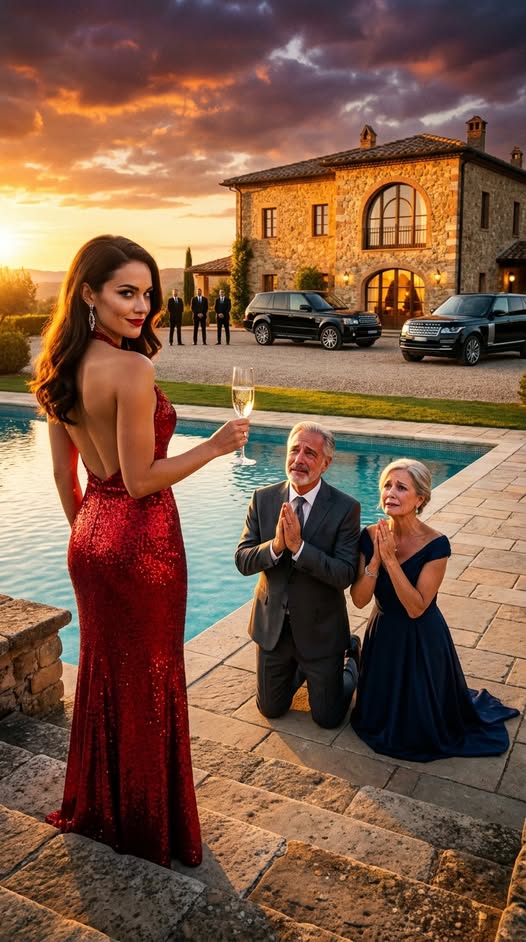
One year later, I sat on the expansive balcony of my master suite. The
California sunset was bleeding brilliant shades of violet and gold across the
sky, reflecting perfectly on the still, glass-like surface of the newly
renovated infinity pool.
The villa hummed quietly around me, a perfectly tuned machine of luxury,
efficiency, and impenetrable security.
I held a crystal glass of Cabernet, my tablet resting on my lap.
I was reviewing the final, court-stamped divorce decree, delivered to my inbox
by my attorney just moments ago.
Julian’s grand plan had imploded with spectacular, catastrophic force. When I
handed the contents of the flash drive over to the FBI, his simple vandalism
charge morphed into federal wire fraud and attempted grand larceny.
To avoid a ten-year prison sentence, Julian took a brutal plea deal.
He was currently legally barred from leaving the state. He was working a
minimum-wage job at a tire recycling plant—the only place that would hire a
convicted felon. One hundred percent of his wages above the poverty line were
automatically garnished to pay restitution for the damages his mother caused to
my home, and the massive legal fees he incurred.
He was living in a cramped, two-hundred-square-foot studio apartment on the
wrong side of the city. With Eleanor. Because she, too, had been financially
ruined by the civil lawsuits I relentlessly pursued against her for the
destruction of my property. Their apartment, I was told by my private
investigator, had no air conditioning.
He was a ghost. Entirely, legally, and financially erased from my timeline.
I took a sip of the rich red wine, the warm evening breeze brushing my face,
carrying the scent of blooming jasmine.
“They thought they could put me in a box,” I mused silently, looking out over
the impenetrable, glowing fortress I had built with my own two hands and my own
brilliant mind. “They looked at a woman who funded their lives and saw a
doormat. They didn’t realize that when you lock a woman in the dark with her own
demons, a bruised ego, and a Wi-Fi connection, she doesn’t learn her place.”
I smiled, a genuine, peaceful smile that reached my eyes.
“She learns how to digitally and financially burn your entire world to the
ground, and she doesn’t even have to raise her voice to do it.”
As the sun finally dipped below the horizon, plunging the hills into twilight, I
simply tapped the face of my smartwatch.
The heavy glass doors locked silently behind me. The perimeter laser grid armed
itself with a soft, electronic chime. The climate control adjusted to my exact
body temperature.
The house faded into a beautiful, quiet fortress, standing vigilant and ready to
protect its rightful queen for the rest of her days.
If you want more stories like this, or if you’d like to share your thoughts
about what you would have done in my situation, I’d love to hear from you. Your
perspective helps these stories reach more people, so don’t be shy about
commenting or sharing.