The Last Time He Raised His Hand; The slap echoed through the living room. For a moment, neither of us moved.
My hand instinctively drifted to my cheek where the sting burned hot against my skin. Across from me, seventeen-year-old Ethan sat in his gaming chair, headset hanging around his neck. The bright colors from his monitor flickered across his face.
All I had done was ask him to lower the volume. “Ethan, dinner is ready,” I had said for the third time. He spun around, eyes blazing with irritation. “I said I heard you!” Then his hand flew. The slap wasn’t hard enough to knock me down, but it wasn’t accidental either. It was deliberate. Calculated.
The kind of slap someone gives when they believe there will be no consequences.
For several seconds, we stared at each other.
Then something unexpected happened.
I didn’t yell.
I didn’t cry.
I didn’t lecture him.
I simply lowered my head and walked away.
“That’s what I thought,” he called after me. “Maybe now you’ll stop nagging me every five minutes.”
I entered the kitchen and quietly closed the door.
My hands trembled.
Not from fear.
Not anymore.
Because that slap hadn’t been the beginning of something.
It had been the end.
The final piece of evidence I needed.
For three years, Ethan had been changing.
It started after his father died.
At first, I excused everything.
The anger.
The disrespect.
The broken dishes.
The screaming.
The threats.
People told me he was grieving.
They said boys process loss differently.
They said he would grow out of it.
Instead, he grew worse.
He towered over me now at six-foot-two.
Every month he became more aggressive, more entitled, more convinced that everyone existed to serve him.
Including me.
Especially me.
I had spent years protecting him from consequences.
Making excuses.
Cleaning up messes.
Pretending everything was fine.
Until two weeks earlier.
That was when my doctor gave me the diagnosis.
Stage three lymphoma.
The word had changed everything.
Suddenly, my future wasn’t guaranteed.
And neither was Ethan’s.
If something happened to me, what would become of him?
A young man who believed violence solved problems?
Who thought women existed to obey him?
Who viewed kindness as weakness?
The diagnosis forced me to face a painful truth.
Love wasn’t enough.
Not anymore.
So after today’s slap, I made a decision.
I picked up my phone.
And I made two calls.
The first was to my doctor.
The second was to the police department’s community intervention unit.
Then I started baking.
Three hours later, the house smelled like chocolate.
The rich aroma filled every room.
I carefully frosted Ethan’s favorite triple-chocolate cake.
The same cake I had baked every birthday since he turned five.
The same cake he’d once helped me decorate while standing on a stool beside me.
Back when he was still my sweet little boy.
Back before anger consumed him.
Next, I brewed a fresh pot of artisan coffee.
Dark roast.
Exactly the way our visitors requested.
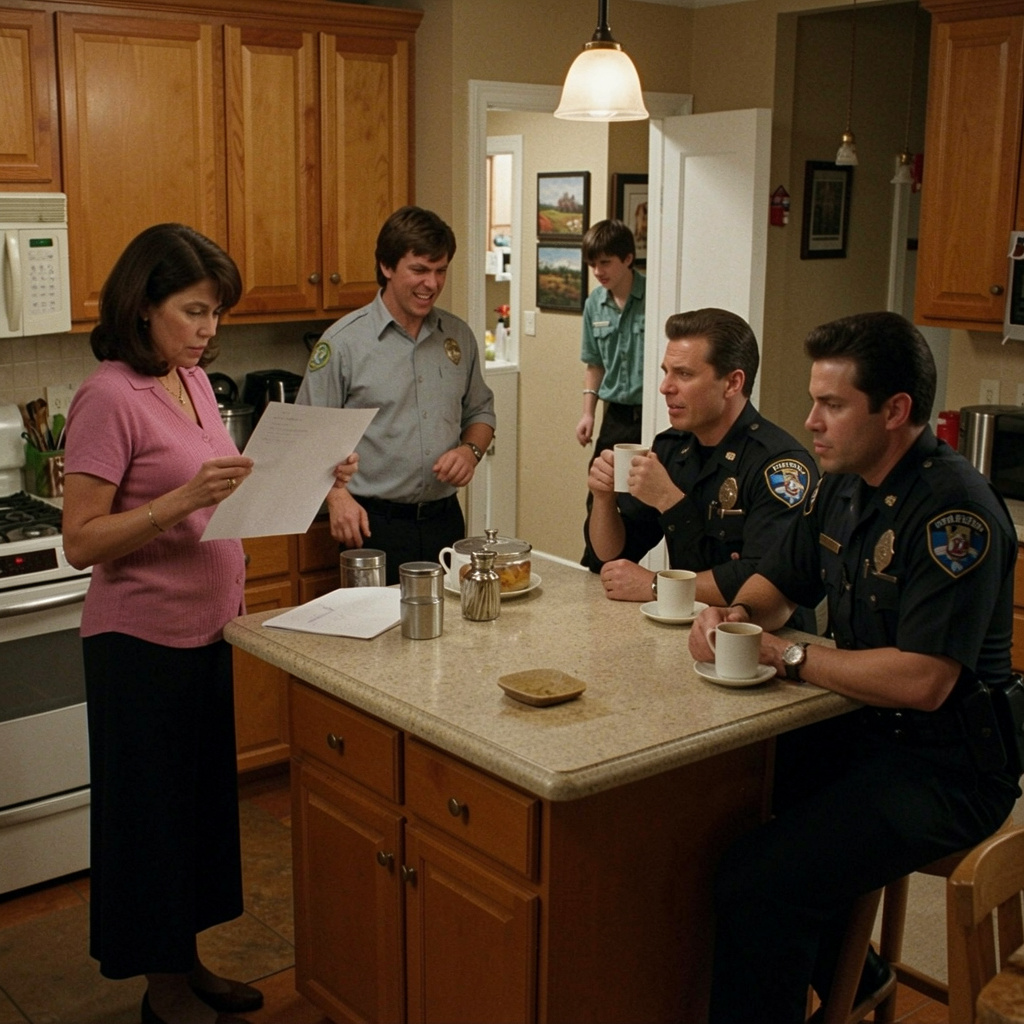
By the time everything was ready, Officers Reynolds and Martinez were seated at the kitchen island.
Neither wore threatening expressions.
Neither looked eager to arrest anyone.
They were simply waiting.
Alongside them sat a folder containing my medical records.
And another folder.
One much thicker.
Filled with photographs, incident reports, therapist notes, school complaints, and documentation I’d quietly collected for years.
Evidence.
Not against my son.
For my son.
Evidence proving he needed help before it was too late.
At seven o’clock, Ethan finally emerged from his room.
He looked refreshed.
Relaxed.
Victorious.
Apparently, he’d spent the last several hours gaming with friends.
He wandered into the kitchen.
Then grinned when he saw the cake.
“About time.”
He stretched dramatically.
“See? A little physical discipline makes you a better mother.”
The officers exchanged glances.
Ethan froze.
Slowly, he noticed the uniforms.
Then the folders.
Then my expression.
For the first time all day, uncertainty crossed his face.
“What is this?”
Officer Reynolds set down his coffee cup.
“Good evening, Ethan.”
The color drained from my son’s face.
“What are cops doing here?”
I folded my hands calmly.
“They’re here because we’re having a conversation.”
His eyes narrowed.
“You called the police over a slap?”
“No,” I said softly.
“I called them because of three years.”
Silence filled the room.
Officer Martinez opened the thick folder.
“Ethan, we’ve reviewed concerns documented by your mother, your school counselor, your former therapist, and several teachers.”
His confidence began cracking.
“This is ridiculous.”
“Is it?” Reynolds asked.
He slid a photograph across the counter.
A hole punched through a bedroom door.
Another photograph followed.
A shattered lamp.
Then screenshots of threatening text messages.
School disciplinary reports.
Witness statements.
The mountain of evidence kept growing.
Ethan stared at it all.
His breathing became shallow.
“Mom…”
I didn’t answer.
For years, every apology had been followed by another incident.
Words meant nothing now.
Only actions mattered.
Officer Reynolds spoke carefully.
“Your mother isn’t seeking criminal charges.”
Ethan visibly relaxed.
For about two seconds.
“However,” Reynolds continued, “she is requesting court-supported intervention services.”
“What does that mean?”
“It means mandatory anger management.”
His eyes widened.
“Behavioral counseling.”
His jaw tightened.
“Psychological evaluation.”
The anger returned.
“You can’t force me!”
“Actually,” Martinez replied, “under certain circumstances, the court can.”
Ethan looked at me as if seeing a stranger.
“You did this?”
“No,” I said.
“You did.”
The words hung in the air.
For once, he had no comeback.
I reached into my purse and removed another document.
My medical report.
I placed it in front of him.
“Read it.”
Confusion replaced anger.
He opened the folder.
Thirty seconds later, his face turned white.
“Mom…”
I remained silent.
His hands shook.
“No.”
Tears appeared instantly.
“No, no, no.”
The reality hit him harder than anything else had.
The cancer.
The treatments.
The uncertainty.
The possibility that I might not always be there to absorb the damage he caused.
For the first time in years, his mask shattered completely.
He looked like a frightened little boy.
“When were you going to tell me?”
“I found out two weeks ago.”
He sank into a chair.
His eyes filled with tears.
“Why didn’t you tell me?”
“Because I needed to know something first.”
His voice cracked.
“What?”
I swallowed hard.
“Whether you’d become someone capable of standing on your own.”
The room fell silent.
Officer Reynolds and Martinez respectfully looked away.
This wasn’t police business anymore.
This was family.
“My father died,” Ethan whispered.
“I know.”
“I was angry.”
“I know.”
“I didn’t know what to do.”
The confession sounded small.
Broken.
Human.
I nodded.
“I know.”
Tears streamed down his face.
Then came words I hadn’t heard in years.
“I’m sorry.”
Not defensive.
Not manipulative.
Not followed by excuses.
Just sorry.
Simple and raw.
For several minutes, neither of us spoke.
Finally, I walked around the island.
My cheek still hurt.
The memory of the slap still lingered.
But beneath all that pain was something else.
Hope.
Because for the first time, Ethan wasn’t fighting.
He wasn’t blaming.
He wasn’t running.
He was facing the consequences of his choices.
The officers eventually stood.
Their work was finished.
Before leaving, Officer Reynolds placed a card on the counter.
“People can change, Ethan.”
My son nodded silently.
After they left, the kitchen felt strangely peaceful.
The cake remained untouched.
The coffee had gone cold.
Ethan stared at the medical report.
Then at me.
Then back at the report.
“What happens now?”
I sat beside him.
“Now you get help.”
“And if I don’t?”
I met his eyes.
“Then you’ll lose me long before cancer ever does.”
Fresh tears appeared.
This time, he didn’t hide them.
That night, we talked for hours.
About grief.
About anger.
About fear.
About his father.
About the years we’d both spent pretending everything was okay.
Nothing was magically fixed.
There were no instant transformations.
No perfect ending.
Recovery would take time.
Trust would take longer.
But for the first time in years, we had begun.
Months later, Ethan attended counseling regularly.
He completed anger management classes.
He apologized to teachers, neighbors, and family members.
Most importantly, he learned accountability.
Real accountability.
Not because police officers frightened him.
Not because courts threatened him.
But because he finally understood something crucial.
Strength isn’t measured by how much power you have over someone weaker.
It’s measured by what you do with that power.
As for me, treatment was difficult.
Some days were brutal.
Some days were beautiful.
But I never forgot the moment Ethan walked into that kitchen.
The moment he expected obedience and found consequences instead.
Because that day wasn’t the day I called the police on my son.
It was the day I finally chose to save him.
And, in a way, it saved both of us.