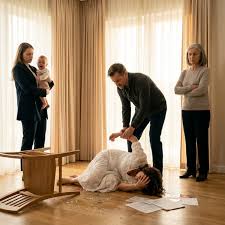
Eight days after giving birth, I was kneeling on the nursery floor, trying to keep blood from soaking through my sweatpants, while my husband zipped up his suitcase and sighed like I was an inconvenience.
“If you’re bleeding that badly, put a towel on it and stop ruining my birthday.”
That was the last thing Tyler said before he walked out the front door.
The nursery lamp cast a soft yellow glow over the room we’d spent months decorating together. Tiny moon-and-star decals covered the walls. A white crib sat near the window, untouched except for the pink blanket our daughter had already kicked off twice that morning.
And there I was—eight days postpartum, dizzy from blood loss, shaking so hard I could barely stand.
Tyler never even looked back.
The suitcase wheels rattled over the hardwood floor. Then came the click of the front door.
Silence.
Except for the baby crying.
I pressed a trembling hand between my legs and stared at the dark stain spreading across the cream-colored nursery carpet.
Something was wrong.
Very wrong.
“Please,” I whispered, though he was already gone.
Outside, I heard his car start.
Then he drove away.
Straight to the airport.
Because his thirty-fifth birthday trip to Cancun apparently mattered more than his wife hemorrhaging after childbirth.
I wish I could say I was shocked.
But the truth is, Tyler had been leaving me long before that day.
Not physically.
Emotionally.
Slowly.
Quietly.
Like a man slipping out of a room while pretending he still lived there.
The signs had started during my pregnancy.
At first, he acted excited. He kissed my stomach. He downloaded baby apps. He painted the nursery.
But after the anatomy scan confirmed we were having a girl, something shifted.
Tyler became distant.
Short-tempered.
Cold.
He worked later. Stayed on his phone longer. Rolled his eyes when I cried over random pregnancy emotions.
“You’re always so dramatic lately,” he’d say.
When my ankles swelled so badly I couldn’t fit into shoes, he complained that I walked too slowly.
When I threw up during our anniversary dinner, he spent the drive home talking about how embarrassed he was.
Still, I kept making excuses for him.
He’s stressed.
He’s scared.
He’ll change once the baby arrives.
That’s what everyone tells women.
Wait.
Be patient.
Understand him.
So I did.
And then I went into labor.
Thirty-six exhausting hours.
The epidural failed halfway through.
My blood pressure dropped dangerously low.
At one point, a nurse rushed doctors into the room while Tyler stood near the window scrolling through sports scores.
When our daughter, Sophie, finally arrived screaming and healthy, I cried so hard I could barely breathe.
Tyler held her for maybe thirty seconds before handing her back.
“She looks like your side of the family,” he said.
No smile.
No warmth.
Just disappointment.
The first week home was worse.
I barely slept. My stitches burned constantly. Breastfeeding felt like someone dragging razor blades across my skin.
Tyler complained about the noise.
About the smell of diapers.
About how the baby interrupted his sleep.
Then came his birthday.
He’d planned the Cancun trip months earlier with three friends.
I assumed he’d cancel once Sophie was born.
He didn’t.
“Babies sleep all day anyway,” he said.
“She’s eight days old,” I whispered.
“And?”
“And I just gave birth.”
“You’re acting like women haven’t done this forever.”
I remember staring at him, hoping—actually hoping—I’d see some flicker of compassion.
Nothing.
The morning he left, I woke up feeling weak.
The bleeding had gotten heavier overnight.
By the time I made it to the nursery to change Sophie, blood soaked through my pad and onto the floor.
I panicked.
“Tyler,” I called.
He appeared in the doorway wearing a linen shirt and sunglasses pushed into his hair.
“What now?”
“I think something’s wrong.”
He glanced at the carpet.
Then at his watch.
And said those words.
“If you’re bleeding that badly, put a towel on it and stop ruining my birthday.”
Then he left.
I don’t remember much after that.
Just flashes.
Calling 911 with shaking fingers.
A dispatcher trying to keep me awake.
A paramedic lifting Sophie from my arms.
Bright hospital lights.
Doctors shouting.
Someone saying the word hemorrhage.
I later learned I’d retained placental tissue after delivery.
I lost nearly half the blood in my body.
One doctor told me another hour at home could’ve killed me.
Killed me.
While my husband drank margaritas on a beach.
Tyler didn’t answer his phone for almost sixteen hours.
When he finally called back, I was in recovery.
“You seriously went to the hospital?” he asked.
I stared at the screen in disbelief.
“Yes, Tyler. I almost died.”
He exhaled heavily.
“Well, now my friends think I’m an asshole.”
Something inside me broke.
Not shattered.
Not exploded.
Just… broke.
Quietly.
Like a rope finally snapping after carrying too much weight for too long.
I looked down at Sophie sleeping beside me in the hospital bassinet.
Tiny fingers curled near her cheek.
Perfect.
Defenseless.
Dependent on me.
And in that moment, I realized something terrifying.
If I stayed with Tyler, one day she would think this was normal.
She would grow up believing love looked like abandonment.
That women were burdens.
That pain should be hidden to avoid inconveniencing men.
I couldn’t let that happen.
So while Tyler spent the next four days posting beach photos online, I made calls.
I spoke to a lawyer.
I opened a separate bank account.
I asked my sister, Nina, to help me move essentials out of the house.
When Tyler returned from Cancun, tan and smiling, he walked into silence.
The house looked mostly the same.
Except for one thing.
The nursery carpet.
The bloodstain remained.
Dark.
Permanent.
I had tried to clean it before the ambulance came.
I never finished.
Tyler dropped his suitcase.
“What happened here?”
I sat on the couch holding Sophie.
“You left your wife bleeding on the floor.”
He rubbed the back of his neck.
“Oh my God, are you still on that?”
Still on that.
I almost laughed.
Instead, I handed him an envelope.
He frowned.
“What is this?”
“Divorce papers.”
His face changed instantly.
At first confusion.
Then anger.
Then panic.
“You can’t be serious.”
“I’ve never been more serious in my life.”
“You’re blowing this way out of proportion.”
“Out of proportion?” I repeated softly.
“You abandoned me during a medical emergency.”
“You were fine!”
“I almost died.”
“But you didn’t.”
That sentence.
That one sentence.
It erased every last doubt.
Tyler didn’t regret what he did.
He regretted the consequences.
The divorce became ugly fast.
Tyler wanted shared custody.
Not because he suddenly cared about Sophie.
Because he cared about appearances.
His family was wealthy. Image mattered.
A divorced man who abandoned his postpartum wife didn’t fit the brand.
So he hired an expensive attorney and painted me as unstable.
Overemotional.
Vindictive.
“She’s suffering from postpartum issues,” his lawyer argued.
“She’s exaggerating normal marital conflict.”
Normal marital conflict.
As if nearly bleeding to death alone was the same thing as arguing over dishes.
The court hearings dragged on for months.
Every appearance exhausted me.
I was surviving on broken sleep and caffeine while caring for an infant.
Tyler, meanwhile, arrived polished and charming.
He shook hands with everyone.
Joked with staff.
Played the role of concerned father perfectly.
Sometimes I wondered if I was losing my mind.
Maybe he really believed his own version of events.
Maybe people like Tyler survive by rewriting reality until they become heroes in their own stories.
Then came the final hearing.
The courtroom was packed.
Tyler’s parents sat behind him in expensive clothes, glaring at me like I’d ruined their son’s future.
My sister squeezed my hand.
The judge reviewed medical records silently for several minutes.
Then she looked up.
“Mrs. Carter,” she said gently, “would you like to describe the events of March seventeenth in your own words?”
I swallowed hard.
My voice shook at first.
But then I saw Sophie sleeping in Nina’s arms near the back of the courtroom.
And suddenly, I wasn’t afraid anymore.
I told the truth.
Every part of it.
The bleeding.
The fear.
The ambulance.
The ignored phone calls.
The hospital records.
And finally, his words.
“If you’re bleeding that badly, put a towel on it and stop ruining my birthday.”
The courtroom went silent.
Tyler shifted in his seat.
His attorney stood quickly.
“Your honor, emotions are clearly heightened—”
But the judge held up a hand.
“No.”
She turned toward Tyler.
“Did you say that to your wife?”
Tyler hesitated.
And in that hesitation, everyone saw the answer.
“I mean… not exactly like that.”
The judge’s eyes hardened.
“Did you leave for vacation while your wife was experiencing severe postpartum bleeding?”
“She said she was okay.”
“I never said that,” I whispered.
He ignored me.
“She gets emotional. I thought she was overreacting.”
The judge leaned back slowly.
Then she picked up one of the medical reports.
“This report states Mrs. Carter required emergency intervention due to postpartum hemorrhaging and significant blood loss.”
No one spoke.
The judge continued.
“One physician notes that delay in treatment could have resulted in death.”
Tyler looked suddenly smaller.
Less polished.
Less charming.
Like sunlight had finally exposed what he truly was.
Then came the moment I will never forget.
The judge removed her glasses and looked directly at him.
“Mr. Carter, parenthood requires empathy, responsibility, and the ability to prioritize another human being’s safety over personal convenience.”
Her voice sharpened.
“Your conduct demonstrates a profound failure in all three areas.”
Behind Tyler, his mother quietly began to cry.
The judge awarded me primary custody.
Supervised visitation for Tyler until completion of parenting and counseling programs.
And when the hearing ended, Tyler finally turned toward me.
For the first time in months, he looked afraid.
“You’re really doing this?” he whispered.
I stared at him.
“No, Tyler,” I said calmly.
“You did this.”
Then I walked away.
The strange thing about surviving betrayal is that healing doesn’t happen all at once.
There’s no dramatic movie moment.
No magical fresh start.
Just tiny decisions.
Tiny breaths.
Tiny acts of survival.
I moved into a small apartment near Nina.
Money was tight.
Some nights Sophie cried for hours.
Some mornings I looked in the mirror and barely recognized myself.
But peace slowly entered my life.
Quietly.
Like sunlight creeping under a door.
No tension.
No walking on eggshells.
No cruel comments disguised as jokes.
Just safety.
One afternoon, nearly a year later, I was folding laundry while Sophie waddled around the living room in mismatched socks.
My phone buzzed.
A message from Tyler.
I miss my family.
I stared at the words for a long time.
Then I looked down at Sophie laughing as she hugged a stuffed elephant.
And I realized something.
This was my family.
Not the illusion I fought to preserve.
Not the marriage I kept trying to save alone.
This.
This peaceful little life.
This tiny girl who no longer had to grow up hearing her mother apologize for existing.
I never replied to Tyler’s message.
Because some losses are not tragedies.
Some losses are rescues.
And the blood he told me to wipe away?
It never fully disappeared from the nursery carpet.
Even after professional cleaning.
Even after new tenants moved into the house.
The stain remained.
A permanent reminder.
Not of the day I almost died.
But of the day I finally saw the truth.
And chose to live.