The neighborhood looked like a Christmas movie set.
Every porch along Willow Creek Lane glowed with white lights wrapped tightly around columns and railings. Giant inflatable snowmen waved from front yards. Wreaths hung on identical front doors, each trimmed with red velvet bows. Even the mailbox kiosk at the entrance sparkled beneath garlands and blinking candy-cane lights.
My son Tyler loved it there.
Five years earlier, he and his wife, Vanessa, had moved into the neighborhood after Tyler’s tech company took off. Overnight, my quiet little boy—the same child who used to wear hand-me-down sneakers and help me clip coupons at the kitchen table—became the kind of man who discussed stock options over imported wine.
I was proud of him.
At least, I used to be.
That Christmas Eve, I drove to their house carrying two carefully wrapped gifts and a tin of homemade cinnamon cookies. My old Toyota rattled as I parked between Tyler’s black Range Rover and the gleaming silver BMW in the driveway.
I remember staring at the car for a moment.
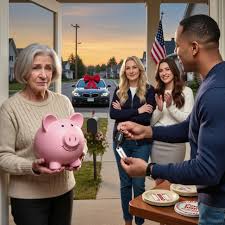
The ribbon on the hood was enormous.
“Beautiful, isn’t it?” Vanessa said when she opened the door. She was wearing a cream-colored sweater dress and diamond earrings that flashed beneath the chandelier light. “Tyler surprised my mother with it this morning.”
I blinked. “The BMW?”
Tyler appeared behind her holding a wineglass. “Sixty grand,” he said proudly. “She’s always wanted one.”
Inside, the house smelled like pine candles and roasted ham. Vanessa’s parents sat beside the fireplace laughing while Christmas music played softly in the background.
I handed over my gifts.
Vanessa smiled politely at the scarf I’d knitted her. Tyler barely looked at the watch box I gave him—the same watch I’d spent three months saving for.
Dinner passed with stories about ski trips, luxury spas, and investment properties. I mostly stayed quiet, sipping tea and listening.
Then came the gifts.
Vanessa’s mother opened the BMW keys and burst into tears. Everyone clapped while Tyler wrapped an arm around her shoulders proudly.
“You deserve it,” he said.
A strange ache spread through my chest, but I smiled anyway.
Then Tyler looked at me.
“Oh right,” he said casually. “Mom, I got you something too.”
He reached behind the tree and handed me a tiny red piggy bank.
Everyone laughed softly, expecting it to be some kind of joke.
I opened it.
Three one-dollar bills folded inside.
At first, I thought there must be more.
“There’s only three dollars,” I said quietly.
Tyler shrugged and took a sip of wine. “Mom, you’re old. What do you need gifts for anymore?”
The room fell silent for half a second.
Vanessa let out a nervous little chuckle. Her father stared into his drink. Her mother suddenly became fascinated with the fireplace.
I looked at my son.
The boy I had raised alone after his father died when he was nine.
The boy whose college tuition I paid by working double shifts at the hospital laundry room.
The boy I once skipped meals for because he needed winter boots.
And now he looked at me like I was a burden someone forgot to remove from the guest list.
But I smiled.
“Oh,” I said softly. “Thank you, sweetheart.”
Then I placed the piggy bank carefully beside my purse and continued eating my pie.
I didn’t argue.
I didn’t cry.
I simply went home.
That night, I sat alone in my small house with only the glow of my tree lighting the living room. The silence hurt more than the insult.
But around midnight, I made a decision.
The next morning, while snow dusted the sidewalks, I drove back to Tyler’s neighborhood.
In my trunk sat a large wrapped box with a gold bow on top.
I placed it carefully on their doorstep, rang the bell, and walked back to my car before anyone opened it.
From across the street, I watched.
Vanessa opened the door first, wearing slippers and holding a mug of coffee.
“Oooh,” she called inside. “Another gift!”
Tyler came behind her smiling lazily.
They brought the box inside.
A few moments later, through the front window, I saw them tear off the wrapping paper.
Then everything changed.
Vanessa’s smile vanished instantly.
Tyler’s face turned pale.
Inside the box was a thick stack of old documents, receipts, and a worn leather folder.
On top sat a single note written in my handwriting.
Merry Christmas.
Since I’m “too old” for gifts, I figured it was time you learned where yours came from.
Tyler opened the folder with shaking hands.
Inside were twenty-seven years of sacrifices.
Medical bills from his childhood asthma treatments.
Past-due notices I hid from him.
Copies of payday loans.
Receipts from pawn shops where I sold my jewelry after his father died.
And at the very bottom…
The deed to my house.
Signed.
Transferred.
To Tyler.
Years earlier.
Because he once told me, “Mom, someday I’ll take care of you the way you took care of me.”
But attached to the deed was another paper.
A legal revocation.
Three months earlier, after Tyler stopped answering my calls regularly and began treating me like an obligation, I quietly changed everything.
The house had been sold.
The money donated.
Half to the children’s hospital that treated Tyler when he was young.
Half to a scholarship fund for single mothers returning to school.
Tyler inherited nothing.
There was one final envelope in the box.
Inside were exactly three dollars.
And a note.
Now we’re even.
From across the street, I watched Vanessa slowly sit down on the couch.
Her expression changed first—from confusion to horror.
Not because of the money.
Because she finally understood something about me… and about the man she married.
Tyler stepped outside a few minutes later, scanning the street until he spotted my car.
For the first time in years, he looked small again.
Not rich.
Not successful.
Just a little boy realizing too late what he had thrown away.
He walked toward my car through the snow.
“Mom,” he said breathlessly when I lowered the window. “Please… I didn’t mean—”
“Yes, you did,” I replied gently.
His eyes filled with tears. “I was joking.”
“No,” I said. “Jokes are funny.”
The cold wind blew between us.
Behind him, Christmas lights blinked silently across perfect houses filled with imperfect people.
“I loved you with everything I had, Tyler,” I continued. “But somewhere along the way, you started measuring people by what they could give you.”
He looked down.
“I would’ve been happy with a handwritten card,” I whispered. “I came last night hoping not for money… but for love.”
His shoulders shook.
For a moment, I almost reached for him.
Almost.
But some lessons arrive too late to soften.
I started the engine.
“Take care of your family,” I said. “And pray they never make you feel the way you made me feel.”
Then I drove away slowly through the snow-covered neighborhood, leaving behind the sparkling lights, the BMW, and the son who finally understood the true cost of three dollars.