The hallway of the Elmwood Condominiums always smelled like a mixture of floor wax and the ghosts of dinners past. I lived in 4B, and Mr. Henderson lived in 4C. At fifty-two, I had become a woman of routines—a byproduct of a life that had once been too chaotic to manage.
After my divorce from David and the “great unveiling” at my daughter’s near-wedding, I had moved to this quieter pocket of Carmel. I wanted a life where I was only responsible for myself. But then I met the silence of 4C.
Mr. Henderson was eighty-eight, a man made of brittle bones and sharp opinions. We had started our relationship with a dispute over a delivery driver who had left his packages at my door.
“I don’t need your charity, Diane,” he’d barked through the screen door three months ago. “I just need people to read the numbers on the door.”
But I saw the way his hands shook when he reached for the boxes. I saw the way his frame seemed to be losing a battle with gravity. So, I started leaving the containers.
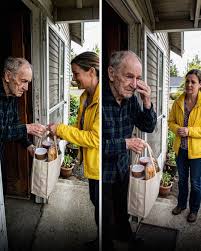
It began with a surplus of beef bourguignon. I’d knocked, left it on the small wicker table in the hall, and retreated. The next morning, the container was back, washed so thoroughly the plastic was cloudy from scrubbing. No note. Just the empty vessel.
For four months, this was our dance. I made lemon herb chicken; he returned the Tupperware. I made lentil soup; he returned the Tupperware. I never saw him eat. I never heard him say thank you. I just saw the empty containers, a silent signal that he was still behind that door, still breathing, still part of the world.
The Morning of the Yellow Envelope
On Tuesday, the container stayed full.
I had left a portion of shepherd’s pie—the kind with the crusty potato topping I knew he liked because he always returned those containers fastest. By Wednesday morning, it hadn’t moved. The gravy had congealed. The air in the hallway felt heavy, like the pressure before a storm.
The paramedics came at noon. I stood in my doorway, gripping my own elbows, as they wheeled him out. He looked like a bird fallen from a nest—small, grey, and finished.
Two days later, there was a knock at my door.
A woman stood there. She had Mr. Henderson’s sharp nose but none of his steel. Her eyes were red-rimmed, and in her hands, she clutched a stack of my mismatched plastic containers and a thick, sun-faded yellow envelope.
“I’m Elena,” she said, her voice cracking. “Mr. Henderson’s daughter.”
“I’m so sorry for your loss,” I said, stepping back to let her in. “He was… he was a very disciplined neighbor.”
She sat at my small kitchen table, the same table where I’d spent months portioning out meals for a man I barely knew. She set the containers down with a hollow clack.
“My father left this for you,” she said, sliding the yellow envelope across the wood. “But there’s something you need to know first.”
I reached for the envelope, but she put her hand over mine. Her skin was cold.
“My father didn’t have a kitchen,” she whispered.
I blinked. “I don’t understand. The units here all have—”
“He sold the appliances two years ago,” she interrupted, her voice breaking. “The stove, the microwave, even the small toaster. He was flat broke, Diane. He spent every cent of his savings and his pension trying to keep up with my medical bills when I was sick. He didn’t want me to know. He told me he was fine, that he was living off a ‘modest inheritance.’ He was too proud to ask for help, and too proud to let me see him starve.”
She took a ragged breath. “He used to call me every evening. For months, our conversations were always the same. I’d ask him what he did that day, and he would tell me, in detail, about the meal ‘his friend Diane’ had made. He described the rosemary on the chicken. He described the way you cut the carrots. He told me that as long as there was a knock on the door at 6:00 PM, he knew he still had a reason to get out of bed and wash his face.”
My heart didn’t just break; it felt like it was being hollowed out. I thought I was just sharing leftovers. I thought I was being “useful,” that old habit of mine. I didn’t realize I was the thread holding a man’s dignity together.
“He told me last week,” Elena continued, “that he wasn’t staying alive for the food. He was staying alive for the knock. He said, ‘Elena, she doesn’t even know my first name, but she treats me like I’m worth a clean plate.’ That was the only thing that kept him from giving up months ago.”
The Contents of the Envelope
With trembling fingers, I opened the yellow envelope.
I expected a thank-you note. Maybe a few dollars for the groceries. Instead, I pulled out a stack of hand-drawn sketches.
Mr. Henderson had been an architect. I remembered him mentioning it once in a grumble about the building’s layout. The sketches weren’t of buildings, though. They were of me.
There was one of me standing at my mailbox, looking pensive. One of me through the cracked door, holding a steaming bowl. One of me laughing on the phone by my window.
At the bottom of the stack was a letter, written in a shaky but elegant script.
Dear Diane,
You thought you were feeding an old man. In truth, you were witnessing a ghost. I spent fifty years designing structures meant to last centuries, yet I ended my life in a room that felt like a cage. Your containers were the only things that crossed the threshold of that cage.
You gave me the greatest gift one human can give another: the feeling of being seen without being judged. You never asked why I didn’t invite you in. You never asked why I didn’t have a ‘Thank You’ card ready. You just kept knocking.
In this envelope, you will find the deed to a small plot of land in Brown County. It’s not much—just a few acres of trees and a creek. I couldn’t build on it, but I want you to have it. Don’t build a house there, Diane. Build a garden. Plant something that grows because you looked at it. You’re very good at that.
Thank you for the shepherd’s pie. It tasted like home.
— Arthur Henderson
The Garden of 4B
Elena left an hour later, leaving me in a silent apartment that suddenly felt much too large. I sat there with the sketches of my own life spread out before me.
For years, with David and Chloe, I had been “visible” only as a provider of services. I was the chef, the bank, the scheduler. I thought that by retreating to this condo, I was finally living for myself.
But Arthur Henderson saw something else. He saw the Diane who stood at the mailbox. He saw the Diane who cared about the rosemary on a chicken leg. He saw the person I was when I thought no one was looking.
A month later, I drove out to Brown County. The land was beautiful—wild, overgrown, and smelling of damp earth and cedar.
I didn’t sell it. And I didn’t build a fence.
I started a small community garden. And every Saturday, I bring a stack of plastic containers, filled with seeds and soil, and I leave them at the edge of the property for anyone who needs to start something new.
I still live in 4B. I still make too much soup. But now, when I knock on a neighbor’s door, I don’t just leave the food and run. I wait. Because I finally understand that the “useful” things we do aren’t the meal—they’re just the excuse to stand in the light of someone else’s existence for a moment.
I am Diane Mercer. I am fifty-two. And I have finally learned that being visible isn’t about being seen by others—it’s about being the one who refuses to let others disappear.
How would you like to continue? We could explore Diane’s first meeting with a new neighbor who needs more than just a meal, or perhaps a scene where Elena and Diane return to the land to plant the first tree in Arthur’s memory.