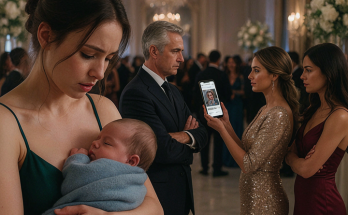
The hospital room was sterile, the air thick with the scent of antiseptic and the heavy, humid silence of a marriage that had been fraying for years. I was forty-one years old, exhausted, and holding a miracle.
Julian didn’t look at the baby. He looked at the clock on the wall, then at me. His eyes weren’t filled with the wonder of a new father; they were filled with a clinical, detached disgust.
“Look at you, Elena,” he said, his voice a low, jagged blade. “You’re gray. You’re spent. You gave birth at forty-one, and for what? To bring a child into the world who’s going to have a mother in her sixties by the time he hits puberty? It’s selfish. It’s a biological gamble.”
“He’s healthy, Julian,” I whispered, pulling the bundle closer. “He’s perfect.”
“Is he?” Julian stood up, adjusting his expensive Italian suit. “At your age, that child isn’t going to turn out well. There are risks, Elena. Chromosomal, cognitive… if he ends up stupid, don’t say I didn’t warn you. I’m not spending the rest of my life caring for a mistake.”
He walked out that day. Three weeks later, he served me divorce papers. Two months after that, I saw the photos on social media: Julian with a twenty-two-year-old yoga instructor named Chloe. He called her “fresh,” “vibrant,” and “genetically sound.” He told the world he was starting over with a “blank slate.”
He left me with a crumbling house, a mountain of medical debt, and a son he refused to acknowledge. He told his lawyers he wanted no custody—he didn’t want to be “tethered to a sinking ship.”
I named my son Leo. And for fifteen years, I worked three jobs to prove Julian wrong
Leo didn’t speak until he was four. Julian’s words haunted me every night during those early years. “If he ends up stupid, don’t say I didn’t warn you.”
I took Leo to every specialist. I spent my nights reading to him, my eyes burning from exhaustion. I worked as a transcriber, a tutor, and a night-shift cleaner. I didn’t care about my “graying” hair or the lines around my eyes. I only cared about the light in Leo’s.
At five, the silence broke. Not with a word, but with a melody.
I had found an old, battered keyboard at a garage sale. Leo sat at it, and within ten minutes, he had replicated the melody of a bird singing outside the window. He didn’t just have an ear for music; he had a mind for mathematical patterns.
By ten, he was a prodigy. By thirteen, he was winning international competitions. He was brilliant, kind, and possessed a quiet intensity that commanded every room he entered.
Meanwhile, Julian’s “perfect empire” was growing. He had built a global tech conglomerate, Vanguard Systems. He and Chloe were the darlings of the business world—the “Ageless Power Couple.” Julian spent millions on anti-aging treatments, desperate to outrun the very thing he had mocked me for. He marketed himself as a visionary who only surrounded himself with the “brightest and the youngest.”
He had completely erased Leo and me from his biography. In his memoir, he claimed he had no children, preferring to focus on “the legacy of innovation.”
The fifteenth anniversary of Vanguard Systems was a global event. It was held at the Grand Opera House, a night of opulence designed to announce Julian’s newest venture: an AI-driven educational platform that claimed to “optimize” child development by identifying “superior” genetic traits.
Julian was on top of the world. His net worth was in the billions. Chloe sat in the front row, draped in diamonds, a trophy of his “successful” escape from his past.
The highlight of the evening was to be a performance by a “mystery guest”—the winner of the Global Virtuoso Award. Julian had sponsored the award, thinking it would be the perfect way to align his brand with “genetically superior” genius.
I sat in the very back row, wearing a dress I’d saved for five years. My heart was beating so hard I could feel it in my fingertips.
“Ladies and gentlemen,” the announcer’s voice boomed. “Please welcome the recipient of the Vanguard Excellence Award, Leo Vance.”
The lights dimmed. Julian stood on the side of the stage, his chest puffed out, ready to shake the hand of the boy he thought would be his brand’s new face.
Leo stepped onto the stage. He was fifteen, tall, and carried the exact same jawline Julian had possessed before the Botox and the fillers. He looked like a younger, sharper, more soulful version of the man standing in the wings.
Leo didn’t go to the piano. He went to the microphone.
Julian smiled, stepping forward to hand him the trophy. He didn’t recognize him. To Julian, Leo was just a talented stranger from a dossier.
“Thank you,” Leo said. His voice was deep and steady.
He looked directly at the front row, then at Julian.
“I was told once that I wouldn’t turn out well,” Leo said, his voice echoing through the silent Opera House. “I was told that because my mother was forty-one when she had me, I was a ‘biological gamble.’ I was told that if I ended up ‘stupid,’ it would be her fault.”
The smile on Julian’s face didn’t just fade—it froze. The color drained from his skin, revealing the hollows the surgeons had tried to hide.
Leo pulled a small, laminated paper from his pocket. He held it up to the camera, and it projected onto the massive screens behind him.
It was Julian’s signed waiver of parental rights from fifteen years ago.
“My name is Leo Vance,” Leo said, his eyes burning with a calm, righteous fire. “And I am the ‘sinking ship’ Julian Thorne tried to abandon. I am the son he called a ‘mistake.’ And tonight, I’m declining this award. Because my genius didn’t come from ‘optimized genetics’ or Vanguard Systems. It came from the woman in the back row who didn’t care if I was ‘perfect’—she only cared that I was hers.”
In just three seconds, the perfect empire collapsed.
The livestream, watched by millions, went wild. The “Ageless Visionary” was revealed in an instant as a man who had abandoned his own flesh and blood over a fear of aging.
Investors began pulling out before Leo even left the stage. Chloe, seeing the PR nightmare, was caught on a hot mic whispering to her agent about “exit strategies.” Julian stood alone in the spotlight, looking every bit of his sixty years—and more.
Leo walked off the stage and straight up the aisle. He didn’t look back at the chaos. He reached the back row, took my hand, and kissed my knuckles.
“Let’s go home, Mom,” he whispered. “I think he’s been warned.”
I looked at my son—the boy who wasn’t supposed to turn out well—and I realized Julian was right about one thing. I had brought a miracle into the world. But the miracle wasn’t the music. It was the boy who knew exactly how to play the truth.