The stage lights were blinding, a sharp, surgical white that made the dust motes in the air look like floating shards of glass. I sat on a stool center-stage, my back straight, my chin tilted just enough to keep the tears from spilling over the rims of my eyelids.
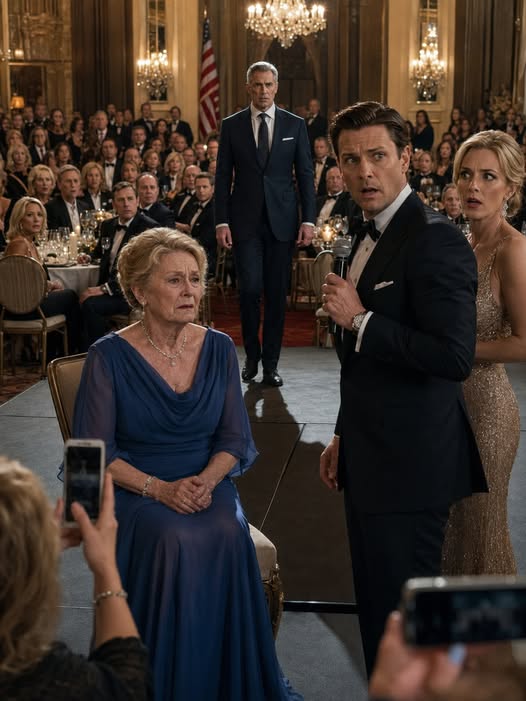
My son, Julian, stood three feet away. He looked magnificent in his bespoke tuxedo, the light catching the gold watch I had bought him for his graduation—a gift that had cost me four months of double shifts at the hospital. He held the microphone with the practiced ease of a man who owned the world, or at least, the three hundred people currently sitting in the ballroom of the Grand Pierre Hotel.
“Alright, ladies and gentlemen,” Julian’s voice boomed, dripping with a casual, cruel charisma. “We’ve auctioned off the Maldives villa, the vintage Ferrari, and the dinner with the Senator. But now, for our final ‘special’ item of the night, something truly… vintage.”
A few ripples of laughter stirred in the front rows. Julian gestured to me with a flick of his wrist, his eyes never meeting mine.
“I’m putting my mother up for auction. The prize? One full week of her ‘unrivaled’ company. She’ll cook you bland meatloaf, tell you stories about her knitting circle, and probably fall asleep by eight p.m. during your favorite movie.”
He paused, a smirk tugging at the corner of his mouth.
“Let’s start the bidding at two dollars. Come on, folks. Who wants my boring mother? Anyone? Or do I have to pay you to take her?”
The laughter wasn’t a wave; it was a slow, suffocating tide. I saw my neighbor, Mrs. Gable, turn her head away in pity. I saw Julian’s fiancée, a girl half my age with diamonds in her ears, whispering behind a silk fan. I felt the shame hit me—a cold, physical weight that settled in my lungs.
I had been the one who stayed up every night when he had the croup. I had been the one who sold my wedding ring to pay for his first business venture. I had been the “boring” woman who sacrificed every dream so he could have a platform to stand on and mock me.
The room stayed silent for three agonizing heartbeats. Julian opened his mouth to deliver the punchline—a final, crushing joke to end the night.
“Going once for two doll—”
“Two million dollars.”
The voice didn’t come from the front. It didn’t come from the VIP tables. It came from the very back of the room, near the shadows of the velvet exit curtains.
The laughter died instantly. It was replaced by a silence so profound you could hear the hum of the hotel’s cooling system. Julian froze, his hand tightening on the microphone.
A man stepped forward into the light. He was older, perhaps sixty, wearing a suit that made Julian’s expensive tuxedo look like a department store imitation. He had white hair, a sharp jawline, and eyes that looked like they had seen the birth and death of empires.
“I’m sorry?” Julian stammered, the smirk finally faltering. “Sir, this is a charity event, but that joke is a bit—”
“I am not joking,” the man said, his voice a low, melodic growl that carried to every corner of the ballroom. He walked down the center aisle, his eyes locked solely on me. He didn’t look at Julian. He didn’t look at the crowd. He looked at me as if I were the only light in a dark cave.
He reached the edge of the stage and stopped. He looked up at me, and for the first time in twenty years, I felt a spark of recognition that made my heart skip.
“Two million dollars for a week of her time,” the man repeated. He then looked at Julian, and the temperature in the room seemed to drop twenty degrees.
“And I’ll double it to four million if you never speak to her again.”
Julian’s face went from pale to a sickly shade of gray. The microphone began to tremble in his hand. “Who… who are you?”
The man didn’t answer him. He turned back to the audience, addressing the room but speaking directly to the son who had just tried to sell his mother for a laugh.
“My name is Arthur Sterling,” he said.
A collective gasp swept through the crowd. Arthur Sterling—the reclusive venture capitalist, the man who owned half the skyline outside those windows, the man who had disappeared from the public eye decades ago.
“Thirty-two years ago,” Arthur continued, his voice steady and cold, “I was a starving student with nothing but a coat and a notebook. I collapsed on a sidewalk in the middle of a blizzard. People walked over me. They looked at me with the same disgust you just showed this woman. But one person stopped. One young nurse spent her last fifty dollars on a hotel room for me, bought me a hot meal, and told me that the world needed my mind more than it needed my suffering.”
He reached out a hand to me, his palm open.
“She didn’t tell me her name. She didn’t ask for a return. She just said, ‘Go be someone.'”
Arthur looked at Julian, and what he said next made my son drop the microphone. The heavy device hit the stage with a thundering thump that echoed through the speakers.
“I spent thirty years looking for her,” Arthur said. “And I find her here, being mocked by the very life she built with her own blood. You called her boring, Julian. But the only thing boring in this room is a man who thinks his wealth is his own. You aren’t successful, Julian. You are just a parasite who forgot to thank the host.”
Arthur looked back at me, a soft, genuine smile breaking through his stern features.
“Evelyn,” he whispered. “I’ve had your dinner ready for thirty years. Would you like to leave this small room?”
I didn’t look at Julian. I didn’t look at the shocked faces of the elite. I stood up, smoothed my dress, and took Arthur’s hand.
As we walked down the aisle, the silence was finally broken—not by laughter, but by the sound of three hundred people standing up, realized that they hadn’t just witnessed an auction. They had witnessed a coronation.
I walked out of the hotel and into the cool night air, leaving the two-dollar jokes behind. I had been a “nobody” for a long time, but as the door of the limousine closed, I realized that the best part of being boring is that people never see you coming until you’re already gone.