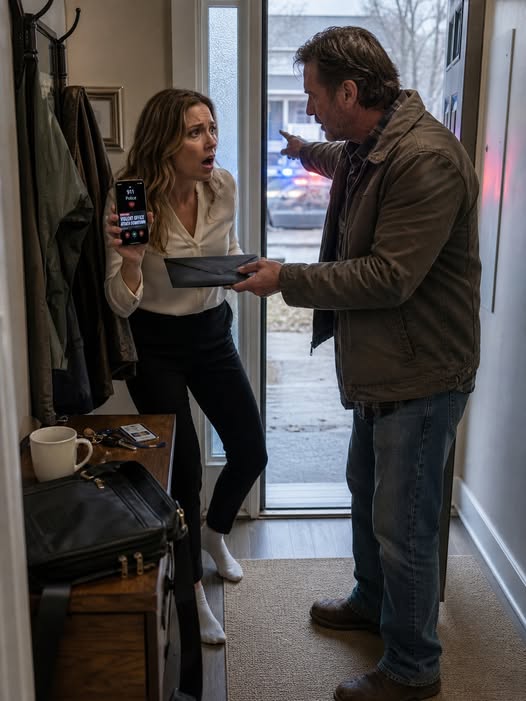
At the door, I froze with my hand on the deadbolt. My skin felt too thin for the air in the room, every nerve ending screaming a warning. Through the wood, I heard a ragged, wet sound—someone breathing hard, a hitch in their chest that sounded like a sob or a lungful of blood.
“Who is it?” I called out. My voice was a jagged rasp, unrecognizable even to me.
“Open… please,” a voice wheezed. It was thin, paper-dry, and distorted by a frantic edge of terror.
I looked through the peephole. The distorted fisheye lens showed a man huddled against the frame. He was wearing a tuxedo, the white shirt stained a dark, terrifying crimson. His face was a mask of bruising and desperation. I knew that face. I hadn’t seen it in years, but a face like that doesn’t leave your mind.
It was Elias, my brother’s best friend. The man who had disappeared six years ago, the same night my brother, Caleb, had been declared missing.
I threw back the deadbolt. Elias practically fell into the entryway, his weight a dead slump against my shoulder. The smell hit me immediately: iron, gunpowder, and the sharp, chemical tang of high-end cologne.
“Elias? Oh my god, Elias?” I dragged him into the living room, kicking the door shut and locking it with a frantic click.
“Is it you, Mara?” he whispered, his eyes rolling back in his head. He gripped my wrist, his fingers slick with something warm. “Tell me it’s you.”
“It’s me. What happened? Where have you been? Is Caleb—”
“He’s alive,” Elias choked out, a spray of red dotting his pale lip. “But he’s not… he’s not the boy you remember, Mara. They’re coming. They saw me break for the perimeter. I didn’t mean to bring them here, but I had nowhere else to go. You’re the only one who knows the layout of the old mill.”
“The old mill? Elias, that burned down years ago.”
He let out a weak, rattling laugh. “It didn’t burn, Mara. It went underground.”
The Secret in the Soil
Ten minutes later, the adrenaline had cleared the fog from my brain, but the horror was just beginning. Elias was slumped on my sofa, a makeshift bandage of kitchen towels wrapped around a jagged tear in his shoulder. He wasn’t shot—he’d been mauled, the marks deep and precise, like the work of a machine designed to mimic a beast.
“They call it the ‘Glass Orchard,'” Elias whispered, staring at my ceiling. “Underneath the mill. It’s a research facility, Mara. Not for medicine. For behavior. Caleb was the first success. They broke him, then they rebuilt him. He’s their lead ‘Gardener’ now.”
My heart felt like it was being squeezed by a cold hand. Caleb, my sweet, artistic brother who used to cry over broken bird wings, was a “Gardener” in a facility called the Glass Orchard?
“Why me, Elias? Why show up now?”
“Because they’re moving to Phase Two,” he said, struggling to sit up. “They’re going to release the first batch into the city. They need a trigger. A psychological anchor to test if the conditioning holds under extreme emotional stress. They chose you, Mara. You’re the anchor.”
Before I could ask what that meant, the maple tree outside my window didn’t just rattle—it shattered.
The glass of my front window exploded inward in a glittering hail. I dove for the floor, dragging Elias with me. Through the dust and the moonlight, a figure stepped through the frame.
It wasn’t a man. It moved with a fluid, predatory grace, clad in a suit of matte-black carbon fiber that seemed to swallow the light. On its chest was a small, glowing emblem: a stylized tree with roots that looked like lightning bolts.
The figure tilted its head, a mechanical whirring sound coming from its neck. Then, it spoke.
“Mara,” the voice said. It was deep, resonant, and familiar. It was the voice that used to read me bedtime stories. It was Caleb.
The Gardener’s Return
“Caleb?” I whispered, my voice trembling from the floorboards.
The figure stepped closer, the heavy boots crunching on the broken glass. He didn’t look at Elias. He looked only at me. The visor of his helmet slid up, revealing eyes that were no longer the soft hazel I remembered. They were a bright, artificial blue, the pupils replaced by glowing apertures.
“Extraction required,” Caleb said. There was no emotion in his voice, no recognition. He sounded like a computer reading a line of code. “Subject 01 is compromised. Subject 02 is ready for integration.”
“Caleb, it’s me! It’s Mara!” I stood up, my hands raised. I saw the way his gloved hand twitched toward a weapon at his hip. “Look at me. Remember the maple tree? Remember the summer we built the fort?”
The whirring in his neck grew louder. For a split second, the blue light in his eyes flickered to brown. His hand paused.
“M-Mara?” he whispered. The word sounded like it was being dragged through gravel.
“Yes! Yes, Caleb!”
But the moment was short-lived. A sharp, piercing tone emitted from a small device on his shoulder. Caleb’s body jerked as if he’d been electrocuted. His eyes snapped back to a vivid, blinding blue.
“Emotional interference detected,” a cold, female voice projected from his suit. “Administering corrective pulse.”
Caleb lunged.
The Fall of the Anchor
I didn’t run. I couldn’t. I watched as my brother, or the thing that used to be my brother, moved faster than humanly possible. He didn’t hit me; he caught me by the waist and threw me over his shoulder as if I weighed nothing.
Elias tried to stand, a kitchen knife in his hand, but Caleb didn’t even look at him. He swept his arm out, a concealed blade in his gauntlet catching Elias across the chest. Elias fell back, his breath leaving him in a final, quiet sigh.
“Elias!” I screamed, pounding my fists against Caleb’s armored back. “You monster! Caleb, stop!”
He stepped back out through the broken window, into the cold 5:15 a.m. air. A black VTOL craft was hovering silently above my driveway, its cloaking field shimmering like a heat haze.
As we were winched up into the belly of the craft, I looked down at my house. My bare maple tree, my maple-wood floorboards, the umbrella stand—all the ordinary things that made up my life.
The door to my house was still open, the light from the hallway spilling out onto the porch.
“Phase Two initiated,” the female voice whispered inside the craft.
As the ship surged upward, I realized Elias was right. I wasn’t just a victim. I was the “Anchor.” They weren’t taking me to kill me. They were taking me to the Glass Orchard to see if my brother could kill the only person he had ever loved.
The blue numbers on my alarm clock were still glowing in the dark room below, counting down the seconds until the world I knew ended, and the harvest began.