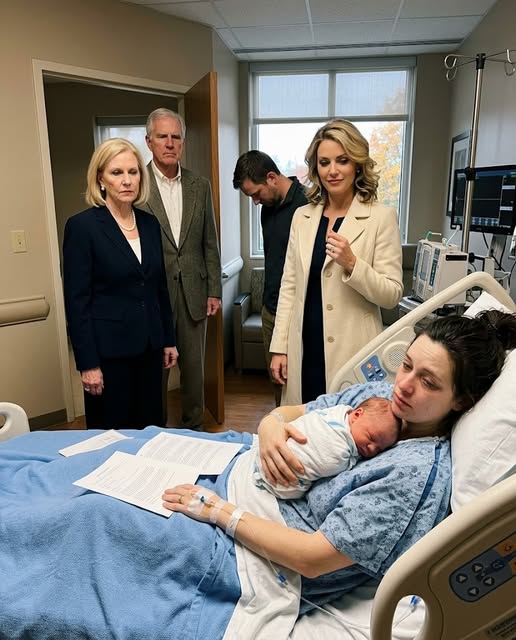
His skin was warm against mine, his tiny mouth opening and closing as if he was still deciding whether the world was safe enough to breathe in.
I could still feel the ache of labor in every bone, the tremble in my legs, the stitches, the exhaustion, the raw animal fear that comes when your body has just been pushed past its limits.
And then my mother-in-law walked into the hospital room with divorce papers.
Margaret Kingsley did not knock.
She never knocked, not on doors, not on lives, not on boundaries.
She entered with her chin lifted, pearls at her throat, her silver-blond hair pinned into the same perfect twist she wore to charity luncheons where she smiled for cameras and spoke about compassion.
Behind her came William, her husband, silent and stiff in an expensive navy suit.
Beside him stood a man I recognized only from the cold leather briefcase in his hand.
A lawyer.
And behind them all was Jessica.
Jessica, in a cream coat that looked too elegant for a maternity ward.
Jessica, with glossy hair falling over one shoulder.
Jessica, wearing my wedding ring on her finger.
For a second, I thought my mind had broken from pain and blood loss.
I stared at her hand, waiting for the image to correct itself.
But the diamond was there, catching the pale hospital light, the same diamond Christopher had placed on my finger two years earlier when he promised that I was his forever.
My husband stood near the doorway.
Christopher did not look at me.
He looked at the floor.
Margaret stepped forward and dropped a stack of papers onto my blanket.
They slid against my thigh and stopped beside my son’s swaddled body.
“Sign it,” she said.
Her voice was low enough not to alarm the nurses outside, but sharp enough to cut through the room.
I looked from the papers to Christopher.
“What is this?”
He swallowed.
His face was pale, his mouth tight, his eyes red like he had been crying or drinking or both.
“Valentina,” he said, barely above a whisper.
“Please don’t make this harder.”
Something inside my chest went still.
My name is Valentina.
For two years, the Kingsleys believed I was a struggling freelance graphic designer who had married their son for his money.
They called me a social climber, a trap, a pretty mistake.
Margaret never said those words in public, of course.
In public she said things like “humble background” and “not quite our world.”
In private, she was less careful.
What none of them knew was that I had been wealthy long before I met Christopher.
Not comfortable.
Not lucky.
Wealthy in the way people whispered about behind boardroom doors.
I was the founder and majority owner of Tech Vista Corporation, a cybersecurity and infrastructure company that handled contracts for hospitals, banks, logistics firms, and private investment groups all over the country.
My net worth had been estimated at $3.7 billion by journalists who had never managed to get a clear photo of me.
I did not grow up rich.
My parents were schoolteachers who stretched every dollar and made birthdays beautiful with homemade cakes and handwritten cards.
When they died in a highway accident when I was nineteen, they left me with grief, medical debt from my mother’s last year of treatment, and a life insurance policy so small it disappeared almost immediately.
I taught myself to code because I could not afford college full-time.
I worked nights in a print shop, mornings in a coffee shop, and built software in the hours between.
I slept on a mattress on the floor of a studio apartment where the heat failed every winter and the ceiling leaked every spring.
By twenty-five, I had my first million.
By twenty-eight, I had more money than I knew how to feel comfortable owning.
But money did something ugly to love.
The first man I dated after my company took off seemed gentle and patient.
He listened when I talked about my parents.
He brought flowers to my office.
He said he admired how hard I worked.
Then I found messages on his laptop.
He had told his friends he was going to propose before my company’s next acquisition closed.
He joked about becoming “set for life” and said he could tolerate my workaholic personality for the right number of zeros.
One message said, “Once she signs, I’ll never have to fake interest in tech again.”
I did not cry until after I ended it.
After that, I disappeared behind legal structures, private trusts, and carefully managed anonymity.
My assistant Carlos became the public face of many business dealings.
My best friend Sophia became the only person allowed to tell me when I was lying to myself.
Then I met Christopher at a charity gala.
I was there as an anonymous donor.
I had just pledged five million dollars to expand a children’s hospital program when a tall man in a black tuxedo backed into me and spilled champagne down the front of my navy dress.
“Oh my God,” he said, horrified.
“I am so sorry.”
He grabbed napkins, then panicked when the napkins made it worse.
I laughed because his face was so genuinely stricken that I could not help it.
“I promise I don’t usually attack strangers with champagne,” he said.
“That’s good,” I replied.
“Terrible habit.”
He looked at my simple dress, my plain heels, the tray of empty glasses on the table behind me, and made the assumption everyone made when I did not arrive surrounded by assistants.
“Are you working this event?” he asked.
I could have corrected him.
Instead, I said, “Something like that.”
He insisted on buying me dinner to make up for the dress.
At first, I refused.
Then he looked so embarrassed, so earnest, so unlike the polished men who usually circled me, that I agreed.
At dinner, he talked about old movies and bad coffee and how much he hated pretending to understand his father’s investment friends.
He asked about me, and for once, I gave someone the version of myself that did not come with headlines.
“I’m a freelance graphic designer,” I told him.
It was not completely false.
I had designed the first logo for Tech Vista myself on a cracked laptop years ago.
“That’s amazing.
I’ve always admired creative people.”
He did not ask how much I made.
He did not ask who my clients were.
He did not try to impress me with his family’s money.
He walked me to my old sedan and said, “I’d really like to see you again, Valentina.”
For the first time in years, I wanted to believe someone was looking at me and not at what surrounded me.
Sophia warned me the moment I told her.
We were sitting in my kitchen, in the modest apartment I used as camouflage.
It looked like the home of a woman making decent but ordinary money.
The furniture was simple.
The art was inexpensive.
The building, however, belonged to me through a holding company and was worth forty-five million dollars.
Sophia sat across from me with her arms folded.
“You told him you’re a graphic designer?”
“Yes.”
“Valentina.”
“I wanted a normal conversation.”
“You don’t get to build a fake life and then act surprised if the real one explodes through it.”
Carlos was gentler but no less concerned.
“Run a background check on the family,” he said.
“At least that.”
“I know who the Kingsleys are,” I told him.
Everyone in certain circles did.
The Kingsleys were old money, or at least old enough money to pretend they had invented class.
William ran Kingsley Group, a private investment firm with a shrinking but still respectable reputation.
Margaret chaired committees, hosted fundraisers, and judged people by their shoes.
Christopher, their only son, worked at the firm under his father.
He was charming, handsome, and soft in a way I mistook for kindness.
For a while, he made me happy.
He brought soup when I was sick.
He remembered that I hated lilies because they smelled like funeral homes.
He kissed my forehead when I was tired and told me I worked too hard.
When he proposed one rainy evening in my apartment, with takeout containers on the coffee table and nervous tears in his eyes, I believed he loved me.
I said yes.
The first time I met Margaret and William, I understood immediately that love would not protect me from them.
Their house sat behind iron gates on a road lined with sycamore trees.
Inside, everything looked expensive and untouched.
The kind of house where no one ever seemed to spill coffee or laugh too loudly.
Margaret looked me over from head to toe before offering her cheek.
“So,” she said.
“Christopher tells us you’re a graphic designer.
How quaint.”
I smiled because I had learned long ago that people reveal themselves faster when they think you are powerless.
“It keeps me busy,” I said.
William grunted from behind a newspaper.
He did not stand.
Christopher squeezed my hand under the table.
I thought it meant he was sorry.
Later, I understood it meant he wanted me to endure quietly.
Then Jessica arrived.
She walked in without being introduced by the staff, which told me she belonged there more than I did.
Tall, poised, and beautiful in a studied way, she wore a silk blouse and diamond studs, her smile bright until it reached me.
“Valentina,” Margaret said, glowing for the first time that evening.
“This is Jessica.
She’s practically family.”
Jessica kissed Christopher’s cheek and sat