I had one earbud in, a mandatory training video mumbling through policy updates no one would remember by the end of the week, and my phone was propped against a stack of patient intake forms that kept sliding apart.
My fingers were sticky from a lemon bar someone had left on the counter with a paper note that said ENJOY!!! in too many exclamation marks.
Then Ava’s name lit up my screen.
My daughter never called me during the day.
She texted memes.
She sent blurry photos of the cat sleeping in weird positions.
She asked for permission with lazy little messages like can i and pls and are you mad.
She only called if something was wrong.
I answered with that automatic light voice mothers use when fear rises before logic catches up.
“Hey, baby.
What’s up?”
There was a pause.
Not the normal kind.
Not the kind where she was switching hands or chewing and trying not to let me hear it.
This pause had weight.
“Ava?”
When she finally spoke, her voice was careful and flat, like she was reading words off a card someone had handed her.
“Mom,” she said, “Grandma Diane says I have to pack.”
My hand froze around the paper cup of water I’d been holding.
Ice clicked against plastic in tiny sharp sounds.
“Pack for what?” I asked.
Another pause.
“She said I don’t live here anymore.”
Everything in my body went still.
I blinked once, hard, as if my eyes had misheard her.
Outside the breakroom, someone laughed.
A printer started up.
A phone rang twice.
It felt obscene that the world was still moving.
“What do you mean you don’t live there anymore?” I asked, and my voice came out louder than I meant it to.
Ava inhaled shakily.
I heard a drawer slide open.
Fabric shifting.
A zipper.
“She told me to pack my clothes,” Ava whispered.
“She said I had to be done before dinner because Uncle Nate is moving in and he needs the room.”
Uncle Nate.
Mark’s younger brother.
Thirty-four years old.
Permanently in transition.
Permanently in need.
The kind of man who always had a reason why life had gone wrong for him and never once considered that the reason might be him.
He had lived with Diane and Roy for years, then with a girlfriend, then with a friend, then in a short-term rental he swore was temporary while he launched an online business.
Every few months there was a fresh start.
Every fresh start somehow cost somebody else money.
“Where is Grandma Diane right now?” I asked.
“In your bedroom,” Ava said quietly.
“She’s going through the closet.”
I pushed back from the table so quickly the chair scraped hard against the floor.
The breakroom door swung open and all the noise of the office slammed into me at once.
“Ava, listen to me.
Stop packing.
Right now.
Don’t put one more thing in that bag.”
“She said you already agreed,” Ava whispered.
“She said you didn’t tell me because you knew I’d freak out.”
The rage came so clean and cold I could almost taste metal.
I
pictured my twelve-year-old standing in her own room, trying to act brave because adults were telling her reality had changed and she was the last one informed.
“No,” I said, making my voice steady.
“You are not moving.
That is your room.
That is your home.
You did nothing wrong.”
She made a tiny sound, a hurt little breath that broke in the middle.
“Where’s Grandpa Roy?” I asked.
“In the living room.
He’s talking to a guy with a toolbox.”
For a second the words didn’t make sense.
“A guy with a toolbox?”
“Grandpa said they should change the bedroom lock before you get dramatic,” she whispered.
Everything inside me went cold.
I grabbed my bag and told the front desk I had a family emergency.
I was halfway across the parking lot before anyone responded.
I dropped my keys once, snatched them up, got into my car, and put Ava on speaker.
The drive home took seventeen minutes.
It felt like an hour.
The whole time I kept talking so she would hear my voice over theirs.
“Stay where you are.
Don’t argue with them.
Don’t help them.
Put your bag down.
I’m on my way.”
In the background I heard Diane’s voice, clipped and superior.
Roy muttering something about logistics.
Nate laughing once in that lazy, empty way of his, as if this were an inconvenience instead of an outrage.
At one point Ava went silent.
“Baby?” I said.
“Grandma wants my desk too.”
The sentence hit me harder than all the others.
Not because the desk was expensive.
It wasn’t.
Mark had assembled it himself the Christmas after we moved in, cursing under his breath and pretending not to enjoy it while Ava handed him screws and read the instructions like she was his assistant.
It was hers.
That was the point.
By the time I pulled into the condo lot, Nate’s truck was backed into our parking space.
Our paid parking space.
My pulse pounded so hard in my throat it made me feel sick.
I took the stairs two at a time.
The front door was open.
Inside, chaos.
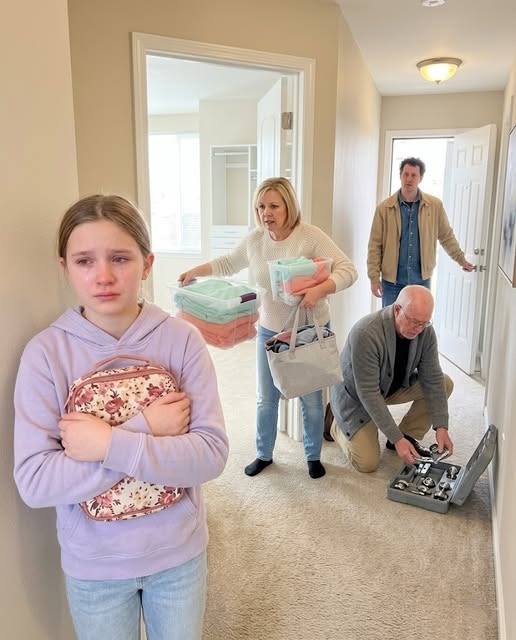
One of Ava’s pink hoodies was hanging half out of a black trash bag.
My jewelry box was open on the bed in my room.
Roy stood in the living room with a handyman kneeling beside Ava’s bedroom doorframe, a drill and a new lock set spread across the floor.
Nate was carrying one of Ava’s storage bins into the hallway like he was unloading his own place.
Then I saw Ava.
She was standing near the couch, clutching her little overnight bag with both hands.
Her face was blotchy, her eyes swollen, her mouth tight with the effort of not crying in front of them.
Something in me nearly broke.
Diane turned at the sound of my footsteps and looked irritated, as though I were late to an appointment she had generously scheduled for me.
“Finally,” she said.
“You need to explain to your daughter that adults have made a decision.”
I stared at her.
Then at Roy.
Then at the new lock on my floor.
“What exactly,” I said, very quietly, “do you think you’re doing?”
Diane folded her arms.
She had that same expression she wore at Thanksgiving whenever she decided someone
else’s kitchen required her authority.
“Nate needs stability,” she said.
“You have more space than a child requires, and frankly, Ava is old enough to understand family sacrifice.
We already discussed that it makes more sense for her to share with you until Nate gets back on his feet.”
I laughed once because the alternative was screaming.
“We discussed no such thing.”
“Mark understands,” Roy cut in.
“He knows Nate needs help.”
“Mark is at work,” I said.
“And if you had really spoken to him, you would not be standing in my house touching my daughter’s things.”
Nate rolled his eyes and set the storage bin down with a thud.
“Your house?” he said.
“That’s cute.”
I turned to him so fast he actually took half a step back.
“Get your hands off her stuff.”
The handyman stood up, holding the new lock in one hand.
“Ma’am, I wasn’t told—”
“You were told wrong,” I said.
“Put that down and leave.”
Roy tried to step between us, puffing himself up in that useless father-patriarch way men sometimes do when they know they’re wrong but still believe volume can rescue them.
“There’s no need for a scene,” he said.
“You brought a locksmith into my home to lock a twelve-year-old out of her bedroom,” I said.
“The scene is already here.”
Ava made a small sound behind me.
I turned.
Her eyes were fixed on the open bag, on the clothes spilling out, and the hurt on her face was so pure it made my chest ache.
I crossed the room and took the bag from her hands.
“Go stand by the kitchen,” I said softly.
“You’re okay.”
She nodded, but her lower lip trembled.
Then Mark walked in.
He had that look he gets when he notices everything at once and says nothing right away.
His gaze moved from the open door to the drill on the floor, then to Ava’s face, then to Nate holding one of her bins, then to me.
He closed the door behind him with careful, deliberate quiet.
“What happened?” he asked.
Diane rushed to answer before I could speak.
“We’re handling a family matter,” she said.
“Don’t start.
Nate just needs the second bedroom for a while, and Ava is being overly emotional because Karen didn’t prepare her.”
Mark looked at Ava.
“Did someone tell you to pack?”
Ava nodded once.
Tears filled her eyes immediately, as if his calm had made it safe for her to stop holding them back.
“Grandma said I don’t live here anymore.”
The room changed.
I watched it happen in my husband’s face.
His expression didn’t explode.
It didn’t twist.
It went still.
That was worse.
He looked at the lock hardware on the floor.
Then at the handyman.
Then he smiled.
Just a little.
“That’s interesting,” he said.
“Because this condo is actually held in Ava’s trust.”
Silence.
Real silence this time.
Thick and total.
Nate frowned first, like he was waiting for the rest of the sentence to make him less stupid.
Roy’s mouth opened.
Diane’s face drained of color so quickly it was almost startling.
The handyman slowly set the lock down.
“What?” Roy said.
Mark set his work bag on the counter.
“The condo is in a trust.
Ava is the beneficiary.
Karen
and I are the trustees until she’s eighteen.
Which means the child you just told to get out is the legal beneficiary of the property you tried to take over.”
Nate laughed once, but there was no confidence in it.
“That’s not how any of this works.”
“Actually,” Mark said pleasantly, “it is exactly how this works.”
Diane tried to recover.
“Don’t be ridiculous.
You bought this place after you got married.”
“With money from the malpractice settlement after Ava’s father died,” Mark said.
The words landed with a force that stilled even me, though I knew the history.
Ava’s biological father, Jason, had died in a hospital error when she was three.
The settlement had been structured for her long-term care.
When Mark and I married five years later and decided to leave our rental, we used a portion of the housing allocation exactly the way the attorneys recommended: into a trust, protected, untouched by extended family, preserved for Ava’s security.
Mark had insisted on it.
He had looked me in the eye across our tiny rental kitchen and said, She has already lost one parent.
Nobody gets to gamble with what protects her.
I loved him fiercely for that then.
I loved him even more in that moment.
Roy’s face turned blotchy.
“You put the property in a child’s name?”
“In a legal trust,” Mark corrected.
“On advice of counsel.
Which you would know if you had ever asked instead of assuming.”
Diane’s voice sharpened.
“Family should be able to help family.”
Mark nodded.
“Family should also know better than to tell a twelve-year-old she doesn’t live in her own home anymore.”
The handyman cleared his throat.
“Sir, ma’am, I’m going to go.
I wasn’t told a child lived in the room and I definitely wasn’t told there was a dispute over authorization.”
“That would be wise,” Mark said.
The man packed his tools fast, muttered a strained apology to me and Ava, and left.
The door shut behind him.
The quiet that followed felt dangerous.
Nate dropped the storage bin.
“This is insane.
I already moved stuff over.
Mom said—”
Mark turned to him.
“You moved your stuff into my daughter’s room because your mother told you to? At thirty-four?”
Nate’s face flushed.
“Don’t talk to me like I’m a child.”
“Then stop acting like one.”
Roy took a step forward.
“Watch your tone.”
Mark didn’t even look at him.
“No.
Watch yours.
You entered our home while we were at work, instructed a contractor to alter an interior lock, and removed personal property from a minor’s bedroom.
Do you know what that sounds like when explained to the police?”
Diane’s eyes widened.
“Police? You wouldn’t dare.”
“You made my daughter cry in her own living room,” Mark said.
“Try me.”
Ava was crying openly now, quiet tears streaming down her cheeks.
I wrapped an arm around her shoulders and felt how hard she was trembling.
Diane saw it and still didn’t soften.
That, more than anything, changed something in me.
I had spent years trying to keep peace with Mark’s parents.
Years swallowing comments about my cooking, my job, my parenting.
Years telling myself that older women can be difficult, that every family has dynamics, that boundaries are easier than war.
But there is a line.
There is always a line.
And she had stepped over it with both feet and then looked proud of herself.
“Get out,” I said.
Diane blinked.
“Excuse me?”
“Get out of my home.
Get out of Ava’s room.
Get out now.”
Roy made a dismissive noise.
“You’re overreacting.”
I pointed at the open door.
“You have sixty seconds before I start dialing.”
Nate looked at Diane, not at us.
That was the pathetic part.
Not a man, just an extension cord plugged into his mother’s entitlement.
Mark stepped toward the hallway.
“Anything belonging to Nate that is currently inside this condo can go back out the same way it came in.
Immediately.”
For a second I thought Diane might refuse.
Her jaw was tight, her shoulders rigid, her eyes hard with the fury of someone unused to consequences.
Then Mark took his phone out and unlocked it.
That did it.
She snapped at Nate to pick up his boxes.
Roy muttered that this was unbelievable.
Nate started hauling his things back toward the door with the sullen resentment of a teenager who’d been told to clean his room.
It took eleven minutes.
Eleven long, humiliating minutes of bins scraping over our floor, Diane hissing under her breath, Roy avoiding eye contact, Ava standing pressed against my side.
At one point Diane paused near the entry table and looked back at Mark.
“After everything we’ve done for you,” she said.
He stared at her.
“You told my daughter she didn’t live here.
Don’t ever use the word everything again.”
She left then.
Roy followed.
Nate was last, lugging a duffel bag and one lamp he had apparently already decided belonged in Ava’s room.
Mark held the door open for him without a single word.
When the hallway finally emptied and the door shut, Ava broke.
Not dramatically.
Not loudly.
Just all at once.
She folded into me, sobbing the kind of sobs children try to hide because they think they’re too old for them.
I carried her to the couch and sat with her curled against me while Mark knelt on the floor in front of us.
“You never have to leave this home because somebody says so,” he told her quietly.
“Do you hear me? Never.”
She nodded against my shoulder.
“Even Grandma?” she whispered.
Mark’s face tightened.
“Especially Grandma.”
That night, after Ava fell asleep between us with her hand wrapped around the sleeve of my shirt, Mark and I sat in the kitchen under the dim light above the sink.
The condo was quiet again, but it didn’t feel the same.
Violation lingers.
He rubbed his hands over his face and said, “I should have cut this off years ago.”
I knew what he meant.
Diane had always pushed.
Roy had always backed her.
Nate had always benefited.
But Mark had spent his whole life being trained to treat that as normal, to smooth it over, to avoid the blowup and call that peace.
“You stopped it today,” I said.
He looked toward Ava’s closed door.
“Not before they got to her.”
The next morning, he called an attorney.
By noon, we had started formal trespass paperwork.
By the end of the week, the building management had written instructions that no guest or relative was to be granted
access to our unit without one of us physically present.
We changed the front lock ourselves.
We added a doorbell camera.
We explained to Ava, gently and carefully, that some adults mistake closeness for permission and that love does not give anyone the right to take what isn’t theirs.
Diane left voicemails for three days.
The first was outraged.
The second was wounded.
The third said we were destroying the family over a misunderstanding.
Mark saved all of them.
Then came the message that made even him laugh in disbelief.
Nate wanted an apology.
He said we had embarrassed him.
Mark listened to the voicemail twice, set his phone down on the counter, and said, “Good.”
Months passed.
The distance held.
Ava slowly stopped asking whether someone could make us move.
She stopped double-checking the lock before bed.
She laughed easily again.
Her room became hers in that unthinking child way that only happens when safety starts to feel boring again.
One Saturday afternoon I found her at her desk, doing homework with music in one ear, sunlight across the carpet, the cat asleep in her desk chair like he paid bills there.
For a moment I had to stand in the doorway and breathe.
Because that was what they had almost stolen.
Not square footage.
Not a room.
Peace.
A year later, Diane sent a birthday card to Ava with twenty dollars tucked inside and a line that read, Hope you know families make mistakes.
Ava read it, looked at me, and asked, “Do I have to answer?”
“No,” I said.
She slid the money back into the envelope and wrote Return to Sender across the front in careful block letters.
I didn’t tell her to do that.
I didn’t stop her, either.
The truth is, people will hear this story and split into camps immediately.
Some will say we were right to draw a hard line the second Diane and Roy weaponized their age and family title against a child.
Others will say blood should count for something, that older relatives make bad choices, that forgiveness matters more than pride.
Maybe.
But I still see Ava standing in that living room with a sleepover bag clutched in both hands, trying to understand how home could vanish because somebody older said so.
And once you have seen a child look that betrayed, you stop worrying so much about who feels excluded from the family.